

Small Details You Missed In Steven Spielberg's Disclosure Day

Contains spoilers for "Disclosure Day"
Steven Spielberg is the king of blockbuster entertainment. He's the mastermind behind awe-inspiring films as "Jaws," "Raiders of the Lost Ark," and "Jurassic Park," to name a few. In recent years, it's felt like Spielberg was slowing down with smaller films, like the musical remake "West Side Story" or his highly personal modern classic "The Fabelmans." But with "Disclosure Day," Spielberg proves he still has what it takes to craft gripping action sequences intertwined with real emotion.
It has all the hallmarks of a classic Spielberg picture. It once more sees the director tackle extraterrestrial life in the same vein as "E.T. the Extra-Terrestrial" and "Close Encounters of the Third Kind." There's boat loads of sentimentality, as characters grapple with their place in the universe and ask big questions, like how aliens would impact global religions. Packaging these grand ideas into a thoroughly entertaining action-adventure flick is a big reason why many critics are calling "Disclosure Day" Spielberg's best movie in years.
On top of all that, "Disclosure Day" is a film that rewards rewatches, especially as governments continue to tease a full disclosure announcement any day now. Until that happens, there are plenty of neat details scattered throughout "Disclosure Day" you may have missed that are worth discussing.
St. Clare foreshadows the ending
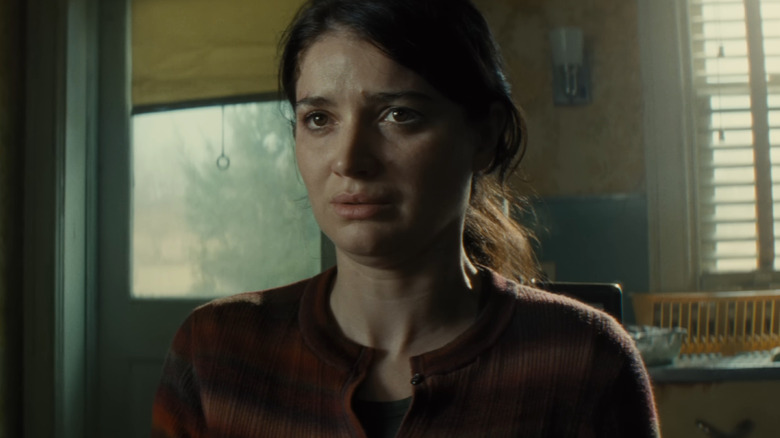
Daniel (Josh O'Connor) initially meets with Wardex agents to rescue his girlfriend, Jane (Eve Hewson). Afterwards, Jane takes him to the Monastery of St. Clare of the Dawn, where she wanted to be a nun but dropped out. Invoking the name St. Clare wasn't just done at random as, along with being the patron saint of good weather, laundry, and eye disease, she's actually the patron saint of television, foreshadowing the film's conclusion.
She received this designation in 1957 despite being born in the 12th century. Pope Pius XII gave her this title based on a miracle during her life where she witnessed an entire mass service on the wall of her room despite being ill and bedridden.
Television, and communication as a whole, plays heavily into "Disclosure Day." The disclosure movement, spearheaded by Hugo (Colman Domingo) hijacks a news broadcast to present the real alien footage. The interconnectedness made possible through television signals allows the message to be heard all over the world.
Pope Pius XII declared that television was a useful instrument, capable of great good and great troubles. You don't need us to tell you how TV and, to a larger degree, the internet have divided us like never before. But it's also capable of bringing us together. "Disclosure Day" reminds us that, every so often, the genuine truth shines through.
The Richard Nixon story is based on true events
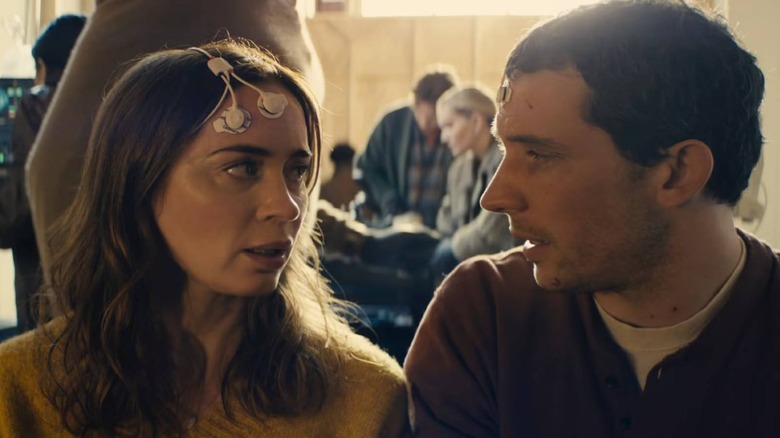
At one point, Daniel goes through some of the alien footage he snuck from Wardex. One video shows Richard Nixon touring an actor through what looks like an alien morgue. Daniel refers to the other individual as some famous actor at the time (the 1970s), but alien conspiracy enthusiasts will know it's Jackie Gleason, star of timeless old school sitcom "The Honeymooners." The video itself is based on a real anecdote.
The strange story comes from Gleason's second wife, Beverly McKittrick. As the legend goes, Gleason was a big UFO enthusiast, and was golf buddies with Nixon. Knowing of Gleason's interest in extraterrestrial life, Nixon reportedly took the actor to Homestead Air Force Base in Florida where he presented the embalmed bodies of several aliens.
Now, did that actually happen? The only source comes from Gleason's ex-wife, so it's not even a first-hand account of it transpiring. But it is fun to think about. Maybe Nixon was playing a practical joke on Gleason and showed him some alien dummies just to freak him out.
At any rate, the event factors into the plot of "Disclosure Day." Later, it's explained that afterwards, presidents weren't told about UFO encounters since they become private citizens after leaving office and could spill the beans to anyone. As for Gleason's story, it remains the stuff of urban legend.
All leads back to Roswell
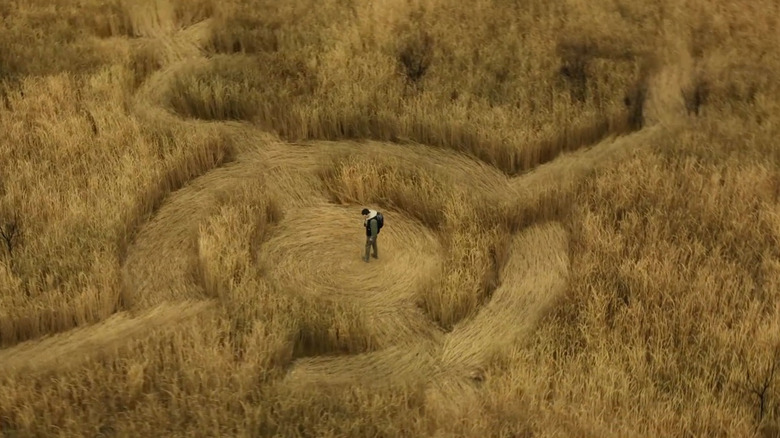
The Jackie Gleason alien story may be a tad obscure for the general public, but everyone should know the story of Roswell, New Mexico. Throughout "Disclosure Day," several characters reference the fact that the existence of aliens has been kept hidden for 79 years. It's an oddly specific number but, assuming the film takes place in 2026, that would place the aliens' arrival date at 1947, the year the Roswell UFO incident took place.
In June 1947, a pilot reported seeing several crescent-shaped objects moving through the sky. Later, it was discovered that odd debris was scattered around the vicinity, and with no one offering an immediate explanation, the media officially dubbed these strange crafts "flying saucers." The United States government investigated and later clarified that the wreckage was, in fact, a weather balloon.
Of course, not everyone believed the government. Over the decades, many conspiracies have taken hold that the truth of a genuine alien spacecraft landing in Roswell was covered up, and that officials simply swapped out the real debris with the weather balloon.
Many believe the government was made aware of alien life that day, and the world has never been the same. Roswell has leaned into its alien history and has pretty much become the UFO capital of the world.
Both Josh O'Connor and Emily Blunt are paired with nepo babies
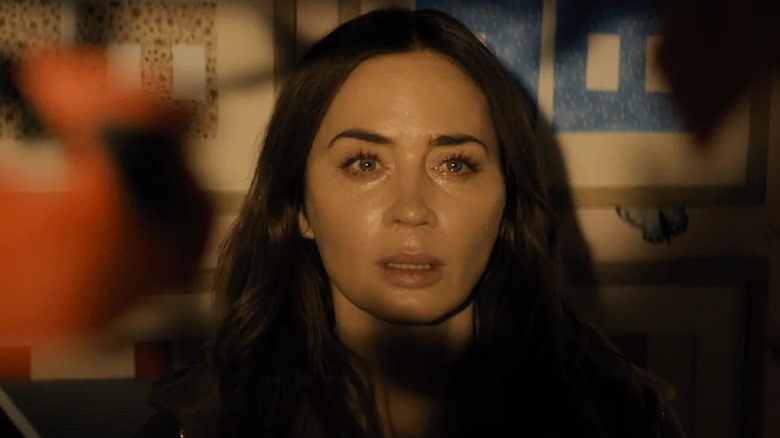
Daniel and Margaret (Emily Blunt) share many similarities. They were both experimented on by extraterrestrial life as children and were imbued with incredible abilities. Even weirder, both Daniel and Margaret are dating people that they abandon halfway through so that they can meet up. And their respective partners — Jane and Jackson (Wyatt Russell) — are portrayed by nepo babies.
While the controversy surrounding nepo babies is largely overblown, and Eve Hewson and Wyatt Russell are talented actors in their own right, it's funny that they have that commonality nevertheless. Hewson is the daughter of U2 singer Bono and is probably best known for playing Adele in "Behind Her Eyes" prior to "Disclosure Day." But chances are she was cast in "Disclosure Day" after having previously worked with Steven Spielberg in "Bridge of Spies."
It's much easier to trace Wyatt Russell's lineage, as he's obviously the son of Kurt Russell and Goldie Hawn. Both are immensely famous actors in their own right, and Wyatt has followed in their footsteps. He has plenty of credits to his name, but lately has gone all in on the Marvel Cinematic Universe as John Walker. He previously appeared in "Falcon and the Winter Soldier," "Thunderbolts*" and will next feature in "Avengers: Doomsday." Starring in a Spielberg movie between these massive projects isn't a bad way to kill time.
Stigmata proves Jane will have a large role later
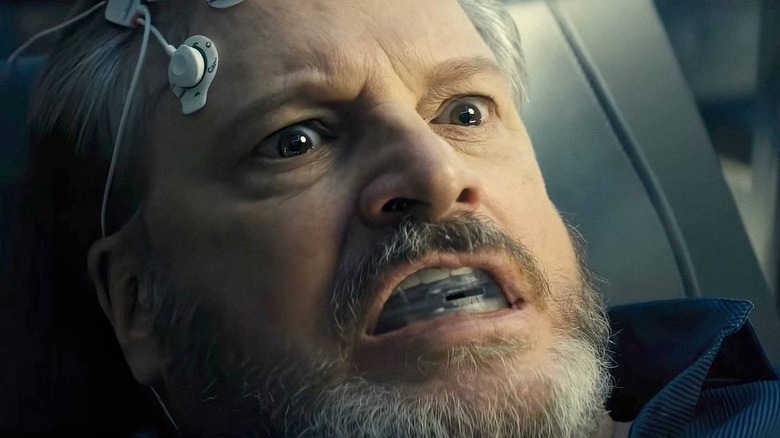
"Disclosure Day" has a surprising amount of religious iconography, exploring how the discovery of alien life would impact every facet of our lives. The avatar for these ideas is Jane, who previously trained to be a nun but left the monastery. She becomes something of a savior by the end, something you should've seen coming if you were paying attention (or went to Sunday school growing up).
Early on, Noah Scanlon (Colin Firth), the head of Wardex, uses alien technology to appear in Jane's cabin. He manipulates her into telling him the truth of Daniel's whereabouts, and later alters her mind so that she'll try to kill Daniel herself. Jane tries resisting Noah's attempts by digging a crucifix into her hand. The pain allows her to resist momentarily, but it also forces out blood.
This act resembles the mystical phenomenon of stigmata. In Christian theology, a stigmatic is someone who shares the same hand or feet wounds Jesus received during crucifixion. Figures in history, like St. Francis of Assisi, have received the stigmata to affirm their connection to Christ.
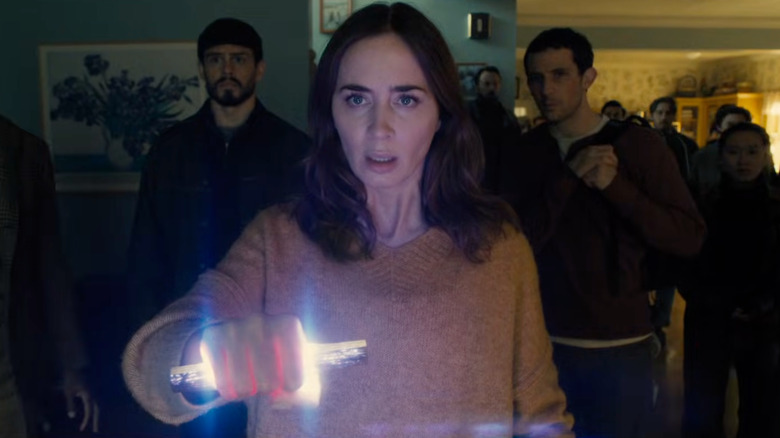
Daniel gives Jane the same alien artifact Noah uses to access her mind but holds many abilities. Jane arrives at the news station at the end with the device to bring power back and let Margaret air her broadcast. In this way, Jane becomes a savior by becoming instrumental to the truth being revealed.
The aliens resemble those from Close Encounters of the Third Kind
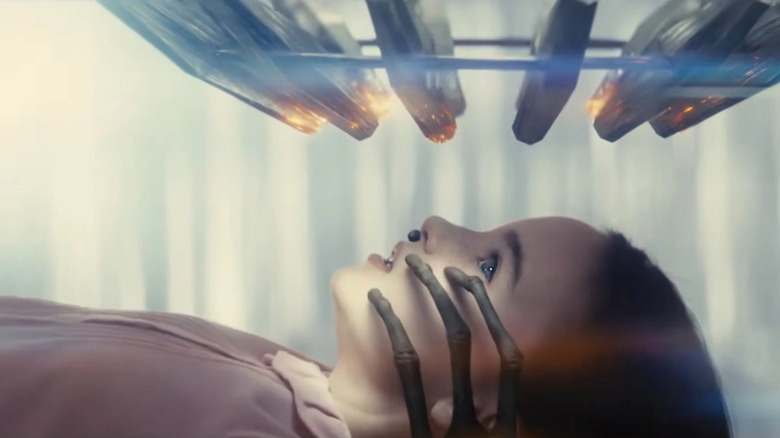
Aliens have taken many forms across pop culture. From "Star Wars" to "Alien" to "Arrival," extraterrestrials have taken all shapes and sizes. But through it all, one of the most consistent iterations has been the "Greys." This is the classic depiction of cosmic beings with gray skin, large heads, thin bodies, and huge eyes.
The aliens in "Disclosure Day" sport this simple yet iconic aesthetic. It's one of many things that connects this to another Steven Spielberg project — "Close Encounters of the Third Kind." The aliens seen in the 1977 film's climax are all small beings with big heads that protrude further back than a typical human skull. The "Disclosure Day" aliens are also pretty minuscule in size, but have the gray skin and big heads that have become commonplace in alien depictions across movies and television.
While the case could be made that the idea of "Greys" came a lot earlier, it was certainly popularized by the Barney and Betty Hill abduction story from 1961 where they were reportedly taken by gray, humanoid-like entities. 1964's "The Bellero Shield," one of the best episodes of "The Outer Limits," has a similar depiction, and it's this appearance that's taken the strongest foothold in the public consciousness. Spielberg clearly likes it, and if it ain't broke, don't fix it.
Steven Spielberg also references an oft-forgotten alien miniseries
While the "Close Encounters of the Third Kind" parallels aren't too surprising, there's an idea in "Disclosure Day" that'll feel familiar to anyone who saw the underrated 2002 Steven Spielberg-produced miniseries, "Taken." No, it doesn't star Liam Neeson. It's a science-fiction miniseries that follows three families over the course of several decades, all of whom have been impacted by potential extraterrestrial life from the moment of the Roswell crash.
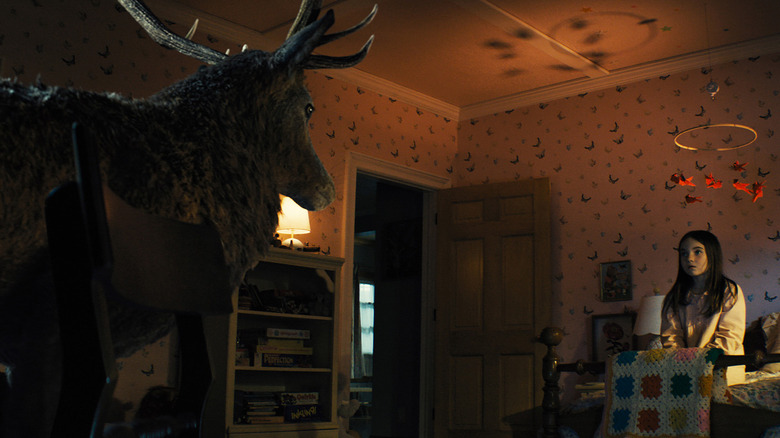
However, Roswell isn't the sole connective tissue. In the miniseries, aliens take on the form of friendly-looking animals, like a smiling shirt-wearing squirrel. In that particular scene, the squirrel leads a child to a tree that's glowing from the inside. The aliens have taken on a more appealing form in order to lure children for experimentation. That exact thing is done in "Disclosure Day."
By the film's climax, Margaret and Daniel are made to relive their childhoods. We see a young Margaret (Delaney Cuthbert) lured into a "Hansel and Gretel" house that's glowing from the inside by a group of animals. This was done to make child Margaret feel more at ease, though none of the animals are wearing clothes, which was probably for the best.
Snow White represents the loss of innocence
While remembering her past, Margaret recalls a comforting song from her childhood, and we see young Margaret singing "Someday My Prince Will Come" from "Snow White and the Seven Dwarfs." It's a surprising choice, considering that "Disclosure Day" hails from Universal Pictures" and "Snow White" is a Disney film. But if any filmmaker is going to get the song they want, it's Steven Spielberg.
"Someday My Prince Will Come" is the perfect song for Margaret to sing at that moment. For starters, Snow White had a knack for communicating with animals. Plenty of woodland critters helped her clean up the dwarfs' cottage, and Margaret herself would soon be visited by a deer, fox, and bird (although these would actually be aliens in disguise).
But Snow White's story could also be read as a tale of the loss of innocence, which is precisely what happens with Margaret. Snow White leaves her home and ventures forth into the woods, marking the transition from childhood innocence into adulthood. Young Margaret also ventures into a forest where the aliens eventually imbue her with the gift of universal communication. She goes from an innocent girl to having the potential to unlock all knowledge.
The eyes have it
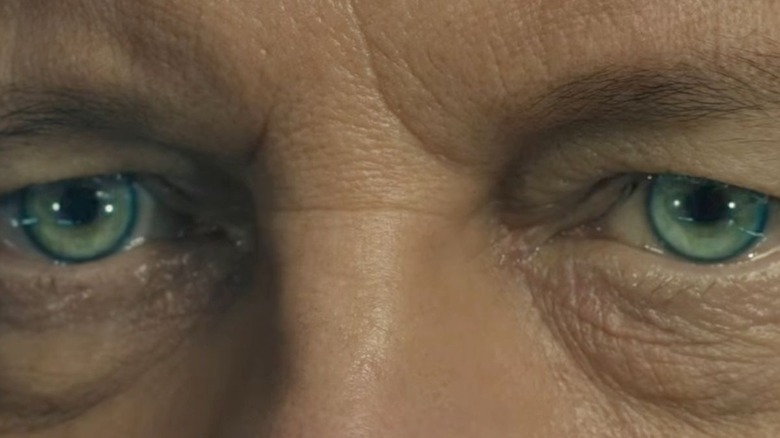
Eyes are the single most important motif in all of "Disclosure Day." Even before its release, the movie's marketing emphasized this, with an eye even appearing inside of a flying saucer on the poster.
When Noah uses the alien tech to infiltrate Jane's mind, we see this "possession" take effect because Jane's normally blue eyes transform into Noah's brown ones, signaling that her brain is inhabited by someone else. At one point, an image of a butterfly is seen in Margaret's eye, and, in fact, when we first see an alien outside of video footage, Spielberg focuses on its eye.
A basic interpretation is that "Disclosure Day" is all about perception. More specifically, it's about who controls what we see. Wardex spends the film trying to hide and obfuscate the truth while Daniel, Hugo, and the rest of their collective want the world to know about aliens. Our eyes have been shielded, but Daniel wants all of us to see clearly for the first time.
Throughout the film, Margaret and Jane worry whether revealing the truth is truly what's best for humanity. It's a tough call, but ultimately, people deserve to know what's really happening, and what they do with that information is on them. Plenty out there believe aliens exist and that they've visited Earth, but the vast majority will need firsthand evidence to believe.