

The Worst Things Lex Luthor Ever Did In DC Comics, Ranked
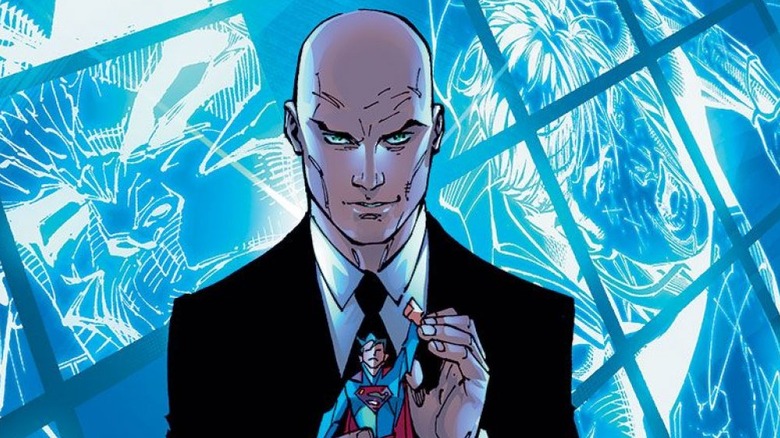
In 1940, just a few years after the Man of Steel's debut, his greatest nemesis was born. Since his first Golden Age appearance in either "Superman" #4 or "Action Comics" #23 (depending on your source), Lex Luthor has been a constant thorn in Superman's side. The criminal genius-turned-scientist-turned-corporate-overlord has been at the center of many DC Comics tales since the Silver Age, and his importance has only grown over the years. In all that time though, Luthor has proven himself to be one of the most heinous characters in comic book history — and we've set out to prove it.
We've compiled a list of some of Lex Luthor's worst actions over the years. "The greatest criminal mind of our time" isn't considered such for no reason, and although he's reformed a little in the past decade, he has a long-running history with evil. Of course, we're sticking to the pages of DC comic books here, so we aren't considering the different live-action adaptations of Lex Luthor, no matter how sinister they may be. Oh, and before the jokes begin, we aren't counting his infamous theft of 40 cakes either, even if it is canon now.
From ruining the lives of those he barely knows to taking active, selfish measures to destroy his own family, Lex Luthor is worse than you probably remember. After all, this guy killed his own parents for the insurance money, sabotaged innocent lives just to kill Superman, and made it impossible for anyone to learn the Man of Steel's identity without having a stroke (believe it or not, that's not even the worst of it). Although Superman is often there to save the day, that never stopped Luthor from being the absolute worst.
5. Ruining lives just for the fun of it
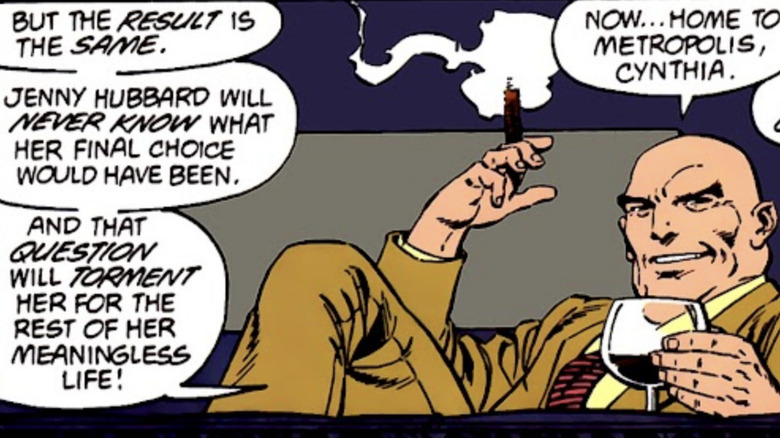
If you didn't already know, Lex Luthor is one of the most egotistical, selfish, and vain characters in the entire DC Universe. No matter which interpretation, he's generally consistent across the board. He's also terribly petty and can be needlessly cruel. Following "Crisis on Infinite Earths," DC rebooted the Superman mythos, reimagining Luthor as a successful business mogul meant to be, according to writer John Byrne, "a cross between Donald Trump, Ted Turner, Howard Hughes and maybe Satan himself!" That last one, in particular, comes into play here.
While the comic book character always had a more sinister bent, the post-Crisis Luthor went from "mad scientist megalomaniac" to straight-up Devil incarnate. We see this especially in "Superman" (Vol. 2) #9, where Luthor travels 900 miles outside of Metropolis to a rural, small-town diner just to torment waitress Jenny Hubbard with a sinful proposition. If she left her life and husband behind to be his own personal playmate for an entire month, he would give her a million dollars.
Although Jenny is first offended by the offer, she begins to consider it when Luthor gives her 10 minutes to think it over. The whole thing is torturous, and by the time she calls her husband to truly weigh the pros and cons, the LexCorp CEO has already driven off, laughing about how he's ruined her life forever. Years later, in "Superman" (Vol. 2) #163, a vengeful Jenny attempted to assassinate the villain during his presidential campaign. However, all she did was garner sympathy support for Luthor.
4. Rain of the Supermen
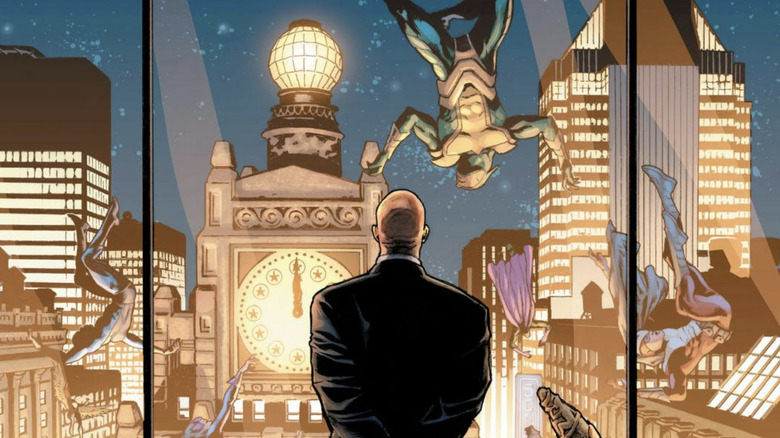
It's no secret that part of Lex Luthor's personal desire is that he wants to become Superman. Grant Morrison explores this idea in "All-Star Superman," among other comic arcs, and even as recently as the DC Rebirth era, he took up the "S" following the death of the "New 52" Man of Steel. But Luthor doesn't just want superpowers — he wants to control those who do. After "Infinite Crisis," Superman lost his powers for a year. During that time, Luthor took superheroics into his own hands.
Like something out of "The Boys," the villain crafted the Everyman Project to infuse normal human beings with metahuman abilities, resulting in the creation of a brand-new Infinity, Inc. (not to be confused with the old version that consisted of the children of the Justice Society of America). However, as depicted in "52" #35, Luthor could turn this "metagene" off — and he does so, resulting in the "Rain of the Supermen" as newly costumed heroes fall to their death on the streets of Metropolis. It's a bloody scene made worse by Luthor's call for a "Superman" to save them.
So, why does he do it? Basically because he feels like it. In some sick, twisted way, it's Luthor's way of reminding everyone that he owns the "superhero business," ensuring his continued dominance over the DCU at a time when Superman was already out of the picture. Not only is this typical Luthor behavior, but it's a horrific ordeal that forces many of DC's greatest heroes to intervene before things get too out of hand.
3. Curing his sister (and then undoing it)

Although she had been around intermittently since the Silver Age, Lex's sister Lena Luthor was re-introduced in the 21st century during Geoff Johns' run on the revived "Adventure Comics" title. Focusing on Kon-El/Connor Kent (one of the many versions of Superboy) as he returns to Smallville, the Boy of Steel finds himself drawn to his classmate Lori, who turns out to be Lena's daughter. Unfortunately, a mysterious illness has rendered Lena paralyzed and trapped within her own mind — until her big brother shows up.
In "Adventure Comics" (Vol. 2) #6, Lex arrives on Lena and Lori's doorstep with a simple proposition: If Superboy — who is a clone created from a mixture of Superman and Luthor's DNA — can get him the ingredients he needs, he can cure his sister's illness. Remarkably, he does it; Luthor cures Lena completely, reuniting mother and daughter in a touching moment that helps convince Superboy that there may be good in Luthor after all. However, almost instantly after his success, Luthor injects Lena with another serum that shifts her back to her old state.
Future versions post-"New 52" reboot would re-imagine their sibling dynamic, with Lex admitting in "Forever Evil" #4 that he is responsible for her paralysis after trying (and failing) to cure her. Lena would eventually go on to become a supervillain, dubbed "Ultrawoman," further putting them at odds. But despite that, there's no excuse for what post-Crisis Luthor did to his sister here in "Adventure Comics," leaving this version of the character worse off than she had been before.
2. Gave up peace in the universe to kill Superman
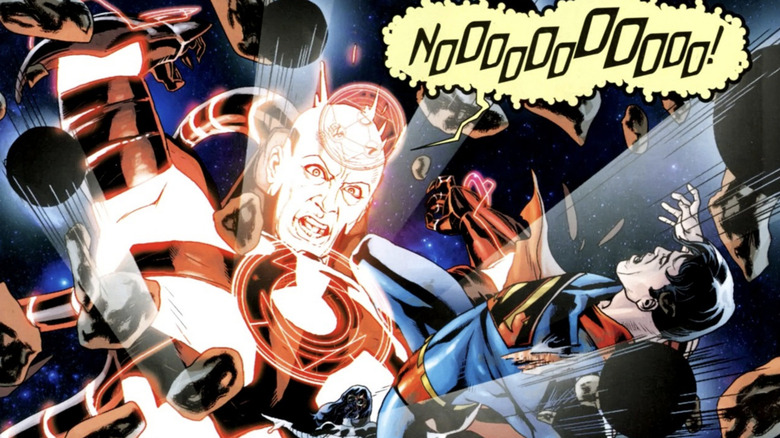
Not long after the incident with Lex and his sister, writer Paul Cornell took over "Action Comics" for a Luthor-centric arc titled "The Black Ring." Following the "New Krypton" saga where Luthor commits another heinous act by obliterating New Krypton (earning him a presidential pardon in the process), Lex hopes to regain some of the power he attained during the "Blackest Night" crossover. This leads him to a cosmic entity that exists within the Phantom Zone, which he merges with to become almost god-like.
The whole thing comes to a head in "Action Comics" #900 when Luthor summons Superman, hoping to use his powers to show the Man of Steel the full weight of human emotion. The problem is, as Luthor discovers, Superman already understands this. While Lex had assumed that Kal-El lived as an alien outsider in the world, he discovers that his enemy was the very same Clark Kent that he grew up with in Smallville (as explored previously in "Superman: Secret Origin"). It's here that Luthor's hatred for Superman continues to fester, though he has a brief moment of clarity.
With the power of the Zone Child at his disposal, Luthor creates a feeling of bliss that scatters throughout the known universe. It touches everyone from hero to villain, balancing the DCU in perfect harmony. The catch? He can't use his newfound power to do anything negative, or it will undo this universal peace. Of course, the moment he reconsiders, he immediately resumes his attack on Superman, ending the happiness of an unfathomable number of beings throughout the DCU all because of his petty vendetta.
1. Offering his daughter to Brainiac
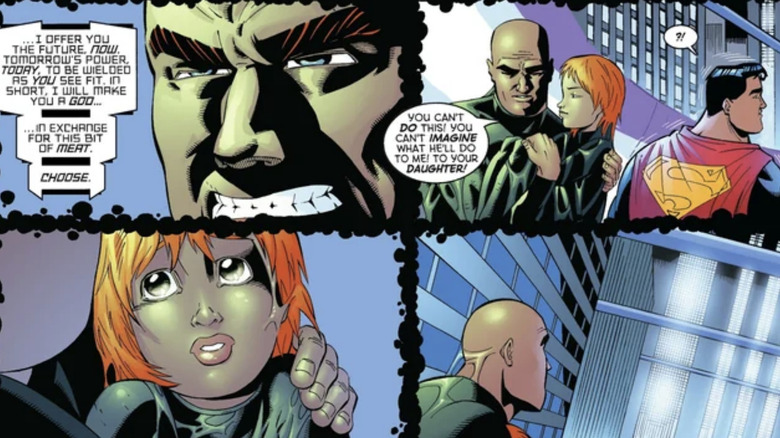
One often-forgotten truth about Lex Luthor is that he is also a father. After Lex's Silver Age sister Lena was erased post-Crisis, the character was re-imagined in the form of his daughter, who he named after a foster sister he grew up with. Lena Luthor II was born from his brief marriage to Contessa Erica Alexandra del Portenza (who he later had killed to not have to share Lena's affection). Not that he cared much about being a father, as evidenced in "Action Comics" #763 when he hands her over to Brainiac 13.
It all started when the futuristic B13 arrives in Metropolis during the Y2K Crisis when that time's Brainiac had shut down the world's computer systems. Hoping to evade the futuristic threat, Brainiac downloads his consciousness to young Lena's body, believing Lex will protect her. But after Superman puts B13 in his place, the future villain offers Luthor a deal: In exchange for his daughter (still housing Brainiac's consciousness), he will offer Luthor the secrets of the future B13 tech, leaving it behind in Metropolis for his fair use. Somehow, Luthor convinces himself that handing Lena over is a good idea.
When Superman confronts Luthor later, he notes that he "can always make another" heir. The cold, callous villain proves himself to be among the most heartless beings in the universe. Thankfully, Superman later saves Lena and brings her back to a grateful Lex, though she disappeared for many years. Both versions of Lena have been reintroduced in the current post-DC Rebirth continuity, with Lena II now an aged-up teenager. Nevertheless, Lex's actions are a damning offense that's hard to ignore.