

5 Deadliest Star Trek Planets, Ranked
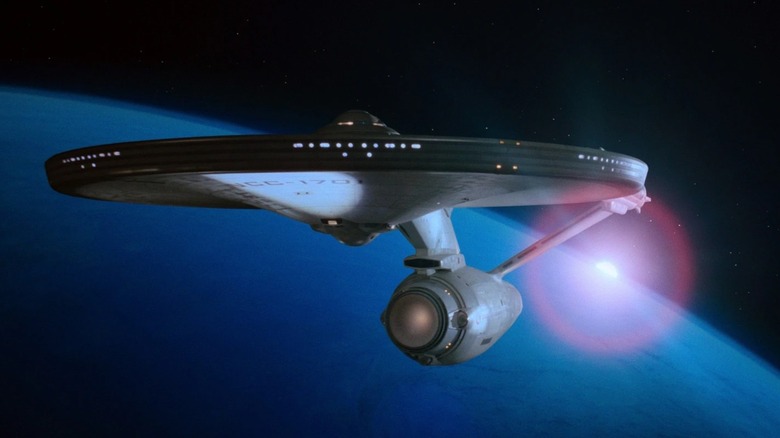
When you sit down to watch an episode of "Star Trek," or one of the franchise's feature films, odds are that you'll see some planets. Because the original series was all about exploration, meeting new alien civilizations, and expanding humanity into the cosmos, new worlds were introduced in almost every episode or film. Now, 60 years after the first episode of "Star Trek" aired on NBC, that's still very much the case, and the list of visited planets numbers in the hundreds (if not more).
Another aspect of the franchise that's remained true is that most worlds that members of the United Federation of Planets visit hold some sort of danger. This can take the form of a hostile species like the Cardassians, Romulans, Klingons, or many others, but it can also be the nature of the visited world itself. Some planets are more dangerous than others, and a good number of the most hazardous worlds are among the deadliest in the galaxy.
Those dangers aren't only posed to Redshirts, either, as some planets have cost the lives of members of the bridge crew. Tasha Yar's (Denise Crosby) demise on Vagra II is evidence of this in the "Next Generation" episode "Skin of Evil." Still, other planets are considerably more dangerous, and these five are among the deadliest from the entire Star Trek franchise. They're ranked based on their harsh environments, their dangerous denizens, and how nuts a Starfleet away team would have to be to venture out onto their surfaces.
5. Rura Penthe
Because of the animus between the Federation and the Klingon Empire, much of the latter's various planets remained outside the purview of the former throughout much of the franchise's history. This changed in "Star Trek VI: The Undiscovered Country," which centers around the first steps in forging a lasting peace between the longtime adversaries. In the film, two people wearing Starfleet uniforms board a Klingon vessel escorting Chancellor Gorkon (David Warner) and kill him despite Dr. Leonard "Bones" McCoy's (DeForest Kelley) desperate attempt to save him.
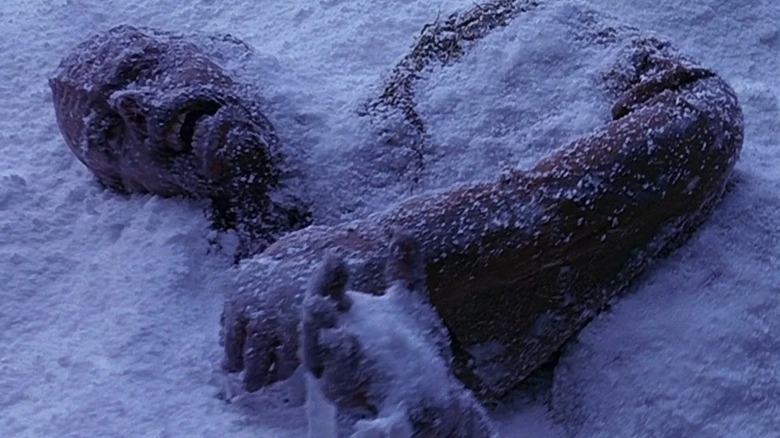
Capt. Kirk (William Shatner) surrenders to avoid further bloodshed, leading to a trial where he and Bones are sentenced to live out the rest of their lives on the Klingon penal world of Rura Penthe. The previously unseen planetoid in the Beta Penthe system orbits its star at such a distance that it's entirely frozen over, making the environment inhospitable to humanoid life, including Klingons. The prison, which provides labor to a dilithium mine, is known as "the alien's graveyard" due to the short life expectancy of its inmates.
Most don't survive a year, and anyone who violates any rules is left to freeze to death on the surface, which takes only a few minutes. Even if someone could survive on the surface for a short while, it's entirely covered with glaciers and high-speed blizzard conditions, limiting visibility and movement. Technically, Rura Penthe is classified as habitable, but that's stretching the meaning of the word to its absolute limits for most lifeforms.
4. The Genesis Planet
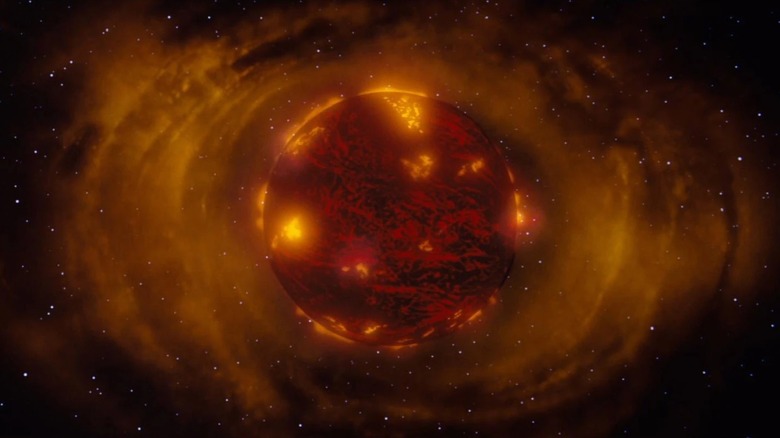
"Star Trek II: The Wrath of Khan" ends with the creation of the Genesis Planet. This comes about when the Genesis Device explodes, destroying the USS Reliant. The Genesis Device is able to capture the gas and dust of the Mutara Nebula into a dense planet, which becomes the final resting place of Mr. Spock (Leonard Nimoy). At least, that's what everyone thinks when the film comes to an end — a new world is created, Spock has died, and the scientific analysis of the amazing technological and scientific achievement is left to be studied.
Of course, when "Star Trek III: The Search for Spock" kicks off, it quickly becomes clear that Spock's body is resurrected as a fast-developing child, thanks to the nature in which the world was created using protomatter. It's the use of protomatter that makes the Genesis Planet so controversial among the leading groups in the galaxy, but it's also what makes the world so dangerous.
Protomatter speeds up the planet's aging, making it incredibly unstable, which includes the various lifeforms that are abundant on its surface. The ultimate fate of the Genesis Planet sees its many ecosystems become erratic and destructive until the planet's geologic activity becomes untenable to all life. Eventually, the planet's surface is awash with molten lava as the Genesis Planet tears itself apart. The planet's core became so volatile that it caused the world's utter destruction, taking anyone foolhardy enough to be on its surface with it.
3. The Demon Planet
A term known to all Trekkies is "Minshara," or M-class, which designates a world as being habitable to human life. Throughout the franchise, the most commonly visited worlds are M-class planets, and there are thousands of them documented throughout the galaxy. It's actually less common for a Starfleet vessel to orbit anything else, which is why the "Star Trek: Voyager" episode "Demon" is so interesting. The crew is desperate for fuel, and the only source of deuterium they find within range is on a Y-class planet.
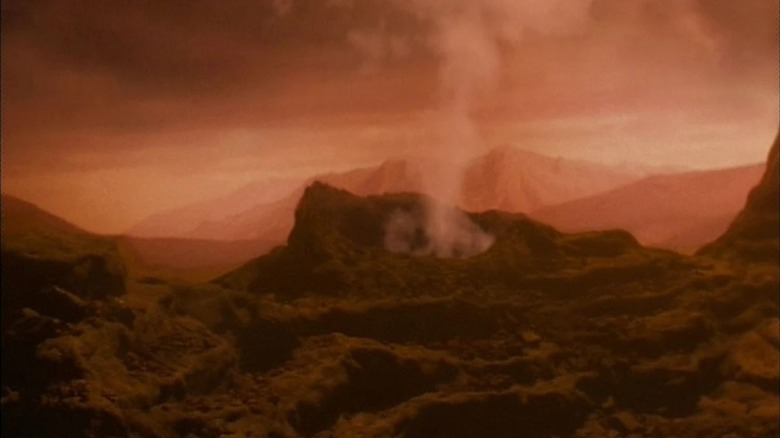
These types of worlds are called "Demon Planets" by the crew, and for good reason, as they're entirely inhospitable to life as it's known throughout the galaxy. This is because they have toxic atmospheres, surface temperatures in excess of 500 degrees Kelvin, sulfuric deserts, and thermionic radiation discharges. They're essentially the most hellish landscapes in the franchise, hence the nickname, but Voyager has no choice but to land and send out a small away team.
They wear hardy atmospheric suits, but soon find a biomimetic lifeform called Silver Blood that mimics the crew members who touch it. This, in turn, threatens the ship, but as is common in every episode, it all works out in the end. The Demon Planet resulted in one of Star Trek's greatest twists, no one saw coming, when its Silver Blood denizens were revisited later in the series. Regardless, one thing was made clear in "Demon," and it's that setting foot on a Y-class planet isn't safe.
2. Ceti Alpha V
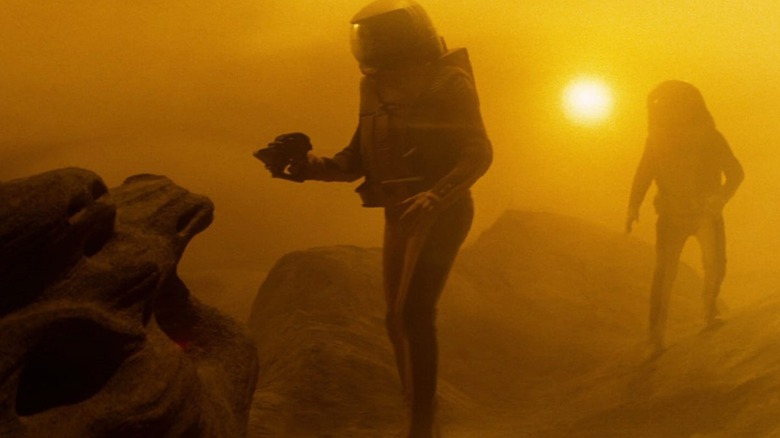
In the "Star Trek" episode "Space Seed," the USS Enterprise comes into contact with one of the most dangerous beings in the franchise: Khan Noonien Singh. The genetically augmented former tyrant and his people quickly become adversaries of Kirk and his crew, which ultimately leads to their marooning on Ceti Alpha V, the fifth planet in the Ceti Alpha system. The planet is barely hospitable, but it's technically an M-class world, where the human augments are able to survive. From that point forward, Ceti Alpha V is off-limits to the Federation.
Unfortunately, the destruction of Ceti Alpha VI results in the fifth planet's orbit shifting, causing the entire world to become a desert. Its only survivors are members of Khan's people and the Ceti eels, which burrow into a person's brain, making them highly susceptible to suggestion. This all comes to light in "Star Trek II: The Wrath of Khan" when the USS Reliant targets the planet, not realizing it's Ceti Alpha V, as a possible site to deploy the Genesis device.
In the case of Ceti Alpha V, the planet's dangers are threefold. First, the world itself is no longer hospitable to most humanoid life, making anyone marooned on it who isn't an augmented human someone with an incredibly short life expectancy. Second, the Ceti eels spell death for pretty much anyone infected, even killing several of Khan's people. Finally, the planet is one of the deadliest because it is where Khan resides for several decades.
1. Talos IV
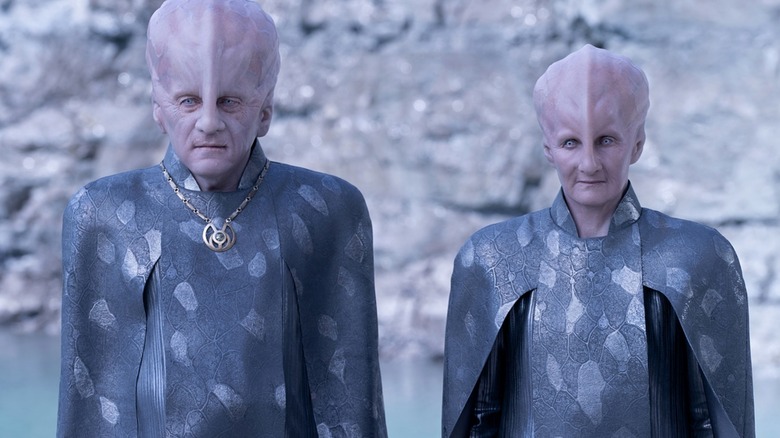
With thousands of inhabited planets across the galaxy, only a handful are as deadly and forbidden as Talos IV. As mentioned in "The Menagerie Part I," "No vessel under any condition, emergency or otherwise, is to visit Talos IV." That's Starfleet General Order 7, and it came into existence after the USS Enterprise visited the planet in 2254. Almost nobody outside of the highest levels of Starfleet command even knew the reason for General Order 7, which is important, as it's the only regulation that carries capital punishment if broken.
For a society that abandoned capital punishment centuries ago, applying it in the 23rd century is a pretty big deal. As it happens, the reason why Talos IV is such a forbidden world has nothing to do with the planet itself, as it's a relatively pleasant M-class world. The problem stems from the Talosians, an indigenous humanoid species so telepathically powerful that even approaching the system is a bad idea.
When it's first visited by Capt. Pike (Jeffrey Hunter), he's lured there by the Talosians through some convincing telepathy. They make it off-world, and soon after, General Order 7 is imposed. Spock later returns to the planet to drop off Pike (Sean Kenney), now confined to a life support chair, as he's been given special dispensation to live out his life there. Subsequent visits weren't met with much calamity, but few have made the journey on the punishment of death, though General Order 7 was likely rescinded sometime in the 24th century.