

5 Time Travel Movies Everyone Needs To Watch At Least Once
Science fiction is one of cinema's oldest genres, going back to 1902's "A Trip to the Moon." Since then, the genre has split into a multitude of sub-genres, and one of the greatest involves time travel. Being able to change the past or peer into the future is quite a tantalizing prospect. After all, who among us wouldn't want to check out an important moment in history or see what happens to humanity in a few thousand years?
That's one of the reasons that "Doctor Who" is such a compelling TV show, but some of the best time travel stories play out on the silver screen. You probably don't have to think too hard to come up with a few great time travel movies — there are plenty of them. It's a genre that's returned to often, as it's fun to explore and makes for great entertainment. They did it in "Avengers: Endgame," and it will continue to come up in major movie franchises as time passes.
Still, there are plenty of great time travel movies that aren't part of mega franchises that everyone should watch at least once. These are the films that you might show your kids one day, or you'd recommend to a friend if they're looking to delve into the world of science fiction. They're films that are at the tops of everyone's lists because they're essentially timeless — pun intended. Each of these five time travel movies is important to the genre, and everyone should see them.
The Time Machine (1960)
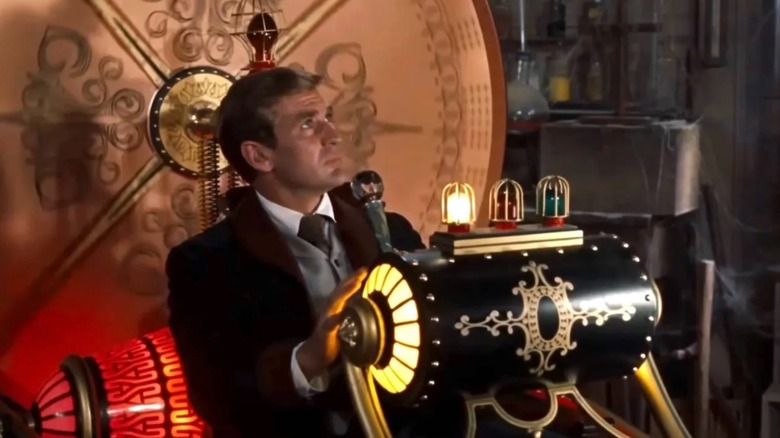
Time travel has been around in films for decades, first used lightly as narrative device in 1917's "The Ghost of Slumber Mountain" but central to 1921's "A Connecticut Yankee in King Arthur's Court." However, the movie that arguably nailed the time travel mechanic was 1960's "The Time Machine." This is the film that perfected time travel as a narrative technique, thanks to H.G. Wells' 1895 novella of the same name. The film begins in 1899 London, where George (Rod Taylor), an inventor who's grown cynical over the violence of his era, creates a time machine to leave his present in search of a more peaceful future.
George's hope for a brighter time is met with the horrors of 20th-century wars and a far-off future that spells doom for humanity. The special effects alone are brilliant in how they use time-lapse photography and miniatures to show the passage of time. "The Time Machine" isn't just a time travel movie that should be on everyone's watch list; it's also a sci-fi movie everyone should watch at least once.
It's a brilliant examination of the human condition, technological reliance, complacency, and the dangers of nuclear annihilation. "The Time Machine" should be the first movie anyone watches about time travel because it establishes the formula: an inventor creates a machine to travel through time. He does so, finding that the future isn't what he expects, so he sets about to change it for the better, using his knowledge of better times and a past he cynically discarded. The film is a brilliant adaptation and was highly influential.
Back to the Future
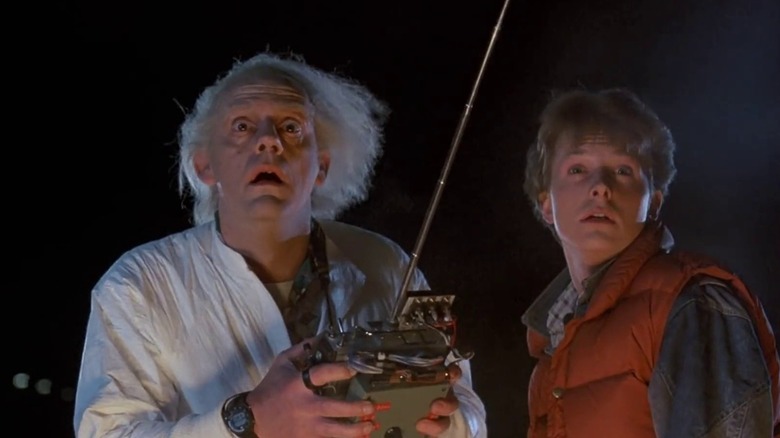
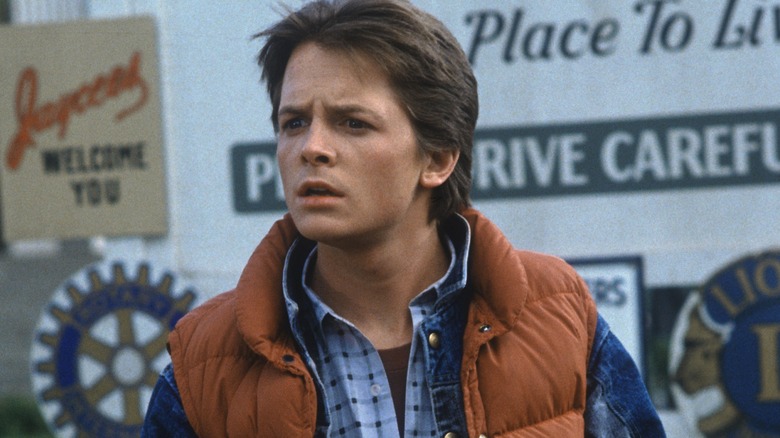
"Back to the Future" is one of those '80s movies that's somehow both a product of its time and also timeless. The film continues to resonate long after its release, and that's largely thanks to its excellent execution. The movie starts off with Marty McFly (Michael J. Fox) meeting up with his friendly neighborhood mad scientist, Emmett "Doc" Brown (Christopher Lloyd). Due to a little mix-up with some Libyan terrorists, some stolen plutonium, and a time machine fashioned into a DeLorean, Marty winds up in 1955.
He quickly messes up his parents' meet-cute, nearly wiping himself out of existence in the process. This establishes the film's primary plot: Marty must ensure that his parents get together or he will vanish from existence having never been born. It all becomes a mess of time travel-related paradoxes, each one overcome by the end. The film was a hit, spawning two sequels and an animated series.
The entire "Back to the Future" timeline is a bit unusual, but it all ties together rather nicely into a single cohesive narrative that connects all of the characters across more than a century. The enduring love fans have for "Back to the Future" speaks to the film's humor and well-written story that's surprisingly easy to follow, despite all of the twists and turns related to time travel and causality. It should be confusing, but it's ultimately digestible, funny, and entertaining, making it one of the best time travel movies ever made.
The Butterfly Effect
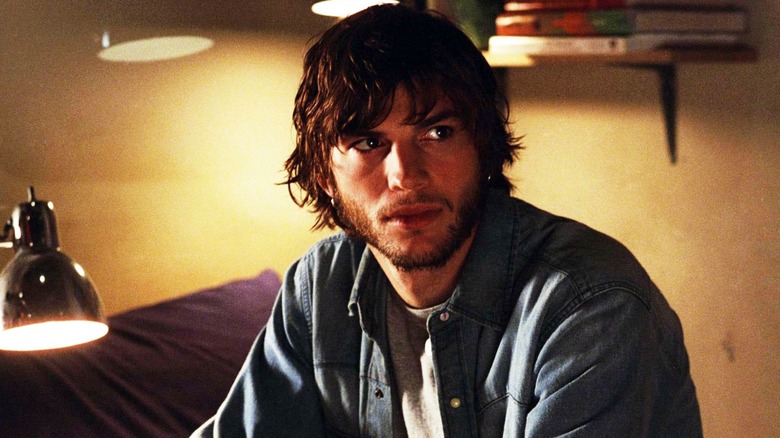
Most time travel movies offer a glimmer of hope for the future, but "The Butterfly Effect" is completely different, thanks to its unusual time travel mechanic. The film's title gives a bit of its time travel secret away, as a "butterfly effect" involves making a small change in the past that causes a ripple effect resulting in something much larger in the future. In the movie, Evan Treborn (Ashton Kutcher) suffers from blackouts during brief but significant periods of his young life.
As he matures, he learns how to recall these moments, but instead of recalling a memory, his conscious mind travels back in time into his young body, allowing him to make changes to his own timeline. It's not your typical "jump into a DeLorean and hit 88 mph" kind of time travel, but that's what makes "The Butterfly Effect" such a compelling movie. Whenever Evan travels back in time, he alters his life, and while he attempts to make things better for himself and the people he cares for, he inadvertently worsens things for nearly everyone, himself included.
His changes result in his imprisonment, he loses his hands, and other events ruin relationships. Each small change results in much larger, unforeseen changes down the line, hearkening back to the title. "The Butterfly Effect" has an interesting ending (and there's more than one, thanks to the director's cut), but it won't be spoiled here. It's a fascinating time-travel film that's unlike any other and should be watched by anyone interested in the genre.
Midnight in Paris
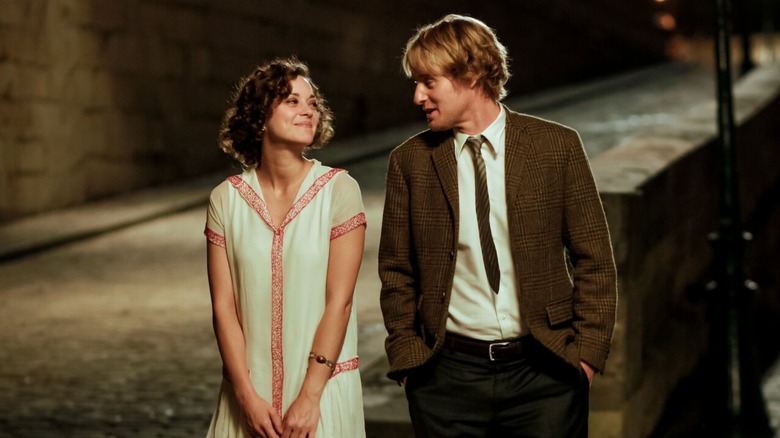
Many time travel movies focus on the means of time travel, but in "Midnight in Paris," the theme is nostalgia. That's something that resonates with all of us, and the film's central focus is Paris, France, in the 1920s. That's when visionaries like Zelda and F. Scott Fitzgerald dined with Ernest Hemingway and Salvador Dalí, Pablo Picasso, and Gertrude Stein. It was a different time, and it's a time and place that Gil Pender (Owen Wilson) dreams about. He also unintentionally stumbles into it inexplicably in Paris at midnight.
Gil travels back to the 1920s art scene where he meets everyone he admires and falls in love with a young woman named Adriana (Marion Cotillard). This is somewhat problematic, as he's in Paris with his fiancée, Inez (Rachel McAdams). As his romance continues, it becomes clear that Adriana shares Gil's Parisian nostalgia. Unlike Gil, her interest lies in the Belle Époque, which she sees as Paris' true golden age, which they travel to.
The film, which Wilson considers to be his best, is an amazing exploration of nostalgia, the city of Paris, and how easy it is to get wrapped up in the idea of something over what it truly is. "Midnight in Paris" isn't a typical time travel movie, but that's what makes it one of the best. The means of time travel isn't nearly as important as the destination, and the story it tells resonates because everyone has an idealized "Paris" of their own.
Looper
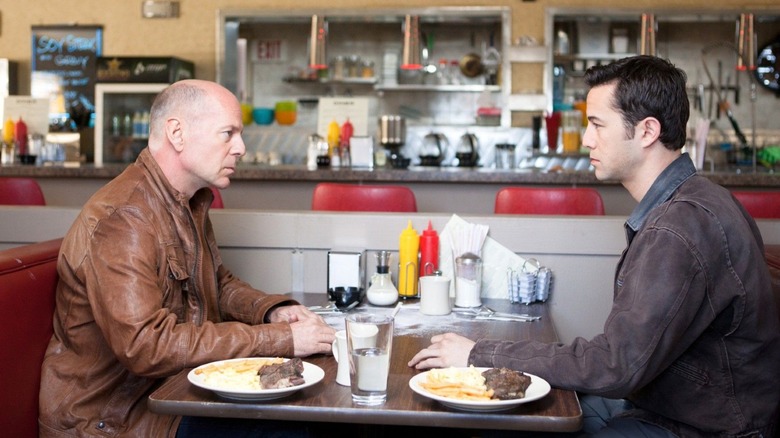
Traveling through time is inherently problematic, because what you do in the past will inevitably impact the future. This creates paradoxes, but "Looper" handles this brilliantly by showing exactly how cause and effect impact future events. The film begins in 2044, where Joe (Joseph Gordon-Levitt) works as a looper, a type of assassin employed by mobsters in 2074. In that time, getting away with murder is almost impossible, so victims are sent back in time for loopers to terminate.
"Closing the loop" means having a looper kill themselves should they survive to 2074, which is the actual present for the movie's purposes. It's a bit confusing, and it becomes more so when Joe comes face-to-face with his older self, played by Bruce Willis. Instead of ending each other, they reluctantly work together (for a time), but a wider plot emerges that involves killing important people in the past to impact the future.
This plays out with one victim, who has his limbs surgically removed in 2044, only to slowly fall apart in 2074. Cause and effect, otherwise playing out across decades, is shown instantaneously to clarify these temporal links, and it's fascinating. "Looper" is one of Willis' most popular movies, and it's easy to see why, as it's not only a great time travel film, but it's also a fantastic action movie. It has twists and turns, takes place across two timelines, and has serious consequences that the viewer can see unfold in multiple ways, proving how powerful time — and its passage — really is.