

5 Movies That Prove 1969 Was The Best Year For Westerns
It might be hard to imagine nowadays, but there once was a time when Westerns were as popular as superhero movies. In fact, Westerns were the dominant genre throughout the first half of the 20th century, with dozens of movies about cowboys, outlaws, and gunslingers getting released every year. Throughout the decades, however, the genre started to lose favor, and you're lucky if you get one Western in movie theaters a year as opposed to several. Yet the best Western movies of all time continue to delight viewers and inspire filmmakers, from the Old Hollywood studio classics to the revisionist masterpieces of the new.
For fans of the Western, one year in particular holds special significance, not just for the quality of the films released, but for what it represented for the genre's future: 1969. A turning point for cinema overall, 1969 saw the Western bending in an exciting new direction, one that would redefine it for decades to come. In the span of 12 months, audiences were treated to both bold, violent new visions of the Old West and gentler, more nostalgic stories of traditional heroism — not to mention comedies, modern-day Westerns, and even a musical ("Paint Your Wagon," starring a singing Clint Eastwood). It's little wonder that the best picture Oscar winner that year was "Midnight Cowboy" (1969), a film that transplants many of the tropes of a classic Western into an urban setting and subverts them. Here are five movies that prove 1969 was the best year for Westerns.
Butch Cassidy and the Sundance Kid
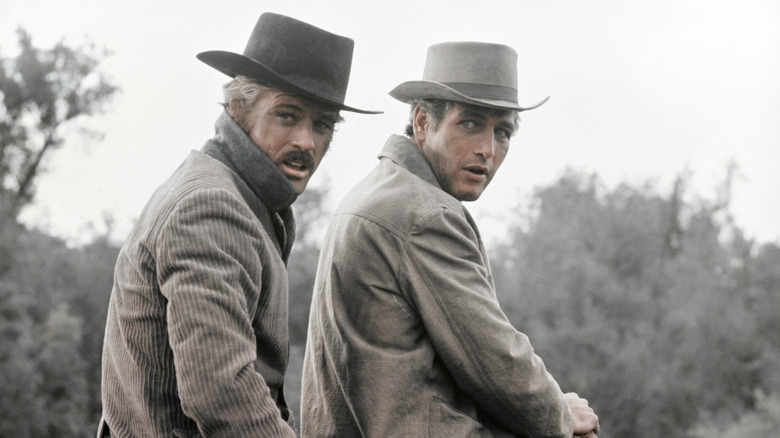
In turn-of-the-century Wyoming, Butch Cassidy (Paul Newman in one of his greatest movies) leads the Hole-in-the-Wall outlaw gang with his trusted companion, the Sundance Kid (Robert Redford in one of his best movies). After beating back a leadership challenge, Butch and Sundance decide to rob the Union Pacific train carrying money to the local bank — not once, but twice. But a posse of lawmen catches wise to the gang's plans, and the dynamic duo makes a run for it to Bolivia with Etta Place (Katharine Ross), a lover to Sundance and a flirter to Butch. Although they try to "go straight," the past catches up with Butch and Sundance, leading to a deadly gunfight.
One of the defining films of the 1960s, "Butch Cassidy and the Sundance Kid" is also one of a handful of Westerns you need to see before you die. Directed by George Roy Hill, it has all of the trappings of a traditional Old Hollywood cowboy flick, but with a decidedly New Hollywood bent, making it the perfect middle ground for a transitional period in American cinema. Its success comes from the ingenious pairing of Paul Newman and Robert Redford, two traditionally handsome leading men capable of being charming, dangerous, and funny in equal measure. A massive box office hit, the film earned seven Oscar nominations, including best picture, and won prizes for best original screenplay, best cinematography, best score, and best song ("Raindrops Keep Fallin' on My Head").
Easy Rider
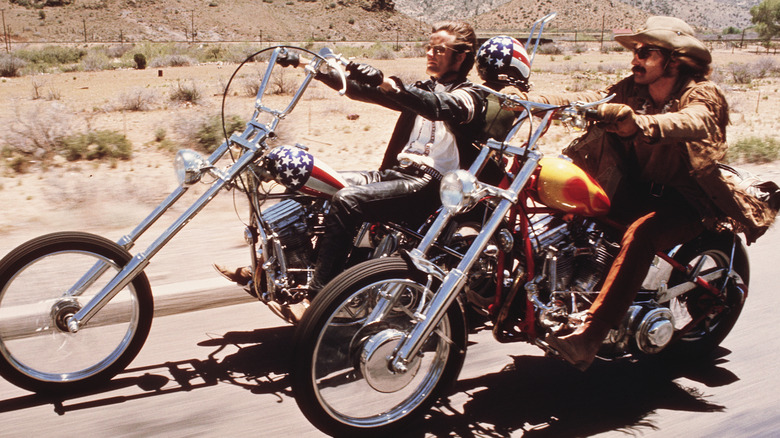
After smuggling some cocaine from Mexico to California, bikers Wyatt (Peter Fonda) and Billy (Dennis Hopper) decide to take their earnings and enjoy some rest and relaxation at Mardi Gras. They hop aboard their bikes and make their way across the country, making a pit stop at an Arizona commune to indulge in some free love and pick up some LSD. After getting arrested in New Mexico, they spend a night in jail with George Hanson (Jack Nicholson in one of his greatest movies), a lawyer who's sleeping off a hangover in a cell. George joins Wyatt and Billy on the road, telling them that others fear them because they represent what they can't have: freedom. Wyatt and Billy finally get to New Orleans, where they drop acid with a pair of prostitutes (Karen Black and Toni Basil) and question their place in America.
Released at the close of the 1960s, "Easy Rider" was one of the most consequential films of New Hollywood, speaking to a generation of hippies who were radicalized by the counterculture. Although not a traditional Western, Dennis Hopper's directorial debut uses many of the trappings of the genre, replacing horses with motorcycles. Like Butch and Sundance, Wyatt (aka "Captain America") and Billy make their way across the Western landscape in search of freedom, and find resistance instead. Raking in massive box office returns from its shoestring budget, the film earned Oscar nominations for Nicholson in best supporting actor and for best original screenplay.
Support Your Local Sheriff!
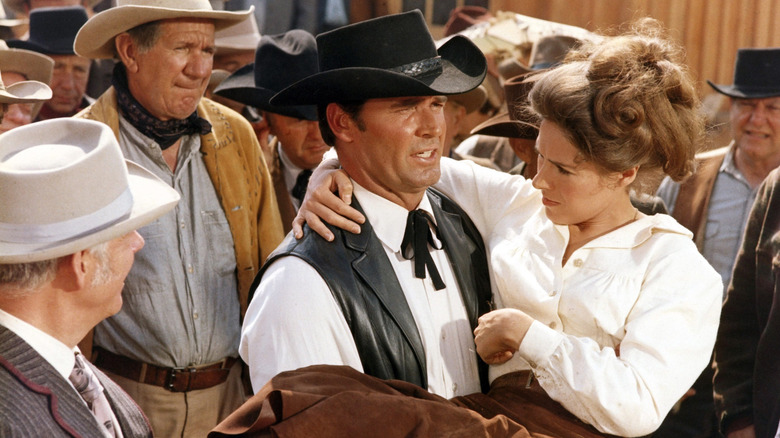
In the early days of the Wild West, the town of Calendar, Colorado, pops up after gold is discovered. The influx of people leads the corrupt Danby clan to institute a toll for all prospectors entering and leaving. The townspeople want a sheriff to clean things up, but everyone who takes the job ends up in the grave. Enter Jason McCullough (James Garner in one of his greatest movies), a sly and laidback gunslinger who takes the job so that he can earn enough money to move to Australia. Before long, McCullough is cleaning up the dusty streets of Calendar with the help of his eccentric deputy, Jake (Jack Elam). But the Darby gang, led by Pa (Walter Brennan) and his son, Joe (Bruce Dern), makes life difficult for the new lawman.
The Western comedy has long been a staple of the genre, from "Cat Ballou" to "Blazing Saddles." Like those films, "Support Your Local Sheriff!" sends up classic Western tropes with a wink and a nod. It certainly helps that director Burt Kennedy directed his fair share of traditional Westerns (including 1966's "Magnificent Seven" sequel, "Return of the Seven"), so he knew the genre inside and out. This film's real secret weapon is James Garner, who came to fame playing gunslinger Bret Maverick on the TV Western "Maverick," and brings that same charm and macho subversion to the role of James McCullough. Garner liked the role so much he returned for a sequel, "Support Your Local Gunslinger."
True Grit
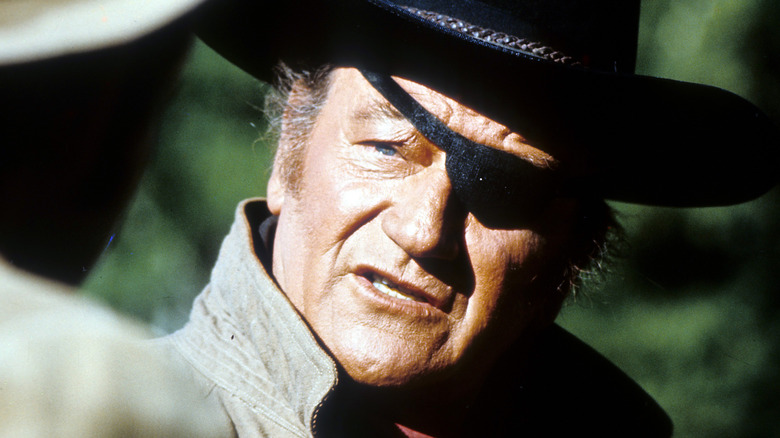
After her father is murdered by gunslinger Tom Chaney (Jeff Corey), teenager Mattie Ross (Kim Darby) travels to the town of Fort Smith, Arkansas, seeking revenge. She hires the drunken, one-eyed U.S. Marshal Rooster Cogburn (John Wayne) to track Chaney down after he flees to Indian Territory with Lucky Ned Pepper's (Robert Duvall) outlaw gang. Cogburn takes the job, if for no better reason than he wants to apprehend Pepper after he's previously escaped his capture. Along the way, they meet La Boeuf (Glen Campbell), a young Texas Ranger who's on Chaney's trail for killing a U.S. Senator. A mismatched trio if ever there was one, Mattie, Rooster, and La Boeuf make their way through the Wild West to bring Chaney to justice.
Although it's been somewhat eclipsed by the 2010 Coen Brothers version — one of those rare movie remakes that are better than the original — 1969's "True Grit" has its own charms. For one thing, it's one of John Wayne's best movies of all time, and the only film for which he won an Oscar as best actor. For another, the Henry Hathaway-directed flick represents one of the last gasps of the traditional Hollywood Western at a time when the genre was being upended. As the Western was becoming more violent, contemplative, and subversive, "True Grit" was an almost defiantly old-fashioned, G-rated entertainment for the whole family. Wayne reprised the role in the 1975 sequel "Rooster Cogburn," one of the last films he made before his death in 1979.
The Wild Bunch
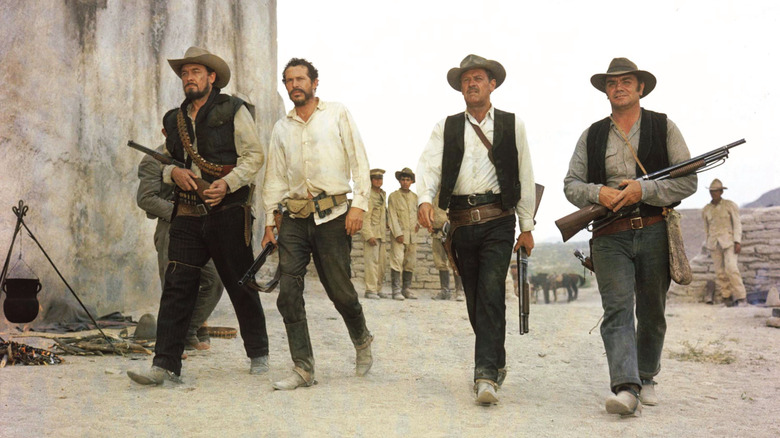
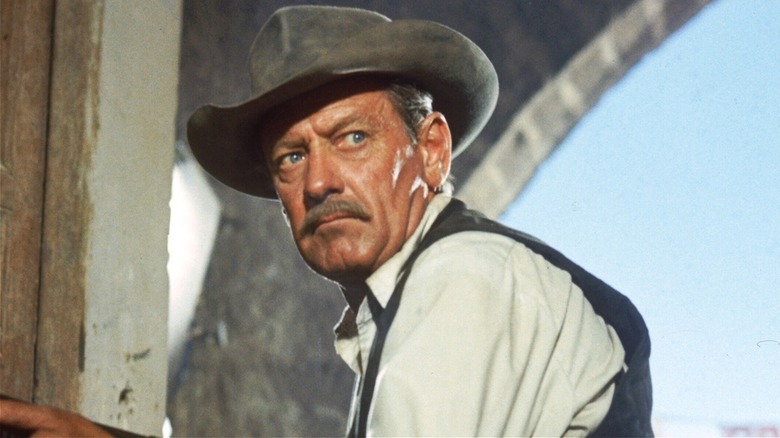
Aging outlaw Pike Bishop (William Holden) plans to retire after one last bank heist. Accompanied by his trusted lieutenant, Dutch Engstrom (Ernest Borgnine), brothers Lyle (Warren Oates) and Tector Gorch (Ben Johnson), and newcomer Angel (Jaime Sánchez), Pike enters a railroad payroll office intent on stealing bags of silver dollars. But the job is a set-up by Pike's former partner, Deke Thornton (Robert Ryan), who's now leading a posse trying to bring the gang to justice. Pike and his bunch narrowly escape with bags full of steel washers instead of silver, leaving them in need of funds. Hiding out in Mexico with old timer Freddie Sykes (Edmund O'Brien), Pike and his gang accept a job offer by a vicious Huertista officer, General Mapache (Emilio Fernández), sealing their tragic fates.
Of all the Westerns released in 1969, none did more to redefine the genre than Sam Peckinpah's "The Wild Bunch." Like the Clint Eastwood spaghetti Westerns coming out of Europe around that same time, Peckinpah's film amped up the violence to a degree never before seen. Centered on crude, ruthless outlaws and characterized by slow-motion shots of carnage, "The Wild Bunch" was bloody, brutal, and bracing, so much so that significant edits had to be made in order to secure an R-rating. An Oscar nominee for its original screenplay and score, the controversial film dragged the Western kicking and screaming into the modern era, and remains one of the most significant titles of the New Hollywood.