

The Strangers: Chapter 3 Review - There's Nothing Strange About This Mediocre Slasher
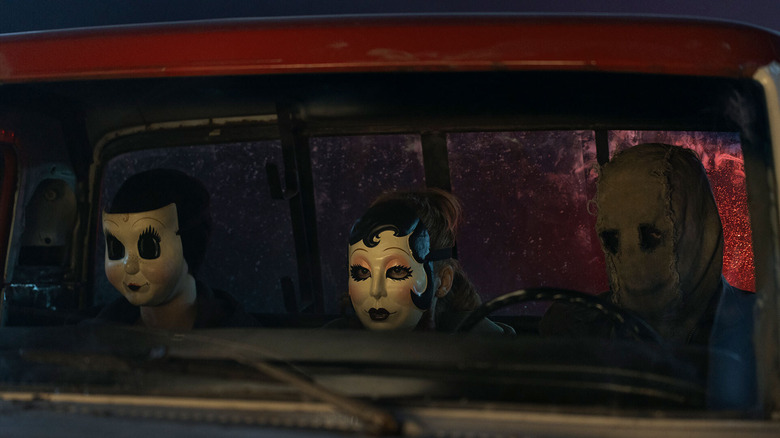
- At the very least, it is an ambitious failure
- An anticlimax after the previous chapter
- Doesn't explore the villain's backstory with enough depth
- So slow-burning it becomes dull
I was one of the few critics who was won over by "The Strangers: Chapter 2," which felt like a necessary course correction after the unambitious, run-of-the-mill reboot that preceded it. The sequel was a sparse survival thriller that hewed closer to "First Blood" and the unrelenting dread of early John Carpenter than the bargain basement slasher I expected, although where I found that atmospheric swerve to be a winning change of pace, most responded with complete boredom. I was surprised that it received worse reviews than the first, not even given the benefit of the doubt for trying something different, even if the newly conceived backstory for the masked serial killers felt a little too reliant on horror tropes.
It's no secret that the sequels were extensively reshot after the outright dismissal of "The Strangers: Chapter 1," and I must begrudgingly admit that any new sense of direction hinted in "Chapter 2" was an illusion. With "The Strangers: Chapter 3," screenwriters Alan R. Cohen and Alan Freedland spectacularly fail to stick the landing, attempting to introduce dimensions to protagonist Maya (Madelaine Petsch) that blur the lines between prey and hunter, but ultimately wind up making her more passive.
If "Chapter 2" hid the baggage of reshoots well, here the overbearing feeling that the direction of the trilogy (and its protagonist's journey to the dark side) transformed entirely during production is inescapable. No psychological character development feels thought through, and the driving tension of stranding the scream queen with two killers is undermined by a monotonous execution.
This is an origin story missed opportunity
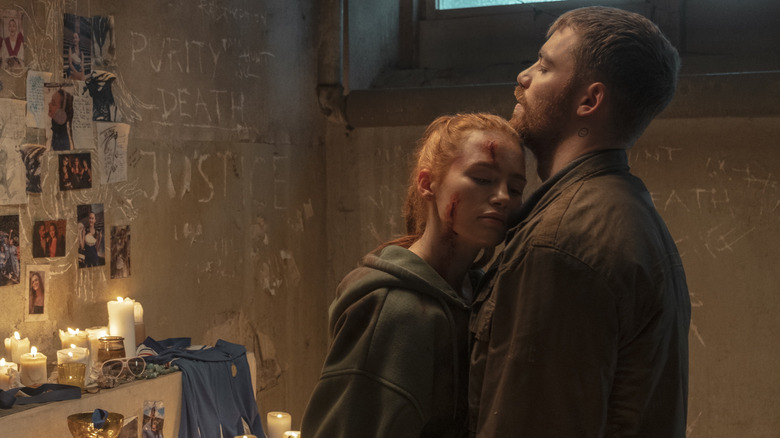
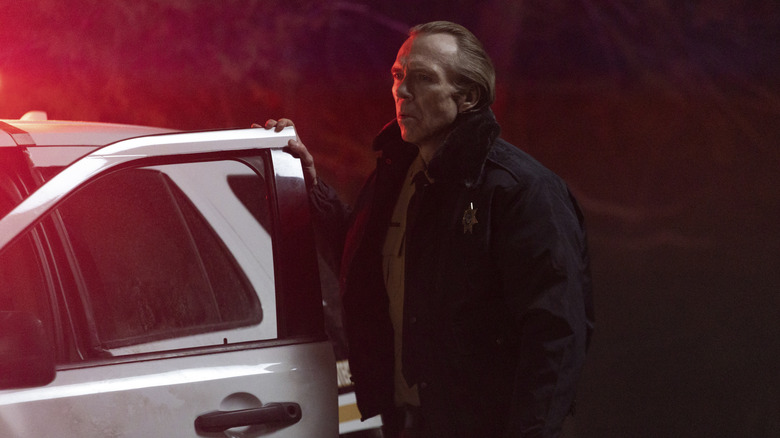
For those of you who need a quick recap, "The Strangers: Chapter 2" ended with Maya managing to successfully kill one of the three Strangers — Pin-Up Girl (Ema Horvath) — after evading their wrath once again. However, more crucial to this latest saga is the newly invented backstory for the masked killers, whose reign of terror began all the way back in elementary school as the soon-to-be Pin-Up Girl killed a classmate she was jealous was spending too much time with her crush. Here, we learn that despite the high-profile nature of that case, its seemingly random nature allowed the kids (a young Scarecrow was her accomplice) to avoid any particularly gnarly consequences, which meant nothing deterred them from doing it again. And did I mention Scarecrow's father is Sheriff Rotter (Richard Brake), who seems adamant to protect his son and cover up his killing spree, even as it's finally on the cusp of being investigated by higher law enforcement agencies from out of town?
Far too much time is dedicated to filling in the blanks of the backstory, which is the main reason why this final chapter is so frustrating. "The Strangers" is now unambiguously a story directly linked to police abuses of power, and a long-running conspiracy designed to keep a group of masked killers from facing justice. Nobody involved with the production seems to recognize that a story about corruption on this scale would lead to weightier dramatic stakes, nor seems to have anticipated how a deeper exploration of this would have resonated in a year so far dominated by law enforcement abuses of power in the headlines. Instead, it's a mere subplot within a story already lacking a concise dramatic hook, an afterthought even next to the central protagonist's journey which has barely been thought through to begin with.
The film is completely anticlimactic
The main thing added to the trilogy during reshoots was the overarching backstory for the Strangers, which was my biggest criticism of the previous chapter; it was a flavor of slasher villain origin story we've seen countless times before. Having now seen the trilogy's conclusion, I'm frustrated for the opposite reason, as their lifelong reign of terror that began in their earliest school days has far more dramatic weight to offer, but hasn't been given the space to drive narrative momentum because, well, it wasn't originally designed to even be there. Incorporating it has added more intrigue to this trilogy closer, but also makes it frustrating in a way it wouldn't have been otherwise — although, if I'm being honest, a frustrating missed opportunity in this current iteration is better than the boring anticlimax it would have been if it was never brought to the table, as first planned.
The sequel effectively teased that Maya's psychology would increasingly blur the lines between good and evil, her desire to avenge her boyfriend killed in "The Strangers: Chapter 1" leading her to commit acts out of sheer desperation that the Strangers do for fun. The finale of the preceding film set the stage for her ultimate mental breakdown, as her morals began to become compromised since no other option was available to help her survive — she had to play her aggressors at their own game and hope for the best.
As heavily teased in the marketing, her murder of Pin-Up Girl has impressed the killers enough for them to afford her a mask, pausing their pursuit to instead cautiously welcome her into the fold as they terrorize more innocent visitors to the town. But the full circle moment where Maya "breaks bad" never materializes, as the movie ensures she remains at a conscious remove from the moment she's asked to take over her victim from the previous film's identity. This means that, rather than forcing her to participate in gratuitous violence and lose her sense of self along the way, the final stretch of her arc is defined by her standing around and passively observing everything happening in front of her, waiting for the right moment to strike back. Director Renny Harlin does his best to maintain the same level of slow-burning dread as he pulled off in the prior film, but it ends up feeling like a mundane, fly on the wall account of the average day at the office for the two surviving killers.
Is "The Strangers: Chapter 3" the weakest of the entire reboot trilogy? Well, it's nowhere near as formulaic as the first (amongst the worst horror remakes of recent memory), an ill-conceived revival so uninspired it forced the creative team back to the drawing board. Instead, it's a more perplexing failure, one where the newfound ambition of the stripped-down sequel has been shrugged off, with nobody quite sure how to satisfactorily close character arcs or explore the surrounding darkness of the world they've created. Is it too late to go back and reshoot "The Strangers: Chapter 2" to make it a stand-alone slasher?
"The Strangers: Chapter 3" is in theaters now.