

5 Fantasy Movies That Created Entire Worlds With Almost No CGI
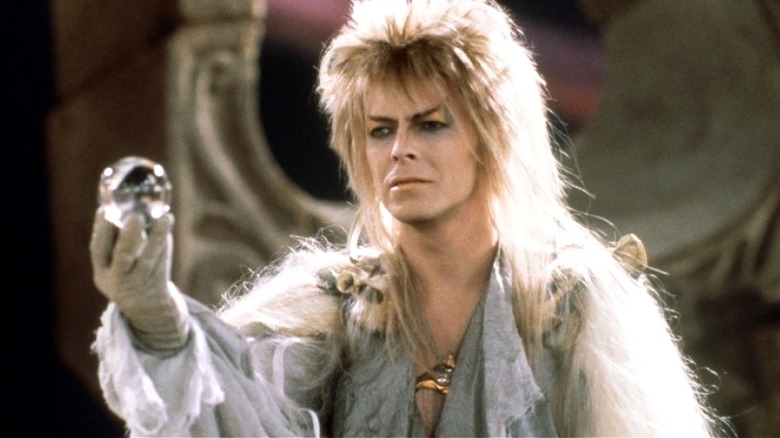
The fantasy genre has long been a part of moviemaking, and the earliest examples of them predate sound. Like its cousin, science fiction, one of the most important aspects of any fantasy film is its world, as this is typically what establishes a story in the genre. Without a fantastical setting, it's not really a fantasy, and modern filmmakers will typically accomplish this via CGI.
There's no denying that CGI has become a massive part of fantasy storytelling in movies today. Director Peter Jackson's better-than-you-remember "The Hobbit" trilogy utilizes a ton of CGI, while his earlier films set in Middle-earth feature it comparatively sparingly. As time passes and technology evolves, CGI becomes a far more desirable method of worldbuilding, as it's less expensive than massive matte paintings, huge sets of miniatures, and other time-intensive means common throughout the 20th century.
Still, there are some movies that came out decades ago that did use CGI in its infancy, yet ensuring that the new technology makes up only a small percentage of VFX shots. These are the films that relied on analog tech to create massive worlds full of fantastic creatures, magic, and more. The use of CGI was revolutionary, but the practical work stands the test of time. Each of the movies here used CGI just a bit, relying primarily on practical effects work to establish their worlds. Our selections are arranged in chronological order of release.
Star Wars
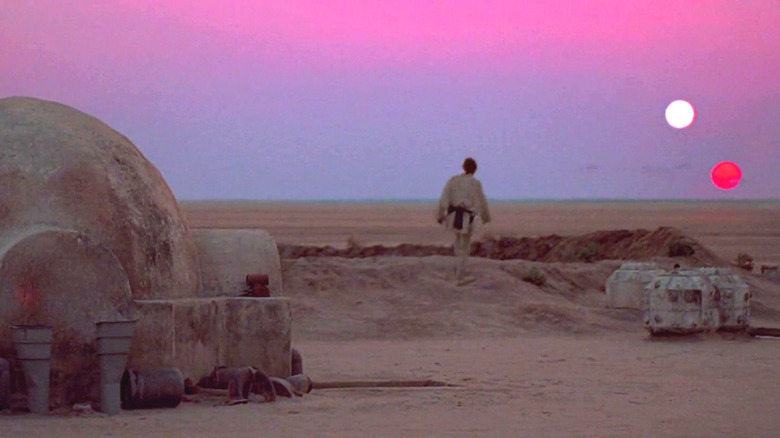
While "Star Wars" is set in space amid alien worlds, it's a fantasy film. The Jedi are wizards, and the Force is akin to magic, placing the franchise firmly into the space fantasy sub-genre. The original film is well known for its impressive practical effects, but despite coming out in 1977, it utilized a tiny bit of CGI that helps establish a pivotal moment in the movie. There's a 40-second scene showing the Death Star, which is one of the first times a three-dimensional object was digitally created for a feature film.
Some of the graphics displayed on screens and in holograms were also rendered on computers by Larry Cuba, but his Death Star clip is the main use of CGI. Everything else was shot practically, using beautifully painted mattes that created whole worlds. Huge formations of Stormtroopers are actually paintings, but watching the film, it's not apparent. Everything blends together seamlessly. It made "Star Wars" a revolutionary film upon release, upping the game for anyone wanting to depict fantastical elements in a movie.
The Death Star trench run, space battles, and vehicle movements all used miniatures and other means. This was also true of all the costumes and creature effects, which director George Lucas altered significantly in his "Special Edition" release. Now he uses CGI extensively, altering the original films beyond many fans' patience, proving that, for most, the practical effects of the 1970s aged far better than the '90s CGI Lucas used to "update" his classic work.
Labyrinth
Jim Henson was the type of director who embraced practical effects, which makes sense for the iconic puppeteer. Still, as digital effects technology improved, Henson embraced it, creating the Henson Digital Puppetry Studio. When it came time to create "Labyrinth," Henson used the nascent digital VFX technology for a single scene. When the film opens, an owl flies about the screen and over a digital labyrinth as the credits roll. The owl is rendered entirely via CGI, which was a significant achievement at the time.
Everything else in "Labyrinth" is shot using traditional practical effects, and there are a lot of them. Being a Henson film, there are plenty of Muppets and similar puppeted effects, but they're blended into their scenery in such a way that they look natural. Some of the scenes in "Labyrinth" are kind of creepy when you look behind the scenes at how they were shot, but in the end, the folks working on the effects managed to create a believable fantasy realm centered around a massive labyrinth.
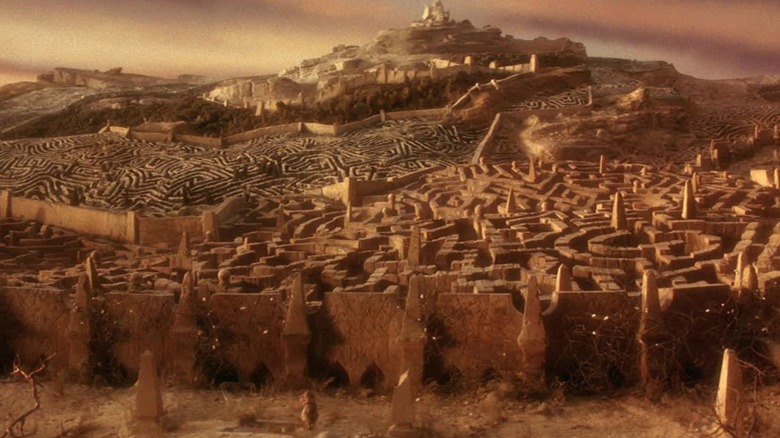
The shots of the scenery, showing Jareth's (David Bowie) castle at the center of the labyrinth (pictured), were achieved via matte paintings. These look absolutely gorgeous despite their age, and the other substitution effects still stand up. The finale, featuring Bowie's "Within You," places Jareth and Sarah (Jennifer Connelly) inside of an M.C. Escher-esque series of staircases. This shot was also accomplished practically, helping the entire project become a beautifully epic fantasy film.
Willow
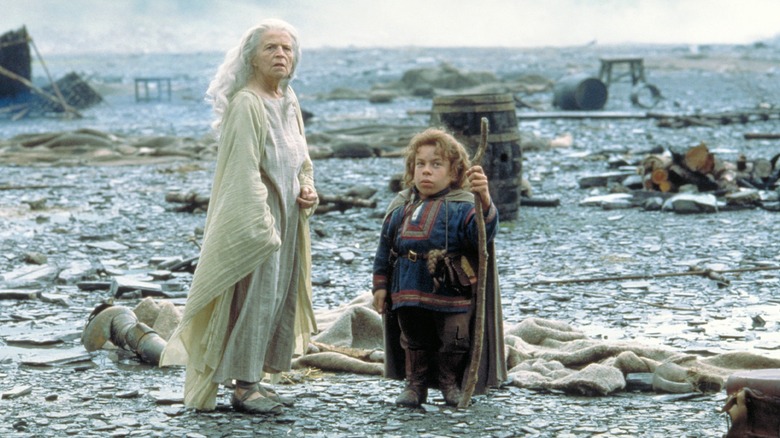
"Willow" is a brilliant fantasy film set in its own world, where dwarves are a race called Nelwyn, and Daikini are the taller humans. Almost everything in the movie is the result of practical effects work, but one scene utilized revolutionary technology in a manner that had yet to be done. In the scene where Willow (Warwick Davis) uses his wand to transform Fin Raziel (Patricia Hayes) from her possum form back to human, he doesn't get it right on the first try. The enchantress' body switches from a possum into various animals before landing on her human form.
This was the first use of advanced photorealistic digital morphing in a feature film, and it's also the only use of CGI in "Willow." The rest of the film relies on matte paintings, substitution effects, stop-motion video, and various other methods to create the film's world. Animatronic characters were also created alongside miniatures and more. The Brownies, Rool (Kevin Pollak), and Franjean (Rick Overton) were shot using blue screen, the precursor to modern green screen technology.
Willow's world is undeniably beautiful and well-established via its practical effects. Still, there's no denying that the film changed the game for digital special effects. By demonstrating a viable means of morphing, the VFX team paved the way for similar techniques in films like "Terminator 2: Judgment Day." While the morphing scene was revolutionary, it's only a moment in an otherwise practical film, one that demonstrated the viability of excellent VFX work in the evolving age of digital tools.
Big Fish
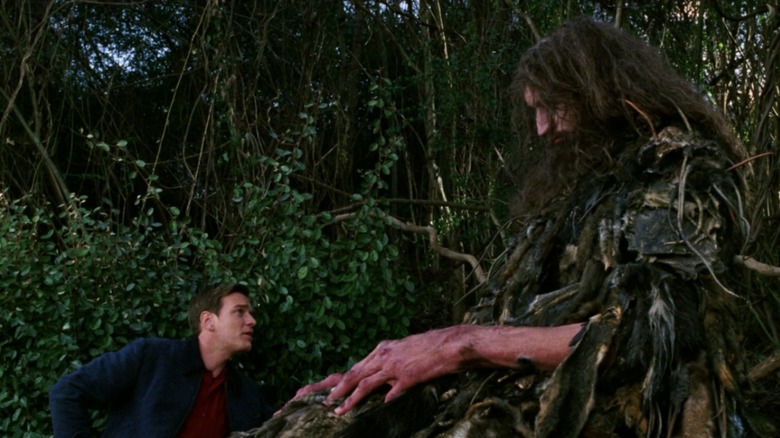
Director Tim Burton has long been a fan of practical effects, though he's certainly used CGI when necessary. His unique style leans heavily into stop motion and other traditional VFX, which is also true of his best film, 2003's "Big Fish." The film tells the story of Edward Bloom (Ewan McGregor and Albert Finney, at various ages), a father who spun tall tales throughout his life, and focuses on the reconciliation between himself and his estranged son. The story is told through a series of vignettes of the past through a fairy tale lens, and each one is visually remarkable.
In terms of CGI effects, these were primarily limited to the depiction of conjoined twins, alongside some impressive costume work. A large fish held by Bloom in one scene is truly just a large, rubber fish prop, so CGI remains sparse in "Big Fish." Some of the film's sets are suggestive of CGI, including a field of daffodils. This could have been rendered in CGI, but instead, Burton wanted it to be real: the crew planted 10,000 silk flowers by hand, instead.
The field looks otherworldly, showcasing its fantastical nature with a relatively ordinary flower. It's the excessive amount of peppy yellow that puts it on par with "The Wizard of Oz's" famous poppy field scene. Even more impressive is the fact that the daffodil sequence is only about two minutes long. Other scenes that appear to be CGI use forced perspective and shorter actor substitution to make Karl the Giant (Matthew McGrory) appear larger than life.
Pan's Labyrinth
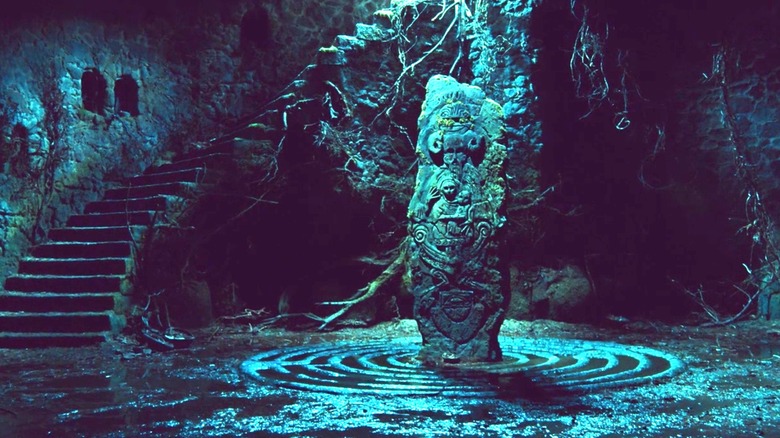
If there's one thing that director Guillermo del Toro leans heavily into in his movies, it's practical effects. His career is filled with spectacular creature designs, monster makeup, and more, as he's preferred to use CGI sparingly in favor of traditional methods. Del Toro has further clarified that he prefers to use CGI only when no practical options are possible. Still, the director has used CGI in several instances, including in "Pan's Labyrinth," widely regarded as one of the best fantasy movies of all time.
Almost all of the creature effects and set designs were created through practical means (including the lanky agility of del Toro regular Doug Jones), save for the giant toad. CGI came into play to enhance some creatures, including the mandrake roots. Outside of CGI, "Pan's Labyrinth" depicts a world that's a frighteningly gorgeous tableau of Francoist Spain during the summer of 1944, largely seen through the eyes of a child. When you look at the various monsters, especially the Pale Man (Jones), it's primarily old-school effects work.
Most of the costume consisted of latex foam, where Jones stood on high lifts, leaving his lower legs exposed and digitally erased in post. You can see how visceral all of the creatures and settings are in "Pan's Labyrinth" because they're real — not created on computers. It's in movies like this that directors weave unforgettable worlds into existence, using CGI only to enhance otherwise impossible tasks. It's especially beautiful in grand fantasy films, proving it's all about how the tools are used in the hands of real artists.