

5 Star Wars Force Powers That Make No Sense
There are probably a few things that come to mind when you think of "Star Wars." Lightsabers, toxic online arguments, and the ever mystical and powerful Force. Ever since "Star Wars" first came out in 1977, audiences have been enraptured with what the Force represents, as it's a cosmic bind that allows Jedi and Sith to access wondrous abilities. Many powerful Force users have been introduced in "Star Wars" over the decades, and occasionally, a new wrinkle in the Force will materialize that raises some questions.
For the most part, the Force makes sense — or, at least, as much sense as anything else in "Star Wars." It's a power anyone can tap into, according to George Lucas, allowing them to perform incredible feats, like pulling a lightsaber toward them without directly touching it or jumping immense lengths. It gives Jedi and Sith superpowers for the most part; but increasingly, the Force has become an end-all, be-all for whenever the plot needs to move in a certain direction. And with certain Force abilities only coming to light in the past few years, it raises questions as to why no Jedi ever performed certain acts earlier.
It may seem counterintuitive to nitpick a franchise with space wizards, but we can only suspend disbelief so much. The Force is supposed to be mysterious, but it should also make relative sense from film to film.
Note: We're strictly looking at canon appearances for these Force usages. The Extended Universe might have more context, but we're not looking at those since they're no longer canon.
Jedi Mind Trick
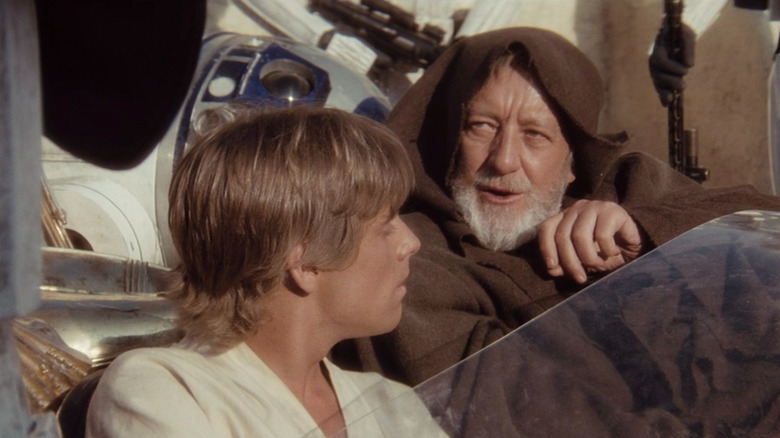
The Jedi mind trick is one of the oldest uses of the Force, dating back to 1977's "Star Wars," later known as "Star Wars: Episode IV — A New Hope." Obi-Wan Kenobi (Alec Guinness) uses it to convince some Stormtroopers that R2-D2 and C-3P0 are not the droids they're looking for. It's a way to influence the thoughts of others, and it's handy to get out of a jam — even if it could come with some awful implications in the "Star Wars" universe. Outside of that, it's nebulous who precisely is impacted by the trick.
It makes sense that a Jedi couldn't use this ability on another Jedi or Sith; they're obviously too powerful and connected to the Force. However, Cad Bane (Corey Burton) is able to resist it to a degree in the animated "Star Wars: The Clone Wars." As a bounty hunter, he's perhaps encountered many Jedi before and could counter it, but then you have Watto (Andy Secombe) in "Star Wars: Episode I — The Phantom Menace." When Qui-Gon Jinn (Liam Neeson) attempts to manipulate him, he proudly proclaims, "I'm a Toydarian. Mind tricks don't work on me. Only money."
Assuming certain alien species, like the Toydarians in Watto's case, are resistant to Jedi mind tricks, why would Qui-Gon even attempt it? The truth is, Qui-Gon needs to fail in his mind trick attempt so that we can get that cool pod-racing sequence. When the plot needs to move along swimmingly, the mind trick is handy to have, but it needs to fail every so often; otherwise, there would hardly be any tension.
Force Ghosts

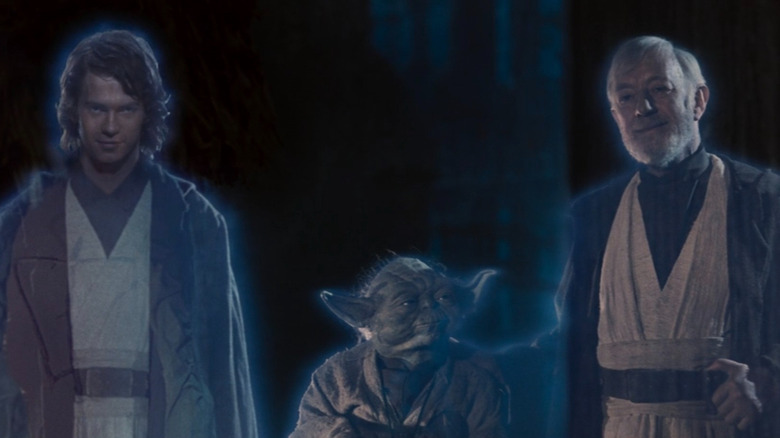
The idea that a Jedi can continue offering guidance to their students even after death is beautiful, in a way. It shows how there's always more to learn, but the mechanics of Force ghosts isn't always clear. At the end of "Star Wars: Episode VI — Return of the Jedi," the ghosts of Obi-Wan, Yoda (Frank Oz), and Anakin (Sebastian Shaw) appear to Luke (Mark Hamill) in the original cut. However, a re-edit swapped out Shaw with Hayden Christensen's version of Anakin, which only raises questions as to why some Jedi appear as they were when they died whereas others can be young again.
There's also the fact that not all Jedi appear to become ghosts. Maybe they do, and we just haven't seen the likes of someone like Shaak Ti return yet. It must require a massive amount of energy and focus to manifest as a ghost, which would explain why they don't pop by for a quick hello more often. We'd also be curious if certain conditions must be met to qualify as a Force ghost. Both Obi-Wan and Yoda fade into nothingness upon their deaths, which could serve as an explanation for how one becomes a ghost. But then you have Qui-Gon Jinn who gets stabbed by Darth Maul (Ray Park), but doesn't disappear, yet he becomes a Force ghost anyway.
"Star Wars: Episode VIII — The Last Jedi" added a confusing wrinkle to this power, too. Ghost Yoda appears to Luke and is able to conjure lightning to destroy the ancient texts. It's one thing for Force ghosts to impart wisdom, but they can also apparently interact with the real world. This feels like a useful thing that could've benefitted living Jedi a lot sooner.
Force Flying
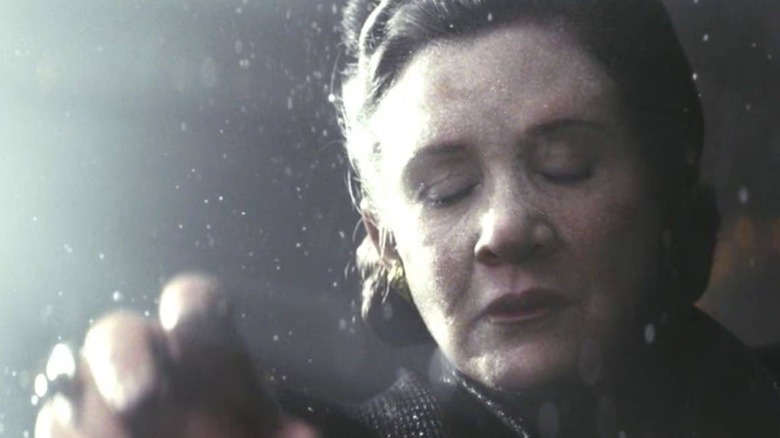
With the Force, Jedi can move at incredible speeds, jump long distances, and lift heavy objects. It's not entirely out of the question that they would be able to fly, too. If they can movie objects through levitation, it stands to reason they could basically do the same for themselves — but we had never seen it before "The Last Jedi." After the First Order blows a hole in the Resistance's ship, Leia (Carrie Fisher) is sucked into space. Anyone watching it for the first time would assume she's a goner, but she then magically flies through the vacuum of space back within the ship's reach, becoming one of the biggest unanswered questions that "Last Jedi" raises.
Leia, as the daughter of Anakin with some light Jedi training, could feasibly wield the Force to an extent. But she's definitely not as advanced in the Force as someone like Mace Windu (Samuel L. Jackson), who gets thrown out of a window by Palpatine (Ian McDiarmid) to his death in "Star Wars: Episode III — Revenge of the Sith." Granted, Anakin just sliced off his arm, so perhaps he couldn't focus enough to fly to safety. Seeing as "Star Wars" is more than happy to bring supposedly dead characters, like Boba Fett (Temuera Morrison) and Palpatine himself, back to life, maybe we'll learn about Mace flying himself to safety in the future.
Despite what Leia accomplished in "The Last Jedi," it's unlikely we'll ever see a Jedi fly again. Since the phrase "they fly now" became a ridiculous meme in the wake of "Star Wars: Episode IX — The Rise of Skywalker," the jokes would write themselves.
Force Healing
Technically, Force healing appears initially in the "Clone Wars" episode "Altar of Mortis" when Ahsoka Tano (Ashley Eckstein) suffers a fatal wound on Mortis, a planet that functions as a conduit for the Force that's inhabited by three gods — the Father, Daughter, and Son. The Daughter uses what's left of her life force to heal Ahsoka's wound to bring her back to life. It's Force healing, but given they're on Mortis and the Daughter's status as a Force god, it makes sense why it could happen under that very niche circumstance.
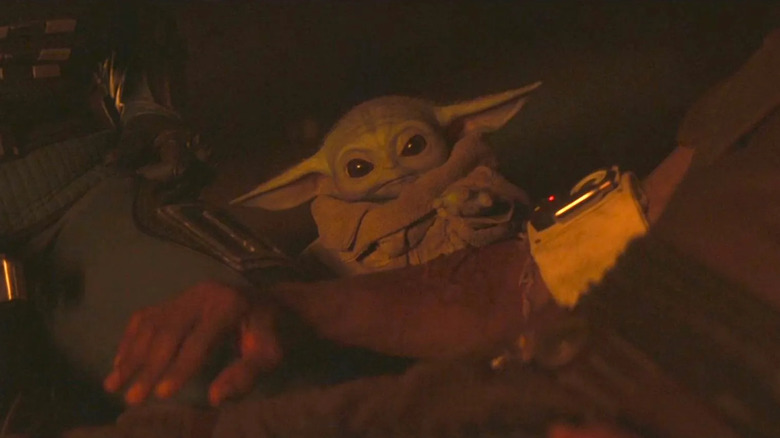
Force healing became much less mythical in December 2019, when two instances manifested for "Star Wars" fans. Grogu heals Greef Karga's (Carl Weathers) arm in "The Mandalorian" episode "Chapter 7: The Reckoning." Then, "The Rise of Skywalker" released in theaters where fans saw Rey (Daisy Ridley) heal both a vexis snake as well as Kylo Ren (Adam Driver). It's a taxing power, though, as Rey literally transfers over some of her very essence to complete this. It's understandable Jedi wouldn't risk their very essence to heal a papercut, but there have been times throughout the franchise where healing someone from certain death could've been in the cards.
For instance, Anakin probably could've used Force healing to save his mother in "Star Wars: Episode II — Attack of the Clones." This could've prevented his descent into the Dark Side; but the Jedi just don't seem to do it all often, which makes it odd if Grogu and Rey, two newbies to the Jedi way, are the first to utilize it, from what we've seen.
Essence Transfer
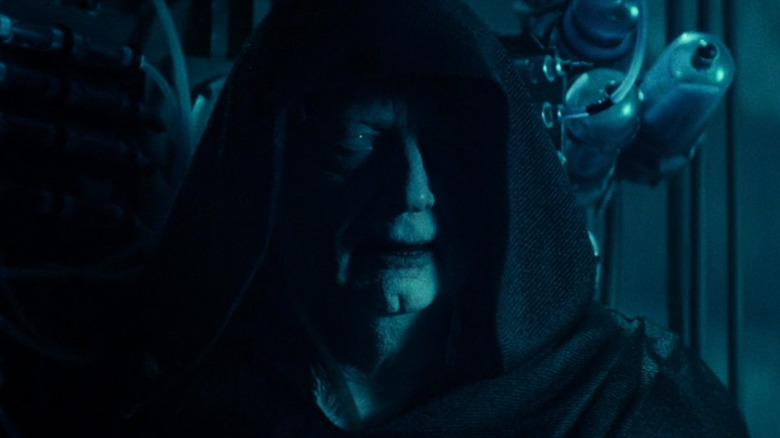
Essence transfer is effectively Force healing on steroids. It's most famous usage came in "The Rise of Skywalker," when Emperor Palpatine somehow returns. We learn that the "somehow" part of this equation is actually an essence transfer, where Palpatine was able to put his consciousness before death into a clone body built on Exegol. He wants to take it a step further by putting his essence into Rey to turn her into a Sith empress and expand his power. This is definitely one of those "unnatural" abilities only a Sith would use that a Jedi would never touch, but it does render death something of a moot point in the "Star Wars" universe.
Much like how we have to wonder why every Jedi doesn't become a ghost, we have to question why every Sith doesn't transfer their essence before death. Honestly, that leads to a terrifying revelation that any Sith who's ever existed could still be out there. A fan-favorite Sith like Darth Bane, who existed centuries before much of "Star Wars" as we know it, could come back if he's been transferring his essence for centuries and interact with newer characters like Rey.
It does seem like Palpatine's gone for good by the end of "Rise of Skywalker." His cultists on Exegol are defeated, and Rey summons the power of every Jedi ever to attack Palpatine, which likely wiped out his essence for good. But it's not like a Jedi has done that every single time they've defeated a Sith. Essence transfer makes for a convenient plot device to bring back whatever Sith creatives want for future "Star Wars" projects, meaning fans are always left questioning if a bad guy is dead permanently.