

'70s Fantasy Movies That Still Look Incredible
Across the history of cinema, fantasy has long remained one of the most popular genres, encompassing far more than your standard sword and sorcery, dragon, and magic-filled worlds. The first fantasy movie is also the first sci-fi film, the 1902 short "A Trip to the Moon" by one of the most influential filmmakers of all time, Georges Méliès. This same variety endured into the 1970s, with movies like "Star Wars" often being labeled as fantasy/sci-fi.
While that's open to debate, there are plenty of '70s fantasy films that are more decidedly labeled as such, and most haven't aged well. Even "Star Wars" got a CGI update, whether fans wanted it or not. That said, the original still looks amazing, though it's not alone. Several '70s fantasy movies continue to look incredible more than five decades after they hit the silver screen.
Some boast a timeless artistic style, while others are technological marvels that stand apart from their contemporaries. Whatever the case, these five movies released between 1970 and '79 are well within the fantasy genre and remain dazzling works of art despite their age. These aren't ranked, but are rather arranged by chronological order of their release dates.
When Dinosaurs Ruled the Earth
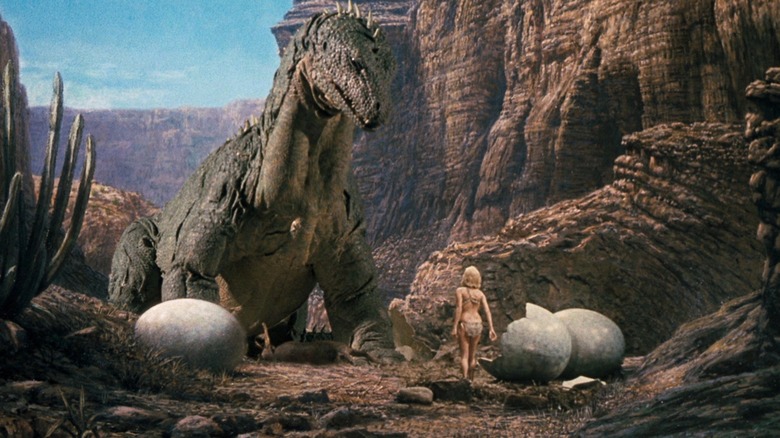
Director Val Guest also wrote the pivotal British fantasy film, "When Dinosaurs Ruled the Earth." The film tells the story of Sanna (Victoria Vetri) from the Cliff Tribe, who is sacrificed alongside two other blonde women to the Sun God Akhoba. She escapes and must survive in a world ruled by dinosaurs. The film is set in the Mesozoic Era, which ended 66 million years ago, so it's filled with all manner of mighty monsters.
The movie came out at a time when our modern understanding of dinosaurs was comparatively limited, so the depictions of the creatures don't align with something you'd see in the latest "Jurassic World" film. Regardless, the special effects were done brilliantly by Jim Danforth, who earned an Academy Award nomination for best special visual effects. He and his team employed several techniques, including stop-motion animation, split-screen rear projection, and matte paintings, to integrate the human actors with their animated counterparts.
Danforth worked as the 2nd Unit Director, meaning he helmed every scene that utilized stop motion animation, as well as a few that didn't. Looking at the film today, it's hard to imagine how it must have been to see it in theaters when it was released in 1970. The animation blends seamlessly with the live-action shots, and every dinosaur or otherwise massive beast features extraordinary detail, making it seem implausible that "When Dinosaurs Ruled the Earth" didn't win an Oscar.
Bedknobs and Broomsticks
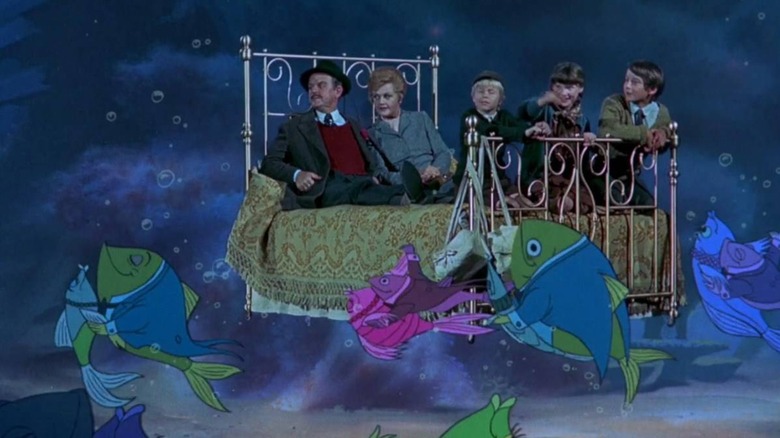
"Bedknobs and Broomsticks" ranks among Angela Lansbury's best films, telling a classic story that blends animation with live-action, not too unlike Disney's earlier effort "Mary Poppins." It tells the story of an apprentice witch (Lansbury), three children, and a magical conman (David Tomlinson) who travel about the world looking for a final piece of a spell. Their driving purpose is to save Great Britain during World War II, so there's an odd mix of Nazis, knights, and animated animals.
To combine 2D traditional cel animation with live-action, the special effects team utilized a sodium vapor screen, the precursor to blue or green screen that was instead yellow. There was also a heavy use of puppetry employing wirework, and these two techniques helped animate the flying bed upon which the live-action characters travel. These methods placed the actors into fully animated environments, making it appear as if they were truly inside of them.
Viewers would see similar techniques employed in other movies of the decade and evolve with those that came later, such as "Who Framed Roger Rabbit?" and "Space Jam." When it came to awards season, "Bedknobs and Broomsticks" beat out "When Dinosaurs Ruled the Earth" for the Academy Award for best special visual effects.
Willy Wonka & the Chocolate Factory
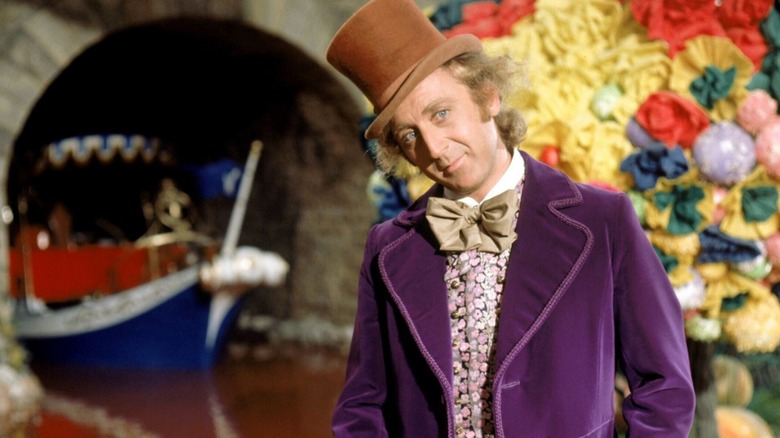
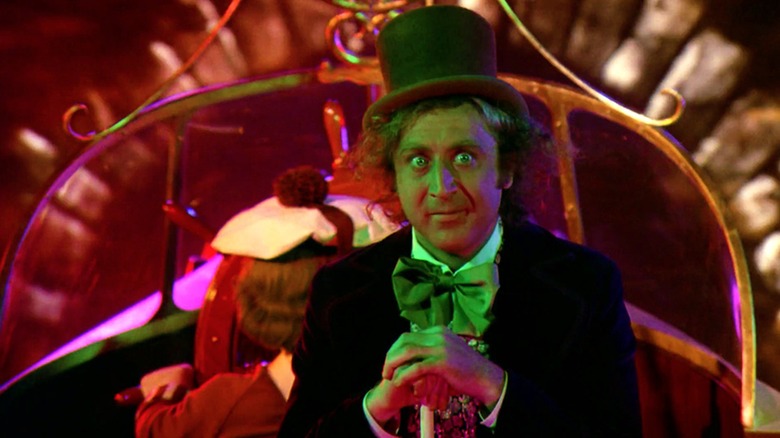
Of the many fantasy films released in the 1970s, the one with the most staying power is "Willy Wonka & the Chocolate Factory." An adaptation of Roald Dahl's 1964 book, it stars Gene Wilder as the titular chocolatier. While the film differs from the source material in several ways, it remains an enduring classic on its own. In it, Charlie Bucket (Peter Ostrum) wins the last golden ticket and tours Willy Wonka's chocolate factory alongside several spoiled kids who successively succumb to their distinct vices.
The film features numerous special effects shots and plenty of world-building around some fantastic set and costume design. There's a lot to look at and fall in love with during every re-watch, as well as moments to be disturbed by. Perhaps the crown jewel of creepiness is the boat ride scene. It's haunting in the weirdest way, with Wilder reciting his lines to his child co-stars without preparing them in the slightest, making their fear and anxiety all the more palpable.
The sequence was accomplished through a simple combination of colored lighting, creepy sound design, and disturbing rear-projected imagery and footage, including a chicken getting its head cut off. Considering the overall tone of the movie, the scene shouldn't work as well as it does, but it remains frightening to many viewers. All of these elements came together to produce an amazing fantasy film that continues to entertain generations of viewers.
The Golden Voyage of Sinbad
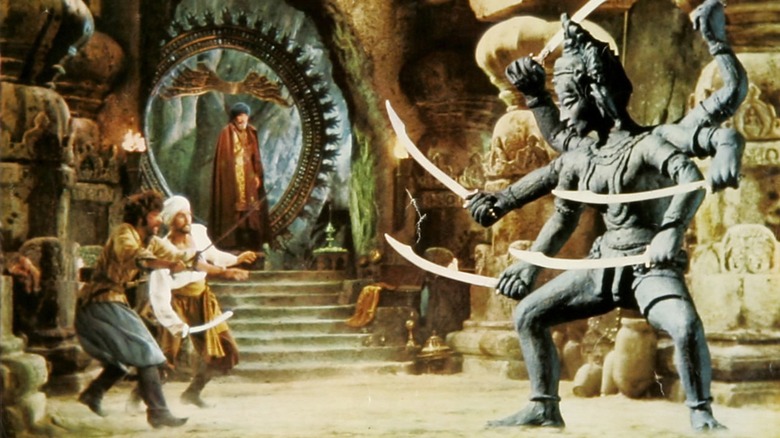
If you know anything about the history of special effects, there's little doubt you know the name Ray Harryhausen. The inimitable artist pioneered his process of Dynamation, fashioning some of the most spectacular stop-motion animated sequences of the 20th century. "The Golden Voyage of Sinbad" is the spiritual sequel to his equally impressive "The 7th Voyage of Sinbad," continuing the story of the titular sailor (John Phillip Law) as he seeks three tablets to gain access to the Oracle of All Knowledge.
The film features many of Harryhausen's best special effects moments, including a battle between a griffin and centaur, and a face-off against a living ship figurehead. The movie's crowning visual achievement is a fight between an animated statue of the Hindu goddess Kali and a group of men. The battle stretches for nearly four minutes as the stop motion statue wields six swords against the live-action actors who blend seamlessly. Everything about the fight is a masterclass in '70s special effects.
Other VFX elements utilized designed sets, miniatures, and matte paintings to build the film's fantastical elements. Miniatures were combined with life-size recreations, including a fully reconstructed ship's deck. The sheer richness of the art direction and design in "The Golden Voyage of Sinbad" makes it a standout that still wows over 50 years later. It won best fantasy and best stop motion animation from the Academy of Science Fiction, Fantasy & Horror Films.
Pete's Dragon
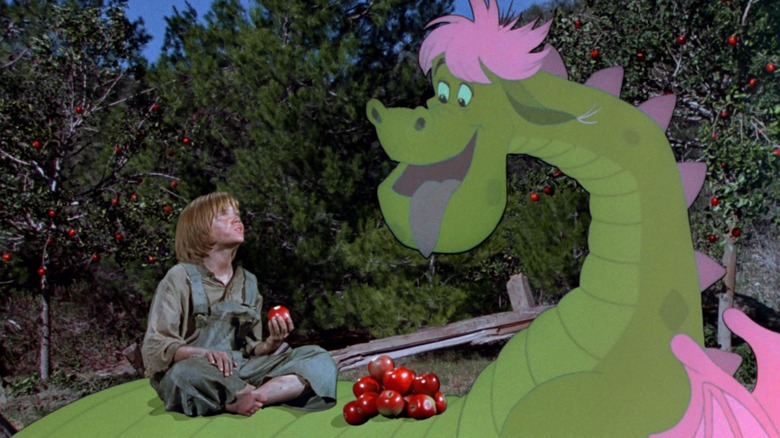
"Pete's Dragon" is another Disney musical blending live-action with animation, featuring starkly contrasted visuals in a familiar setting. The movie tells the story of an orphan named Pete (Sean Marshall) who escapes from his abusive foster family, thanks to an oft-invisible dragon named Elliott. Pete settles in the town of Passamaquoddy, Maine, where he attends school, meets all manner of interesting people, and goes on various misadventures alongside his green scaly friend.
While "Pete's Dragon" is a beloved classic, it suffers from pacing issues. This isn't a problem for its 2016 remake, which eschewed the prior blend of traditional 2D cel animation with live-action for CGI FX. While this worked well enough, the original animation and live-action interactions are still visually stunning. Elliott's personality shines through far better in traditional animation than it does in CGI, which is one of the reasons fans still enjoy the OG "Pete's Dragon."
Veteran animator Don Bluth led the film's animation sequences and personally drew the first and last drawings from each scene. While Disney had previously merged the two mediums in films like "Mary Poppins" and "Bedknobs and Broomsticks," "Pete's Dragon" differs as it includes an animated character within a live-action movie. Elliott stands out as the film's sole animated figure, instantly instilling the dragon with a sense of charm.