

Franco Nero's Strangest Spaghetti Western Is Streaming For Free
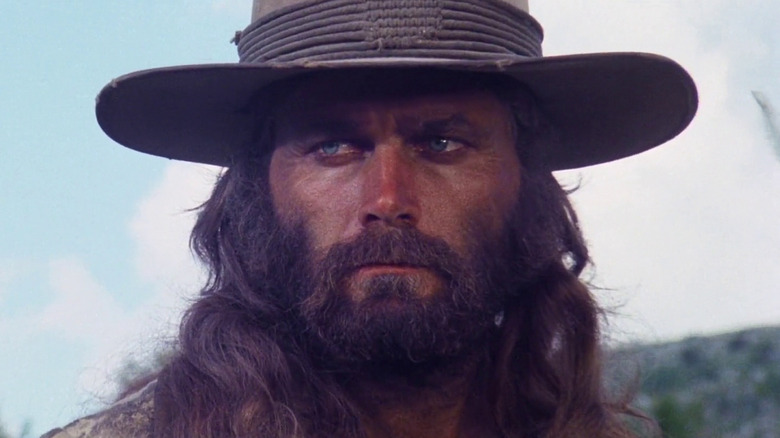
Enzo Castellari's 1976 film "Keoma," which is available to watch for free on Plex, Tubi, and Pluto TV, isn't your typical spaghetti Western. It may incorporate many quintessential elements of the genre — first and foremost, Franco Nero's tragic gunslinger — but it does so in a way that's often surreal and allegorical. It took a different approach to its contemporaries, which perhaps isn't surprising when you consider that the genre's popularity was already declining in the '70s (the film arrived a decade after Sergio Corbucci's "Django," which is also streaming for free, and Sergio Leone's Dollar Trilogy starring Clint Eastwood), so fresh ideas were needed. In retrospect, "Keoma" can be heralded as one of the best twilight spaghetti Westerns, but its initial reception wasn't exempt from controversy.
One of the main talking points was Guido and Maurizio De Angelis's unconventional score, which contained a vocal track and English lyrics that served as narration: While some enjoyed the originality, others found it insufferable. Admittedly, Nero had a hand in that since he told the brothers he wanted something very Leonard Cohen-esque (deeply obscure and melancholic), and they certainly delivered on his request. But as divisive as it might be, it's hard to debate that the soundtrack created a poignant mood for the picture, effectively underlining its main themes of racism, identity, and redemption, among others.
Castellari has also been accused of relying too much on cinematic techniques such as slow motion, excessive use of close-ups, and panning shots, some of which were innovative at the time. Looking back, however, all those creative choices contributed to turning "Keoma" into a cult classic, heavily influencing a long line of filmmakers (Quentin Tarantino has always been a huge fan of Castellari's work), and giving us one of the most peculiar Westerns to ever come out of Italy.
The return of a mixed-race prodigal son
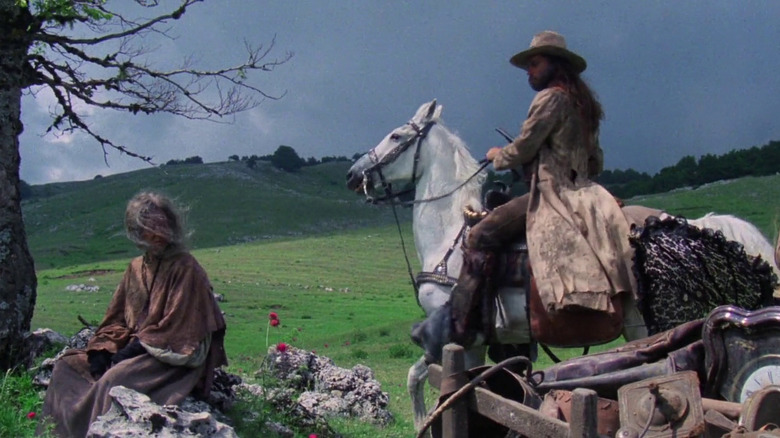
Keoma Shannon (Franco Nero), a half-Indian and half-white ex-Union soldier, returns to his dilapidated hometown after the Civil War, where an ominous plague of some kind runs rampant. He's accompanied by an eldritch witch who follows him around like a bad omen, even though she claims to have saved him as a child when his tribe was massacred. The town is now ruled by a tyrant named Caldwell (Donald O'Brien), who forced the sick into concentration camps and forbade anyone from leaving the place unless they were dying. His help is Keoma's three racist brothers, William (William Berger), Lenny (Antonio Marsina), and Sam (Joshua Sinclair), who viciously despised and bullied him for his "low blood" growing up.
After saving a pregnant woman from Caldwell's henchmen, Keoma encounters an old friend, George (Woody Strode), who now lives as the town's homeless drunk. He tells him about the ruin Caldwell brought on them, and how his siblings became ruthless accomplices. After visiting his father (Orso Maria Guerrini), Keoma decides to confront his brothers and bring an end to Caldwell's reign, no matter how much blood he has to spill to free his home and save the good people in it.
Underneath the disquieting plot, the dominant through line in "Keoma" is evidently the character's search for identity. He wanders through his hometown like a lost child looking for pieces of himself. Via meticulously placed flashbacks, we slowly learn about his troubled upbringing, riddled with hate and trauma because of what he is. Only ever loved by his father and George (another outcast for being a Black man), he clings to those fractions of love, which prove potent enough to die for.
An unusually emotional reckoning for a Western
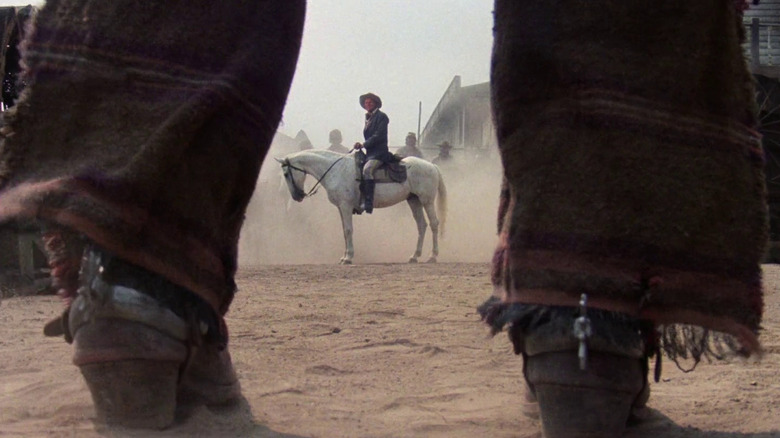
Although shot mainly in Italy and Spain like most spaghetti Westerns, the hopelessly dire and desolate atmosphere of "Keoma" makes the film seem like it takes place in a world of its own. Destruction, brutality, and greed are everywhere in this place, and Franco Nero (with his long hair, dishevelled beard, and rugged clothes) is more mysterious warrior than cowboy. It's all by design: Enzo Castellari and Nero shared a vision for how the film should look before they even had a script to work from, putting an emphasis on evocative images over dialogue and trusting the viewer to translate them into powerful emotions.
The musical narration can be a bit on-the-nose at times, but it's useful when it comes to piecing together the backstory and helps us understand Keoma's feelings. Not that Nero needs assistance: After spending a decade on the screen as one of the most iconic faces of the genre, he's at the height of his powers here. In complete control, he carefully flits between fierce, brooding, and utterly charismatic as the story demands, delivering a performance that surprisingly ends up playing more on the heartstrings than our other senses.
Sure, "Keoma" doesn't hold back on action and brutality (its second half unleashes a plethora of gunfights and killings), but it's the titular character's emotional depth and relentless fight for freedom that stay with us the most in the end. His final line — "A man who's free never dies," famously borrowed from Nero's friend, author Clair Huffaker — before he rides into the endless prairies of the Apennine Mountains leaves us with a sense of pathos, a beautiful yet defiant final moment in what is one of the most criminally underrated Westerns of its era.