

All 9 Quentin Tarantino Movies, Ranked By Box Office

Quentin Tarantino isn't just a director or a guy whose comments on matters like Paul Dano's acting chops can break the internet. He's also become, over 30+ years in the filmmaking community, an institution whose every word and artistic move can inspire reverence, controversy, apathy, and every other emotion under the sun. Online film nerd domains salivate over every situation related to this man, whether it's Quentin Tarantino's alleged obsession with feet or his explanations of the finer intricacies of his various movies. You can't escape this guy's influence, for better and for worse.
His greatest lasting legacy, though, is the nine movies he's written and directed. From "Pulp Fiction" to "Django Unchained," Tarantino's motion pictures are what really drive his pop culture reputation. An insightful way to break down the varying levels of cultural impact his works have achieved is by ranking Tarantino's directorial efforts from lowest to highest grossing at the worldwide box office. Engaging in this exercise reaffirms the truth that not even Tarantino can make audiences rush out for just any kind of film. However, it also reinforces that his enduring appeal has propelled some very unorthodox movies to unexpected financial heights. The complexities of Quentin Tarantino's legacy are exemplified within this box office ranking. Grab yourself a Royale with cheese and dive into those nuances.
One note: the two "Kill Bill" movies, since they're considered a single motion picture by Tarantino, have their worldwide grosses combined for the purposes of this list.
9. Reservoir Dogs

Not every massive filmmaker immediately starts as a box office powerhouse. Even Steven Spielberg had humble box office beginnings with "The Sugarland Express" before "Jaws" changed everything. Quentin Tarantino followed this template to a tee with "Reservoir Dogs," his grimy 1992 indie movie that forever changed how people heard the song "Stuck in the Middle with You." In its initial theatrical run, this project grossed only $2.99 million worldwide. Almost all of that came from its $2.83 million domestic cume. That's a genuinely solid haul given that the feature never played in more than 61 North American theaters.
Plus, this tiny indie only cost $1.2 million to make. The early 90s were dominated by excessive budgets that redefined just how costly motion pictures could be. Something like "Reservoir Dogs" striking a chord with global arthouse moviegoers showed that you didn't need countless zeroes at the end of a movie's budget to make it a success. Plus, "Reservoir Dogs" outgrossed several 1992 movies domestically with significantly more theaters and marketing money at their disposal, like "Newsies" or "Mom and Dad Save the World."
With this feature, Tarantino established his distinctive creative voice and proved that there were more people out there who clicked with his idiosyncratic sensibilities. It wouldn't be long before both the cultural reach and box office numbers for his projects substantially ballooned from the days of "Reservoir Dogs." You've got to start somewhere as a filmmaker, and this was as fine a launchpad as any.
8. Grindhouse

If there's ever been anything in Tarantino's career that counts as an outright "flop," it's 2007's "Grindhouse." This unique feature saw Miramax's two genre movie specialists, Tarantino and Robert Rodriguez, uniting to each deliver one half of a double feature paying homage to classic B-movies. Rodriguez helmed the zombie feature "Planet Terror," while Tarantino was in charge of "Death Proof," the latter of which starred Kurt Russell as a killer stunt driver. This audacious entity ran 191 minutes and also came with a slew of fake movie trailers for titles like "Machete" and "Thanksgiving." While it offered plenty of bang for one's buck, general audiences also weren't very familiar with the "grindhouse" tradition this whole enterprise was a tribute to.
Thus, "Grindhouse" immediately cratered over its April 2007 opening weekend. Grossing only $50.18 million worldwide on a $53 million budget, this endeavor made significantly less than usual for typical Tarantino titles or pre-2010 Rodriguez movies. In hindsight, Tarantino has claimed the project was just inaccessible to the mainstream public. Rodriguez, meanwhile, has alleged that Harvey Weinstein (whose studio, The Weinstein Company, released "Grindhouse") sabotaged the "Grindhouse" marketing campaign because "Planet Terror" starred Rose McGowan, whom Weinstein allegedly previously sexually assaulted.
Whatever led to this project capsizing, "Grindhouse" is the only Quentin Tarantino directorial effort to make under $74 million worldwide since the release of "Reservoir Dogs." Sometimes big swings just don't connect with the ball. That certainly happened with the financial disaster, albeit critically acclaimed, "Grindhouse."
7. Jackie Brown
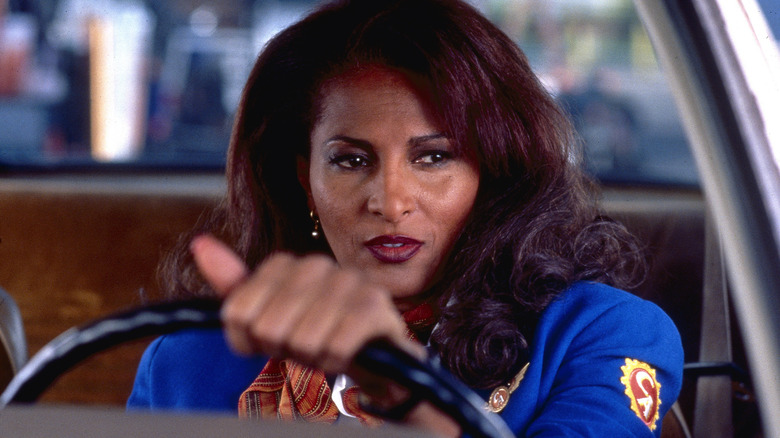
Quentin Tarantino's big follow-up to "Pulp Fiction" was 1997's "Jackie Brown," an adaptation of Elmore Leonard's 1992 novel "Rum Punch" and an homage to blaxploitation films. The latter element was apparent in "Jackie Brown's" leading lady, "Coffy" star Pam Grier, while Samuel L. Jackson, Robert De Niro, Robert Forster, and more rounded out the ensemble cast. Today, the movie has garnered a reputation as being one of Tarantino's strongest works, an exemplary film with a richly human center in addition to providing so much gripping entertainment. Its tremendously precise visual and pacing sensibilities have also earned widespread adulation.
However, back in 1997, "Jackie Brown" was burdened by an underwhelming box office run. Coming hot off "Pulp Fiction," which cleared $200+ million globally, "Brown" had a more muted financial run that only reached $74.72 million worldwide. Granted, on a $12 million budget, the feature was already profitable just from its $39.67 million domestic haul. Still, expectations were higher that Tarantino's newfound fame could propel anything he touched to greater box office numbers. However, the smaller-scale "Jackie Brown" was overshadowed by flashier titles like "Titanic," "As Good As It Gets," and fellow Miramax title "Scream 2" as the go-to adult-skewing movie of December 1997. Luckily, "Jackie Brown" stuck around in the cultural conversation for decades after that box office run wound down.
6. The Hateful Eight

Since 2009, all but one of Tarantino's directorial efforts have cleared $300+ million worldwide. Global hits like "Django Unchained" and "Once Upon a Time...in Hollywood" reflect how far Tarantino's come from being an unknown kid at the 1992 Sundance Film Festival. However, that doesn't mean everything he's touched as a filmmaker in recent years has turned into box office gold. The one financial exception among his post-2007 motion pictures is his 2015 feature "The Hateful Eight," a darker western confined largely just to one cabin and featuring a cast eschewing movie stars like Brad Pitt and Leonardo DiCaprio.
This $62 million budgeted feature only grossed $54.11 million domestically, while its worldwide box office reached $151.81 million. While that does mean "The Hateful Eight" did 2.5 times its budget worldwide, it also did less than half of what "Inglourious Basterds" and "Django Unchained" made across the globe. Part of the problem may have been The Weinstein Company constantly shifting when "The Hateful Eight" would enter a typical wide theatrical release. For his part, Tarantino thinks Disney set "The Hateful Eight" up at the box office by depriving the feature of any Cinerama Dome screenings (Disney procured the space for "Star Wars: The Force Awakens" in late December 2015).
Whatever went on here, "The Hateful Eight" fell short of box office expectations. Still, getting a feature this relentlessly bleak and un-mainstream to $151 million worldwide still speaks highly of Tarantino's post-2007 cultural cache.
5. Pulp Fiction

Right away, the $8 million budgeted "Pulp Fiction" established itself as a wondrous box office phenomenon. Debuting atop the domestic box office in its first two weekends of release, "Pulp Fiction's" first three days of domestic business were already more than triple the lifetime gross of "Reservoir Dogs." From there, the feature never experienced a weekend-to-weekend decline larger than 32% for its first seven weekends of release. It even went up 8% over Thanksgiving 1994, nearly two months into its run. People couldn't get enough of this motion picture and its wildly unique, non-linear spirit. There had truly never been a movie like this before, and audiences showed up in droves to see it.
Five months into its North American run, "Pulp Fiction" was still scoring $2+ million weekend grosses, which ensured it cleared $100 million in this country in early April 1995. Eventually, "Pulp Fiction" grossed $107.92 million domestically, enough to make it the 10th biggest movie of 1994 in North America, ahead of significantly more expensive titles like "Maverick," "The Client," and "Star Trek: Generations." Worldwide, this project amassed $212.88 million, a sign that it wasn't just Americans who couldn't get enough of this grim outing.
"Pulp Fiction" was ridiculously profitable on its minuscule price tag, and it ensured Tarantino would be directing further movies for years to come. Sometimes, it takes a while for these Earth-shattering hits to materialize. Others, like "Pulp Fiction," are game-changing box office smashes right from the get-go.
4. Inglourious Basterds

After "Grindhouse" flopped, there was a lot riding on 2009's "Inglourious Basterds" to reaffirm that Tarantino was still capable of drawing in a hefty crowd at movie theaters. This time around, Tarantino embraced a more accessible premise: Nazi hunters pursuing Adolf Hitler and other fascists in World War II. That was a lot more digestible to the general public than a Byzantine 70s B-movie homage. "Basterds" had another advantage in starring not a famous actor from the 70s, but Brad Pitt. In the late 2000s, Pitt was on a hot streak thanks to box office hits like "Ocean's Thirteen," "The Curious Case of Benjamin Button," and "Mr. and Mrs. Smith." Putting him in a crowd-pleaser Tarantino film as the character Lt. Aldo Raine was a recipe for financial success.
All memories of "Grindhouse" flopping instantly vanished once "Basterds" touched down into theaters. Grossing almost $38 million over its first weekend, "Basterds" performed more like a summer blockbuster than a film that later scored countless Academy Award nominations. It eventually grossed $120 million in North America alone, an impressive sum that meant "Pulp Fiction" was no longer Tarantino's biggest movie ever in this territory. Impressively, "Basterds" grossed $316.8 million worldwide, a testament to how globally appealing its European period piece setting was.
With "Inglourious Basterds," the war to prove Tarantino's box office viability had been firmly won. That's what happens when you follow up your biggest flop with the highest-grossing (up to that point) title of your career.
3. Kill Bill

Six years after "Jackie Brown," Quentin Tarantino returned to the director's chair for an expansive directorial effort that paid homage to classic martial arts movies and all kinds of vintage pop culture. This was the "Kill Bill" saga, which was a collaboration between Tarantino and the film's leading lady, Uma Thurman, who was never the same after the films. This lengthy effort was shot as one motion picture, but eventually released in two volumes in October 2003 and April 2004. Whenever Quentin Tarantino's been asked whether "Kill Bill" is one movie or two, though, he's been adamant that this enterprise is a single motion picture experience. Financial and marketing pressures haven't diluted his passion for "Kill Bill" being solely his fourth directorial effort.
The combined worldwide grosses of the two "Kill Bill" volumes was $334 million, with "Volume 1" taking in $176.46 million globally and "Volume 2" amassing $153.53 million. After "Jackie Brown" didn't quite hit lofty box office expectations, the "Kill Bill" movies were lucrative reminders of Tarantino's global appeal, with "Volume 1" even coming close to matching "Pulp Fiction's" worldwide gross. Containing plenty of action and suspenseful set pieces, the "Kill Bill" installments delivered plenty of spectacle that moviegoers fell head over heels for.
The enduring appeal of this revenge saga was reaffirmed in December 2025 when "Kill Bill: The Bloody Affair," a 270+ minute cut combining both "Volumes," grossed a robust $3.4 million on opening weekend. The Bride's box office mojo is just never-ending.
2. Once Upon a Time...in Hollywood
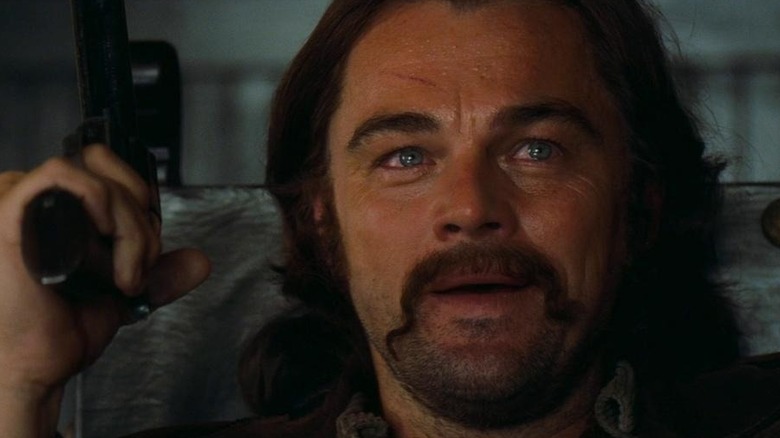
Believe it or not, "Once Upon a Time...in Hollywood" was the first Quentin Tarantino directorial effort to be released in North America by one of the major movie studios. Before this, a pair of Harvey Weinstein-run indie studios (Miramax and The Weinstein Company) had been the exclusive domestic release home for Tarantino's various works, dating back to the days of "Reservoir Dogs." Sony/Columbia Pictures, though, controlled the release of "Once Upon a Time...in Hollywood" following Weinstein's endless allegations and The Weinstein Company's collapse. Securing the marketing muscle of a major studio, not to mention the star power of Leonardo DiCaprio, Brad Pitt, and Margot Robbie, propelled "Once Upon a Time...in Hollywood" to impressive box office heights.
Released in late July 2019, "Once Upon a Time...in Hollywood" had no problem competing against that month's other newcomers like "Spider-Man: Far from Home" and "The Lion King," as seen by its outstanding $142.5 million domestic haul. Throw in another $234.92 million internationally, and this 60s period piece drummed up a mighty $377.42 million worldwide. Tarantino's esteemed reputation no doubt helped "Hollywood," but other factors, like this being DiCaprio's first movie since he won his first Oscar for "The Revenant," also doubtlessly aided its financial victories.
In the years following its release, Quentin Tarantino has landed on "Once Upon a Time...in Hollywood" as his best movie. Audiences also clearly felt immense fondness for this project, given how lucrative it was in a moviegoing season dominated by CG-heavy blockbusters.
1. Django Unchained
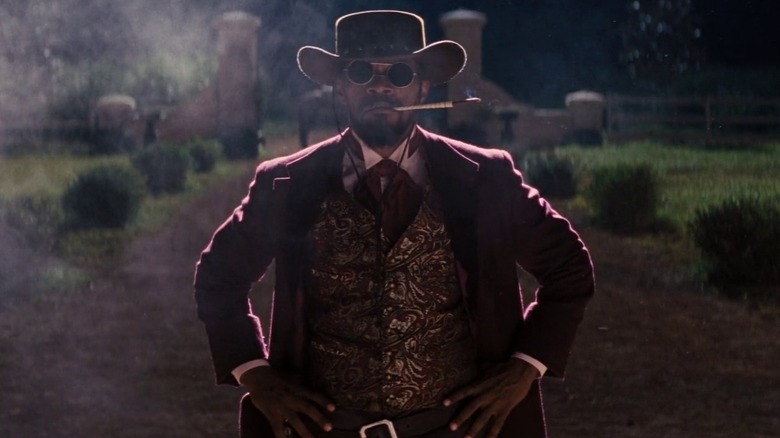
For years, Hollywood has clung to a warped perception that movies with Black leads simply don't make much money overseas. It's a ridiculous notion that nonetheless persists in the global film industry and has hindered the worldwide theatrical rollout of countless movies over the years, including "Sorry to Bother You." Among the many movies disproving this myth is "Django Unchained," a 2012 motion picture that was partially inspired by Quentin Tarantino going on a shopping spree in Japan. This feature starred Jamie Foxx as the titular Django, a slave who becomes a bounty hunter to rescue his captive wife. In his quest, he encounters and kills many white slave owners in a searing depiction of the mid-19th-century American South.
Released on Christmas Day 2012, "Django Unchained" was a massive hit domestically, grossing $162.8 million in this country alone. By far Tarantino's biggest movie in North America, it's also his only title to secure $150+ million in this territory. "Django Unchained" was also a smash overseas with a massive $287.03 million cume for a $449.84 million worldwide haul. That put "Django Unchained's" gross comfortably ahead of white-led 2012 movies like "Prometheus," "Snow White and the Huntsman," and "Les Misérables."
Even on a $100 million budget, "Django Unchained" was a tremendously profitable exercise that also became Tarantino's box office high point. It vividly and lucratively capsizing the idea that Black-led movies can't turn a profit overseas is just the cherry on top.