

10 Actors Who Became Famous After One Scene
Despite how easy it might look, acting is hard work, often requiring maddening repetition over long days of shooting mere moments of screen time. The finished product that arrives in movie theaters is polished and shows little of what actually went into making it, and this is especially true of a film's most noteworthy scenes. Whether an actor has to deliver an impassioned monologue or work through one long take, most bring their A-game, and the viewers notice.
Scenes that don't come around often are the ones that elevate an actor to fame and fortune. These are the scenes where a new actor comes onto the scene. It could be their introductory moment in a film, or it could be a significant focus much later. Regardless of where the scene falls, it's one that sticks out in the minds of viewers. This can happen to a complete newcomer who killed it in their first movie, or it can happen to a seasoned television or theater veteran who's only recently taken up film.
Even more uncommon is the actor with a long career and not much notice, only to finally have that one scene that makes them a star. There are many different types of scenes that qualify, but they're so rare that the few times they do occur, they're worth mentioning. These 10 actors all became famous after a single scene in a movie, whether it was their first time on camera or their 50th.
Matthew McConaughey - Dazed and Confused
Matthew McConaughey had his feature film debut in "Dazed and Confused," and it set him on the path to becoming a major player in Hollywood. The only credit he had prior to the film was a role in a Trisha Yearwood music video from the year prior. Not only did "Dazed and Confused" expose the world to McConaughey's exceptional talent and dashing good looks, but it also gave him a catchphrase. Even if you've never seen the movie, you've almost certainly heard "Alright, alright, alright."
McConaughey has never shied away from his catchphrase and doesn't mind it when fans say it to him on the street. When he signed on to the film, McConaughey wasn't sure he'd become a full-time actor, so playing David Wooderson could have been a one-off. Instead, it launched his career and gave him a catchphrase that's endured for more than 30 years. What's so fascinating about the line is that McConaughey ad-libbed it, as it wasn't scripted.
Of course, the scene in question isn't merely of David saying those three words. It has several lines of dialogue prior, establishing the character's penchant for a particular type of cigarette. After the film, McConaughey had a few roles before gaining more traction in Hollywood. By the end of the decade, he'd gone from side character to Hollywood leading man. In the years since, McConaughey won an Academy Award, which is, to quote the actor, "Alright, alright, alright."
Margot Robbie - The Wolf of Wall Street
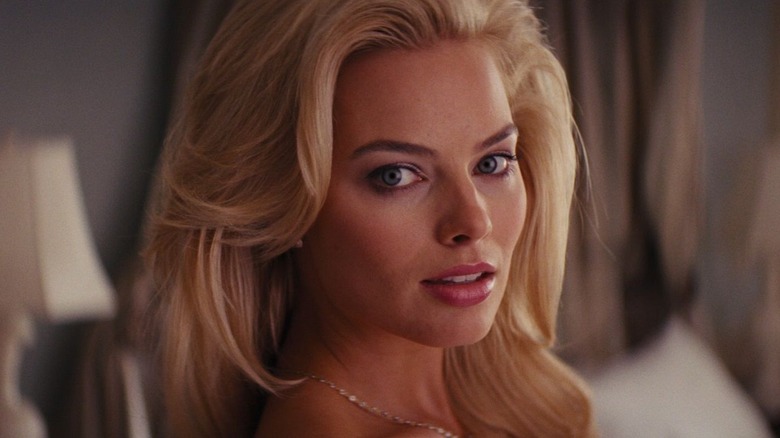
While she started her career primarily in Australian television, there's hardly a moviegoer today who doesn't know the name Margot Robbie. That's largely due to her breakout role in 2013's "The Wolf of Wall Street," where Robbie plays Naomi Lapaglia, the second wife of Jordan Belfort (Leonardo DiCaprio). Robbie's performance throughout the movie shows off her talent, and on that aspect alone, she's built a successful career.
Still, while her scenes are impactful, there's one moment in the movie that introduces her to the world, and it's one you won't find in this article. Many of Robbie's scenes include nudity, which fits the film's plot, as it doesn't shy away from depicting Belfort's lavish and debaucherous lifestyle. Robbie is topless in a few scenes, but in one, she's completely naked, and that's the scene that helped make her a star. While Robbie is empirically beautiful, her nudity isn't what makes the scene memorable ... Well, it does, but not because she's attractive.
Instead, it's bold, daring, and demonstrative of an actor who's not afraid to take risks. In fact, Robbie insisted on going full-frontal in the scene, which involves her character seducing Belfort for the first time. Robbie understood why nudity was necessary and took the role despite her trepidation. Regardless, she was determined to give the best performance possible. Robbie delivered, and in the years since, she's become Barbie and Harley Quinnn — and she received three Academy Award nominations.
Christoph Waltz - Inglourious Basterds
One of the most important scenes in any movie is its opening. If it's done poorly, viewers lose interest, though most are done well enough to keep people interested. Only a handful of directors have truly mastered the opening scene, and Quentin Tarantino's for "Inglourious Basterds" is a master class in opening scene perfection. Every element is flawless, which is due in no small part to Christoph Waltz's Colonel Hans Landa.
Every word of dialogue, every knowing smile, and every look he gives is menacing despite his charming disposition. Waltz acted primarily in German cinema and television since the 1970s before finding his way onto a Tarantino set, so he was an established actor. Still, he wasn't well known outside his native country, but "Inglourious Basterds" changed that. Every scene he's in is dripping with charismatic malice, and they're all excellent, but the opening scene is Waltz's finest.
It stretches for just over 19 minutes and flawlessly establishes the film's tone through Landa's determination, ingenuity, and inhumanity. The audience wants to see him get his comeuppance, but they also want to see him get more screen time, so it's a duality that Waltz plays to perfection. On top of that, Tarantino credits casting Waltz with saving the movie. Waltz quickly became fully established in world cinema. He won an Academy Award for "Inglourious Basterds" and nabbed his second for "Django Unchained," which are his only two nominations as of writing.
Cameron Diaz - The Mask
Few actors break into feature films and instantly establish themselves as a star, but Cameron Diaz can make such a claim. "The Mask" is her first credited role, where she plays Tina Carlyle, a honeypot sent into a bank to do surveillance for a future robbery. Tasked with charming a teller, she sets her sights on Stanley Ipkiss (Jim Carrey). By the end, Tina is redeemed from her life as the villain's tool into a proper heroine, and that's the role that launched Diaz's career.
It all goes back to her opening scene, where Stanley is talking to his buddy at the bank. A woman walks into the building out of the rain, and the camera takes a slow-motion approach as she shakes her hair. This moment is a fantastic introduction to Diaz on the silver screen, and while it plays on her looks, it's what happens next that helps to make her a star.
She's meant to distract Stanley while taking footage of the bank's vault via a hidden camera, but she ends up charming the audience just as easily. It's relatively brief, but memorable, and her remaining scenes are equally enjoyable to watch. Still, it's Diaz's introduction to the audience that ensures she found fame in Hollywood. Diaz went on to star in numerous feature films, even voicing Fiona in the "Shrek" franchise, and she retired from acting for over a decade before making a comeback in 2025.
Sean Connery - Dr. No
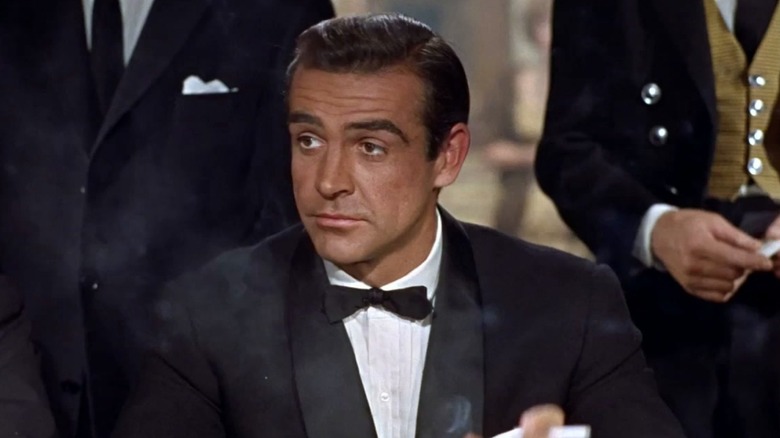
Sean Connery is known for playing numerous popular characters throughout his career. But if you had to point at one as his most famous role, it's definitely James Bond. Connery began acting in the early 1950s, and he had a few roles on television and in some films. Still, it was 1962's "Dr. No" that made him a household name. It transformed the actor into an action star, and he played Bond in six subsequent films in the franchise.
Connery introduces himself the moment he shows up on screen, answering the question of his identity by saying, "Bond. James Bond," while lighting a cigarette. That classic bit of dialogue has been repeated many times in the years since, and it's iconic of both the character and the actor. Interestingly, it was Connery who came up with the line, as it wasn't in the script. Instead, he was simply meant to say, "I am James Bond," which doesn't have the same sort of panache as the line Connery ad-libbed.
As he introduces himself, Monty Norman's "James Bond Theme" plays, helping to convey the character's importance to the audience. This wasn't just Bond introducing himself to audiences around the world; it was Connery doing the same. His career exploded after "Dr. No," and he went on to appear in dozens of movies and television shows. He even produced a Tony Award-winning play before retiring in 2003. Still, to most, he's best remembered as James Bond.
Julie Andrews - Mary Poppins
Julie Andrews is probably best known for two roles: Maria in "The Sound of Music" and the eponymous magical nanny in "Mary Poppins." The latter is her debut film, though Andrews had a solid career in the theater long before she graced the silver screen. She began working in the entertainment industry as a child, so Andrews was already well-known to some. But she wasn't properly introduced to the masses until her first scene in "Mary Poppins."
The first time Mary Poppins appears on screen, she does so by floating down from the sky while holding up her umbrella. It's a classic scene, showing just how magical and wonderful the children's new nanny truly is, though it wasn't particularly easy to shoot. Andrews has described her flying scenes as panic-inducing and noted that they were saved until the very end in case of an accident. Still, she showed up, hung from her flying harness, and made movie magic all the same.
The scene shows Andrews casually landing on the ground as the children watch in fascination, discussing whether or not she's a witch. Each subsequent scene Poppins is in shows the actor's commanding presence. Andrews' film career flourished after "Mary Poppins," landing numerous roles and taking full advantage of her vocal talents and cinematic appeal. She voices the Queen in the "Shrek" franchise, and she most recently voiced Lady Whistledown in the hit Netflix series "Bridgerton."
Terry Crews - White Chicks
Before getting started in acting, Terry Crews launched his professional career in football, first in college and then in the NFL. He retired from the game in 1997, moved to Los Angeles, and began acting, which is what he's best known for today. While Crews had several roles in movies and TV series, he shot to prominence due to his performance in 2004's "White Chicks," playing Latrell Spencer. He's a pro football player who takes a liking to Marcus/Tiffany (Marlon Wayans), leading to his most iconic scene.
After he wins a date with the undercover agent, Latrell arrives at the date in his convertible. Marcus/Tiffany is apprehensive, so a randomly-played song on the radio leads to one of the film's funniest scenes. Latrell declares that it's his favorite song and proceeds to sing along to Vanessa Carlton's 2002 debut hit, "A Thousand Miles," and it's hilarious. Every movement Crews makes is jarring as he gleefully sings a song you wouldn't expect a pro football player to excitedly dive right into.
The scene is brief, but significant to Crew's career. He told The Independent, "It changed my life. Twenty years ago, we made this movie. To see what it has become year after year. Every summer, a new 13-year-old discovers "White Chicks." After seeing the movie, Adam Sandler rewrote a character in "The Longest Yard" specifically for Crews. He went on to become a leading actor in "Brooklyn Nine-Nine," "The Expendables," and much more.
Beatrice Straight - Network
Beatrice Straight is an actor with a long career, having performed in numerous theatrical productions and television shows before becoming known for her work in feature films. Before appearing in 1976's "Network," Straight had already won a Tony Award, so she was well-known in quite a few circles. That's especially true of the small screen, where she began her on-camera career in 1951. Over the course of several decades, Straight appeared in numerous shows, primarily in single-episode appearances and a handful of films.
Then she did "Network," and a whole new aspect of the entertainment industry was introduced to the actor through a stellar-yet-brief performance. Straight only appears on screen for 5 minutes and 2 seconds, and in that short bit of celluloid, she gives an Academy Award-winning performance. In fact, Straight's time on screen as Louise Schumacher holds the distinction of being the shortest ever to win an Academy Award, though it wasn't the shortest to be nominated.
In her pivotal scene, Straight sits opposite her husband, Max Schumacher (William Holden), discussing his infidelity. After he admits to loving another woman, Louise launches into an impassioned monologue, decrying her situation as she peppers her husband with accusations and a demand for respect. It's one of cinema's most heartfelt scenes, and Straight delivers her lines as if she's suffering alongside her character. Straight's performance is delivered by an ardent professional, showcasing her command of well-written dialogue that's truly unforgettable.
Brad Pitt - Thelma & Louise
When you think of some of the biggest movie stars on the planet, it's likely that Brad Pitt's name comes to mind, as he's built an impressive career. Of course, he didn't start out as a leading man, and like most in his profession, he began working in small roles before making it big. Pitt began acting in the late 1980s, and for a few years, he landed small parts, primarily in television shows. He joined the cast of "Thelma & Louise" in 1990 as J.D., and that role completely changed his life.
J.D. is a robber, which he explains in a pivotal scene in the film. He describes this while lying in bed with Thelma (Geena Davis), explaining that he doesn't rob banks, but instead targets liquor stores, gas stations, and convenience stores. When she asks how, J.D. not only describes how he robs a place, but stands up, grabs a hairdryer, and demonstrates how he makes a living.
Pitt is in impeccable shape, showing off his handsome features and washboard abs. This makes him stand out, as does his charming disposition while wielding a hairdryer, wearing a cowboy hat and jeans with a smile on his face. The scene launched Pitt's career, and it's also one that his future friend and co-star, George Clooney, frustratingly lost to him. Clooney told The Times, "The part launched his career in film," and he refused to watch the movie for years over losing the part.
Salma Hayek - Desperado
Salma Hayek began acting in Mexico, primarily on television in telenovelas. She later made her way to the United States, where she became a leading figure in Hollywood. The door that opened for her came in the form of 1995's "Desperado" as Carolina, a bookstore owner in a small Mexican town that's home to a group of criminals being hunted by El Mariachi (Antonio Banderas). Her performance in the movie catapulted Hayek to superstardom.
When she's first introduced on screen, it's in a scene that shows the world that it was about to get a new star. The scene opens with El Mariachi walking out of a bar as a bad guy follows him. Carolina comes into the picture seemingly having nothing to do with the underlying story, without a care in the world. As she crosses the intersection, a car slams into another, and it's clear why. Carolina is a beautiful woman, and she looks back with a knowing smile on her face.
She walks towards El Mariachi, who saves her from a gunman while Tito & Tarantula's "Strange Face" plays. Hayek doesn't say a word in this scene because she doesn't have to. Her presence is all that's needed, with all of her acting kept to her facial expressions. Sure, she's gorgeous, but Hayek's ability to convey dialogue without actually saying it is what makes her performance shine in the scene, as well as throughout the film.