

Dune 2 Isn't Denis Villeneuve's Best Sci-Fi Movie According To Rotten Tomatoes

When "Dune: Part Two" hit theaters in March 2024, it was immediately apparent that acclaimed director Denis Villeneuve had yet another hit on his hands. Still, it's not his highest-rated film on Rotten Tomatoes, despite overwhelmingly positive reviews for "Dune: Part Two" from critics — and it's not even his highest-rated science fiction film. That honor goes to Villeneuve's 2016 film "Arrival."
"Blade Runner 2049," another sci-fi flick from Villeneuve, didn't fare too badly on the aggregator, earning a healthy 88% critical rating. (For contrast, Villeneuve's first "Dune" movie only scored an 83% rating.) "Dune: Part Two" is definitely sitting pretty with 92%, but "Arrival," released almost a decade before the "Dune" sequel, takes the edge with 94%.
Like "Dune" and "Dune: Part Two," "Arrival" was nominated for multiple Academy Awards, and also like the "Dune" films, it had the distinction of being nominated for Best Picture. (It lost twice, sort of — first mistakenly to "La La Land" and then correctly to "Moonlight.") So why is "Arrival" still Villeneuve's most critically beloved film, and could a future "Dune" film oust it from the top spot?
Arrival is Denis Villeneuve's science-fiction masterpiece
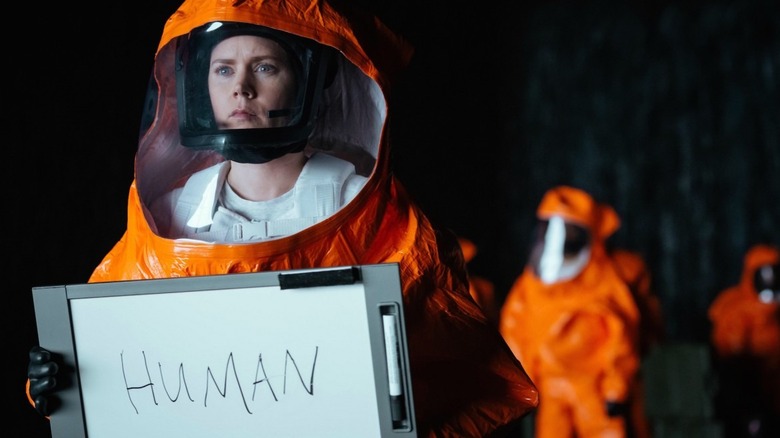
What makes "Arrival" — which, like the "Dune" films, is an adaptation, based on a short story by Ted Chiang titled "Story Of Your Life" — so special that it ousted "Dune: Part Two" for the top Rotten Tomatoes spot? "Arrival" might be a massive science fiction movie about aliens communicating with planet Earth, but it's also a deeply felt, moving story about a mother grieving the loss of her daughter.
After linguist Louise Banks (Amy Adams, who was, astonishingly, not nominated for Best Actress that year) loses her daughter Hannah to a terminal illness, she's asked for her help by the U.S. Army after alien spaceships start trying to communicate with humans. Alongside a physicist named Ian Donnelly (Jeremy Renner), Louise is able to decipher the alien language, using whiteboards to communicate with them, but she starts having intense, overwhelming visions of Hannah any time she speaks with the aliens. Meanwhile, the Army grows suspicious of the aliens when Louise reports that they used a word that could mean "weapon," though Louise insists that the aliens don't mean harm.
The way that Denis Villeneuve intertwines Louise's larger mission and her grief for her child is brilliant, and if you haven't seen "Arrival," we wouldn't dare to spoil it here. Still, it's not a huge surprise that it's Villeneuve's biggest sci-fi critical darling to date.
The third Dune film could win over critics and beat out Arrival
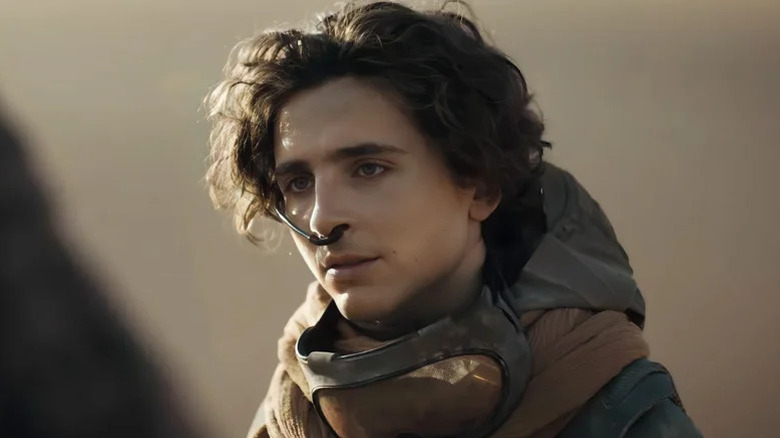
If Denis Villeneuve outdoes himself with 2026's "Dune: Part Three," it's quite possible that it could surge ahead of "Arrival" and become the director's best-rated sci-fi film. Based on where "Dune: Part Two" left off, a third film — based on the second book in Frank Herbert's saga, "Dune Messiah" — should be pretty action-packed.
After Paul Atreides (Timothée Chalamet) accepts his dubious role as the long-rumored messiah to the Fremen people of Arrakis, he becomes fully drunk with power, declaring a holy war and demanding the hand of Princess Irulan (Florence Pugh) in marriage. His speech at the end of "Dune: Part Two" is frightening in its intensity, and a third film could make it abundantly clear that Paul might be the protagonist of "Dune," but he's certainly not the hero.
Before officially beginning work on "Dune: Part Three," Villeneuve said he had a huge condition for making the film in the first place. "If we go back, it needs to be real, it needs to be relevant, if ever I do 'Dune Messiah,' [it will be] because it's going to be better than 'Part Two,'" Villeneuve told Empire in 2024. "Otherwise, I don't do it." Clearly Villeneuve feels that "Dune: Part Three" meets those conditions, which means it definitely could prove to be his biggest critical hit yet.