

What You Never Noticed About Light In No Country For Old Men
Since bursting onto the Hollywood scene with 1984's masterful neo-noir thriller Blood Simple, Joel and Ethan Coen (better known as the Coen brothers) have created one of the most impeccable filmographies in the history of moving pictures. That fact is all the more impressive since their body of work is also one of the weirdest, with the brothers traversing madcap comedies (1987's Raising Arizona), gangster epics (1990's Miller's Crossing), existential marvels (2001's The Man Who Wasn't There), and classic Westerns (2010's True Grit) with equal dexterity.
In their genre-hopping endeavors, the Coens have also re-invented many classic tropes into singularly offbeat tales of human fallibility. In 2007, the Coens found a most worthy accomplice in their ongoing explorations of moral duplicity in literary icon Cormac McCarthy, adapting his acerbic, nihilistic novel No Country for Old Men into what's become the crown jewel of their entire cinematic oeuvre.
A brooding beast of a film, No Country for Old Men features Josh Brolin playing an average Texan who stumbles upon a big bag of money left adrift in the desert after a drug deal gone horribly wrong. Determined to claim the loot for his own, the man eventually finds himself pursued by the local sheriff, and a contract killer who gives new meaning to the term "cold blooded." Part pulse-pounding chase movie, part harrowing theological meditation, and part classic crime thriller, No Country for Old Men found the Coens at the top of their game, delivering a cinematic masterwork destined to be studied and debated for all eternity.
And, according to one savvy viewer, it saw the Coen brothers making profound use of light and color, to flesh out the moral codes of their central characters.
Light and color convey heavy themes in No Country for Old Men
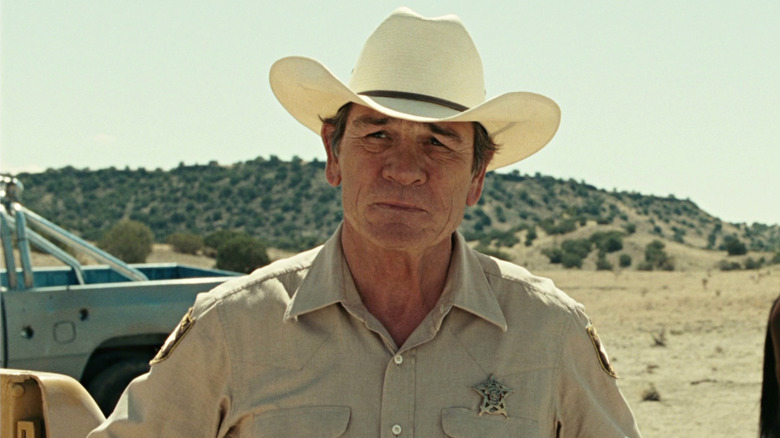
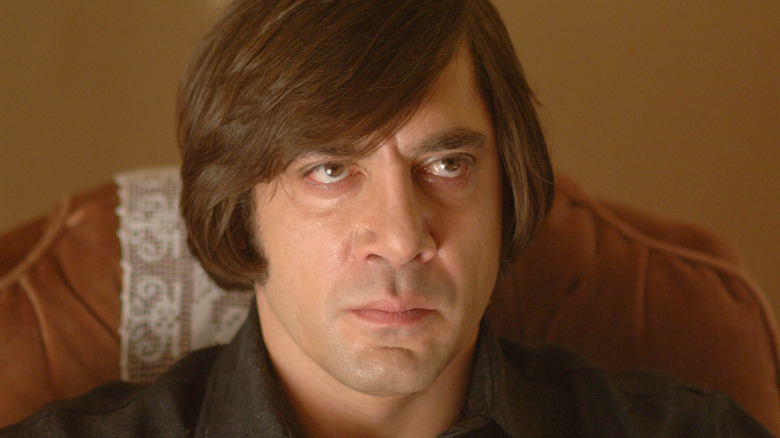
Said viewer took his No Country for Old Men theories to Reddit a few years back, in one of the platform's more well-thought-out posts. Those theories focus largely on the characters Ed Tom Bell (Tommy Lee Jones) and Anton Chigurh (Javier Bardem), exploring the simple, yet effective way in which the Coens utilize light and color to symbolize their place on the spectrum of good and evil.
Jones' Bell is the aforementioned sheriff, while Bardem is the cold-blooded killer. They could not be on more opposite ends of the spectrum, with Bell playing the virtuous lawman to Chigurh's demonic murderer. But according to the Redditor, you should know which side each man is on, based purely on how the Coens dress them, and what light they're typically shot in.
"Throughout the film we see Bell shown in light colors, in well-lit environments, and generally surrounded by white colors ... we're subconsciously being told that Bell is our good guy, and a representation of good," they wrote. "Chigurh is the leading cause of death in this film, and he's typically shown in dark rooms, dark environments, and dark clothing. In the most simple use of symbolism, we're subconsciously being told that Chigurh is our bad guy, and a representation of bad / death."
It's worth noting that when these characters do appear in alternate lighting, they look like different people altogether, with darkness essentially consuming Bell, and light exposing Chigurh's craggy, devilish facade. And simple as the technique is, it's another example of the Coen duo's unimpeachable cinematic genius.