

5 Sci-Fi Movies That Are Surprisingly Accurate According To Scientists

It's fairly common for sci-fi movies on every scale to try to be true to at least some facts, with blockbuster productions and scrappy indies alike hiring experts from the field to make sure that the movies don't stray too far into unrealistic territory. Every high concept is grounded in a semblance of scientific fact, and the key to a great sci-fi movie is finding a way to anchor a story in something plausibly realistic enough to give you enough creative freedom when it comes to the fiction. Once the science passes the smell test, the sky is the limit on where you can go with it next.
For this feature, we looked at lists from scientific experts — including NASA's jet propulsion laboratory – of the movies that got the facts right and eliminated any titles that are already famous for their realism. The following five movies have been chosen precisely because you'd never expect to see them on lists of the most factually accurate sci-fi films, but they are far more grounded than you may have ever realized. Some have already become a reality, while others are a lot closer to coming true than you might want to hear.
Jurassic Park
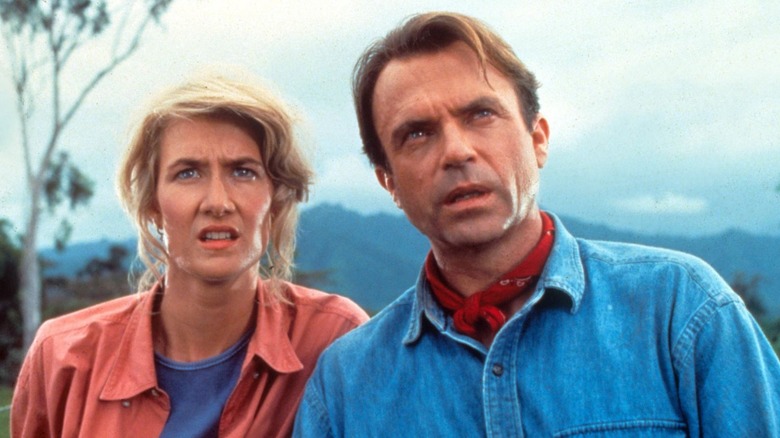
If you can get past a high concept that is not scientifically accurate – the half-life of DNA is roughly 521 years under neutral conditions, with 2.4 million year old samples among the oldest ever found. That's still a long way from making a Tyrannosaur, among other dino-sized problems — Steven Spielberg's blockbuster adaptation of Michael Crichton's novel has been commended for grounding its conceit in real scientific themes.
We don't need to worry about the consequences of resurrecting dinosaurs and letting them run amok, but all the disasters spring from ignoring the principles of chaos theory; overlooking important variables in their research that were predicting disaster over the excitement of being the ones to shepherd a major scientific breakthrough. Or, as Crichton and David Koepp's screenplay put it, the scientists "were so preoccupied with whether they could, they didn't stop to think if they should."
This is why, despite the limitations when it comes to cloning via current technology, "Jurassic Park" has still been lauded by many in the scientific community due to the important questions it raises about the necessary safeguards in genetic research. The science presented by Mr. DNA (Greg Burson), who walks us through how the cloning technology operates in this universe, isn't entirely plausible, but remains effective as a jumping off point to explore wider issues related to genetics in a way that was easy to digest for kids the world over.
The Thing from Another World

Although director John Carpenter's far more gruesome and paranoid 1982 adaptation of the novella "Who Goes There?" has eclipsed it in terms of cinematic influence, 1951's "The Thing from Another World" has it beat when it comes to grounding it in reality. At least according to the scientists at NASA's jet propulsion laboratory, who included it in their list of most scientifically plausible movies, partially as a response to the movies which were included in the least likely column. For that list, they naturally prioritized blockbusters by Michael Bay and Roland Emmerich, where realism and logic are thrown out of the window in favor of explosively silly action.
Despite a premise every bit as ridiculous as the apocalyptic scenarios of a "2012" or an "Armageddon" — charting the fallout after an alien with plant DNA crash lands next to a military base — it is surprisingly well-researched when it comes to depicting the tense collaboration between different teams countering the same threat. Here, members of a US Air Force base in Anchorage, Alaska, find themselves teaming up with a close-knit group of scientific researchers, showing how crucial life-or-death decisions are made under enormous pressure, and how this multidisciplinary collaboration is often stress-tested in the moment.
So, while the alien biology doesn't resemble any life form known to us, the human drama which binds the team dealing with the threat has been given the seal of approval by the scientific community. We don't have to worry about humanoid plant creatures coming for us, but "The Thing from Another World" still offers an intriguingly legitimate crash course in how diverse teams are forced into collaboration.
The Day the Earth Stood Still
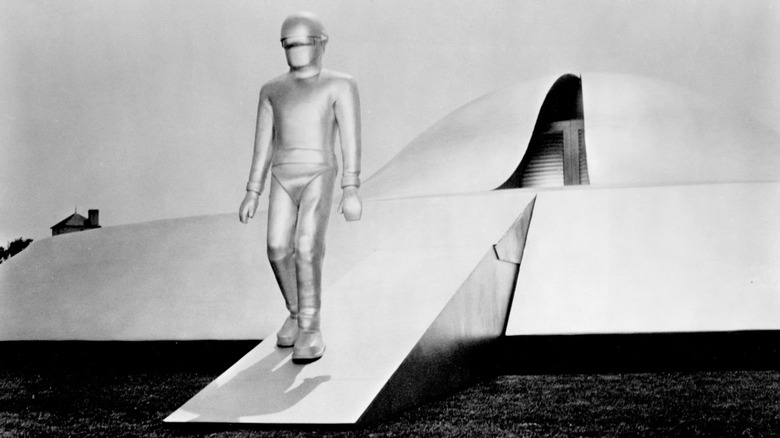
Next up is another 1950s B-movie classic which offered more thought-provoking ideas than audiences were primed to expect from sci-fi. Robert Wise's "The Day the Earth Stood Still" reflected the paranoias of the atomic age, with Michael Rennie's Christ-like alien Klaatu visiting Earth to warn the American President about the devastation that awaits if mankind didn't abandon nuclear power. It was developed as more of a prescient parable than a hard sci-fi tale, although science consultants were on hand to lend several scenes an extra air of credibility.
At one point, in the window of Professor Jacob Barnhardt's (Sam Jaffe) home, we see a blackboard with the workings out of an equation linked to the three-body problem. This was thanks to UCLA astrophysicist Samuel Herrick, who incorporated his own research to lend this scene added scientific realism. However, this is just the cherry on top of the cake, as "The Day the Earth Stood Still" was long considered to be one of the most realistic accounts of the response to an alien visitor, with the co-operation between governments, the military and scientific bodies more realistic in their communication with a foreign life form.
Within the genre, you can see this relatively realist approach — paranoid, but still operating based on caution and research — echoed in more recent grounded sci-fi tales such as "Arrival." Arguably, Denis Villeneuve's movie is more realistic to our current age, as governments threaten to militarily act on their distrust of aliens, but the process depicted within Wise's film wrote the rule book it deviated from. It did so with maximum scientific accuracy when it came to Klaatu's use of atomic power and advanced physics, too.
Metropolis
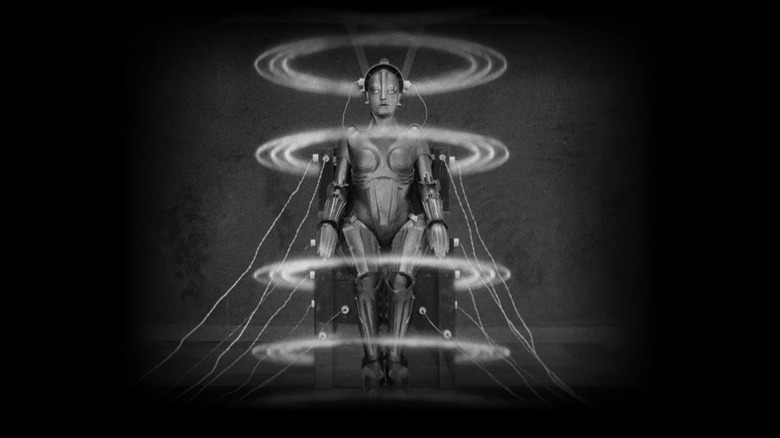
When NASA's scientists met up to debate the most and least realistic sci-fi movies at their 2011 conference, they probably weren't anticipating the extent to which Fritz Lang's silent epic "Metropolis" would prove eerily prescient in the decade that followed. Now considered by many to be the high watermark of German expressionism, it was shrugged off by many critics in its home country upon release for what was seen as a communist message.
The elaborately crafted dystopia — still jaw-dropping nearly a century later, when its influence can be felt in everything from "Blade Runner" to Star Wars – was ruled by wealthy businessmen in gigantic skyscrapers, where the workers lived far underground, in a future where automated robots were set to replace human labor once and for all.
Author H.G. Wells was among its harshest critics, not understanding why workers wouldn't want to be relieved of their duties through mechanical progress, and assuming Lang wanted to hold back technological advancement. A century later, Lang's futuristic fears were proven to not be political propaganda. Instead, it reflects our modern world where several industries are being handed over to AI, the workforce is rapidly shrinking and growing poorer, and the richest men in the world couldn't care less. It's a realistic grounding for a "Romeo and Juliet" style romance otherwise set in a visually breathtaking world that audiences in 1927 weren't ready for. "Metropolis" has aged so well that soon it will barely qualify as science fiction.
Gattaca
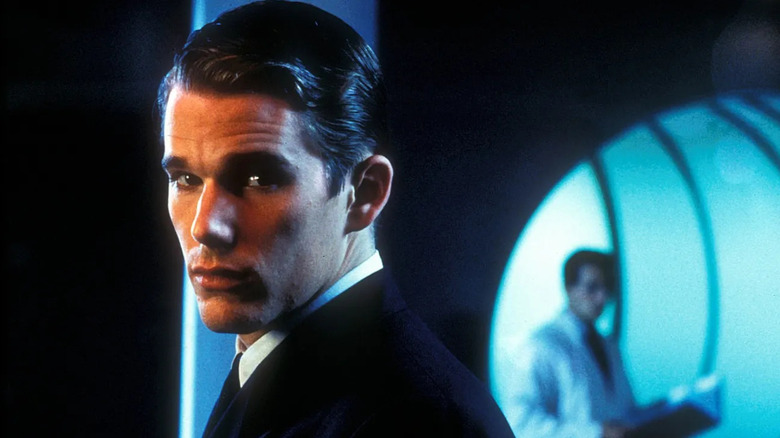
Described as the most realistic sci-fi movie of all time by NASA, and beating out both "2001: A Space Odyssey" and the Carl Sagan adaptation "Contact," is the 1997 cult classic "Gattaca," now considered one of the era's best genre movies despite being a box office bomb upon release. This dystopian movie about a eugenicist future has been heralded by the experts as a warning of a future which relies too much on genetic diagnosis, imagining a world where a child's fate was predetermined prior to birth, using their DNA to find out how long they'd live, and whether they'd be a social outcast.
While discrimination remains illegal, these practices are still used to profile people throughout life. Vincent (Ethan Hawke) tries to outrun his supposed fate by stealing another man's identity (with his consent) to live out his dream of space travel.
DNA profiling and other eugenics-aided tech enhancements may not yet be a reality, but director Andrew Niccol's film does hit a nerve as allegory, predicting many of the technologies used by law enforcement agencies which have shown discriminatory racial biases in their methods of profiling. Many of the movie's concepts are grounded within real biotechnology research, if accelerated to their darkest extremes. It was a bleak future that unfortunately felt all too plausible for many scientists, and with the rise of AI already revealing biases against people from diverse, less affluent backgrounds, the movie now feels relevant in a more broad way than initially intended.