

All 6 Dr. Seuss Movies, Ranked From Worst To Best
There's a handful of authors almost everyone will encounter during their childhood, with Theodor Seuss Geisel, otherwise known as Dr. Seuss, being one of the most prominent of the bunch. His best stories, often presented in rhyme, blend fantastical worlds and characters with the kind of moral thematic resonance that any new reader can latch onto, and hopefully carry with them into adulthood. Brevity is the name of Seuss' game, as most of his books don't run longer than 70 pages or so. This presents something of a dilemma when it comes to adaptations.
Classic stories such as "The Cat in the Hat," "How the Grinch Stole Christmas" and "The Lorax," among others, have found great success on television, where they can harness the pacing of the books via brisk, 30 minute specials. Nevertheless, there's been quite a few adaptations from page to screen in the format of theatrically released feature films, both animated and live-action. The commonality between all six movies based on Suess' work is that they share the same problem of having to pad out the story in order to suit the elongated runtime of a movie, often delegating its best moments to footnotes.
Determining the worthy order of these films is less dependent on whether they're faithful adaptations and more whether the filmmakers behind these projects are able to infuse their own sense of identity into an already classic tale. You'll see where this mindset comes from the further you get down the list, with the higher ranked entries (for better or worse) transcending whatever Seuss had initially envisioned.
6. The Grinch (2018)
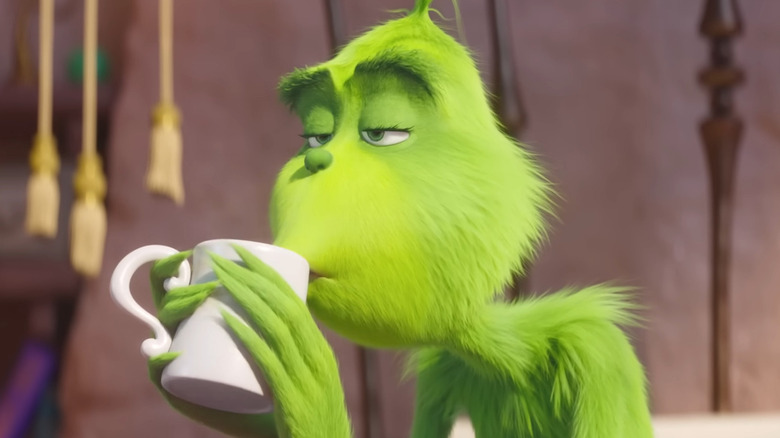
With a beloved children's book, animated television special, and a live-action feature film to his name, the Grinch is remembered in the cultural zeitgeist as the avatar of disdain for the holiday season. No matter which incarnation you prefer, the one constant is that the hermit is presented as a jerk, yet there's a sick pleasure in watching his attempts to put a damper on Whoville. It makes his epiphany about the true meaning of Christmas joy a transformative lesson that sticks. Illumination's "The Grinch" instead does its own thing by removing conflict altogether.
On the surface, the basic tenets of the Dr. Seuss story are present in the 2018 animated feature adaptation. The Grinch (Benedict Cumberbatch) is a green grouch who lives in a mountain cave on the outskirts of Whoville with his dog Max. He hates the Christmas season, and plans to steal it out from under Whoville. The change that sinks this movie's chances of making an impression is that Cumberbatch's Grinch isn't very mean at all. It's a toothless and unfunny portrayal that removes any kind of edge the character once had. The Grinch's animosity hardly registers above annoyance, and the moments where he does lash out are often accompanied by an immediate apology. The song ought to be called "you're a passive aggressive one, Mr. Grinch."
Directors Scott Mosier and Yarrow Cheney are more interested in garnering sympathy and sentimentality without taking the steps to actually earn it. Not even the copious amount of colorful Christmas imagery can make "The Grinch" come across as anything but antiseptic, whose commitment to being inoffensive ensures it'll be forgotten among future generations.
5. The Lorax
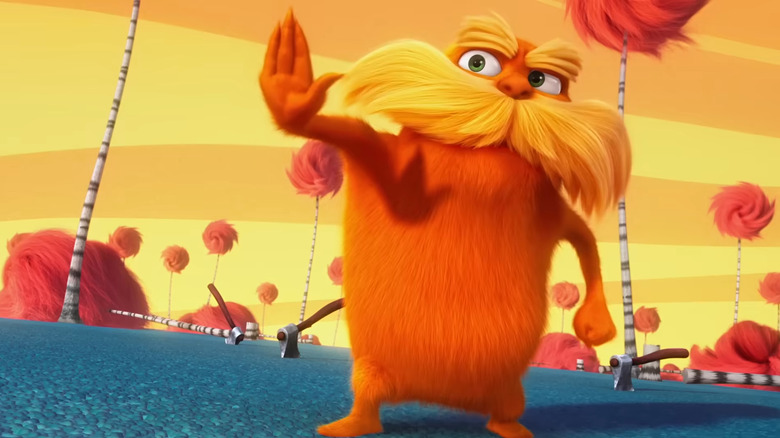
Dr. Seuss wrote "The Lorax" in 1971, with a television special released the next year to help deliver its pleas to take care of the environment. By 2012, it was clear that people hadn't taken his message to heart, which made the arrival of an animated big screen adaptation a great way to reach younger audiences with its timeless lesson. Unfortunately, this version of "The Lorax" bungles this opportunity by softening the blow with tedious jokes and corporatized cop outs that make you wonder why they bothered.
The city of Thneedville has opted to build a community centered around artificiality, much to the chagrin of citizen Audrey (Taylor Swift — of which this doesn't rank among her best performances) who yearns for the days when Truffula trees were everywhere. 12 year-old Ted (Zac Efron) takes it upon himself to find out what happened to them by visiting the Once-ler (Ed Helms) on the outskirts of town. Burdened by shame, the elderly hermit recounts his story of how he met the orange creature known as the Lorax (Danny DeVito) as a young man, and proceeded to ravage his forests for profits.
To this day, Seuss' "Lorax" remains a classic cautionary tale about our own complicity in making this an unsuitable world to live in, and how it's never too late to turn that around. The film is the most compelling when it's developing the tragic (albeit rushed) friendship between the Lorax and the Once-ler, and less so with the abominable Thneedville plot, which offers easy answers and a traditional villain in the greedy Mayor O'Hare (Rob Riggle). Perhaps the Once-ler should have chopped this up in the edit bay.
4. The Cat in the Hat (2026)
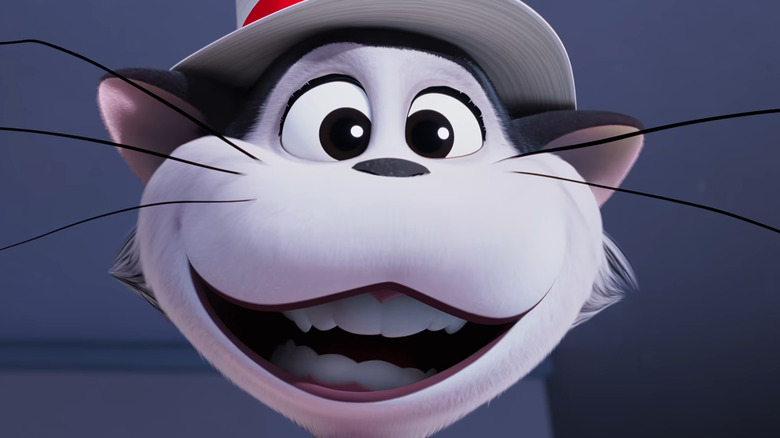
It's safe to say that, among Dr. Seuss' oeuvre of memorable characters, the Cat in the Hat is the most iconic. After making his big screen debut with a critically reviled 2003 live-action feature film, the chaotic anthropomorphic feline returning to the cinematic spotlight this year with "The Cat in the Hat" (now playing in theaters nationwide) seemed like a no-brainer. The result is an animated feature whose heart is in the right place, and features its share of heartwarming moments, but ultimately falls short of its ambitions.
In this incarnation, the Cat (Bill Hader) is a troublemaking employee of the Institute for the Institution of Magic, which serves as the hub for otherworldly creatures to entertain children in the real world. After a series of costly screw-ups, he's given a last chance assignment involving a sibling pair, Gabby (Xochitl Gomez) and Sebastian (Tiago Martinez), who are having a difficult time adjusting to their big move. In the chaos, the Cat loses control of a portable time machine called the Go-Backer, thrusting the three on a chaotic adventure through their unpacked boxes to retrieve it. Also, the fish (Matt Berry) is sentient, the strict landlady (Paula Pell) is on their case, an external beast also wants the device, and there's still more going on.
"The Cat in the Hat" is at its best when the colorful animation indulges the children's imaginative streak, and less so when it focuses its efforts elsewhere. The film is often trapped in a tug-of-war of wanting to be "Monsters Inc," "Inside Out," "Turning Red," and, weirdly, "Avengers: Endgame" all at the same time. There's a more streamlined and less exhausting movie in here somewhere.
3. Horton Hears a Who!
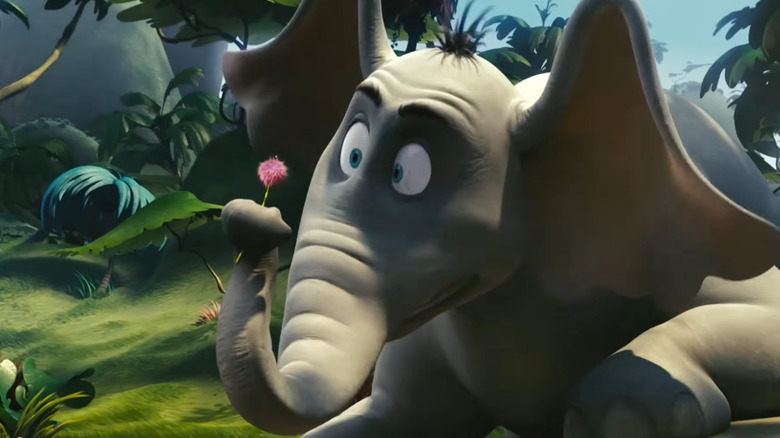
Of all the feature films based on Dr. Seuss' work, 2008's "Horton Hears a Who!" comes the closest to feeling like a direct adaptation of the original story. But like most good transitions from one medium to another, the animated feature is imbued with its own identity that expands upon the story in some interesting ways.
Deep in the Jungle of Nool lies Horton (Jim Carrey), a peculiar yet kind elephant who possesses a heart as big as his stature. One day, he hears noises coming from a miniature white speck laying on top of a flower, which turns out to be Mayor McDodd (Steve Carell) of the town of Whoville. Horton, in spite of not being able to see the people below, decides to take care of his miniature friends by attempting to bring them to safety. Non-believers like Sour Kangaroo (Carol Burnett) are filled with such contempt for the notion of life on such a small plane of existence that she enlists the help of vulture Vlad Vladikoff (Will Arnett), among others, to snuff the flower out of existence.
"Horton Hears a Who!" marks Carrey's second yet noticeably lesser role in an adaptation of Dr. Seuss' work. He doesn't make much of an impression, especially since he gets overshadowed by Carell, who provides a surprising amount of warmth, humor, and urgency as the Jor-El of Whoville. Mayor McDodd's efforts to warn Whoville of their impending doom is a great example of one of those animated subplots that's better than the actual plot. Burnett is also doing great voiceover work as a nasty figure who not only relishes in her hatred, but compels the other animals of Nool to indulge their prejudices as well.
2. How the Grinch Stole Christmas (2000)
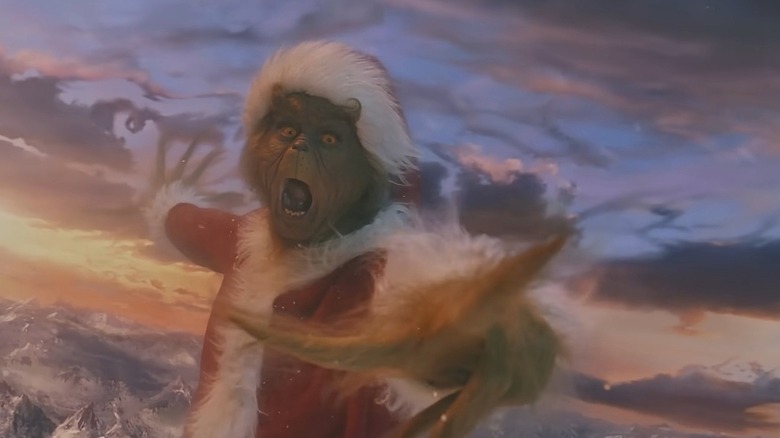
Dr. Seuss' stories are better suited to animation because live-action flirts with the uncanny valley. Just because something looks cute in one medium doesn't mean it will translate well to another. Take the Whos, for example, in Ron Howard's "How the Grinch Stole Christmas," whose prosthetics make the snowflake-residing citizens look like human-rat hybrid science experiments gone wrong. There's also the matter of Michael Corenblith's impressive production design being clouded by an unflatteringly smoky color grading. Whatever aesthetic issues the film has is made much easier to sit with, however, once we're introduced to the Grinch (Jim Carrey) himself.
While "How the Grinch Stole Christmas" does follow the template of Dr. Seuss' story, it largely predicates itself on being a vehicle for Carrey's over-the-top sensibilities. Your mileage for his manic brand of comedy will vary, but you can't deny that he doesn't fully become the Grinch (part of this is due to an impressive, albeit grueling transformative experience in the makeup chair for Carrey). The character even forms a charming bond with the pure-of-heart Cindy Lou Who (Taylor Momsen), who sees through his snarling act.
Dr. Seuss purists have issues with the film's hit-or-miss slant toward more crude humor, understandably so. There is something hilariously deranged about a family Christmas movie having a prominent "key party" joke. It goes to show that, if you're not going to stay true to the source material, then you might as well go for broke. For better and worse, that's exactly what "How the Grinch Stole Christmas" does.
1. The Cat in the Hat (2003)
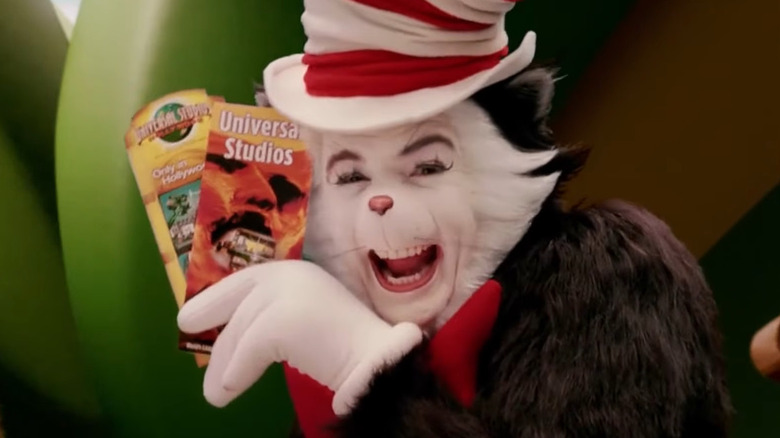
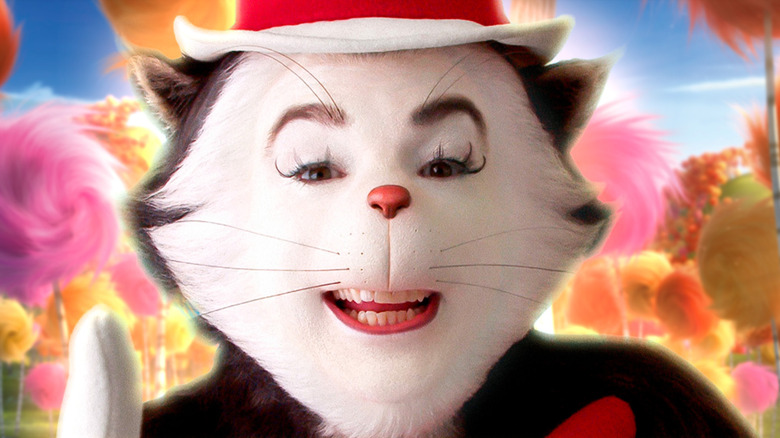
Among the critical thrashings that 2003's "The Cat in the Hat" received at release, none was more potent than that of Audrey Geisel, whose disappointment led to her restricting any more live-action adaptations of her late husband's stories. In that respect, the film serves as a cultural artifact of the early 2000s that's so bizarre that it has to be seen to be believed. Many will argue it's a desecration of what made Dr. Seuss great, and while it's difficult to refute that, this version of "The Cat in the Hat" is strangely more attuned with the source material than most people give it credit for.
With their mom (Kelly Preston) always away at work, her slimy boyfriend (Alec Baldwin) trying to weasel his way in, and their babysitter (Amy Hill) sound asleep, rulebreaker Conrad (Spencer Breslin) and neat freak Sally (Dakota Fanning) are left to their own devices. That changes, however, when the Cat in the Hat (Mike Myers) waltzes into their lives with the intent of showing them how to have fun through his own brand of playful anarchy.
Caked in layers of makeup, Myers plays the irreverent Cat as if a feline eldritch horror wanted to become a comedian, and tested out his material by sowing chaos wherever he goes. It's a uniquely wild performance that captures the spirit of how terrifying it would be to have this showboating entity teach you a lesson through demolishing your house. As the only film that production designer Bo Welch ever directed, "The Cat in the Hat" is a colorful, crude, terrifying, and frequently hilarious fever dream that's like no other movie you've ever seen.