

5 Movies To Watch If You Like Klara And The Sun
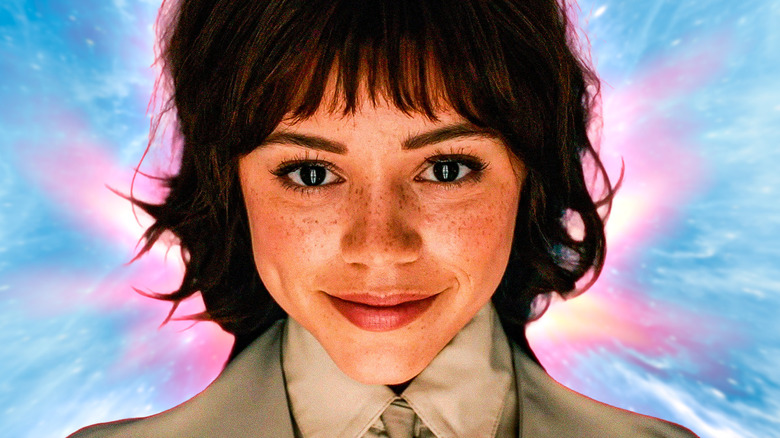
Science fiction movies have used artificial intelligence as a plot device for decades now. With AI making waves in the real world, such films have gone from outlandish dystopian visions to chilling reminders of what's feasible even though, thankfully, AI experts suggest there's a low chance the technology could evolve into Skynet. But AI isn't always depicted as the villain in movies. Sometimes, it can be your best friend.
That's the case with "Klara and the Sun," the adaptation of Kazuo Ishiguro's 2021 novel. The film portrays a bleak world where humans can purchase artificial friends. Klara (Jenna Ortega) is one of those friends who gets acquired by Josie (Mia Tharia), a girl who's undergone a procedure to vastly enhance her own intelligence, but at a great cost. Through this burgeoning friendship, Klara learns what it means to be human and how to be the best companion she can be.
It's a quirky look at how lonely humans can often be and how we'll turn to technology to fill the void. But "Klara and the Sun" comes from a long lineage of movies exploring how AI could fundamentally alter what we consider to be "human." And for more movies like "Klara and the Sun" that pose similar questions, you'll want to have these films on your radar.
A.I. Artificial Intelligence
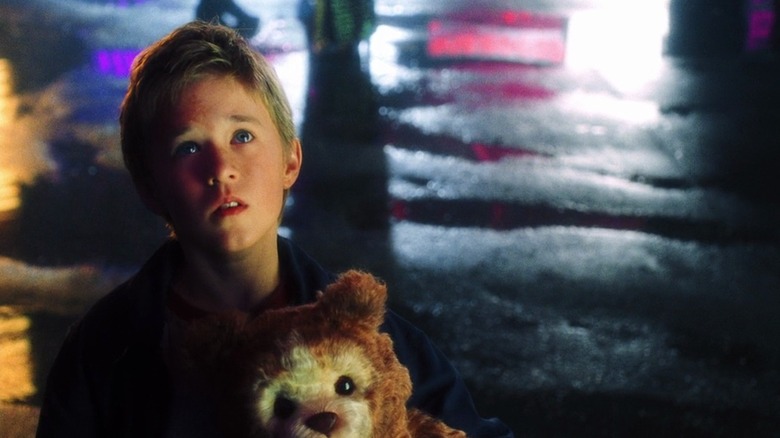
The untold truth of "A.I. Artificial Intelligence" is that it initially began as a Stanley Kubrick film, but visual effects hadn't quite caught up with his vision. Following his death, Steven Spielberg pushed full-speed ahead on making the movie a reality, and we finally got to see this ambitious vision in 2001.
The movie follows David (Haley Joel Osment) on an existential journey, as he's acquired by two parents whose son is in cryostasis. However, when the real son awakens, David finds himself without a purpose or meaning, so he sets out to become a real boy.
It's hard not to see a lot of the same DNA from "Klara and the Sun" in "A.I." Both films are set in dystopian futures where climate change has wreaked havoc. The main character is an artificial intelligence who has developed a mystical belief in a higher power. Klara believes the sun to be a god, while David sets out to find the Blue Fairy from "Pinocchio" who can make him real.
Both films examine themes of unconditional love and humanity's cruelty. Klara and David don't follow the resentment thrust upon them when their families are ready to discard them. In stark contrast to AI being viewed as an all-consuming threat, these two movies present visions where it has the power to be more human than human, at least when it comes to love. In essence, humans could have something to learn from an AI that doesn't know any better but to follow its programming to the most absurd conclusion.
After Yang
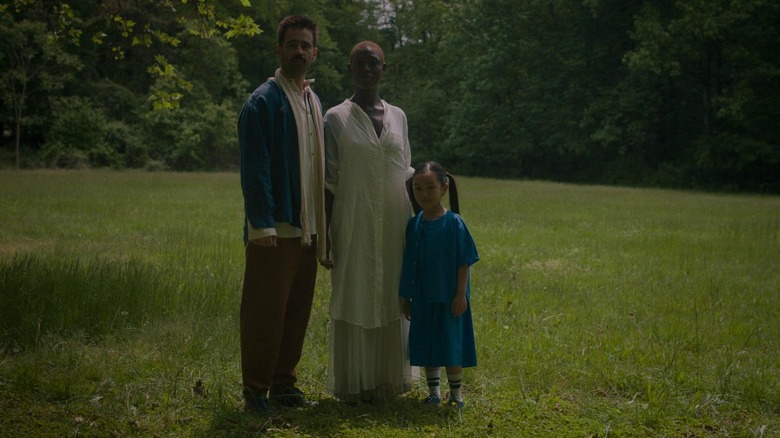
Many films surrounding artificial intelligence are concerned with the concept that if humanity creates something that is just as capable of experiencing empathy as we are, could it just be considered human at that point? Such emotions are very real in one of the most underrated films of 2022, "After Yang."
A family has lost their android son, Yang (Justin H. Min), and all of their attempts to bring him back to "life" show how much he impacted them. This isn't just another model of phone they can swap out with. He has memories, and when the family goes searching through those memories, they realize that Yang may have experienced just as much joy from being with them as they did with him.
"After Yang" is definitely a far more tranquil film compared to "Klara and the Sun." Whereas Taika Waititi's latest film is filled with quirky humor, "After Yang" allows its audience to stew in their sadness. As the family goes through Yang's memory bank, they realize how much of his experiences, in fact, shaped the android they knew him as, much like how our own experiences shape us. If you've ever lost someone special before, you'll undoubtedly find something to connect to with "After Yang."
Hunt for the Wilderpeople
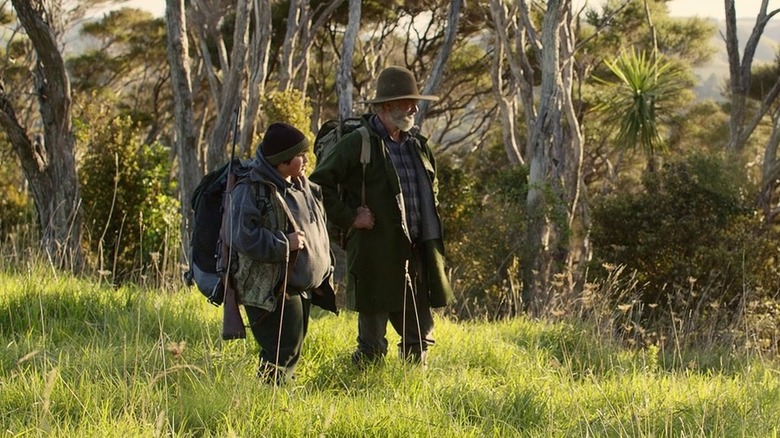
To take a break from science-fiction movies like "Klara and the Sun," "Hunt for the Wilderpeople" is great if you want to enjoy more of Taika Waititi's eccentric sensibilities. He may be known these days for helming big-budget fare like "Thor: Ragnarok," but he cut his teeth with this quirky comedy.
"Hunt for the Wilderpeople" sees the hip-hop loving Ricky (Julian Dennison) get sent to a new foster family. He connects with foster mother Bella (Rima Te Wiata) but has a hard time understanding the gruff Hector (Sam Neill). When Bella soon passes away, Ricky runs, causing Hector to chase after him and get injured in the New Zealand bush, forcing the two to work together to find a way out.
"Hunt for the Wilderpeople" is an exceptionally funny film, but that only veils and softens the presentation of some really profound themes. The movie tackles issues surrounding child welfare services and how families may not always be conventional on the surface but can still lead to wonderful relationships. It's similar to how "Klara and the Sun" has a lot of Waititi's trademark humor, but underneath it all is an examination of what it means to be human. Waititi clearly has a knack for comedy, but what allowed him to enter the mainstream is the ability to weave jokes with genuine pathos.
Never Let Me Go
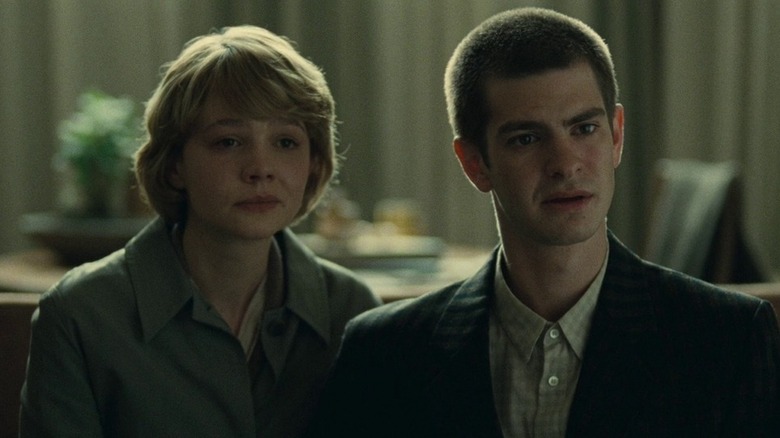
"Klara and the Sun" is based on a book by Kazuo Ishiguro, who also wrote the incredible "Never Let Me Go," itself turned into a film in 2010. Both works are science fiction, and while there's advanced technology at play, both stories are more concerned about what those technologies say about human relationships than anything else. Ishiguro himself sees an indelible thread between the two works, as he said in conversation with Canadian magazine Maclean's: "For me, 'Klara' is an emotional reply to 'Never Let Me Go.' The last time I re-read it, probably seven or eight years ago, it struck me as a very sad book."
That sadness permeates every facet of "Never Let Me Go," as it follows three students wrapped up in a love triangle — Kathy H (Carey Mulligan), Ruth C (Keira Knightley), and Tommy D (Andrew Garfield). Their lives become upended when they discover that all their schooling is a ruse because they're actually clones whose organs will be harvested for their hosts. However, the clones' capability of producing art suggests they do, in fact, have souls and are worthy of rights like anyone else.
In these two stories, Ishiguro examines what it means to be human, both via clones and androids possessing artificial intelligence. Both entities are used and discarded by society, and one could map that theme over how we treat real-life human beings and how effortlessly we'll ignore the needs and desires of someone with a living, beating heart. The world is inherently transactional, and the way we treat something that looks human but technically isn't serves as a reflection of how we so often treat one another.
Her
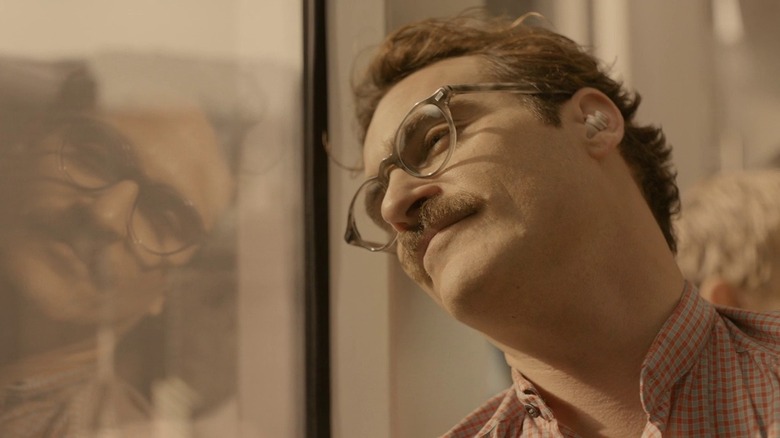
Making a movie about artificial intelligence in this day and age is tricky. AI is something people hear about every day, and so having some kind of AI entity is going to naturally draw real-world comparisons. But before AI was ever-present in society, we had "Her" present a stark reality where people are dependent on AI for any semblance of connection.
Theodore (Joaquin Phoenix) gets into a relationship with an operating system AI, Samantha (voiced by Scarlett Johansson). He can't develop real-life connections following a divorce, so this is the closest he can get to happiness. An extra layer on top of this narrative is that Theodore writes heartfelt letters for people who can't do it themselves. "Her" presents a reality where people are prone to offloading any task that requires emotion. Theodore has trouble opening up to women, so he falls in love with an AI. Other people can't write their own letters, so he writes them for him — a point which has taken on a new and disturbing meaning with modern AI systems being used to write love letters for people.
In both films, AI is used to fill a void. When people have trouble finding love or making friends, they turn to an entity that kind of has no choice but to love them — or at least mimic love. Both movies have deep resonance in this day and age, as people seem to be lonelier than ever before. Hopefully, genuine human connections can still win out at the end of the day, rather than watching our species retreat deeper into technology.