

Why You Can See Everything Blew Everyone Away At The Box Office
Three-hour documentaries about disgraced tech moguls don't tend to make a splash at the box office ... but somehow, Lance Oppenheim and Nathan Fielder's documentary of sorts about Elizabeth Holmes, "You Can See Everything," performed admirably at the box office despite only being in a limited release. What went right for this movie? Check out the video above, and keep reading in the meantime.
In early September 2026, A24 did two surprising things with "You Can See Everything." They released the movie abruptly at the Telluride Film Festival, and it simultaneously dropped a bizarre teaser trailer that features Holmes, who's serving time for defrauding investors with her non-functional blood-test company Theranos, asking Fielder why she would deceive him. To say that trailer made massive waves is an understatement, and as Fielder ultimately revealed during a Q&A session (via Vanity Fair), "I really am struggling to this day to understand exactly what I experienced." If that doesn't pique your interest, what could?
Clearly, a lot of people were interested. As Variety noted in its box office post-mortem, the movie made $15 million — again, in a limited release — and also achieved another fat. "Among its opening weekend bona fides, 'You Can See Everything' secured the largest debut for any film playing on under 1,000 screens since 2006's 'Borat,'" the outlet wrote.
There are a handful of factors at play here. First, this isn't ... a documentary by normal standards, to say the least. While the first half is a sort of straightforward look at Holmes, her partner Billy Evans, and their children before Holmes leaves for her prison sentence, the second 90 minutes is something entirely different. Then there's the wild secret actor. What else brought theatergoers to see everything in "You Can See Everything?"
You Can See Everything is one of the most ambitious movies in recent memory, and audiences loved it
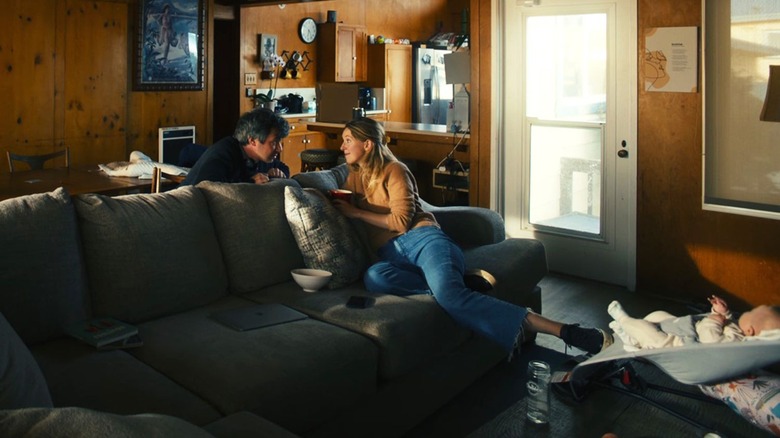
The directorial team-up on "You Can See Everything" also definitely got a bunch of cinephiles interested in this innovative, weird, unsettling, and enthralling project. Nathan Fielder has been making a name for himself with shows like "Nathan For You" and "The Rehearsal," two documentaries of sort where he performs experiments to attempt to improve businesses (in the former) or stages real-life events to learn something about them (in the latter). Lance Oppenheim's other great 2026 film, "Primetime," centers around Chris Hansen at the height of the mania surrounding "To Catch a Predator," is also making waves with audiences and is definitely one of the best movies of the year ... so anyone who saw "Primetime" when it hit theaters may have also added "You Can See Everything" to their agenda.
The secrecy, as we mentioned, also helped ... but the fact is that "You Can See Everything" is a movie that will drive conversation and drew in audiences partly because they wanted to be a part of that conversation. As Fielder said in a post-release interview with Wired, the film changed partway through, putting him in front of the camera and revealing something totally unexpected. As he put it:
"But with this, we're really trying to give the viewer everything. We're trying to focus on these moments that we couldn't really make sense of fully. Like I was saying, still to this day, I'm debating. Why are me and my editor talking, two days ago, about trying to understand certain things? I've talked to people who have seen it, and they're all bringing out new ideas that I would never even consider."
Decide for yourself: You Can See Everything" is in theaters now.