
All 4 Disney Beauty And The Beast Movies, Ranked From Worst To Best
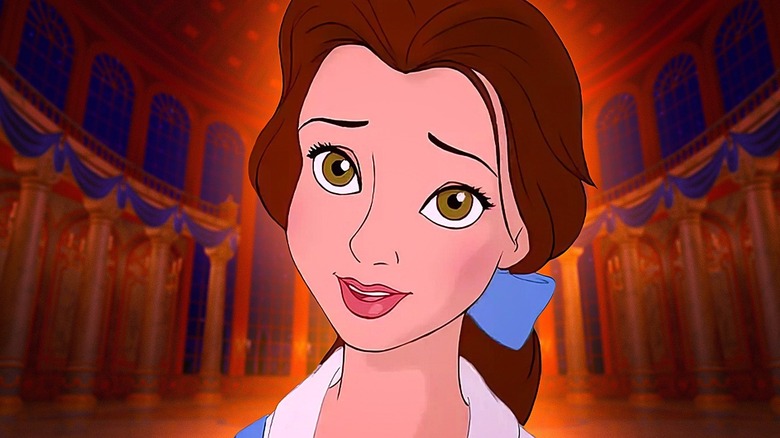
Stories, by their very nature, are meant to be passed down from generation to generation. Among those fictional narratives that have evolved the most is that of the fairy tale, using folklore to tell yarns of mythical beings and places. In some respects, Disney's animated features have taken on the same effect, with their adaptation of "Beauty and the Beast" being a seminal text of the studio's fantastical history for young and old alike.
The 18th century fairy tale from French author Gabrielle-Suzanne Barbot de Villeneuve (and later Jeanne-Marie Leprince de Beaumont) about a lovely woman and an aesthetically monstrous being had already been adapted for the screen, most notably with Jean Cocteau's "La Belle et la Bête" in 1946. Even Disney attempted an adaptation in the '30s and '50s. It wasn't until the late '80s, however, when they got the ball rolling again, culminating in Gary Trousdale and Kirk Wise making their directorial debuts with the critically acclaimed 1991 animated musical.
Among its place as one of the tenants of the Disney Renaissance are all of the accolades it earned, including winning two Academy Awards (best original song and best original score) and being one of only three animated movies ever nominated for best picture. It went on to spawn a highly successful Broadway show adaptation, countless video games, two direct-to-video midquels, and a live-action remake. Let's rank all four films, and see which ones have kept Looper's enchanted rose blooming.
4. Belle's Magical World
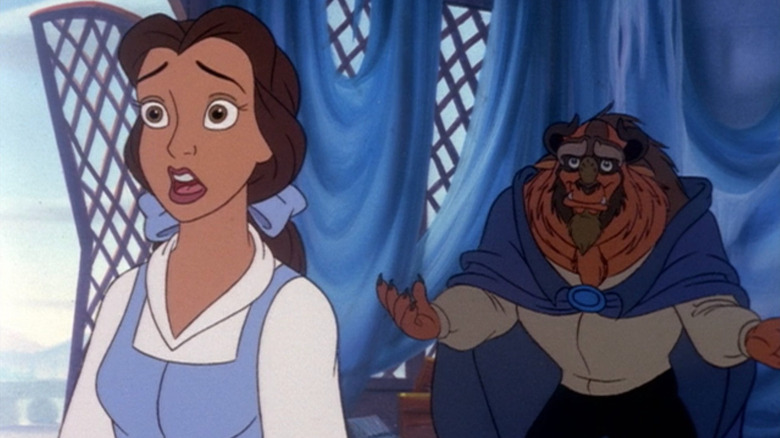
Disney dominated the market with direct-to-video animated sequels after the unprecedented success of 1994's "The Return of Jafar." While there are some genuine diamonds in the rough, a good percentage were hastily-produced cash grabs. The worst offenders were those that strung together a bunch of episodes of a television series and called it a day. 1998's "Belle's Magical World" is guilty of this strategy, resulting in one of the worst "movies" in the company's history.
Disney capitalized on "Beauty and the Beast" not providing a proper timeframe for how long Belle (Paige O'Hara) stayed in the castle by filling in the blanks with a collection of uninteresting 22 minute stories. "The Perfect Word" sees the castle's magical inhabitants attempting to reconcile the two after the Beast (Robby Benson) causes yet another outburst, "Fifi's Folly" sees the subtitular feather duster (Kimmy Robertson) mistakenly believe that her beau Lumiere (Jerry Orbach) is having an affair with Belle, and "The Broken Wing" follows Beast becoming obsessive over an injured bird that Belle takes care of.
These are all supposedly taking place during the "Something There" song, but it's hardly a companion piece to the 1991 film. There isn't even a framing device to tie them altogether. By the time "Belle's Magical World" reaches the third story, it becomes pretty evident why this shoddily animated series never got picked up, especially since it would have explored a new cycle of abuse from the Beast week after week.
3. Beauty and the Beast (2017)
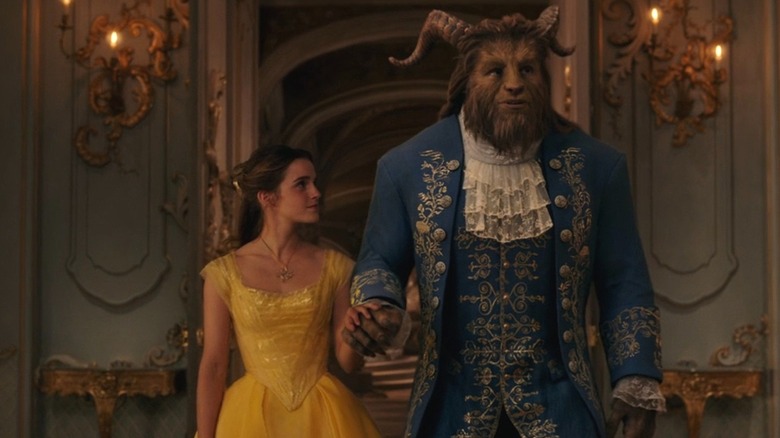
The many different screen adaptations of "Beauty and the Beast" prove that a reimagining can work if the material is approached from a fresh angle. Unfortunately, Bill Condon's 2017 live-action remake is a soulless rehash that possesses virtually no identity of its own. Once again, we follow clever bookworm Belle (Emma Watson) yearning for a greater life beyond the provincial village. She inadvertently gets that change when rescuing her father Maurice (Kevin Kline), who has been held captive by the cursed being simply known as Beast (Dan Stevens). Belle takes his place as prisoner, only for her and Beast to forge an unexpected romance. Meanwhile, the narcissistic hunter Gaston (Luke Evans) vows to stop at nothing to force Belle to be his bride in spite of her disinterest in him.
Condon's "Beauty and the Beast" hits practically all the same beats of the original, yet still runs 45 minutes longer. There are some changes though, notably in a few unmemorable original songs and Belle being an inventor with a more call-to-action temperament. These variances, however, are little more than underdeveloped cosmetic modifications to cover up the same issues that plague other Disney remakes. It's an anemic film with an ugly faux opulence that rarely comes alive, let alone in the company of the Beast's distracting CG face. The only thing this version outdid from the original is making over $800 million more at the box office.
2. Beauty and the Beast: The Enchanted Christmas
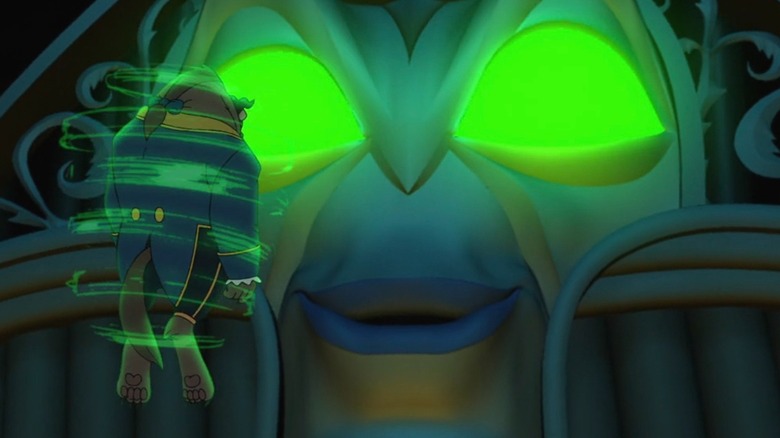
The first direct-to-video follow-up to "Beauty and the Beast," "Beauty and the Beast: The Enchanted Christmas" was initially envisioned as a sequel that would have seen Gaston's previously unseen younger brother vowing revenge. Somewhere along the line, however, the film was retrofitted into this mostly average direct-to-video midquel you may have never even knew existed that takes place a few weeks after the wolf rescue in the original.
As the holidays encroach, Beast finds himself in a sour mood on account of his transformation having taken place on Christmas all those years ago. Belle's attempts to connect unfortunately can't bring him the same comfort as a massive organ named Forte (Tim Curry). Unlike the other magical inhabitants, Forte is much more appreciated by the Beast, and the instrument will do anything to sabotage the couple's bond to keep it that way.
For the most part, "The Enchanted Christmas" is your traditional holiday special. Like "Belle's Magical World," it doesn't add to anything the 1991 film was able to accomplish through a single song. The only real reason to watch it, other than the surprisingly decent animation, is Curry's performance. It's fun to watch one of the great voice-over actors make a delectable meal out of being the devil in the Beast's ear. Not to mention that Forte displays a genuine menace on account of being rendered through computer-generated imagery, presenting an interesting clash against the traditionally 2D-animated world.
1. Beauty and the Beast (1991)
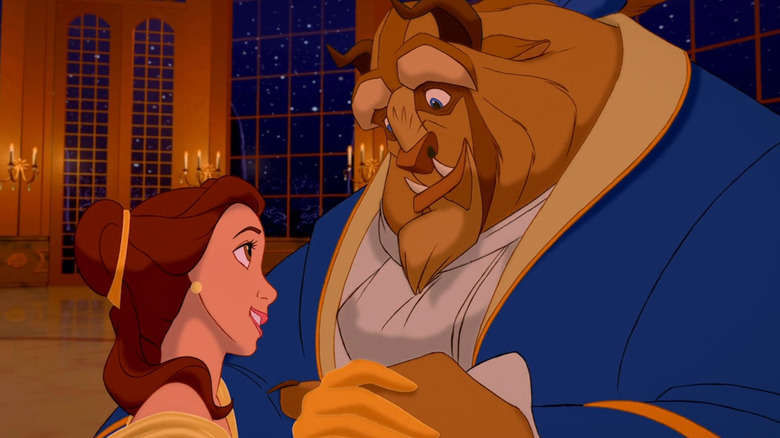
When talking about the kind of movies that demonstrate aesthetic magic from the first frame to the last, "Beauty and the Beast" is a key exemplifier. Even the work-in-progress cut that screened at the New York Film Festival in 1991 received widespread critical acclaim. In spite of "The Little Mermaid" kicking off the Disney Renaissance, it was "Beauty and the Beast" that sent the company into another stratosphere.
After the striking storybook opening, the film introduces one of the best Disney characters of all time in Belle, an intelligent reader who couldn't care less about the village's animosity towards her intelligence. That conflict, coupled with the boorish hunter Gaston (Richard White) forcefully trying to butt into her life, makes her adventure with the horned Beast that much more compelling. Two trapped souls, one in ambition among a sea of idiots and the other in temperamental isolation, are the balm that one another needs to find peace.
The award-winning songs from Alan Menken and Howard Ashman (in his final credited work) are still soulful and buoyant all these years later. Then there's the seamless blend of traditional and computer animation that allowed these settings (most notably the grand ballroom) to feel more expansive than ever before. The longevity of a film's reputation requires mutual admiration from the filmmakers and those that fall for their vision, and that's why the number one spot couldn't have gone to anything else.