

Carrie Review: Mike Flanagan Reinvents Stephen King's Horror Classic
- Terrific cast
- The expanded story really works
- Successfully deepens and darkens the original narrative
- The show's many points-of-view occasionally lose some tension
- Carrie's more patient story sometimes slows things down
Though it was originally published more than five decades ago, the metaphors that govern the horror in Stephen King's debut novel "Carrie" are as rock-solid now as they were in the mid-1970s. At its simplest level, it's a story about the hell of living through high school as someone who's seen as different. The more complex layers of the story, however, deal with everything from female sexuality to the way the social order of teenage life occasionally requires a blood sacrifice — perhaps even a literal one.
These ideas still work, which helps to explain why "Carrie" has led so many lives over the decades. The story has been adapted to film twice, gotten one film sequel, has been adapted as a TV movie, and even adapted into a musical. Now, horror auteur Mike Flanagan is here to take another swing at the story, this time for its first-ever series adaptation.
So, why does "Carrie" need to be a series? Because Flanagan and his team are after something bigger, something that takes those timeless central metaphors and deepens and broadens them, delivering a show that's very much made for this moment while still keeping the old "Carrie" thrills intact.
Meet the new Carrie White
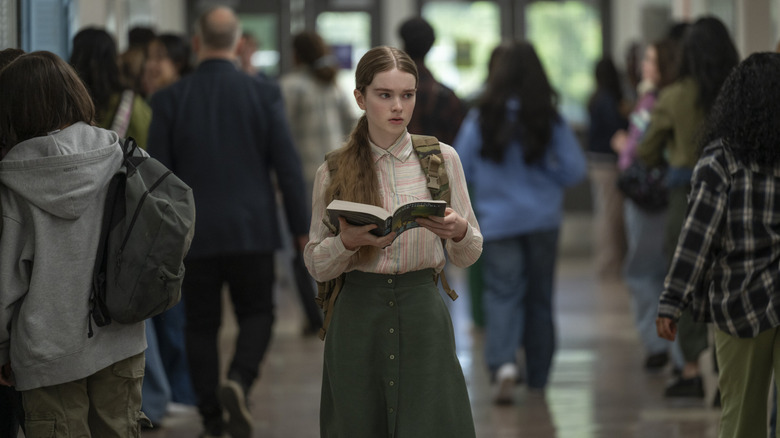
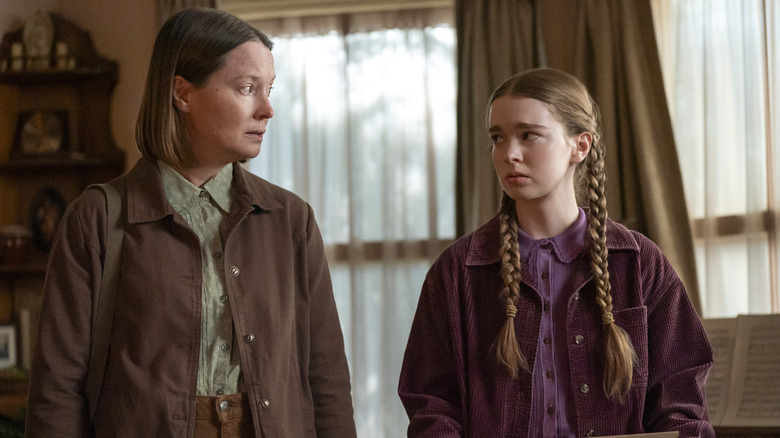
Mike Flanagan's first step in creating a new vision of "Carrie" that will simultaneously appeal to new fans and longtime lovers of Stephen King's original involves reshaping the origin story — but just enough to find a new way in to Carrie White's (Summer H. Howell) version of high school hell. While King's novel picks up with Carrie already in the public school system, the series begins with the sudden death of Carrie's father Ralph (Tahmoh Penikett), the family's provider and the only one of them who ever really ventures into the outside world. With their breadwinner gone, cops and social workers descend on the White home, where Carrie's mother Margaret (an unstoppable Samantha Sloyan) rages against "the state" coming to tell her how to live her life. A compromise is reached: The Whites can continue to live on their own, but Margaret has to get a job, and Carrie has to go to public school.
Deeply sheltered Carrie, with a worldview shaped entirely by the religious fundamentalism and anti-government paranoia of her parents, ventures out to high school. She's unaware of almost everything about modern teenage life, from social media to menstrual cycles. At school, she meets people her own age, including overachieving student-athlete Sue Snell (Siena Agudong) and spoiled rich girl Chris Hargensen (Alison Thornton), along with teachers like Ms. Desjardin (Amber Midthunder) who hope to help her assimilate. But of course, not even Carrie knows what will happen next, and the deeper she descends into the high school pressure cooker, the more a frightening power that's haunted her for most of her life starts to bubble to the surface.
Positioning Carrie's introduction this way, with a plunge into the deep waters of teenage social life rather than an in media res introduction to Carrie as a longtime target of bullying, allows the show some room to expand its narrative right up front. Because Carrie doesn't really know what she's in for, the series has to establish her social and emotional footholds in this new world outside of her mother, which means we spend more time up front with Sue, Chris, and even Ms. Desjardin and the other teachers. A fully formed world starts to emerge, helped along by mysterious documentary-style segments that mirror the news clippings and excerpts in King's novel. There's a sense of immersion, and while the old metaphors are still very much a part of this narrative, there's an opportunity to deepen and darken everything about this story.
The show has a bigger narrative with a bigger purpose
It's understandable that horror fans would come to this story with a certain degree of skepticism, even if Mike Flanagan does have a track record of taking classic scary stories and remixing them into expansive, weblike narratives of human frailty and terror. "Carrie" is a short novel that turned into a compact movie, so what does a miniseries have to offer us that we didn't already get? The answer, which comes through Carrie's sudden introduction to high school, is complexity.
Carrie's arrival at school is a major shock to her system that's compounded by bullies, social media, parties, and all the other trappings of her new, very much unsheltered life ... but she's not the only one facing upheaval. Her arrival is a catalyst for bullying and brutality from her peers, yes, but it also forces all of them to ask and answer some hard questions about who they really are. Chris, Sue, and the rest of the teenagers surrounding Carrie all have big questions of their own — not quite as existential as Carrie's, but just as pressing. It's an oversimplification to say that everyone gets their own arc and their own conflict. But Flanagan and a fantastic writing team — that also includes Justina Ireland and Elan Gale — do indeed push things in that direction, and great performances from Siena Agudong and Alison Thornton (who truly captures the crisis roiling in Chris' soul) make that feel real.
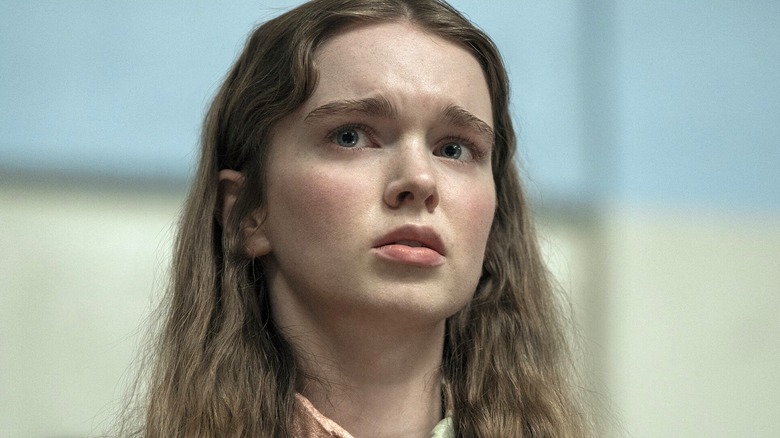
But of course this is Carrie's story at its core, which means that much of the emotional heavy lifting still falls on Summer H. Howell and Samantha Sloyan, who turns away from the campier aspects of Margaret White to portray her as frightened, angry, and deeply, perilously human. Howell, following Sissy Spacek's indomitable lead, strikes the perfect balance between Carrie's naïveté and her intelligence, seeming to grow and evolve with every passing second of screen time. She's someone who catches on quickly, and yet her life has not prepared her for the cruelty of the world, or for how quickly kindness can shift to something darker. It's a phenomenal central performance, and it has to be, because Flanagan is clearly after something bigger here than an expanded version of the basic beats of Stephen King's story.
Those beats are still there, and the show hits them, but this "Carrie" is about the larger tapestry of what America expects and demands of its teenagers. These kids are all, in their own way, pushing back against the larger societal cage that has been built around them, its bars constantly changing shape to prevent any real escape. Sometimes it really is as simple as bullies being bullies, but more often this is a show that wants to do more, both with its plot (seriously, you will never see some of these swerves coming) and its larger meaning. Carrie is the central character, but she's also the springboard to a larger conversation not just about the hell of high school, but about what we can do to combat said hell. Mike Flanagan, horror cinema's great humanist, has done it again, and you won't want to turn away from this series.
"Carrie" premieres on October 7 on Prime Video.