

Primetime Review: Robert Pattinson's MVP Year Continues

- Robert Pattinson is absolutely elite
- The visuals and style are so suitable to the themes
- The way it implicates the viewer can feel intermittently dicey
Films focusing on real life subjects do not require the performers to look and sound exactly like the figures they're portraying. For every Jamie Foxx's Ray Charles with its startling mimicry, there's a Michael Fassbender's Steve Jobs. Fassbender didn't look or sound like Jobs, but he felt like him; he captured the cultural memory of the man behind Apple. Similarly, Robert Pattinson doesn't look much like Chris Hansen, the central figure in Lance Oppenheim's "Primetime." And for all the painstaking work Pattinson put into sounding like him, there's an uncanniness in his approximation. But this isn't a traditional biopic. In fact, it's not really a biopic at all.
"Primetime" is both a nightmarish psychological thriller and a pitch black comedy unpacking the very idea of Chris Hansen. Not the man himself, but of what he has become in the pop cultural consciousness in the ensuing 20 years since the heyday of his greatest achievement, NBC's "To Catch a Predator." But the movie's not strictly about the show, either. If you want the true story you would be better served by David Osit's documentary "Predators," which deals much more directly in the facts and circumstances behind the show's history and its many subsequent pretenders.
Instead, "Primetime" weaves a yarn by taking what that show has meant to us and the many ways its long shadow casts a pall over every true crime podcaster and junior detective influencer's extralegal excursions ever since. It is a darkly comic and deeply disturbing look at the intersection of journalism and entertainment, of justice and exploitation.
Primetime is an over-the-top dramatization
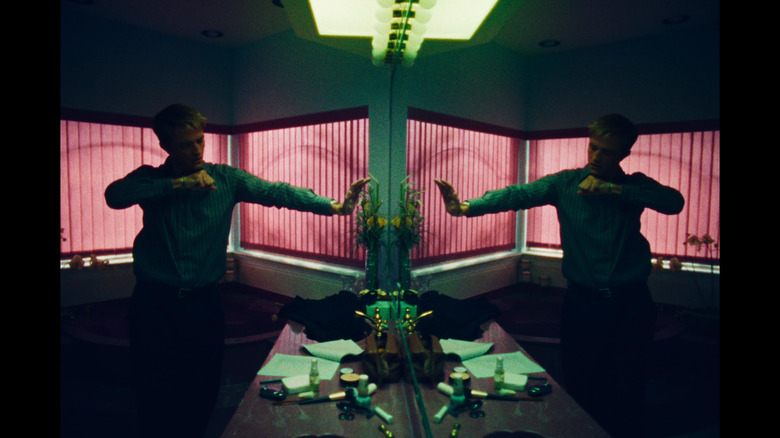
When we first see Chris Hansen (Robert Pattinson), he's sitting by a mirror, rehearsing lines to himself from a pedophile's chat logs. In Pattinson's hands, the repulsive innuendos and grooming manipulation bend and stretch, like toffee pulled and pulled until it suits the shape it needs to provide maximum shame and humiliation on camera. It does not feel like an award-winning journalist preparing for an interview, but like a performer preparing for the stage. But later in the film, when asked if a bracelet he wears is an acting totem, Hansen defensively, offendedly, insists nothing he does is acting.
Therein lies much of the tension in "Primetime," a film that dramatizes Hansen and his work, not strictly from the Esquire article upon which the screenplay is based, but the Hansen who has evolved in our understanding of his public persona into a meme. Centering around the network's decision to move "To Catch a Predator" to prime time to go head to head with ABC's "Lost," the show, in theory a news endeavor meant to expose pedophiles and raise awareness for child safety online, must escalate its aims. Beneath the very thin veil of moral superiority Hansen and his collaborators hide behind, they are at the end of the day, entertainers, and their pursuit of capturing the most puerile and sensationalist images and moments leads them all to ruin.
Hansen is the ring leader, the face of the show, and the one who gets recognized everywhere they go. He eats up the fame, but his personal life is crumbling and threatening to create problems for the production and his already contentious family situation. In interviews, Lance Oppenheim and Pattinson himself have said his performance is Tom Cruise in "Jerry Maguire" meets Dracula, but in some weird ways, his Hansen is like a meaner corollary to another fictional character he's brought to life: Batman. Only his Jerry Maguire energy — the hungry, begging charmer in his day-to-day — is like a Bruce Wayne persona, and who he becomes for the camera — a bloodthirsty vampire nourishing himself by performing circus tent vigilantism — is his true mission. (There is even a notable moment where Pattinson's voice slips into his Batman voice.)
If Hansen is Batman, Decoy Dan (Skyler Gisondo) is his Robin: an aspiring actor who takes the job as a decoy for the show only to find himself repeatedly exposed to the psychological torment of having deviants flashing him and all manner of other trauma. And Hansen's producer Andie (an always pitch-perfect Merritt Weaver) is like Alfred, dutifully and thanklessly making the entire operation work, no matter how little she is appreciated or acknowledged. These supporting roles are also heavily fictionalized and this metaphor is getting torturously dragged out, but it ought to sell the craven and exaggerated world of "Primetime."
Oppenheim brings us back to 2006

You may know director Lance Oppenheim from the Max doc "Ren Faire," but here in his narrative feature debut, he and cinematographer David Bolen utilize their experience together as documentarians to recreate 20 years ago in a way that dramatically blends technical accuracy and grounding elements of objective reality. This is done by using multiple video formats of the era, and a more manipulative, emotional reality through the use of dramatic staging, evocative colors, and stylized images. There are multiple sequences that brilliantly intercut between a control room perspective of the show being filmed and edited with more hyperbolic perspectives up close and in the segments themselves.
Hansen at one point talks about how evil people used to get stoned in the town square, but the television set is the new town square. Despite his showmanship and his obsession with fame and industry clout, Hansen does deeply believe in what he does as necessary and heroic, but he wields the screen like it's a guillotine. However, when he lets the blade drop, the punished aren't beheaded. As Hansen excitedly tells a man asking if he ever wants to bleed the predators, what he does is a little worse.
The film wants to implicate the viewer as an indictment of this kind of spectacle enduring in popular culture, but it really is sinfully entertaining, even in its interrogation of Hansen, the show, and its fans. In recent memory, there have been a lot of earnest minded films that elicit laughter from audiences not tuned to its sincere frequency, but the cackling that "Primetime" inspires feels purposeful. It is not a shock to discover Oppenheim got ideas and suggestions from Nathan Fielder, with whom he has the upcoming "You Can See Everything" about Elizabeth Holmes. The approach and the tone here feel a little bit like if Fielder had made Dan Gilroy's "Nightcrawler" or Billy Wilder's "Ace in the Hole."
But its acidity is perhaps undercut by its pure pulp thrills and the vantablack comedy it finds in this challenging subject matter. Yes, we the audience are on the hook for the tabloid sensationalism of Hansen and his work, but by the looks of things, everyone involved was having a ball themselves in exploring it.
"Primetime" premieres in theaters on September 25.