

5 Movies To Watch If You Like 2026's Resident Evil

There have been some fun video game movies over the years, but Zach Cregger's take on "Resident Evil" is the first that feels legitimately great. We even argued in our review that it doesn't feel hyperbolic to call it the best of all time right out the gate, as there's not much in the way of competition for that title. It helps that this 95-minute thrill ride ignores game lore, instead acting as a dramatization of the most chaotic playthrough you've ever seen. It captures the rush that comes with playing a video game whilst feeling distinctly cinematic, adapting the franchise to Cregger's dark comic sensibilities rather than the other way around.
If you're hungry for more movies like it, then don't look towards previous entries in the "Resident Evil" franchise. They may be more faithful to the source material, but they don't capture the gory slapstick thrills that make Cregger's film so singular and unmissable. With this in mind, we've selected five titles that feel like spiritual siblings to his movie; ingenious horror-comedies, well-received video game adaptations, and original movies which translate the logic of gameplay onto the screen in bold and inventive ways. Some are widely acclaimed, others are more divisive, but are all worth a look if you're wanting to chase the same highs you got on this deadly one-way trip to Raccoon City.
Exit 8

It's pure coincidence that "Resident Evil" is the second acclaimed video game adaptation this year that kicks off with the protagonist struggling with the news that his girlfriend is pregnant. In Cregger's film, that pre-empts Bryan's journey further into infected Raccoon City, giving him a reason to try and get home; in the Japanese blockbuster "Exit 8," adapted from a viral horror game of the same name, it's just the last thing a poor commuter known only as The Lost Man (Kazunari Ninomiya) hears before getting stuck in an endless loop of Tokyo subway corridors. However, the films do complement each other beyond that one plot similarity, as director Genki Kawamura makes his liminal space simulator feel similarly cinematic.
As with the game, the protagonist's only hope for survival is spotting anomalies in the looping design; if he goes forward rather than back after seeing one, for example, he's back to square one. Kawamura and co-screenwriter Kentaro Hirase transform this into a movie narrative by dramatizing the story as something akin to a game playthrough, the protagonist acting as a stand-in for a gamer who struggles to grasp the simple rules and makes obvious mistakes. Like Cregger, they realize that video game adaptations are at their strongest if we're not watching someone conquer a challenge, but repeatedly fail at it, although they deviate from his approach in trying to flesh out the game beyond the limited perspective of the source.
Hundreds of Beavers

Although not a video game adaptation –- although we'd love to see one -– this indie comedy sensation from director Mike Cheslik was directly influenced by let's play videos, with the second act transforming from a parody of survival films into what feels like a slapstick playthrough of "Zelda" or "Animal Crossing." Protagonist Jean (Ryland Tews) has been repeatedly overpowered by beavers sneaking into his apple orchard and is particularly useless at catching animals. After capturing the attention of a Master Fur JTrapper (Wes Tank) who wants him as his protege, and his Furrier daughter who wants him as a husband, he's told by the father that he can marry so long as he captures hundreds of beavers for him first.
The movie uses video game logic in showing the protagonist perfecting his approach to the hunt, with his progression mirroring a playable character in your average role-playing game. Even though "Hundreds of Beavers" has the same manic, hyper-violent slapstick of a vintage "Tom & Jerry" cartoon brought kicking and screaming into live action, it takes its video game influences seriously. Even as a mostly silent film, it uses iconography like repeated visits to a merchant's shop straight out of "The Legend of Zelda" to outline expository details. And like "Resident Evil," it barely takes a pause for breath, with the rules otherwise delivered through seeing them in action. It's one of the best video game movies not based on one.
Society

Loved in Europe but so trashed by American critics it went unreleased in the States for three years after its premiere, Brian Yuzna's body horror satire quietly became one of the most influential films for a new generation of genre filmmakers. Its fingerprints are all over the audacious third act of "The Substance" and the recent crop of eat-the-rich black comedies, while there are traces of its infamously stomach-turning third act all over Cregger's work. Set in Beverly Hills, rich kid Bill (Billy Warlock) is convinced that something isn't quite right with his parents and sister, and following his sister's boyfriend death after giving him a mysterious tape that seems to provide evidence they attended a murder orgy, he's still nowhere closer to the truth.
In noir style, he tries to find answers amongst his affluent school friends and eventually finds what he's looking for under his own roof –- and the third act that follows is one of the most surreal gore fests ever committed to celluloid, part Sam Raimi gross-out comedy, part Salvador Dalí hallucinatory nightmare. The icky creature designs in "Resident Evil" are as indebted to this trailblazing work as they are the video game source material. With Bryan first encountering a body fusing creature at a quaint family home, it's easy to assume this movie was consciously on the director's mind as he was shooting.
Army of Darkness
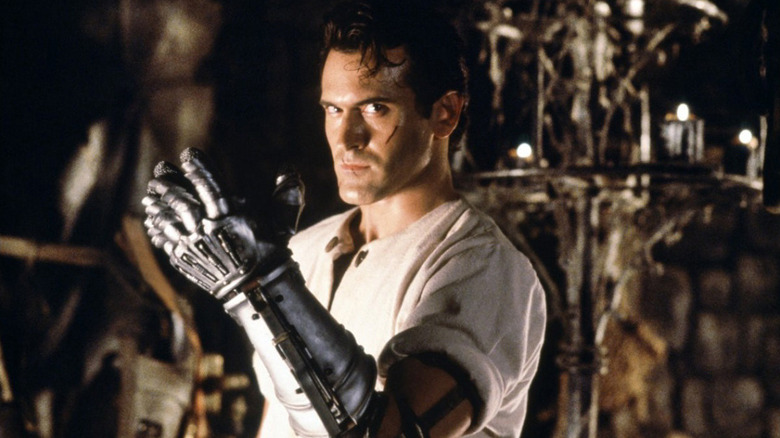
A hapless hero who could save humanity from an undead curse is repeatedly stopped in his tracks by making the wrong decision at every turn. That could describe Austin Abrams' protagonist in "Resident Evil" but equally fits Bruce Campbell's Ash Williams in Sam Raimi's "Army of Darkness," where the horror hero transforms into the Buster Keaton of gore; unsurprisingly, those are the best movies in this franchise. Although tonally closer to "Evil Dead II," Abrams' Bryan is more similar to this iteration of Ash, gradually buying into his own hype as an action hero despite stumbling from one bad decision to the next.
His main flaw in the final act at the Umbrella Corporation is believing that he's grown to overcome all obstacles, and that he'll be received as a hero for transporting the cure, when in reality, he still hasn't stopped to think about how his actions affect the bigger picture. For Ash, things are even worse, as he's welcomed as a hero in the Middle Ages after killing a Deadite, but soon proves that his disregard for the rules (like not knowing the correct phrase to retrieve the Necronomicon) unwittingly puts people in danger. Both think they can save time and do things the easy way. Raimi and Cregger are kindred spirits for putting flawed, haphazard heroes front and center and letting all hell break loose because they were the ones in the driver's seat.
Hardcore Henry

Your mileage will vary on this last title, which will either energize you with its first-person shooter aesthetic, or leave you with one of the most painful headaches in your life. However, with the brief sequences in "Resident Evil" that call back to the game's first-person shooter perspective, this experiment from director Ilya Naishuller -– who went on to make the more conventional Bob Odenkirk action vehicle "Nobody" — is of interest if you want to see how far that approach can be pushed within a cinematic narrative. Told exclusively from the point-of-view of its titular character, it's a love letter to video games that don't follow coherent logic.
After being woken up in an airship lab by Estelle (Haley Bennett), the lead flees to Moscow, chased by mercenaries, in desperate need to charge his cybernetic led. Sharlto Copley appears as several characters –- respawning after being killed -– who throw exposition at the screen, and visits all the locations you'd expect from a sci-fi shooter. There are abandoned warehouses, strip clubs, hotels, secret laboratories, and cartoonish big bads who lead armies of clones. It doesn't make a lick of sense, but if you can get on its wavelength, it won't matter; it's designed to sweep you up in its propulsion, throwing obstacles at the screen faster than a gamer would know how to respond. It's the over-cranked, over stimulating version of Cregger's "Resident Evil" approach, though its aesthetic could alienate you -– proceed with caution.