

5 Most Historically Accurate Adventure Movies, Ranked
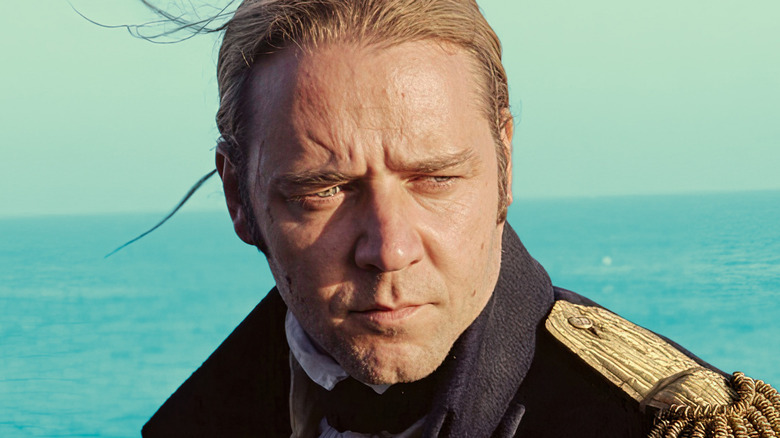
Some of our favorite adventure movies have no basis in reality. Historians look at "Gladiator" as more of a comedy than an authentic sword and sandals epic, while British viewers will laugh off "Robin Hood: Prince of Thieves" showing Kevin Costner's hero riding on horseback from Dover to Nottingham in a single day — and no such silliness will stop us loving either of them. However, for every laughable fudging of the facts in those blockbusters, there are plenty more great adventure films which deserve credit for getting their facts right, and here, we're selecting five of the very best, all of which are as thrilling as they are meticulously researched.
As with many of our prior features counting down the most historically accurate movies in a variety of different genres, the following five titles are ranked from our least-to-most favorite, not least-to-most accurate. As these movies are among the best in their genre, however, we'd advise you don't get hung up on the ranking — each one of these would be a worthy number one if there wasn't such stiff competition.
5. The Man Who Would Be King
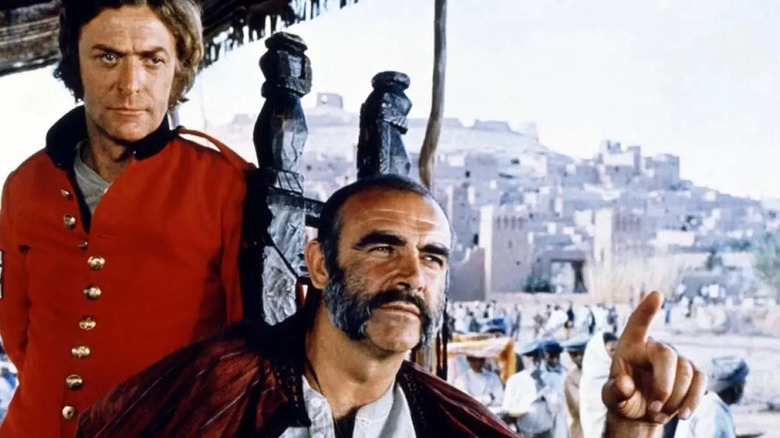
A decades-in-the-making passion project for director John Huston, which would be considered by both Sean Connery and Michael Caine to be the greatest film they'd ever made, "The Man Who Would Be King" is a joyous buddy movie hidden inside a swashbuckling epic. The two actors star as former British soldiers in 1880's India who devise various criminal schemes but, hungry for greater adventure, cook up a plan to travel to the Middle Eastern region of Kafiristan posing as soldier allies, with the intent of overthrowing the king and looting the land. Their expedition is stopped in its tracks as they pass a much-robbed village and end up helping its residents defend themselves from much larger armies — which leads both sides to view Connery's character Davert as something of a God.
Adapted from Rudyard Kipling's 1888 short story, Huston's adaptation manages to similarly balance crowd-pleasing thrills with a commentary on British colonialism. More importantly for this list, however, is the attention to detail with which it invokes the very specific social context for these regions during this period. Kafiristan was a real, remote region that was forcibly converted to Islam in the late 19th century when the Emir of Afghanistan exerted direct rule. Prior to then, it was so difficult to get to, many real-life adventurers would make the perilous journey beyond the mountains to get there.
The two leads have long been assumed to be based on explorers Alexander Gardner and Josiah Hartlan, who similarly travelled to the Middle East in the hopes of making themselves kings. Kipling lifted from Gardner's writings for further authenticity, although considering how fantastical those were (he was alleged to be a fraud for years), they already felt tailor-made for an over-the-top work of fiction.
4. Master and Commander: The Far Side of the World
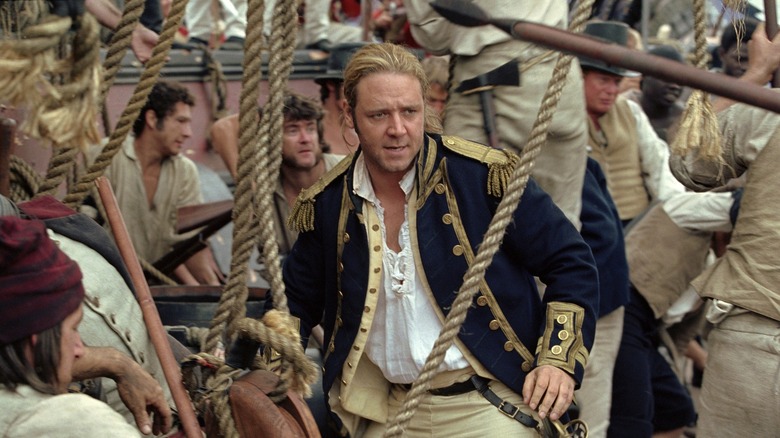
Drawn from Patrick O'Brian's novel series, although not adapting any single entry, "Master and Commander: The Far Side of the World" is as meticulously researched in its depiction of 19th century naval life as its source material. In fact, the only major historical change was imposed on director Peter Weir by the studio, who insisted that the enemy ship be changed from American to French. Although some interpreted this as an attempt to not offend US audiences, it was for the more practical reason of avoiding too much historical exposition about the ongoing conflict between the two nations. Overlooking this, the movie otherwise maintains the faithful depiction of a ship crew during the Napoleonic wars, from stark class divides on board, to routine drills and era-appropriate tactics for naval combat.
Although a fictitious character, ship captain Jack Aubrey (Russell Crowe) and his exploits across the novel series are drawn from real-life accounts of Captain Thomas Cochrane, many of which were detailed in his 1860 memoirs "The Autobiography of a Seaman." They feature a throwaway reference to a surgeon who followed Cochrane from ship to ship, which inspired Paul Bettany's character Stephen Maturin, although both the novel series and the film adaptation were truer to life than expected in depicting that friendship.
Off the pages of the autobiography, the two real figures exchanged many letters when not stationed at sea together, which biographer David Cordingly found in Britain's National Maritime Museum. When even the central friendship is historically accurate, you can rest assured that everybody involved in the production did their homework.
3. Seven Samurai
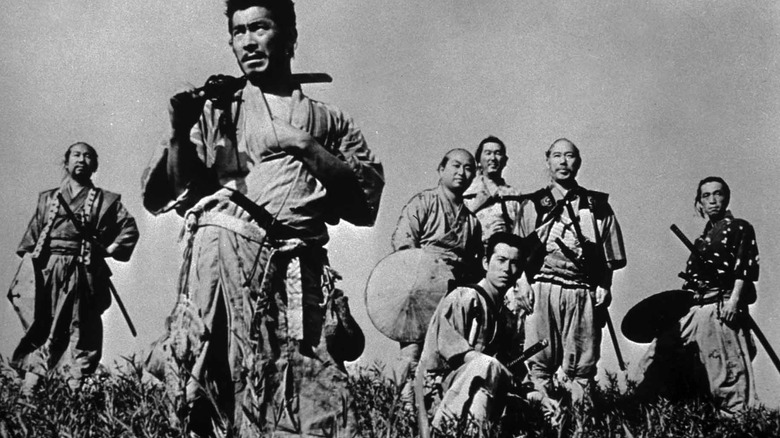
One of the most influential movies of all time, Akira Kurosawa's "Seven Samurai" would be considered his definitive masterpiece (and the definitive samurai movie) if his filmography didn't have such stiff competition. This was the director's first samurai epic, entering production just after the American occupation which prohibited the production of samurai films ended, and immediately established the director as an obsessive when it came to period accurate sets and costuming. This approach extended to researching the era of the story itself: The late 16th century, a period of fascination for the filmmaker because he saw parallels with a post-war Japan in need of rebuilding.
There were rigid class divisions between peasants and the higher-class samurai, who often had to resort to pillaging villages because their code prohibited them from being paid for manual labor. Despite this, there were accounts of samurai defending rural villagers during such a brutal era, and this was something the director wanted to explore as an allegory for a society still reeling from a military dictatorship. Several members of the samurai troupe — including leader Kambei (Takashi Shimura) — were directly inspired by historical figures, with set pieces such as the kidnapping scene directly drawn from biographical accounts of those inspirations.
Film historians view "Seven Samurai" as a direct rebuke to the near-mythic jidaigeki action epics produced under the dictatorship, with a filmmaker who is a descendent of a real samurai clan reassessing and subverting the heroic cliches of the genre. In doing so, he crafted a nuanced portrayal that refuses to whitewash the heroes' darkest crimes, without sacrificing the bombastic sword-slinging action.
2. Lawrence of Arabia
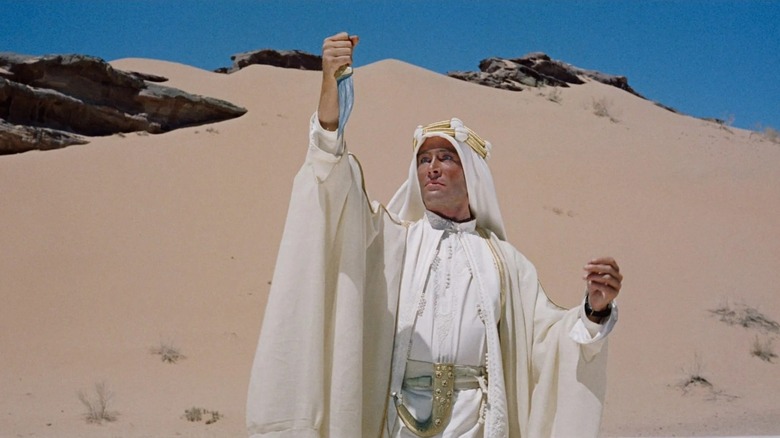
One of the greatest best picture winners of all time, "Lawrence of Arabia" is also the title on this list which has split historians down the middle. Like many period pieces adapted from true events, it takes liberties with the chronology and caused considerable controversy due to certain characterizations. Egypt was the only Arabic country not to ban the movie for its negative portrayal of Arab culture, which even reimagined Prince Faisal (Alec Guinness) as something of a tribal chieftain, despite being a highly educated Turkish politician in real life. Even the casting of Peter O'Toole as Lawrence caused backlash, as the 6'2 actor would have towered over the 5'5 historical figure he was playing.
If this leaves you wondering why director David Lean's beloved epic made it onto this list, look no further than the source material: T.E Lawrence's 1926 memoir "Seven Pillars of Wisdom." Although he was one of several British and French intelligence officers operating in the region, the autobiography positioned himself as being of significant importance, with many historians labelling it self-aggrandizing. This informed the characterization here, with the book also featuring several anecdotes that made it into the movie, from his perspective of events that led to the massacre of 1,500 Turkish troops, to a hospital encounter with a British medic who slapped him, believing him to be of Arabic descent.
Historians also agree that it's a rightfully damning depiction of British foreign policy during this period, with the country causing many more generations worth of conflict by promising the same land to multiple countries. It's not a whitewashed portrait of a controversial figure, and that nuance shines through even when Lean simplifies other aspects of this period to make a rousing epic.
1. Barry Lyndon
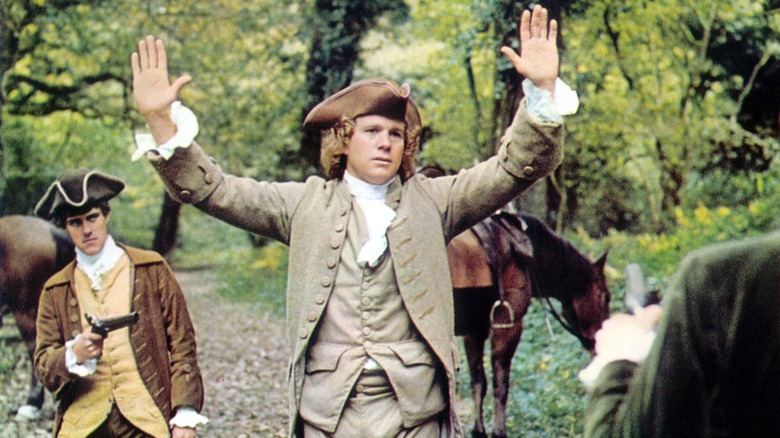
When you think of Stanley Kubrick, the first word that might come to mind is "perfectionist" — and this adaptation of William Makepeace Thackery's 1844 novel was one of his boldest gambits when it came to authentically recreating the past. Working with a desire to make every frame look like an 18th century oil painting, Kubrick used cutting-edge technology (including camera lenses developed by NASA to capture the moon landing) so that he could film using only the natural light in the scene, as he hated the "artificial" look of other period dramas. Then there was the actual look of his actors, with the director studying the fashion and makeup of the period, even going so far as to research specific table manners so they would use napkins in an era-appropriate way.
This highly detailed approach to invoking a bygone period onscreen initially left audiences cold; now considered a masterpiece, one reviewer even compared it to the empty aesthetics of a coffee table picture book. It's a shame, as beneath the restrained emotion is a dry comedy about a social climber (Ryan O'Neal's Redmond Barry) who leaves Ireland to seek his fortune, one misadventure at a time.
He's a fictitious character, but Thackery's novel was inspired by two Irish historical figures (Andrew Robinson Stoney and James Freney) who became infamous for their nobility-fooling cons after arriving in England. With an accurate depiction of various European wars and aristocracies grounding the central character's arc, it succeeds in Kubrick's intent to bring a vivid historical portrait to life.