

Onslaught Ending Explained: What Happens To Celeste?

Contains spoilers for "Onslaught"
Adam Wingard's "Onslaught" is a kind of pre-Halloween punch bowl of flavors — part slasher flick, part '80s action throwback, part dark comedy, part modern military thriller. The sum of its parts is a gory, high-speed ride with equal reverence for "The Terminator" and "The Fog."
In its adherence to the former, Adria Arjona's Celeste is the film's Sarah Connor, doing Linda Hamilton proud as a U.S. Army veteran of an unspecified Middle East campaign now working as the manager of a barren New Mexico trailer park. A surprise weekend with her young daughter Daisy (Blake Kennedy) coincides with a violent attack on the desert community when three genetically enhanced supersoldiers escape from a secret nearby military base. Driven mad by the severe trauma and the experiments of a third-generation Operation Paperclip Nazi scientist named Kammler (Dan Stevens), the trio of heavily armed commandos lay siege to the trailer park, forcing Celeste to confront her own PTSD and rekindle her combat prowess to keep her daughter safe.
The entire back half of the film is one long night, with the supersoldiers stalking the residents of the trailer park one by one. Celeste and Daisy get some help from local delinquent cop Kovacks (Eric Wareheim), and fellow resident and Vietnam vet Josiah (Reginald VelJohnson). Meanwhile, a mysterious government operative named Cyrus (Drew Starkey) begins to clean up the messy trail the commandos have left, uncovering the secrets of the private military contractor who built the killers and colliding with Kammler's enigmatic wife, Hanna (Rebecca Hall).
What happens at the end of Onslaught?
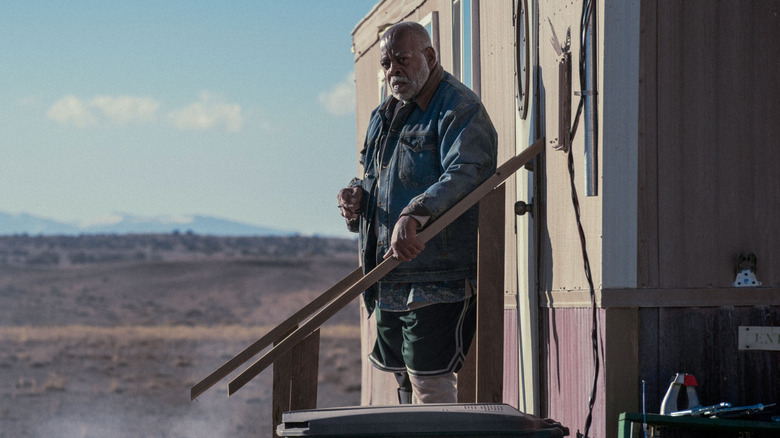
In their frantic battle against the supersoldiers, Celeste and Josiah both take hits, with the latter looking nearly down for the count and unable to move from his trailer. Celeste manages to take the head off one of the attackers as he pursues Kovacks when the policeman makes a break for his car, and a second goes down shortly after in the ensuing mayhem. That just leaves the Butcher (Alex Pereira), the leader of the group, who, it's revealed, has a hidden history with Celeste. They served together in the army, before PTSD left them both changed.
The Butcher purses Daisy, but Celeste intercepts him, chainsaw in hand, for an old-fashioned showdown. With a bit of slick dexterity, she manages to get in under the supersoldier's attack and slice into him, leaving the third and final commando dead.
As dawn arrives, Josiah emerges from his trailer, alive. Cyrus and a group of G-men arrive in a fleet of blacked-out SUVs, along with Hanna Kammler. They administer medical attention to the three survivors, and Cyrus implies to Celeste that if she doesn't willingly relocate with Daisy, things may go badly for them. With no real choice, and no way to warn her ex-husband about why their daughter is about to disappear, she agrees. Hanna watches the situation with an air of Nazi evil, urging Cyrus not to let the survivors — proven capable through their encounter with the supersoldiers — go to waste.
Who is really in charge of the secret organization in Onslaught?

The precise chain of command in "Onslaught" is one of its more confusing elements. Dr. Kammler, we are told, is "third-generation Paperclip," referring to the very real U.S. program of bringing over Nazi scientists after World War II to build rockets for America. That presumably means Kammler is the grandchild of a Third Reich scientist, but his wife is also German, and seems to be the one pulling the strings.
Later, after Cyrus gets involved, we are told that the base from which the supersoldiers escape used to be operated by the government, but that it now belongs to a private military contractor, who are the ones actually funding Kammler's experiments. So there's the government — with a secret division of some sort that Cyrus works for — the military, and this private company, where Kammler and Baylor (Michael Biehn) work.
The confusing part comes at the end of "Onslaught," when Cyrus and Hanna Kammler show up together to the remains of the trailer park. Hanna makes it clear in a phone call earlier in the film that she, for some reason, is now the one in charge, despite Cyrus working for the government directly.
So what's happening here? Most likely, the Kammlers are technically U.S. government assets who are loaned out to the private contractor, which would explain why Hanna's husband has to be blindfolded to go to the base. The darker implication, though, is that the Nazis are deeply embedded in the entire fabric of the U.S. government and military, far more than this isolated incident. Knowing it's not quite built to handle that enormous presence, "Onslaught" keeps things vague. Regardless, Hanna's level of power at the end makes the whole thing deeply unsettling.
Onslaught is a secret sequel to a 2014 film

Part of the key to the secret government landscape of "Onslaught" can be found in one of Adam Wingard's previous films — and no, not "Godzilla vs. Kong." In 2014, Wingard teamed up with his longtime screenwriting collaborator Simon Barrett (who also penned "Onslaught") on "The Guest," a horror thriller about a mysterious U.S. Army veteran named David (Dan Stevens), who shows up to the home of one of his former squadmates after his death. Ostensibly there to offer condolences and help the family in the aftermath, David's behavior becomes increasingly strange, ultimately revealing that he was a test subject in some sort of military experiment.
In an interview with the Associated Press, Wingard revealed that the new film takes place in the same universe and continuity as "The Guest," and that the two secret government organizations are one and the same. "It's not a direct sequel in the sense that it's a continuation of those characters," the director explained, "but it takes place in the same town as 'The Guest,' and the idea is that the secret programs we're seeing going on here are just other little aspects of the same thing that David's character came from in 'The Guest.'"
Unfortunately, "The Guest" has even less explanation for its secret military programs than "Onslaught." Still, the connection between the two does emphasize the scale of weird stuff going on around the town of Moriarty, which seems to be a bit of a world unto itself, free from more explicit government oversight.
Where do they take Celeste at the end of Onslaught?
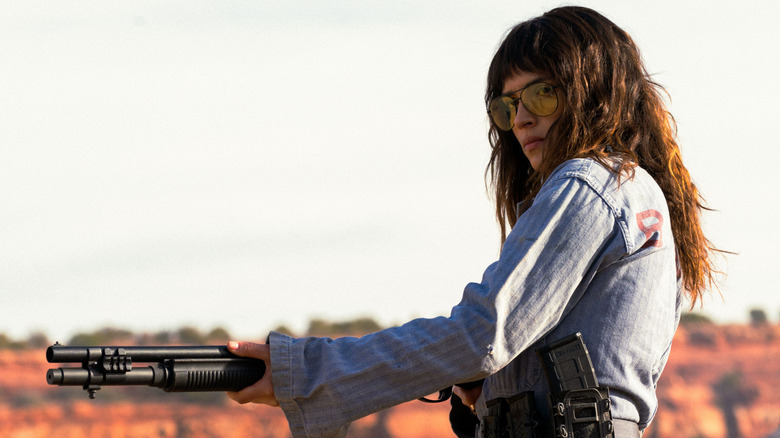
Celeste, Daisy, and Josiah all get relocated at the end of "Onslaught," with a sinister implication that they may be used again in Hanna Kammler's various schemes. Where they go isn't explained exactly, but if you watch through the credits of "Onslaught," you'll get a hint.
The credits play alongside a string of images — missing person's posters for the various inhabitants of the trailer park, and what appear to be fragments of an independent investigation, either from Daisy's father or someone else, into what happened to the three survivors. The final image shows a map of Alaska and suggests that may be where the trio were moved.
Since "Onslaught" is kind of a stealth sequel to a 12-year-old movie, it seems very possible that we'll eventually get some continuation of the story, either with some of these characters returning or entirely new ones dealing with the same shadowy cabal. Alaska lends itself naturally to the sort of stunning vista shots and remote settings Adam Wingard utilizes in "Onslaught," and given how different the film is from "The Guest," it's possible that the sequel could be a different genre entirely, if it ends up happening.
PTSD, Nazis, and the forever war
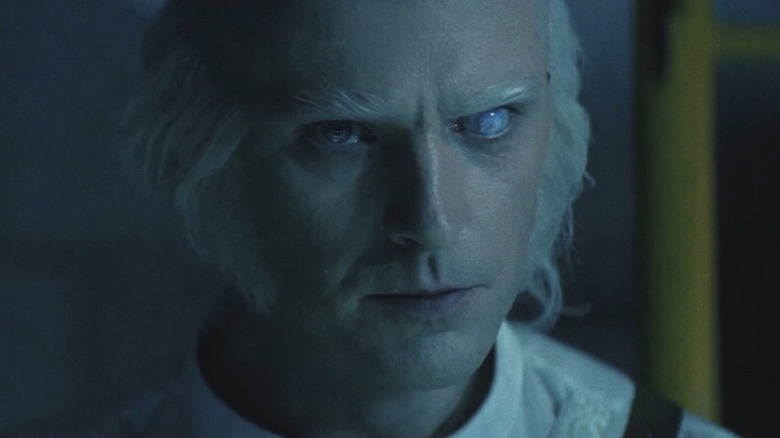
The best war movies understand that the toll of war on the living can be nearly as severe as the fate of the dead, and while "Onslaught" isn't really a war movie, it too carries this theme. The film is more interested in heightened genre aesthetics than it is in saying anything too sophisticated, but it also makes its views patently clear.
The opening credits flash over a dizzying montage of American war over the last century, intercut with Illuminati imagery and different presidents justifying violence again and again. This sets the tone early, and the rest of the film argues the same point — that for most of its modern history, this country has always either been waist-deep in a war, or grappling with the aftermath of one.
"Onslaught" primarily shows the corrosive build-up of harm on veterans, discarded by the war machine after they serve their use, but we are also told that the three supersoldiers are intended for campaigns against a domestic civilian populace — in other words, killing ordinary Americans. "Onslaught" shows a nation of eternal war, crushing all beneath it.
In the same interview where he acknowledged the connections to "The Guest," Adam Wingard said he views "Onslaught" as the "cap" on a thematic trilogy that also includes 2011's "You're Next." All three films deal with PTSD, and how the machinery of violence created for war rarely stops on a dime once it returns home. "Onslaught" is bold and brazen in its style, but it's also often right on the money.