

5 Legendary Western Actors Who Starred In Terrible Sci-Fi Movies
On the surface, Western and science fiction movies couldn't seem more different. The former tends to be incredibly grounded, and even if the plot's not based on a real story, it feels like something that could happen. The sci-fi genre is rooted in more fantastical elements. There might be space travel, time travel, and androids in the mix, showing humanity what's possible in our future rather than looking back at the past.
Then again, you have major projects like Star Trek, which Gene Roddenberry pitched as a Western (specifically "Wagon Train") in space. They've both been immensely popular genres at various points in time, so maybe it's no surprise to see so many Western actors give the sci-fi genre a whirl. Heck, John Wayne has a secret role in "Star Wars: Episode IV — A New Hope" that you probably never realized was there before. And "The Magnificent Seven" star Yul Brynner played a gunslinger robot in 1973's "Westworld" that was oddly similar to his most famous cowboy.
But an actor ditching their bread and butter doesn't always have fruitful results. Plenty of actors who starred in legendary Western films tried science fiction at one point, leading to disaster.
Paul Newman in Quintet
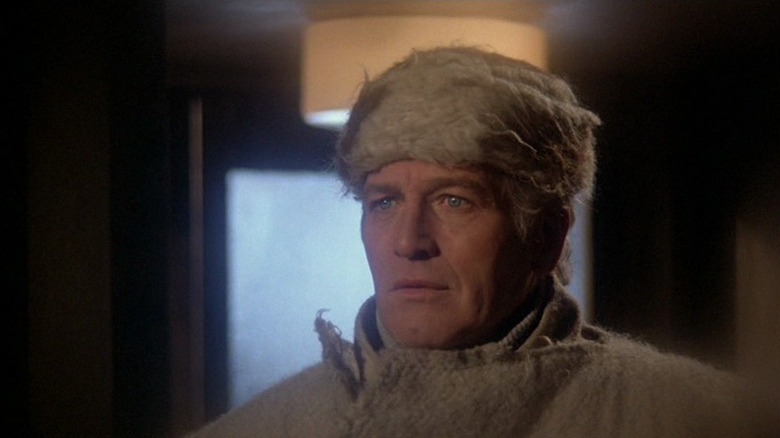
Some of the best Paul Newman movies ever are Westerns. "Butch Cassidy and the Sundance Kid" redefined what was possible within the genre by dismantling the idea of how prototypical outlaws could operate. And even lesser-known efforts like "The Left Handed Gun" and "Hombre" gave Newman a chance to simultaneously showcase his charisma and stoicism. Of course, Newman dabbled in all sorts of Hollywood movies regularly, except for science fiction.
Maybe that's because the one time he did a sci-fi film — 1979's "Quintet" — it was an unmitigated disaster. That may sound surprising, given Newman's acting acumen and Robert Altman on director duties. It's a post-apocalyptic film where humanity has entered a second ice age. Seal hunter Essex (Newman) stumbles upon a bizarre game being played where losing means death. It sounds like the kind of thing that could be prescient to our modern era, where civilization is on the brink of collapse, but people would rather waste time on trivial matters than work together to make things better.
But "Quintet" is a snore. It's not even pleasant to look at, as Altman smeared Vaseline over the camera lens to emphasize the snowy, cold environment. This only makes things blurry, which hurts your eyes after a two-hour runtime. The plot itself is impenetrable. The titular game, Quintet, has undefined rules, so you don't know what's going on until someone's trying to kill another player. It's a movie trying to get a philosophy across rather than being entertaining in the slightest, so it's not surprising Newman would steer clear of sci-fi after it.
Jack Palance in Cyborg 2
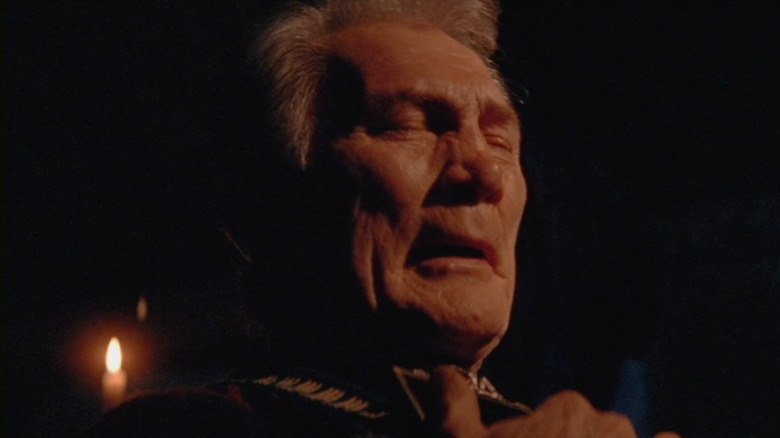
Jack Palance was no stranger to Westerns, whether he was portraying a grizzled villain or a morally complex hero. Easily, his most iconic performance is as the terrifying Jack Wilson in 1953's "Shane." He barely has any screen time, but when he appears, he commands the screen even when he's just standing still.
Palance brought a certain gravitas to every role, which helped lend some credence to the 1993 sci-fi flick "Cyborg 2." With a title like that, you might not exactly be expecting high art, but even the movie's attempt at action-heavy sci-fi fun gets hampered. Set in 2074, the plot follows a cyborg named Cash (Angelina Jolie), who's tasked with blowing up a rival company's board of directors. However, her combat trainer Colt 45 (Elias Koteas) falls in love with her and has her escape.
Palance plays Mercy, who guides Cash in her journey while reckoning with the discovery that he, too, is a cyborg. It's hard not to watch "Cyborg 2" and see it as a cheap imitation of "Blade Runner." The first "Cyborg" starring Jean-Claude Van Damme wasn't exactly a masterpiece, but the sequel falls short of even that. That's probably due to the fact it has almost nothing to do with the first film. It has a separate, mostly nonsensical plot that randomly inserts flashback scenes involving Van Damme to try to build a connection, but it slows things down even further. It's one of many sci-fi sequels you probably didn't know existed until now, and it should probably remain forgotten.
Kirk Douglas in Saturn 3
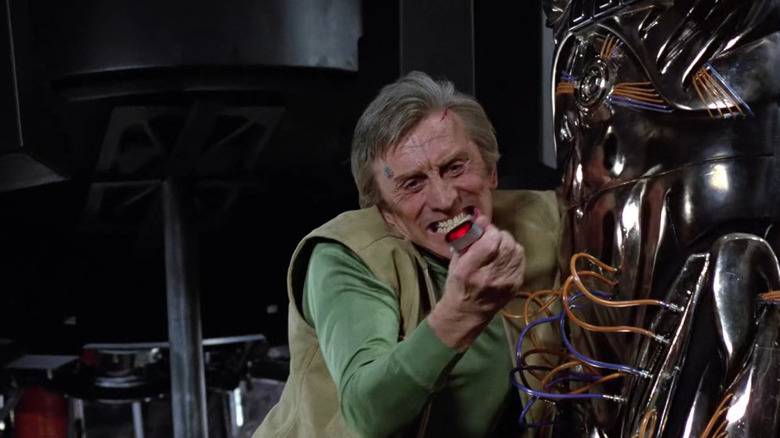
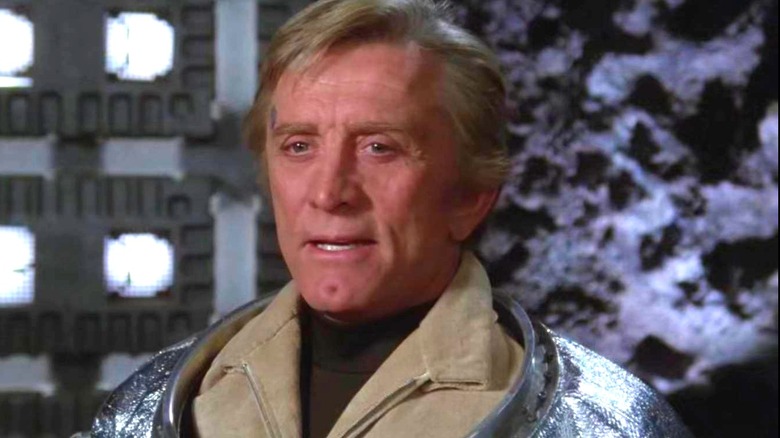
Kirk Douglas' contributions to the Western genre span numerous decades. He went from traditional Westerns that had very clear viewpoints of good and evil, like his turn as Doc Holliday in 1957's "Gunfight at the O.K. Corral," to more revisionist turns, like the 1975 political satire "Posse." Of course, at a certain point, Westerns went out of fashion. Blockbusters like Star Wars proved that science fiction could make big bucks, and it seems as though Douglas wanted to get his own Star Wars with 1980's "Saturn 3."
Fortunately, there aren't two other Saturn movies you have to watch first. Here, Adam (Douglas) and Alex (Farrah Fawcett) work on a research space station called Saturn 3 where they're soon joined by the maniacal Benson (Harvey Keitel, who is weirdly dubbed by Roy Dotrice), who wants to replace at least one of them with a robot, Hector. But the robot gains Benson's consciousness, including his homicidal lust, and goes on a rampage, trying to woo Alex and killing anyone in its path.
Hector may be one of sci-fi's most evil robots, but everything else in the film is lacking. It's pretty uncomfortable from the start, given the massive age gap between Douglas and Fawcett, and things don't get better when the robot tries to assault Alex. And despite all these characters supposedly being smart, they make one dumb decision after the next. "Saturn 3" is meant to be a dark science-fiction horror film, but you'll probably just wind up laughing at it.
Robert Vaughn in Battle Beyond the Stars
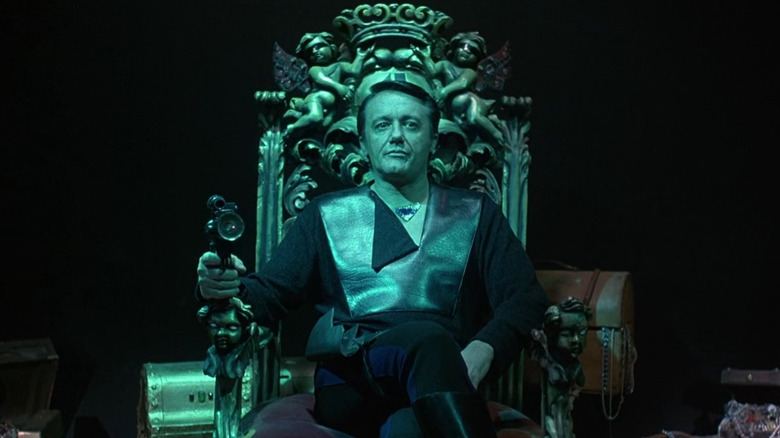
Robert Vaughn had a few Westerns under his belt, but he only needed one to permanently impact the genre. Vaughn might be best known for playing Lee in "The Magnificent Seven." Lee is a world-weary veteran who differentiates himself from the rest of the seven by being filled with self-doubt and worry rather than being a stoic yet sure gunslinger.
Producer Roger Corman effectively got Vaughn to play the exact same character in 1980's "Battle Beyond the Stars," which is a sci-fi retelling of "The Magnificent Seven" anyway. After a warlord threatens a peaceful farm planet to submit to him or face annihilation, a young farm boy sets out to recruit a collective of powerful warriors, one of whom is Gelt (Vaughn), a cynical assassin who's constantly paranoid that everyone is out to get him due to a lifetime of making enemies.
The movie pretty much speed-runs through the plot beats of "Magnificent Seven," clearly assuming you've seen it before. And all that means we never really get time to grow connected to the characters. Unlike "Magnificent Seven" (and its inspiration, "Seven Samurai"), "Battle Beyond the Stars" features archetypes designed to look cool and, in Sybil Danning's case, look good in a metal bikini. As a schlocky piece of '80s sci-fi, it undoubtedly has fans somewhere. But it'll just remind you of much better movies out there.
Charlton Heston in Solar Crisis
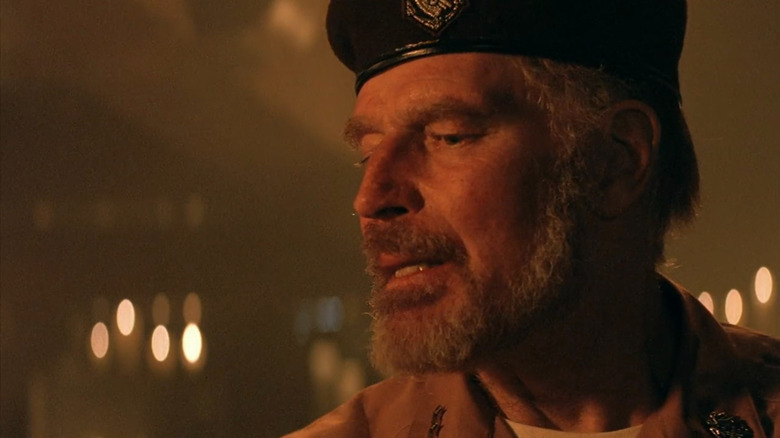
Charlton Heston could do it all. He could be a lonely cowboy in "Will Penny" or be one of the last remnants of humanity in "Planet of the Apes." That's plenty of fine pedigree in both the Western and science-fiction categories, but Heston does have a few blemishes here and there, notably with the 1990 sci-fi film "Solar Crisis."
Just to give you a sense of how bad the film is, director Richard C. Sarafian was officially credited as Alan Smithee in the credits, the catch-all name filmmakers use when they don't want to be publicly affiliated with a movie. "Solar Crisis" was a joint production between the United States and Japan, and after a muted response overseas, the film was heavily cut up to secure U.S. distribution. Therefore, Sarafian wanted to separate himself from the finished product, but Heston could have no such luxury.
The film is about astronauts needing to drop an anti-matter bomb into the sun to prevent a solar flare from destroying the planet, sort of the opposite of the vastly better "Sunshine." That might be entertaining enough, but the film moves at a glacier's pace, getting bogged down in side plots rather than getting into the meat of the story. It's a movie that wants to be an action-packed spectacle and a philosophical meditation, but winds up doing neither well.