

The End Of Oak Street Ending Explained
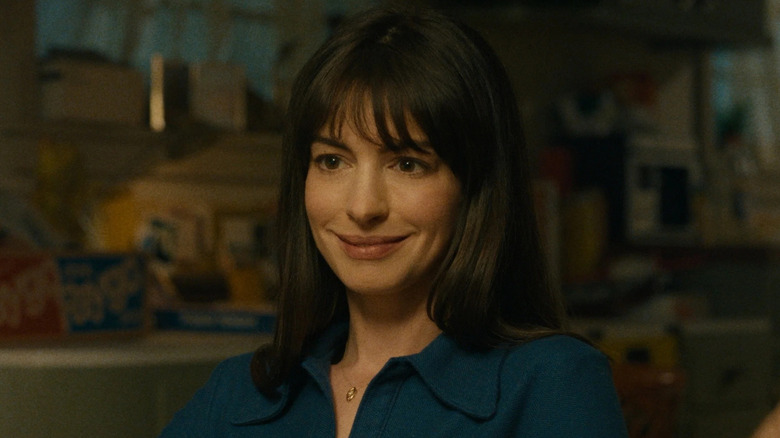
Films produced by J.J Abrams have previously arrived with mystery box marketing that raises more questions than answers; who could forget the first cryptic teaser for "Cloverfield" which didn't even include the title? Naturally, being a producer on director David Robert Mitchell's "The End of Oak Street" hinted there was more than met the eye, even after the first teaser revealed its premise about a family whose neighborhood was sent back to the prehistoric era, where they have to fend off dinosaurs. It's an elevator pitch that made you sit up and take notice, but was it the only trick Mitchell had up his sleeve?
The biggest surprise of "The End of Oak Street" is that it is exactly what it says on the tin: a classic, Spielbergian family adventure that harks back to the Amblin classics of the 1980s. It's a fun time that offers more than simple nostalgic thrills, but your affection for it will be increased if you grew up on the films that inspired Mitchell. There are no big secrets to unpack -– however, our post-screening deep dive uncovered the greater emotional resonance for its creator, with themes every bit as personal as the ones Spielberg explored in his earliest blockbusters.
Before we dive into those, however, here's a quick plot refresher.
The beginning of the end (of Oak Street)
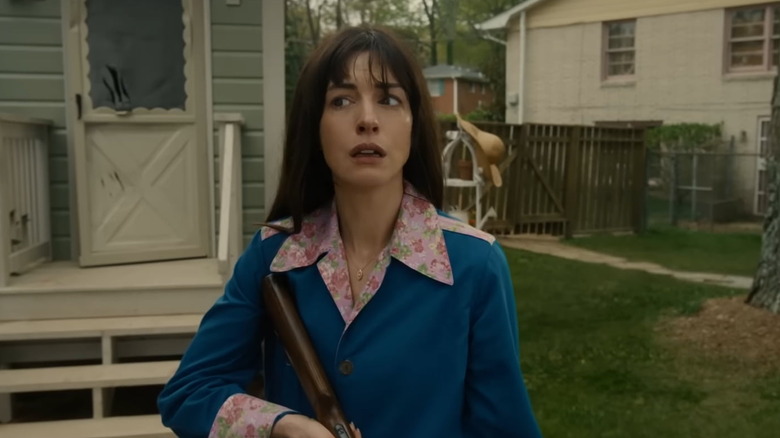
Things take a turn for the worse after Greg (Ewan McGregor) tries to distract a dinosaur from eating Denise (Anne Hathaway), with the patriarch gobbled up in front of his wife and children, Audrey (Maisy Stella) and Brian (Christian Convery). Alongside the newly orphaned Jeanette (Jordan Alexa Davis), Denise tries leading them a safe place away from the rampaging reptiles, with the kids struggling with their grief and worried about a growing fire engulfing the neighborhood. After a close call with a Titanoboa, the family notice a wormhole has just opened above the garden of librarian Mrs. Valcourt (Emily Kuroda), which can only be accessed if they jump into it from the roof.
Jeanette jumps through fine, but it closes just as Brian leaps, causing him to badly sprain his leg -– his yelp of pain alerts dinosaurs to the scene, but luckily, their dog Starbuck returns to fend them off (good boy!). Now, smaller but just as deadly dinos are running amok through Mrs. Valcourt's house, but luckily, she has a shotgun, and takes them out in enough time for the family to jump through the wormhole. They arrive back in Oak Street, landing comfortably in a neighbor's pool a few blocks from their home, where they discover that they've gone back less than an hour before the wormhole gobbled everybody up.
The ending of Oak Street
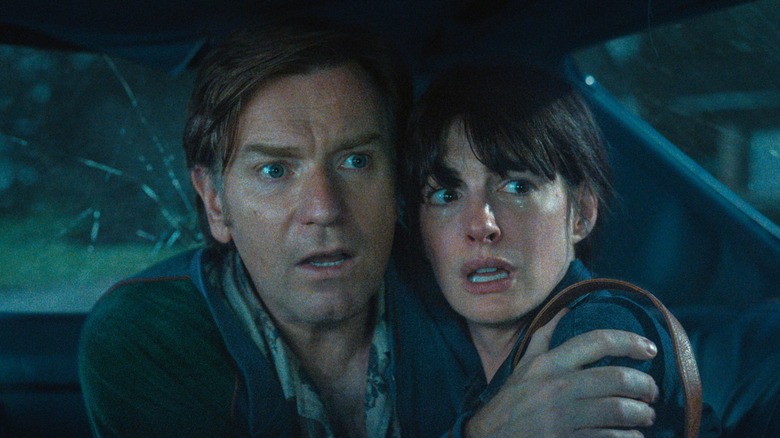
Leaving would save them, especially when they see the time is 10:45, just 20 minutes before the wormhole opened. However, with the clock rewound, the family have an opportunity to reunite with Greg, who they bump into delivering pizzas in the safe area a few streets up. With no time to waste, they embrace, watch the wormhole cover their neighborhood, and head off. We flash forward two years later and discover that Denise saved the day, alerting everybody in the neighborhood to escape with the brief time she had.
We also hear that, despite two years of research, scientists have still not discovered why a wormhole would manifest here, and why it linked to that specific prehistoric era; thankfully, the neighborhood was thankfully abandoned before the dinosaurs could do much damage in the present day. Greg and Denise were on the brink of divorce, but after briefly living a life without him, Denise realizes she still loves her husband, and they're at their happiest during this brief glimpse to the future.
More importantly, Denise hasn't sacrificed her career and is about to publish a non-fiction book titled — you guessed it — "The End of Oak Street" about her experience through the wormhole, and the alternate reality she helped everybody escape. Greg doesn't have these memories, however, but a picture of the deceased Greg posing in front of two dinosaurs having sex is hung on their walls as proof that he was there, even though he luckily doesn't remember it.
Wormholes
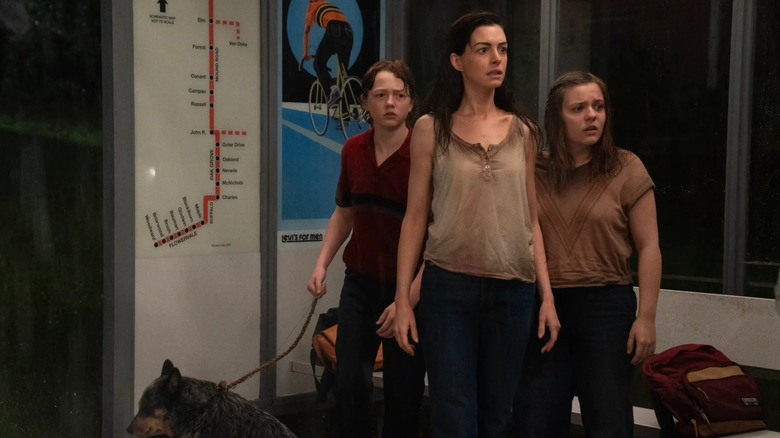
At the beginning, Audrey tells her friends about her love for Carl Sagan, and her dream of studying at Cornell University, where he was a professor at the time. His hit 1980 series "Cosmos" and its best selling tie-in book made him a household name, and her fandom is how she recognized the phenomena of wormholes before anybody else. As can be heard in a news report over the epilogue, scientists still don't know why these naturally occurring wormholes transported Flowervale 65 million years into the past.
This is a quick and easy way for the writer/director to get out of answering detailed questions. Audrey explaining that the portals were initially smaller tremors building up to a bigger one which swapped the whole neighborhood tells us all we need to know, allowing more focus on the emotional core rather than exploring a subject which would require more exposition.
However, "Oak Street" is set in 1982, and there is a historical inaccuracy which seems to have crept through another wormhole. Sagan hadn't written or theorized about wormholes at this point in his career and would only go on to write about them in his sole fiction novel "Contact" in 1985. He was originally going to explore space travel via the more familiar concept of a black hole, but physicist Kip Thorne's advice and prior research pointed him in another direction; but at the time of the film's setting, wormholes weren't his area of expertise.
Subverting Spielberg
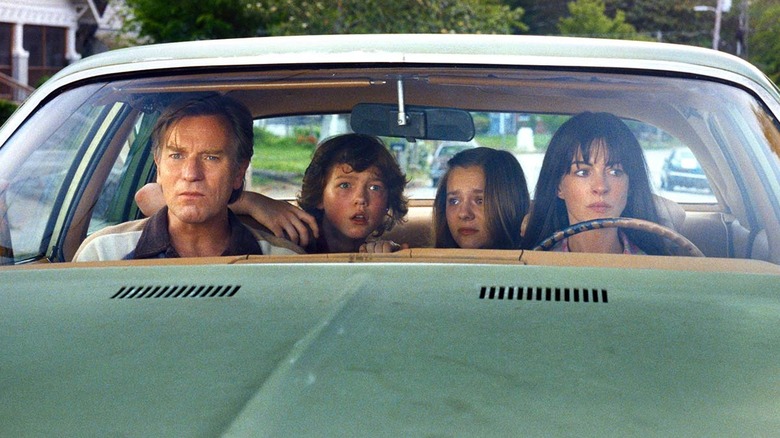
Aside from containing more dinosaurs than "Jurassic Park" could handle, the biggest connection to Steven Spielberg's filmography is its divorce narrative. Long before "The Fabelmans," it was clear that Spielberg's parents' divorce shaped his outlook, with many of his earliest masterpieces being attempts to reckon with it. The father whose obsession with aliens leads him to abandon his family in "Close Encounters of the Third Kind" is Spielberg's attempt to understand why a parent would leave, and in response, "E.T: The Extra-Terrestrial" explores this dynamic from a child's perspective.
Mitchell doesn't hide behind sci-fi allegories; Denise and Greg are arguing in front of their kids from the start, with Denise's novel being a thin veil for her emotions. After going back in time, their relationship heals –- what's a better memory to bond over than taking a cheesy photo in front of mating dinosaurs? – but only after Greg is chomped up does Denise realize she doesn't want a life without him.
After returning to the evening before the event, she helps the entire neighborhood avoid getting swallowed back into the wormhole, with her husband as the ultimate priority. Two years later, they're still a happy family, with this glimpse at a worst-case scenario shocking them back into being a loving unit once again — an unashamedly sentimental ending you wouldn't find in any of Spielberg's tales of broken homes. It's the biggest twist on his classic adventure movie formula.
A Loving Tribute
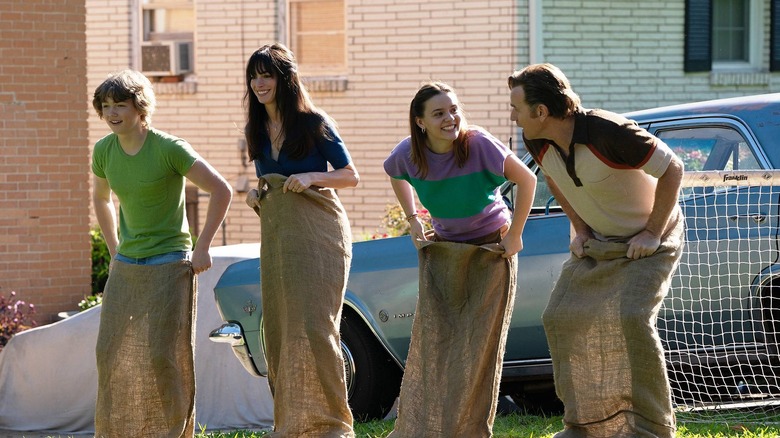
"The End of Oak Street" is dedicated to three people, but the one who gets an individual title card is the writer/director's father, Robert Allen Mitchell, adding an extra emotional dimension. Rather than being about a family getting back together after the threat of divorce, it can be interpreted as an even more touching tribute from son to father, with the family turning back the clock to spend more time together.
This is Mitchell's fourth movie, and the third he's set in the Detroit suburbs (after "It Follows" and "The Myth of the American Sleepover"), with city natives having already spotted various throw-away references to the city's culture. The director would have been 7 years old -– slightly younger than the Platt's son Brian here –- in summer 1982, when this story unfolded, and the nostalgic depiction of childhood in the suburbs makes it clear that Mitchell is drawing from his own early memories of growing up there.
In a 2015 interview with his hometown paper The Detroit News, Mitchell shared that he writes about those neighborhoods because of their unique identity; "I'm aware there's a sense of 'The American Suburb' and that's how it's seen, but for me, growing up there, it is specifically Metro Detroit." With most of his family still living in the Metro Detroit area, "The End of Oak Street" pays tribute to his loved ones and hometown -– albeit with a lot more dinosaurs.