

Tony Review: This Anthony Bourdain Biopic Leaves A Bitter Taste
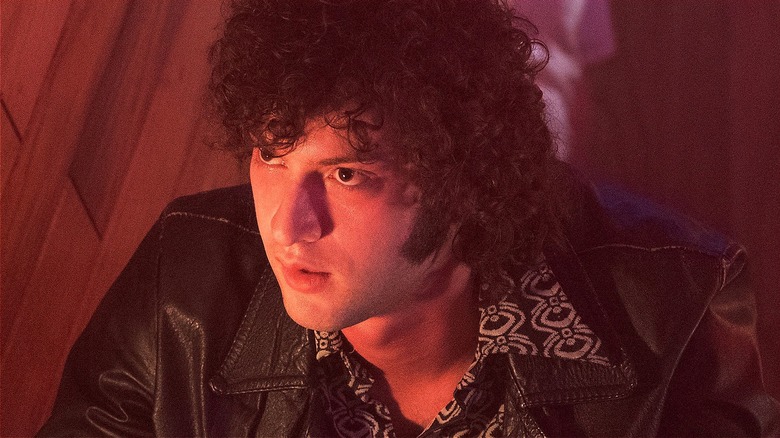
- Performances are solid, especially Antonio Banderas and Leo Woodall
- Certain kitchen scenes are tight, tense, and fun
- Far too much foresight about the subject's life (and overplays its hand)
- Plot gives a central focus to romance, not cooking
- The film is mostly filled with empty character archetypes
This review contains discussions of addiction and suicide.
For a handful of reasons, I was apprehensive going into "Tony," writer-director Matt Johnson's biopic of chef, travel writer, and television host Anthony Bourdain. Biopics are tricky, and a lot of them stick to tired formulas or tweak real details until the person being depicted feels unrecognizable. As for Bourdain specifically, he was a famously cantankerous, prickly, curious, brilliant, and well-traveled man who died by suicide in June of 2018 (while filming an episode of "Parts Unknown" in France with his friend and collaborator, chef Eric Ripert). So how does "Tony" — adapted from one specific part of Bourdain's memoir "Kitchen Confidential" by Johnson and co-writers Matthew Miller, Todd Bartels, and
Lou Howe — depict this complicated, fascinating man?
That is a tough question, and one I've been attempting to answer since I saw a screening of this A24 film. First, some basics. Dominic Sessa, the breakout star of "The Holdovers" who also held his own in the goofy threequel "Now You See Me: Now You Don't," portrays a young Bourdain, who's attending Vassar College and trying to become a writer. After Tony loses out on a writing fellowship, he lies to everyone in his orbit — his parents Pierre and Gladys Bourdain ("Mad Men" alum Rich Sommer and "Succession" veteran Dagmara Domińczyk) and the object of his affection, Nancy (Emilia Jones) — and runs to Provincetown in Cape Cod, where he gets a job at a small beachside restaurant. (In real life, Bourdain worked at the Lobster Pot; the fictional version in the film is called The Flagstaff.)
There, Sessa's Tony meets the restaurant's learned head chef (Antonio Banderas), the charming but sleazy Sal (Leo Woodall), and Stavros (Stavros Halkias, of course). So does "Tony" truthfully depict Bourdain's early years in the kitchen?
Anthony Bourdain's time in Provincetown is depicted strangely
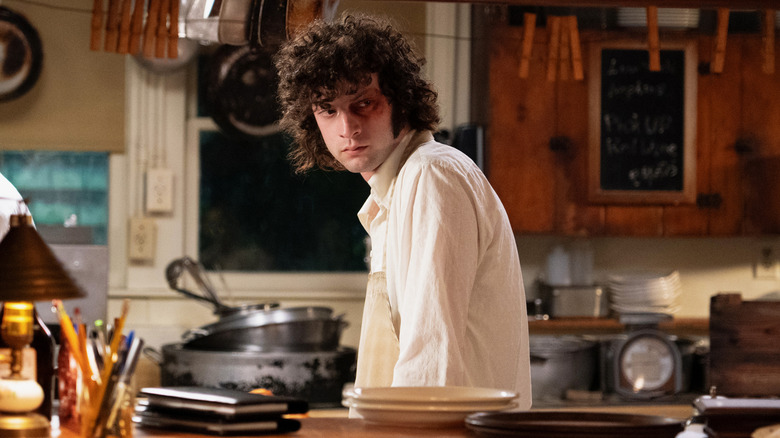
Throughout the runtime of "Tony," I did not feel, despite Dominic Sessa's engaging, fully game performance, like I understood the man, the myth, and the legend that was Anthony Bourdain. Granted, it's hard to capture the guy's entire essence in one film; there are three different reality TV shows ("No Reservations," "The Layover," and "Parts Unknown") that put him on full display if that's what you're after. The bigger issue I had was, honestly, that at no point did I buy that Sessa's Tony really enjoyed cooking that much, because he kept telling the audience and his paramour Nancy that he's a writer, not a guy who works in a kitchen.
That's also partly because Matt Johnson and his co-writers leaned into Bourdain's youthful dishonesty; almost everything that comes out of Tony's mouth is an outright falsehood, from claiming he did get the writing opportunity at Vassar to pretending he's writing about Antonio Banderas' unnamed chef when Nancy asks why he's breaking down a freshly caught tuna in the kitchen. Though the kitchen scenes in "Tony" are the only fun ones — especially moments that show Tony slicing his hand open trying to shuck an oyster or getting hazed by the other chefs with a hot pan — the film doesn't do a particularly great job of selling you on the idea that this version of Bourdain actually loved food, which he did.
For that matter, the movie is also lying to you. Though the real Bourdain did follow a woman named Nancy (his first wife) to Vassar, he didn't follow her to Provincetown — but he sure does just that in "Tony." This points to another big issue with the film: the characters.
The characters in Tony feel as thin as a high-quality chef's knife
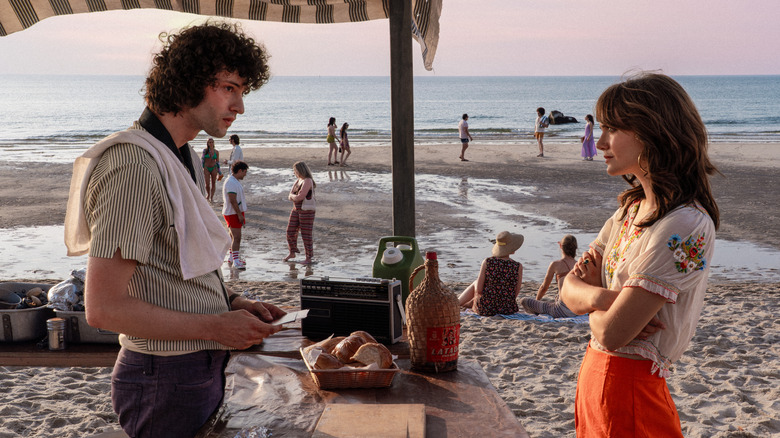
The characters in "Tony," when all is said and done, have as much heft and weight as garlic skin. The aforementioned Nancy, played gamely by Emilia Jones, has no purpose other than to make Tony sad when he sees that she's dating a coworker at a Provincetown pizza shop. Sal is a cautionary tale who abuses drugs and alcohol, a bizarre nod to Bourdain's substance-fueled days working in New York City kitchens (something also described in "Kitchen Confidential"). Antonio Banderas' Chef, a man who reluctantly houses a wayward Tony and wakes him each morning with a bucket of water to the face at first, is also just sort of a caricature; even when he explains that he toiled in Michelin-starred kitchens so that he could open his own restaurant in Provincetown, he just feels like a plot device. Nancy, in particular, gets a comically outsized amount of screen time — yet the cooking scenes outshine all of the romantic ones.
Matt Johnson, who made "Nirvanna the Band the Show the Movie," is funny; "Tony" is not. There's a belabored joke about the Culinary Institute of America and the CIA, and Banderas' Chef attempts a "Social Network" move by telling the young chef to go by his full name instead of Tony. Between weird changes to Bourdain's actual biography, an often clunky script, and a bizarre lack of attention to the art of cooking, this biopic doesn't even come close to capturing the essence of the deeply unique man that was Anthony Bourdain. "Tony" leaves behind a bitter taste, which is incredibly unfortunate ... because the late, great Bourdain deserves a better biopic.
"Tony" opens in a limited release on August 7 and nationwide on August 21.