

The Odyssey Twists Christopher Nolan's Most Famous Storytelling Trick
Contains spoilers for "The Odyssey."
Though the mythical world of "The Odyssey" is a new one for Christopher Nolan, his fingerprints run all through it. It is his signature non-linear story, told out of sequence through underscored montage, condensing a vast expanse of time and space into a tight experience. The Nolan grandeur is here, though a bit more embellished to maintain the mythopoetic sentiment. And of course, there's his most famous storytelling trick — the third-act answer to his film's ongoing mystery. But in "The Odyssey," the director flips his own convention on its head.
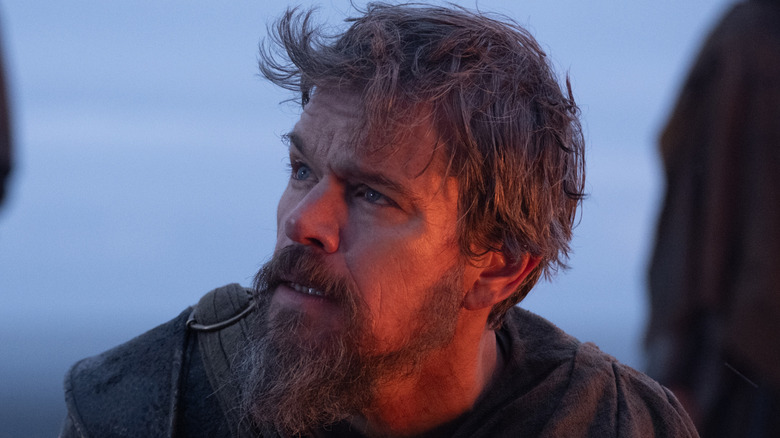
Nolan fans know the premise well — the repeated question, brought up numerous times from the beginning straight to the final chapter, where the key piece of information is revealed. In "Memento," it's the story of Sammy Jankis. In "Interstellar," it's the ghost in the bookshelf. In "The Prestige," it's the teleportation trick. And in "The Odyssey," the question is one Odysseus (Matt Damon) is repeatedly asked along his long journey back to Ithaca: Why doesn't he want to go home?
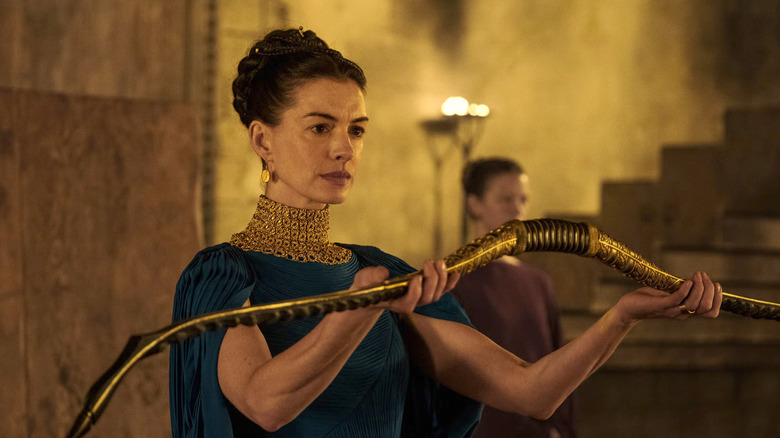
This is the foundation of Nolan's unique angle — that Odysseus' own fear of return, not just the wrath of Poseidon, has shifted fate against him. In the final act, we get the answer as a disguised Odysseus confesses to Penelope (Anne Hathaway) the horrors he wrought at Troy. However, unlike twists from other Christopher Nolan movies, it's a reveal we all should have seen coming, adding to its impact.
One man's trick to break Zeus' Law forever
From the start, "The Odyssey" emphasizes that all decorum in this ancient world is built on a basic set of moral standards ascribed as "Zeus' Law." This primarily dictates how to treat guests and strangers with kindness and generosity, as they may be gods in disguise. It is the founding principle upon which a great civilization was built, and as the film shows, that civilization is failing.
When he finally returns to Penelope, dressed as a beggar, Odysseus takes the blame for that collapse. "What if, when he left the belly of the horse, and opened the gates of Troy, he saw 10 years of rage pour into that city in one night?" he says. "We left them a gift, an offering of peace, that they took into their home. We violated all that's ever sacred between people."
It is this shattering of the most basic covenant between men that is positioned as the source of Odysseus' suffering. More importantly it is why, despite his claims to the contrary, he truly did not wish to go home, as well as why he eagerly eats the lotus flower and forgets his life upon washing up on the island of Calypso (Charlize Theron). "One man's trick to break Zeus's law forever," Odysseus tells Penelope. "We lived in a world of palaces and trade, language, blind to its beauty, until we broke it."
The Trojan Horse is the ultimate betrayal
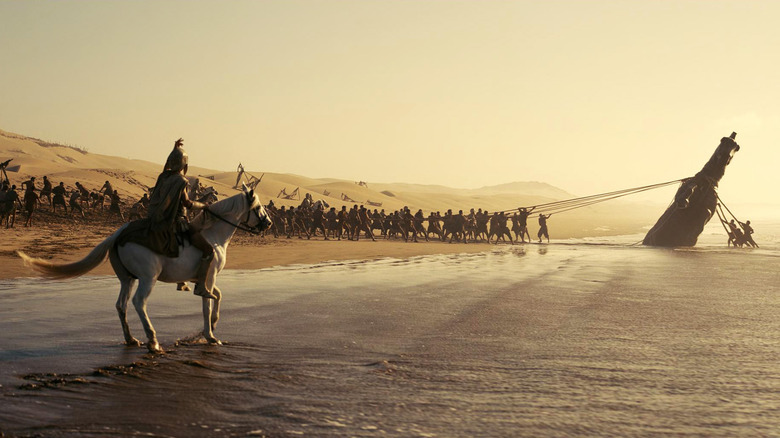
The way Odysseus lays out his confession at the end of "The Odyssey" is familiar. It echoes Don Cobb (Leonardo Dicaprio) in "Inception," who admits at the end that it was he who planted the idea in his wife's mind that her world was not real — an idea that led to her suicide. Yet in every other Nolan film, the true missing piece is something we don't know until we are told. In "The Odyssey," it's something we should have understood from the beginning.
It is the movie's resounding truth, from start to finish. The film opens on the horse, a gift meant to stab its receiver in the back, and at every turn, we learn that such an act is a defilement of sacred law. Every time Odysseus finds land, its denizens greet him with hostility, because how could he ever receive a warm welcome after doing what he did?
When we first witness the fall of Troy, it's a triumph. When we revisit it during Odysseus' confession, there is only horror. The trick Nolan plays this time is not withholding the answer, but hiding it in plain sight. He doesn't have to keep it from us, because he knows we will buy into the myth. And in the confession, he flips his own question upside-down. Why does Odysseus not want to come home? How could he ever come home after, in his own words, burning the world-entire?