

5 Movies To Watch If You Like Christopher Nolan's The Odyssey
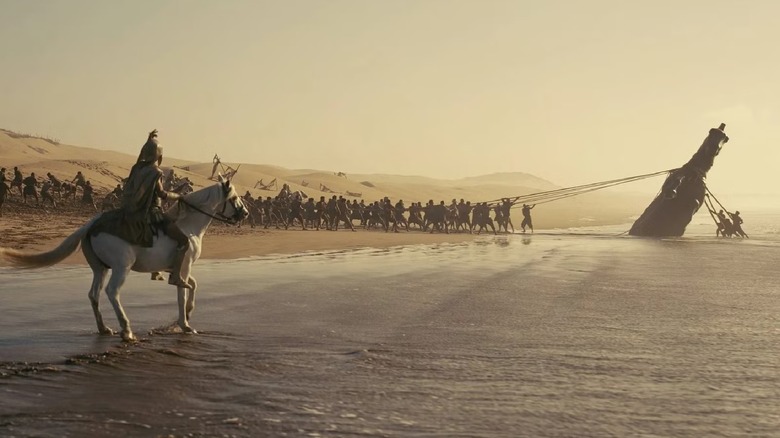
Christopher Nolan's adaptation of "The Odyssey" is finally here, and his take on the epic Greek poem attributed to the blind writer Homer is his first film since his 2023 Oscar winner "Oppenheimer." For his take on this classic tale, Nolan enlisted his creative team — wife and producing partner Emma Thomas, composer Ludwig Göransson, and cinematographer Hoyte van Hoytema, just to name a few — and reunited with collaborator Matt Damon to cast him as Odysseus, the tragic hero who finds himself hopelessly lost at sea after winning the Trojan War.
Damon is joined by a whole host of A-list stars, including Anne Hathaway as his long-suffering wife Penelope, Tom Holland as his nearly-grown son Telemachus, Benny Safdie as the king of Mycenae Agamemnon (and Jon Bernthal as his brother Menelaus, the king of Sparta), Lupita Nyong'o as Menelaus' captive wife Helen of Troy (and her twin sister and Agamemnon's wife Clytemnestra), Himesh Patel as Odysseus' right-hand man Eurylochus, Elliot Page as the soldier Sinon, John Leguizamo as the loyal swineherd Eumaeus, Charlize Theron as the nymph Calypso, and Zendaya as the goddess Athena ... just to name a few. As Odysseus and his men try to return home from the war and face trials and obstacles, their number dwindles — leaving Odysseus to reunite with his wife and son on his own.
This star-studded adaptation of one of the world's most famous stories is genuinely phenomenal, and if you want to keep watching great, epic films once you leave the movie theater, we've got you covered. From other masterpieces by Nolan to a very offbeat take on "The Odyssey" to the conclusion of one of the greatest fantasy trilogies ever made, here's what you should watch after "The Odyssey."
Oppenheimer
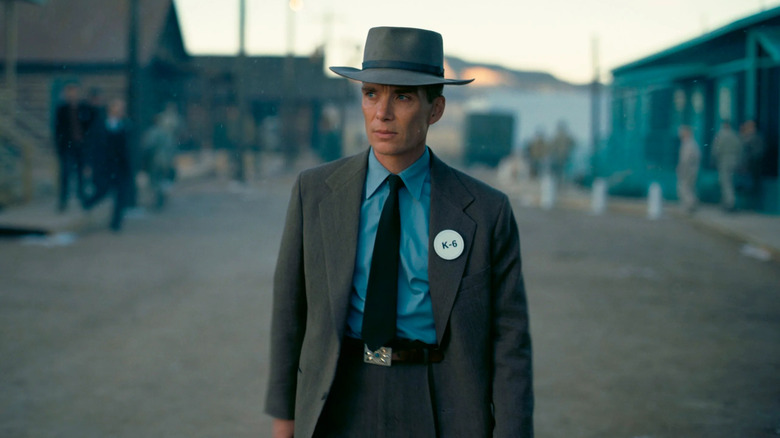
It's almost impossible to have a conversation about Christopher Nolan's version of "The Odyssey" without referencing "Oppenheimer." Adapted from Kai Bird's tome "American Prometheus," Nolan casts Irish star Cillian Murphy as the famed theoretical physicist J. Robert Oppenheimer — a role that ultimately netted Murphy his first Academy Award for best actor — and approaches his story using a dual timeline, providing a similar approach to "The Odyssey" (in which Odysseus describes most of his journey to Calypso in flashbacks).
In one timeline, we watch as Oppenheimer works with military men like Gen. Leslie Groves (Matt Damon) and fellow scientists like Ernest Lawrence (Josh Harnett) and Edward Teller (Benny Safdie) on the Manhattan Project at Los Alamos, where he's instrumental in creating an atomic bomb. In the other, we witness the personal pain and strife that Oppenheimer and his wife Kitty (Emily Blunt) endure as Oppenheimer is baselessly investigated by the US Atomic Energy Commission, which is engineered by the resentful Rear Admiral Lewis Strauss (Robert Downey Jr.), during which Oppenheimer's long-standing affair with accused communist and psychiatrist Jean Tatlock (Florence Pugh) is uncovered.
On the surface, "Oppenheimer" and "The Odyssey" are both extraordinary epic films that share cast members, but they're also about the hubris of man — and how any man can become death, the destroyer of worlds if given the chance. If you haven't seen "Oppenheimer" you must watch it after "The Odyssey."
O Brother, Where Art Thou?
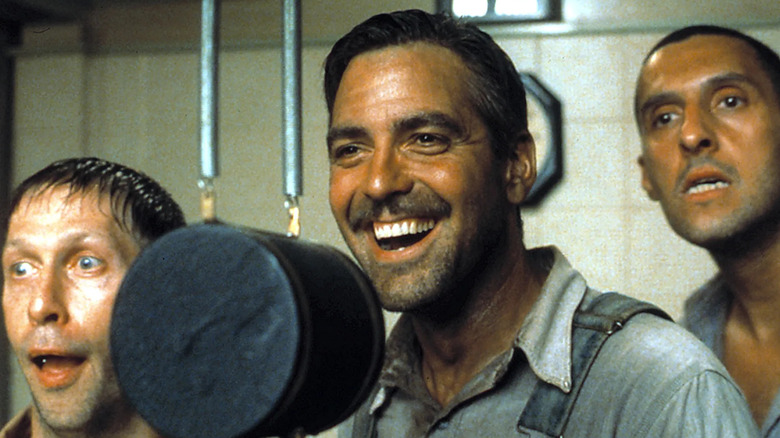
If you loved "The Odyssey" but you're looking for a much sillier take on the source material, look no further than Joel and Ethan Coen's 2000 romp "O Brother, Where Art Thou?" Though the famous directing duo claimed they never even bothered to read the epic poem before adapting it into a fresh and creative story, that feels impossible; this is a version of "The Odyssey" set in the American South in the late 1930s that recalls some of the poem's incredibly famous trials and iconography. George Clooney leads the film as Ulysses Everett McGill (with his first name referencing Odysseus), who goes by Everett and is incarcerated alongside his friends Pete and Delmar (John Turturro and Tim Blake Nelson). Promising that he knows where treasure is buried, Everett convinces Pete and Delmar to stage a daring escape for prison, and before long, the three of them are on the run.
As Everett, Pete, and Delmar evade the police, they encounter a one-eyed Bible salesman and secret Klan member Daniel "Big Dan" Teague (John Goodman), three singing sirens, and receive advice from a blind man ... and as it turns out, there's no buried treasure. Everett simply wanted to break out of prison to reunite with his wife, Penny (Holly Hunter), before she remarries. "O Brother, Where Art Thou?" is probably the silliest adaptation of "The Odyssey" in history, but it's fresh, fun, and deeply charming — and has an absolutely killer soundtrack to boot thanks to the plotline where the trio form a band called the Soggy Bottom Boys. ("Man of Constant Sorrow" is a stone cold bop.)
The Lord of the Rings: The Return of the King
We couldn't put the entire "Lord of the Rings" trilogy on this list, so we had to go with the third and final installment, "The Return of the King" — because it's matches the epic scale of "The Odyssey" the best and provides a satisfying conclusion. Across three years, director Peter Jackson released "The Fellowship of the Ring," "The Two Towers," and "The Return of the King" in 2001, 2002, and 2003, respectively ... and "The Return of the King" wraps up the story of the bold young hobbit Frodo Baggins (Elijah Wood) who volunteers to travel into the heart of Mordor alongside his loyal best friend Samwise Gamgee (Sean Astin) to destroy Sauron's One Ring in the fires of Mount Doom.
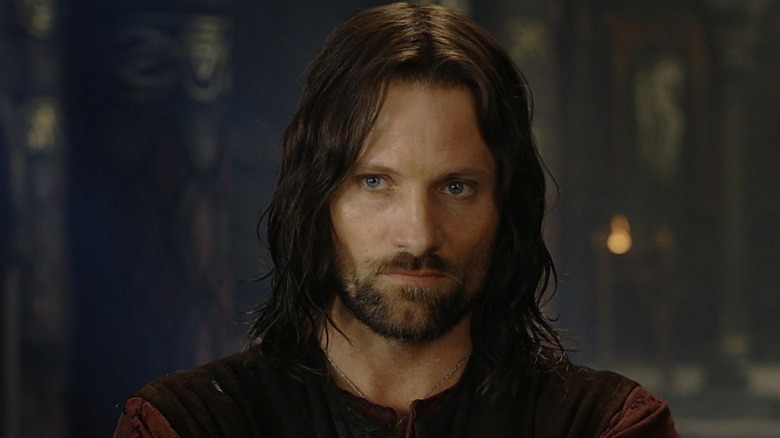
While Frodo and Sam prepare to enter Mordor alongside their disloyal companion Gollum (a motion-captured Andy Serkis), a different kind of odyssey is happening elsewhere in Middle Earth as Aragorn (Viggo Mortensen) prepares to return to the kingdom of Gondor and take his rightful place as its king. In both "The Odyssey" and "The Return of the King," two fighters become monarchs after their kingdoms go without leadership for decades — and both of them fight valiantly alongside their allies to do so, with elf Legolas (Orlando Bloom), dwarf Gimli (John Rhys-Davies), and wizened wizard Gandalf (Ian McKellen) by his side. When Frodo — decades-old spoiler alert! — finally launches the ring into Mount Doom as Aragorn and his armies mount a final push against Mordor's enemies, it's as thrilling as the conclusion of "The Odyssey" ... and the "Lord of the Rings" trilogy indisputably paved the way for cinematic epics like "The Odyssey."
Troy
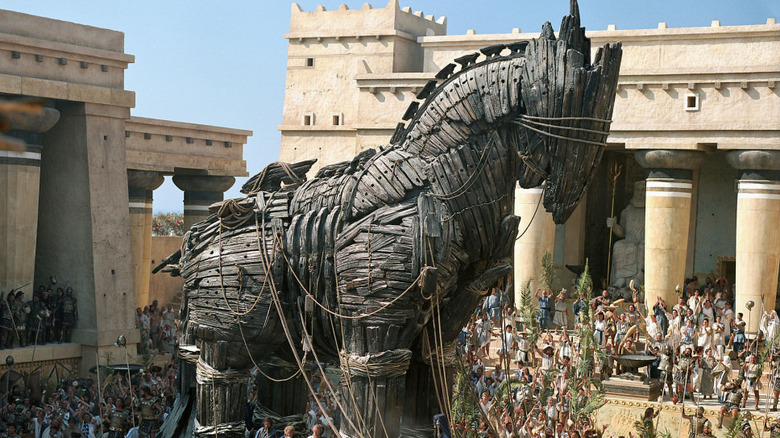
There will, inevitably, be comparisons made between "The Odyssey" and Wolfgang Peterson's 2004 film "Troy," even though the best comparison that comes to mind is that meme having to do with hydrogen bombs and coughing babies. Put simply, "Troy," written by future "Game of Thrones" showrunner David Benioff, isn't nearly as good or well-excuted as Christopher Nolan's "The Odyssey," but to be fair, it adapts a different epic Greek poem, so pairing them together would, ostensibly, give you the fullest picture of the Trojan war — especially because we only see the tail end of the conflict in Nolan's film as Matt Damon's Odysseus and his men tuck themselves inside of the famous Trojan horse to stage an ambush.
With Brad Pitt as Achilles, Diane Kruger as Helen of Troy, eventual "Succession" star Brian Cox as King Agamemnon, Orlando Bloom as Paris, and Eric Bana as Paris' older brother Hector, "Troy" begins when Agamemnon brings the Greek kingdoms together, meeting with fellow royals like Menelaus (Brendan Gleeson) and, you guessed it, Odysseus (Sean Bean). While Achilles takes Paris and Hector's cousin, priestess Briseis (Rose Byrne) hostage and eventually becomes her lover, war rages when Paris and Helen fall in love and Paris spars with Menelaus; when the two men wound each other, the peaceful pact enacted by Agamemnon is officially broken, and the Trojan War begins in earnest. Again, we cannot stress this enough: "Troy" is not a good movie, but it's a deeply enjoyable one with an insanely stacked cast (Julie Christie and Peter O'Toole play supporting roles in this film). Pair "Troy" with "The Odyssey," and honestly, you'll have a pretty good time.
The Dark Knight Rises
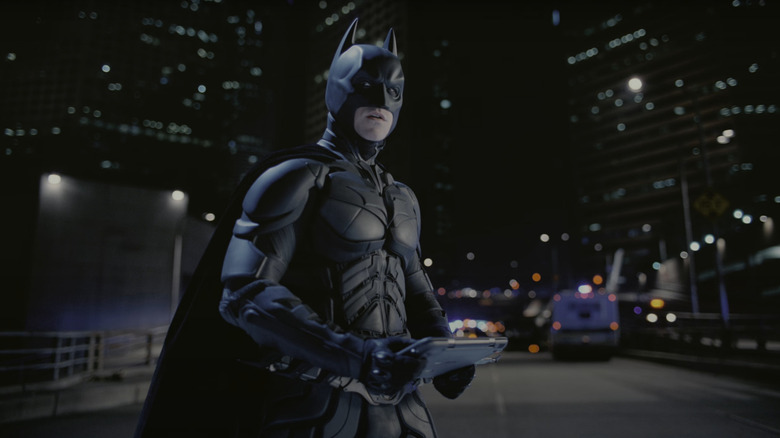
There are probably a lot of people out there who will gleefully tell you that "The Dark Knight Rises" is the weakest entry in Christopher Nolan's beloved and influential Dark Knight trilogy. That may or may not be true, depending on who you talk to, but one thing is for sure: "The Dark Knight Rises" is the most directly tied to "The Odyssey," and you can see a clear throughline from this trilogy capper to Nolan's 2026 epic.
So why is that? In this 2008 superhero film, Bruce Wayne (Christian Bale) is attempting to retire from his secret nighttime career as the masked vigilante known as the Batman when Gotham is suddenly attacked by Bane (Tom Hardy), who wants to avenge the "Batman Begins" villain Ra's al Ghul and level the city. Bane breaks Bruce's back during a massive fight in an underground sewer and leaves him for dead to carry out his nefarious plan. Bruce, however, has other plans. Despite being seemingly broken like Odysseus, he trains his body back to its full strength, returns to Gotham in secret as Odysseus does to Ithaca, and is able to bring Bane down — before faking his own death and absconding with cat burgler Selina Kyle (Anne Hathaway). See? Not only do Odysseus and Bruce both save the day in relative secret, but they both get to link up with Hathaway!
"The Odyssey" is in theaters now.