

5 Best Courtroom Movies Of All Time, Ranked
For as long as trials have been open to the public, ordinary people have been obsessed with them. From reading the details in newspapers to following the play-by-play on Court TV, true crime fanatics can't get enough of every juicy detail that emerges from the opening statements to the reading of the verdict. So it's little wonder that the courtroom drama has been among the most popular movie genres since the dawn of cinema.
At its best, a good courtroom drama can distill all the intrigue, suspense, and high stakes of a trial into its purest form, cutting out the fat and leaving you with just the good stuff. They can be salacious fun, tapping into our inner voyeur in the same way as a true crime docu-series. At the same time, they can affirm the importance of law and order, preach the necessity of the criminal justice system, and satisfy our yearnings for good to triumph over evil. They can also provide actors with tremendous showcases, as a trial is rife with monologues, cross-examinations, and nail-biting tension.
Here are the five best courtroom dramas of all time, ranked. In assembling this list, we looked at a number of factors: How accurately does it dramatize the intricacies of the law? Has it stood the test of time? Does it warrant repeat viewings on cable, streaming, and home video? And most important of all, is it as riveting and exciting as a real-life trial? You be the judge of that.
5. Anatomy of a Murder
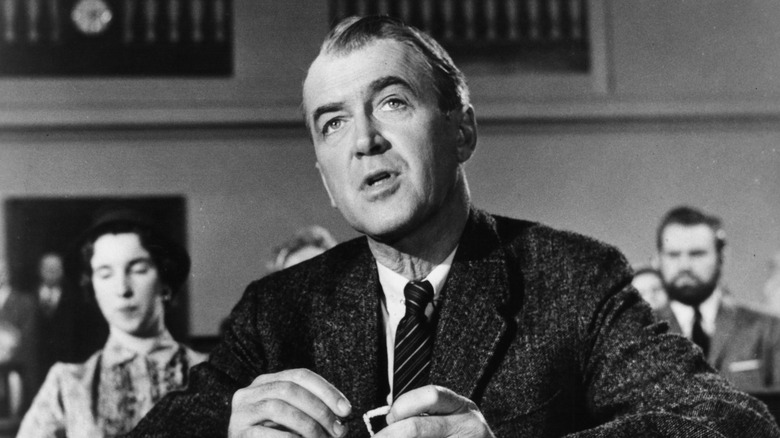
Small town lawyer Paul Biegler (James Stewart in one of his best movies) is all but retired after losing his re-election bid for district attorney, spending his days by the lake with his former colleague Parnell McCarthy (Arthur O'Connell). He's lured back into the courtroom by Laura Manion (Lee Remick), who wants him to represent her husband, U.S. Army Lieutenant "Manny" Manion (Ben Gazzara), in a murder trial.
Manny owns up to the murder of a local innkeeper, but asserts he did so after his wife accused the man of rape. He also claims to have no memory of the incident, laying the groundwork for a temporary insanity plea. Paul tries to work his charm on the no-nonsense judge (played by real-life attorney Joseph N. Welch, famed for confronting Senator Joseph McCarthy), but he's got his work cut out for him against District Attorney Lodwick (Brooks West), who's brought in big city prosecutor Claude Dancer (George C. Scott) to tear the defense to shreds.
Directed by Otto Preminger, "Anatomy of a Murder" stirred controversy when it was released in 1959, and was even temporarily banned in Chicago for touching upon the hot-button issue of rape. Yet it was also praised for its legal accuracy, with the American Bar Association naming it one of the best trial movies of all time. The film earned seven Oscar nominations, including best picture and best actor for Stewart, who gives one of his best performances as a laid-back yet highly-skilled attorney.
4. A Few Good Men
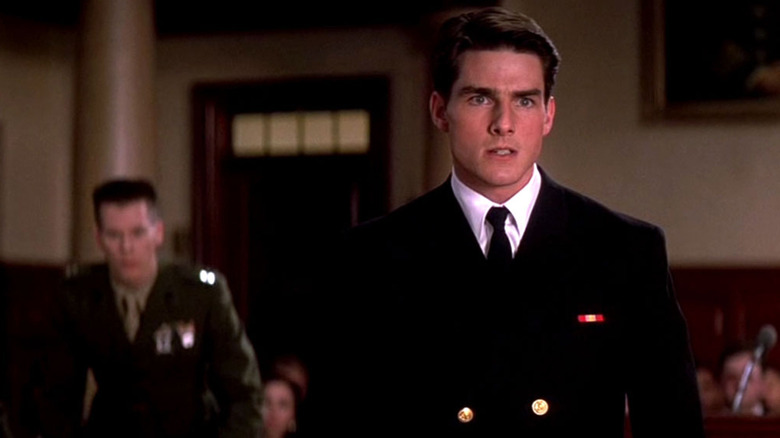
When U.S. Marine Private William Santiago (Michael DeLorenzo) is found dead at the Guantanamo Bay Military Base in Cuba, two of his fellow Marines (Wolfgang Bodison and James Marshall) are accused of murder. JAG Corps Lieutenant Daniel Kaffee (Tom Cruise in one of his best movies) is assigned to their defense, and he expects to wrap things up with a speedy plea deal. Yet his co-defense, Lieutenant Commander Joanne Galloway (Demi Moore), suspects the two men carried out a "code red" — aka extreme corporal punishment — against Santiago, and pushes Kaffee to go to trial.
As Kaffee digs deeper, it's revealed that the base's commander, Colonel Nathan Jessep (Jack Nicholson in one of his best movies), likely ordered First Lieutenant Jonathan Kendrick (Kiefer Sutherland) to punish Santiago for breaking the chain of command in asking for a transfer. Despite his initial resistance, Kaffee enters a plea of "not guilty" for the marines and makes the bold move to put Jessep on the stand in search of "the truth."
One of the best films directed by the late, great Rob Reiner, "A Few Good Men" launched the screenwriting career of Aaron Sorkin, who adapted the script from his own play. It features some of his most iconic writing, particularly the courtroom standoff, which ends with Nicholson barking, "You can't handle the truth!" in response to Cruise's demand for it. The 1992 release earned four Oscar nominations, including best picture and best supporting actor for Nicholson.
3. The Verdict
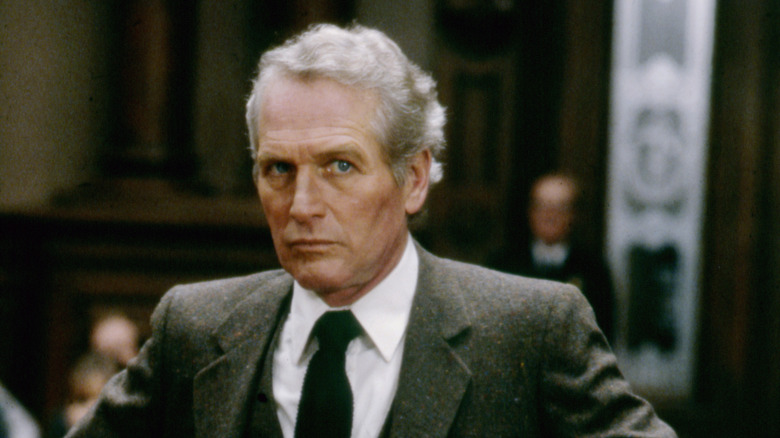
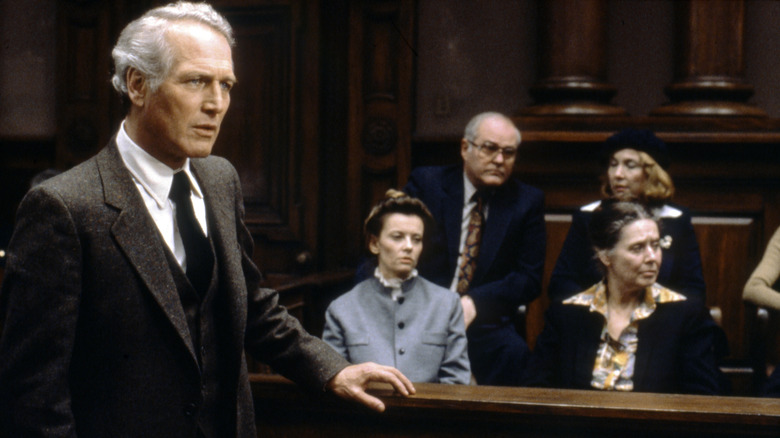
Boston attorney Frank Galvin (Paul Newman in one of his best movies) spends his days chasing ambulances and drinking himself into oblivion. Desperate for cash, he takes a medical malpractice case from his former partner, Mickey Morrissey (Jack Warden), who gives it to him out of charity. Galvin visits the young woman he's hired to represent, who went to a Catholic hospital to give birth and choked on her own vomit after receiving general anesthesia, leaving her in a coma.
Deeply moved by the young woman's condition, Galvin decides to take the case to trial, turning down the healthy settlement offered to the family by the Catholic diocese. Even after setting the bottle aside, Galvin still has a steep hill to climb against the hospital, which has a large legal team, led by the brilliant attorney Ed Concannon (James Mason), on its payroll. Medical experts disappear, evidence is difficult to track down, and witnesses are reluctant to testify. Galvin is also romantically entangled with barfly Laura Fischer (Charlotte Rampling), who may have ulterior motives.
Released in 1982, "The Verdict" was an artistic high point for director Sidney Lumet, who kicked off his feature filmmaking career with another legendary courtroom drama, "12 Angry Men." As written by David Mamet, the film is less concerned with the outcome of the trial than it is with the redemption of Galvin, who finds his way back after years astray. "The Verdict" earned five Oscar nominations, including best picture, best director, and best actor for Newman.
2. To Kill a Mockingbird
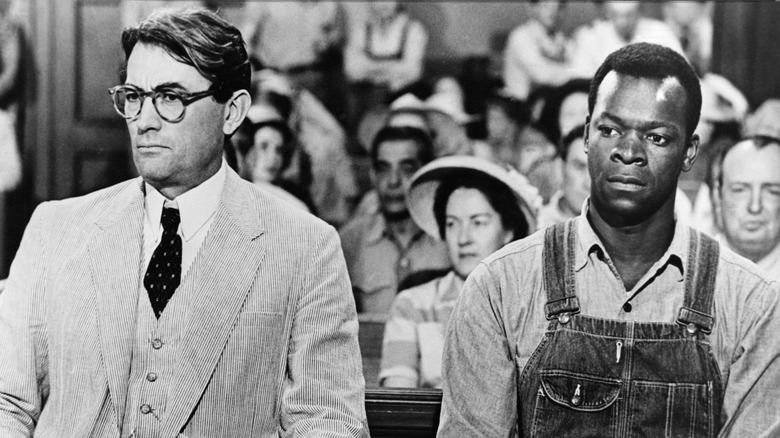
In Depression-era Alabama, widowed attorney Atticus Finch (Gregory Peck in one of his best movies) is raising his young children, Scout (Mary Badham) and Jem (Phillip Alford), while representing people who are too poor to pay for legal defense. Scout and Jem are terrified of their reclusive neighbor, Boo Radley (Robert Duvall in one of his greatest movies), whom they suspect to be a monster.
Meanwhile, Atticus is appointed to represent Tom Robinson (Brock Peters), a black man accused of raping a white woman, Mayella Ewell (Collin Wilcox). Although there's little evidence supporting the claim, Mayella's word is good enough to convince the towns' largely white population, who are ready to lynch Tom before a trial even commences. Suspecting that Mayella's drunken, racist father (James Anderson) is to blame for her beating, Atticus puts up his best defense, even though the cards are stacked against him. He pleads to the all-white jury to consider the words enshrined in our Declaration of Independence, stating that all men are created equal, to little avail.
Adapted from Harper Lee's Pulitzer Prize-winning novel, "To Kill a Mockingbird" has long been held in esteem as an honorable work of cinema, even if it does play into white savior tropes. Directed by Robert Mulligan, it's a deeply moving story of one man standing up for what's right and passing that lesson down to his young children. The film won three Oscars, including best actor for Peck and best adapted screenplay, and competed for best picture.
1. 12 Angry Men
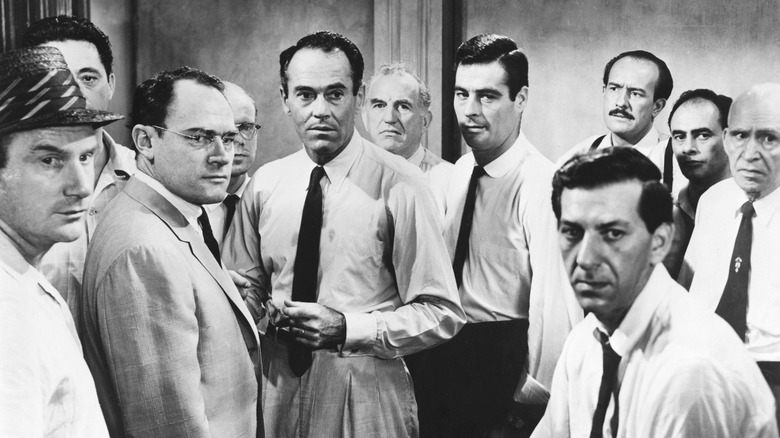
After hearing closing arguments, 12 jurors are dismissed to determine the fate of an inner-city teenager accused of murdering his abusive father. The judge instructs the jurors to consider reasonable doubt in their deliberations, as their decision could send the 18-year-old to the electric chair. As the temperature rises in the New York City Courtroom on this hot summer day, 11 of the jurors are ready to find the kid guilty and go home. But Juror 8 (Henry Fonda) has his doubts.
As the deliberations drag on, Juror 8 raises arguments that poke holes in the prosecution's trial, casting doubt upon the defendant's guilt. Initially, some of the jurors allow their racial prejudices against the Latino "slum kid" to inform their assessment of the case. Yet one by one, they come around to Juror 8's reasoning, save for the hot-tempered Juror 3 (Lee J. Cobb), who lets his relationship with his estranged son cloud his judgment.
Released in 1957, "12 Angry Men" was the feature debut for Sidney Lumet, who often made films about the importance of upholding the rule of law against institutionalized lawlessness. In adapting Reginald Rose's television play for the screen, Lumet doesn't shy away from the script's theatricality. Instead, he embraces it, using dramatic lighting, camera angles, and lenses to create a sense of the walls closing in on the jurors as the deliberations drag on. The film earned Oscar nominations for best picture, best director, and best adapted screenplay, and was later remade by William Friedkin.