

This Game Of Thrones Theory Fixes Daenerys' Ending With A Major Prophecy Twist

Welcome to "Fanon Fixing Canon," a weekly column where we investigate infamous plot holes or terrible storyline decisions. Through a combo of detective work and meticulous fan theorizing, we fix these problems so they no longer exist — and canon is immaculate once again.
There's a lot to nitpick about what went wrong with "Game of Thrones." This particularly pertains to its $90 million final season. However, such critiques are not really what Fanon Fixing Canon is about. We're not here to tear beloved things apart — instead, we're here to find ways to make the senseless make sense. Because of this, let's devote some time to highlight a sneaky way that "Game of Thrones" Season 8 and George R.R. Martin's source material offer a reasonable explanation for Daenerys Targaryen's (Emilia Clarke) controversial ending.
Daenerys does some bad things on "Game of Thrones." In the end, the combination of pressure and devastating personal losses turn her into the kind of evil conqueror the Targaryen bloodline is infamous for producing. However, her romantic interest-slash-nephew (still, ew) Aegon "Jon Snow" Targaryen (Kit Harington) ends her budding reign of terror by stabbing her to death in front of the Iron Throne. While this seems like a disappointing end to Dany's hitherto heroic arc, her death fits a very particular deep lore element that sits at the core of the franchise: the Azor Ahai prophecy.
Being an influential power player of Targaryen blood, Dany is one of the primary candidates to fulfill this prophecy of a hero who rises to vanquish darkness. However, at the end of the day, "Game of Thrones" suggests that she actually plays the role of Nissa Nissa, Azor's ill-fated wife ... and it's all thanks to Arya Stark (Maisie Williams), who kills the Night King (Vladimir Furdik) and thus allows Jon to stay on the board long enough to become the true Azor Ahai.
So what is an Azor Ahai, anyway?
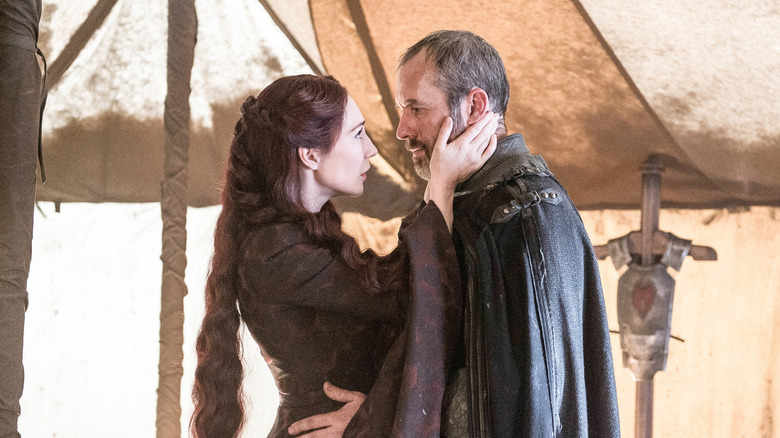
A major figure in the Lord of Light religion, Azor Ahai is a great mythical hero whose story is supposed to repeat itself in the form of the Prince that was Promised, per a prophecy by the mighty Aegon I Targaryen, aka Aegon the Conqueror. Azor's primary function is to act as a champion who wields the mighty Lightbringer sword and defeats the forces of darkness. Because great things can't be achieved without grievous sacrifice — especially in the religion of the Lord of Light — a necessary component of making Lightbringer is death. Namely, the death of Azor's wife, Nissa Nissa, whom he has to personally stab in the heart in order to unlock the sword's full power and fulfill his function to fight evil.
Some proponents of the Lord of Light, like Thoros of Myr (Paul Kaye), don't much care about the sword part of the story, and suggest that the story may simply be an allegory about the sacrifices that the acquisition of power requires. Elsewhere, Melisandre (Carice van Houten) fully buys into the idea that Azor Ahai will be reborn as the Prince That Was Promised, who's destined to replicate Azor's trick of vanquishing evil, and acts accordingly.
Who are the candidates for the Prince That Was Promised role?

We know that the Prince That Was Promised is somehow related to Aegon the Conqueror, whose dream the whole prophecy was originally based on. In other words, every single person descended from the guy is potentially fair game for the title, especially since there's a possibility that the so-called Prince is misgendered in the prophecy.
Predictably, this has led into multiple interpretations over the years. Even without going into the prequel spin-off show "House of the Dragon" and its hints that Rhaenyra Targaryen (Milly Alcock and Emma D'Arcy) might be the Prince That Was Promised, this leaves us with several viable candidates during the "Game of Thrones" era. The most prominent of them — at least comparatively early in the game — is Stephen Dillane's Stannis Baratheon, whom Melisandre initially champions. By the final season, however, the primary candidates still standing are Jon Snow and Daenerys Targaryen.
While "Game of Thrones" Season 8 kind of drops the Azor Ahai concept during its endgame, the show at least has the dignity to provide enough hints about the Prince's true identity for an educated guess that it's meant to be Jon. Through tenacity, luck, and the occasional resurrection assist, he becomes the show's ultimate heroic figure, and plays a role in defeating the final season's two most lethal forces — the Night King and, tragically, Dany. Because of their romantic relationship and the manner of her death, this locks Dany in the narrative role of Nissa Nissa, who has to die by Azor Ahai's blade as a necessary sacrifice to bring peace.
Arya killing Night King is a key move in dooming Daenerys
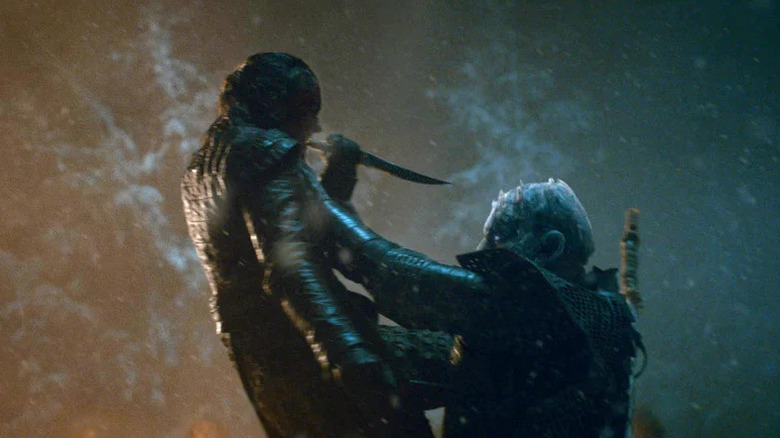
As mentioned, Jon Snow — who famously knows nothing — gets a lot of help and has plenty of luck before he becomes the closest thing "Game of Thrones" has to a true Prince That Was Promised. Apart from Melisandre hitching her wagon to the Team Snow train by resurrecting the guy, arguably the greatest individual assist comes courtesy of Jon's stepsister, Arya Stark.
"Game of Thrones" Season 8, Episode 3, "The Long Night," features a grand showdown between the forces of Winterfell and the Night King's wight army. While he fights bravely, the Battle of Winterfell doesn't go great for Jon, whose struggles end with him staring the wight dragon Viserion in the face. Just as Viserion prepares to kill him, however, Arya kills the Night King with her Valyrian steel dagger, saving the day.
Had Arya not been able to pull this off, it's entirely possible that someone else would still have managed to defeat the Night King's forces at some point, of course. However, Jon Snow was literally seconds away from certain death when the Night King was killed, so he certainly wouldn't have survived to end Daenerys' later brutalities.
The prophecy doesn't fix Dany's arc, but it does fix her ending

With even Melisandre — the show's most prominent Azor Ahai expert — backing more than one candidate, it's clear that the legend is wildly difficult to decipher and leaves a lot to interpretation. However, as the Night King, Daenerys Targaryen, and Ramsay Bolton (Iwan Rheon) can attest, Jon Snow is an omnipresent force in the show's Westeros leg of evil-vanquishing business. Meanwhile, Dany's arc moves from emancipation to taking the Iron Throne by any means necessary, which gives her shades of grey well before her ultimate heel turn.
Should anyone but Jon have killed Dany, her story would have been that of a hero who ultimately becomes a villain, which could have been a magnificent tale but was heavily undermined by the abruptness of her evil streak. However, Jon stabbing her to death and thus recreating Azor Ahai's killing of Nissa Nissa ties them both into the deep mythology they're connected to by blood — only, Dany ends up representing a different character in the prophecy than many might have assumed.
This adds depth to Dany's "Game of Thrones" ending and explains how the way she dies ultimately makes sense. Of course, in the grander context, it also reduces her into the kind of sacrificial lamb role she's spent the entire show actively battling against, which undermines Daenerys' series-long storyline ... but then again, her badly-built endgame arc already saws through that particular branch of the great "Game of Thrones" tree.