

Backrooms Review: A Horror Movie Caught Between Big Ideas
- Great cast
- Perfect production design
- It plays with existential, ambiguous horror in very exciting ways
- Gives in too much to conventional narrative pressure
- Tends to meander when it should be focusing in certain key moments
A concept like the Backrooms thrives on mystery, which makes building a narrative film out of its lore particularly challenging. You can only reveal so much about this legendary liminal creepypasta before you start to take some of the shine off, but if anyone understands that, it's Kane Parsons.
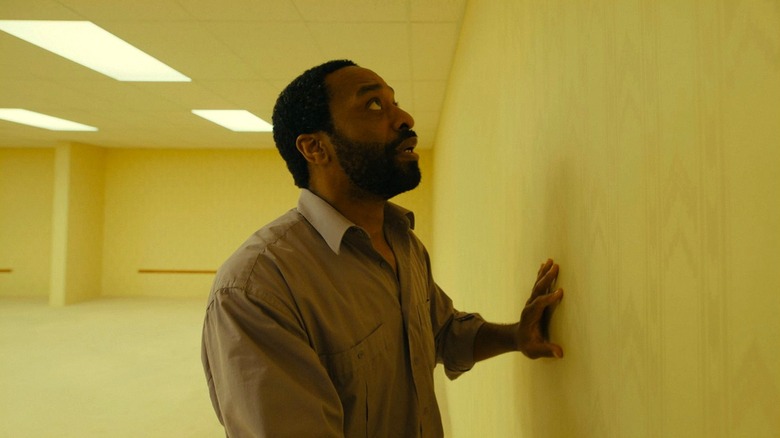
Parsons, who built a reputation as an analog horror artist through a string of YouTube short films about the Backrooms, is adept at riding the lean between revealing secrets and preserving others — but even he can't entirely nail "Backrooms," the first feature inspired by the internet horror concept. Lots of things about the film work, from the simple joy of seeing the Backrooms laid out on a big screen to the dynamite core cast, but like the strange world of its title, "Backrooms" can't help but exist in a liminal space.
This is a film caught between big ideas and ambiguous horror, character study and visual showcase. It wants to be mysterious, but it also wants to lay out some lore for the Backrooms' biggest audience yet. And despite its bright spots, it ends up caught in the middle.
The protagonist is layered ... just like the Backrooms
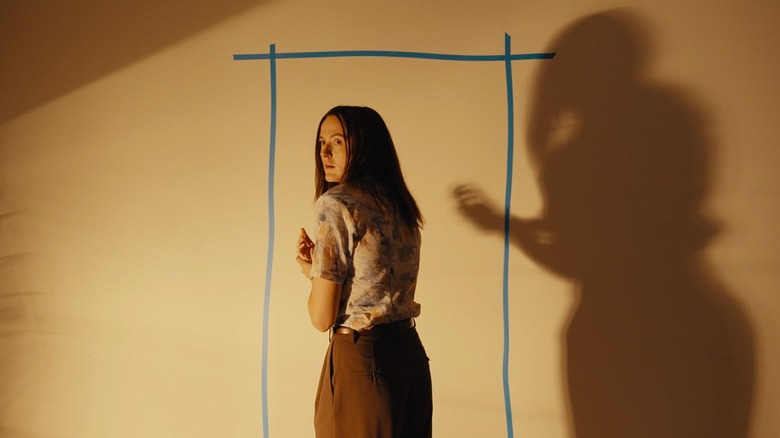
Clark (Chiwetel Ejiofor) is a mess, to put it lightly. His marriage recently crumbled, he's running a failing furniture store, and he drowns his sorrow over his failed architecture career in too much booze. Clark tries to manage all of this with the help of his therapist, Mary (Renate Reinsve), but what he really wants is something to get him excited about life again.
He finds that something one night when, alone in the store, he investigates an electrical issue and ends up on the other side of a wall, where an impossible and vast complex of rooms waits. At first these rooms, with their strange geography and even stranger architectural quirks, are a source of fascination for Clark's troubled mind, but the deeper he gets, the more Mary worries about him, and soon both therapist and patient are sucked into a nightmare.
Kane Parsons, very aware of his built-in web audience for the film, opens "Backrooms" with an appropriately tense, grainy found footage prologue that feels ripped right from his series of short films, yanking viewers into the film's journey and delivering very memorable scares. From there, we shift to third-person camera in the early 1990s for Clark and Mary's story, and while that doesn't jar the audience right out of the movie, it does present some particular narrative challenges. Over the course of its 110-minute runtime, the film rises to meet many of these challenges, while simply dropping others by the wayside.
It feels like two concepts fighting for space
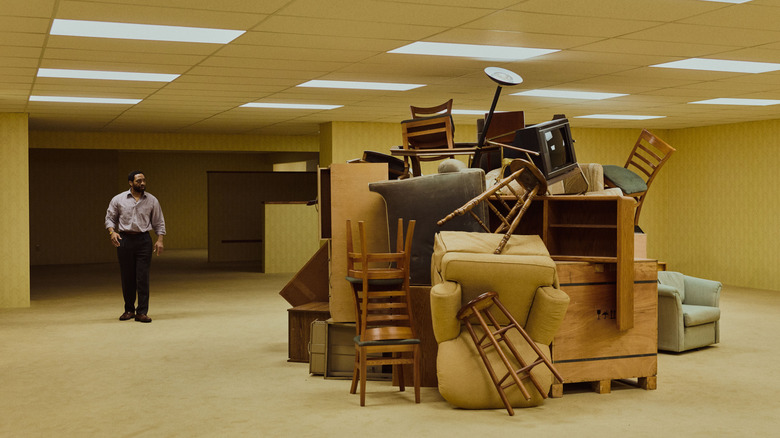
Let's make one thing clear: "Backrooms" mostly works. Chiwetel Ejiofor and Renate Reinsve are remarkably game for the gauntlet Kane Parsons sends them through, there are several sequences frightening enough to verge on the jaw-dropping, and Parsons' gifts as a visual stylist scale up to fit the bigger budget and wider exposure of the project. (Not surprisingly, many critics were left stunned in their first reactions.) There's a lot to like here, particularly when Parsons and screenwriter Will Soodik lean into the absolute weirdness of the Backrooms themselves, what they are, and what they can do.
But it's here that "Backrooms" starts to show its biggest flaw, which lies in its efforts to maximize the appeal of the concept. There's nothing wrong with reaching the widest possible audience with your work, but in the case of "Backrooms," there are layers of mystery that get stripped away when you attempt to explain too much, center the liminal vastness of the title location on human characters, or simply give in to predictable horror instincts in the final act. It's difficult to discuss how this works without spoilers, but at a certain point "Backrooms" starts to feel like other, less strange films, to its detriment. Conventional narrative choices arrive suddenly, almost without context, yanking the film out of its liminal reverie.
What salvages the film even when it starts to give into the pressure to be something more predictable and narrative-driven, though, is the way Parsons and Soodik frame the Backrooms as a kind of reclamation space for human memory, loss, and our ideas of who and what we're meant to be. Setting the film in the 1990s is a master stroke, not just because it allows Parsons to lean into the analog appeal of the concept, but because it lets the young filmmakers (Parsons is only 20 years old) play with the notion of nostalgia horror in some very exciting ways. Watching "Backrooms," those viewers who were around to see the 1980s and early 1990s will recognize the furniture, electronics, relentless fluorescent light, and dingy carpet. Sense memories come to the surface, but "Backrooms" is not interested in catering to nostalgia. Instead it asks us to consider all of these visual elements in a new light, warping and reshaping them for its own purposes. It's not a nostalgic film, but rather a film about how memory and our sense of who we used to be — or worse, who we were supposed to be — can poison us, not just individually but collectively.
When "Backrooms" is playing with horror on that existential level, punctuated by a couple of truly marvelous jump scares, it works wonderfully. Unfortunately, it flinches and turns from this approach one too many times. Even with its flaws, though, this is a remarkably cohesive calling card for Parsons, and the announcement of an exciting new voice in horror filmmaking.
"Backrooms" premieres in theaters on May 29.