

Sterling K. Brown's 2026 Revenge Thriller Has A Near-Perfect Rotten Tomatoes Score
One of 2026's most egregious box office casualties so far, "Is God Is" is a road trip revenge thriller that combines "Kill Bill" (one of the best revenge movies of all time) and "O Brother, Where Art Thou?" through a Southern Gothic lens. It currently sits at a 98% critical rating on Rotten Tomatoes, as well as an 88% score from audiences, yet has made just a little over $3 million at the box office. Amazon MGM Studios not giving it much attention in the marketing department is the reason why you probably haven't heard of this wholly original film.
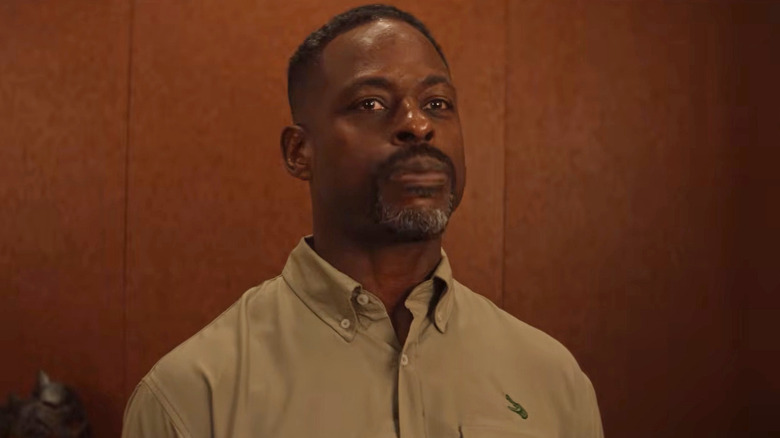
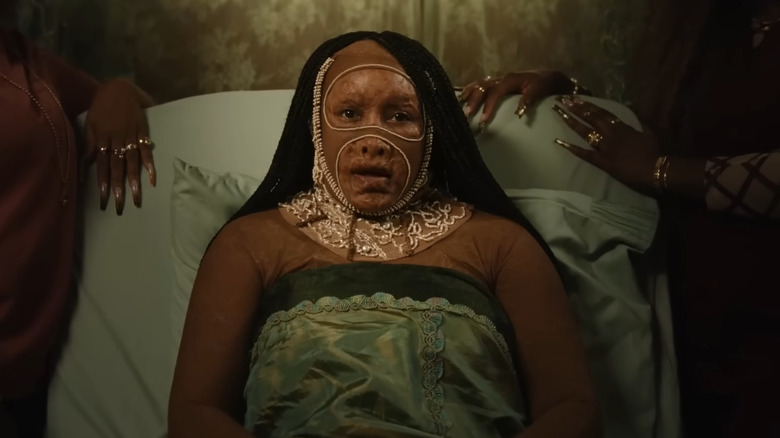
Playwright Alesha Harris makes her directing-screenwriting debut with a feature adaptation of her award-winning 2018 stage play about twin sisters on a mission from God (Vivica A. Fox). In this case, God is a terribly scarred woman on her deathbed who calls upon her estranged 20-something daughters Racine (Kara Young) and Anaia (Mallori Johnson) to kill their abusive father (Sterling K. Brown). Credited only as The Man — but also called the Monster — he burned God alive in a bathtub years ago, with both girls also horrifically burned trying to put out the fire. With the Man ultimately getting away scot-free, God's final request is that the fraternal twins kill their dad for good.
While the sisters meet a string of strange characters on their quest, including an over-the-top preacher (Erika Alexander), their dad's mute lawyer (Mykelti Williamson), and his new family (Janelle Monae, Xavier Mills, and Justen Ross), the Man's minimal presence casts a big shadow over the proceedings.
The twin sisters' dynamic is at the heart of Is God Is

Sterling K. Brown is no stranger to playing antagonists throughout his career in projects like "Supernatural," "The Predator," and even "Brooklyn Nine-Nine" (where he was one of its best guest stars), but the Man is an entirely different breed of menace.
Aleshea Harris centers him as this malevolent yet obscured figure who haunts the story. The film can hardly look at him in full profile during those unsettling black-and-white flashbacks, a technique which Harris used to her advantage. "I knew going in that I wanted us to obscure his face, give him an epic size by not showing every bit of him at the beginning, letting us hear a lot about him and saving his voice until I'm ready," she told the Hollywood Reporter. It's disarming because Brown is such a naturally likable presence, which makes his sadistic nature here even more upsetting.
The Man, however, doesn't overshadow the bond between Racine and Anaia, whose sibling relationship has its own complexities thanks to the dynamic between Kara Young and Mallori Johnson. Racine and Anaia have an entire dialogue without saying so much as a word to each other, psychically communicating like telepaths. Harris knew right away that these two actors were meant to play opposite each other after their audition. "When I put them together and they matched, I knew," she said, adding, "They had tremendous chemistry their first time in a Zoom room together." Yet despite their stylized rapport, the twins still have their blind spots in places.
Aleshea Harris deconstructs the nature and cost of revenge
Rather than having the twins on the same page, Aleshea Harris has them approach their revenge mission from opposite ends of the spectrum, with Racine having no qualms about doling out her rock-in-a-sock beatdowns and Anaia feeling conflicted about the potential consequences. The deconstruction of revenge doesn't come from the conventional figures of the outside world, but from within their tug-and-pull dynamic. No other parties get a say in what should happen, other than those directly affected by The Man.
It's one of many complicated conversations some folks are having on social media about the film's commentary on rage, and who benefits from it. Accountability looks very different in 2026 than it did just a few years ago, as toxic masculine figures have hijacked the narrative of what justice looks like. Harris frames the anger of wronged Black women as righteous, with the film explicitly showing how the perpetrator of violence is protected by a broken system. "The wrong is so deep and the wound is so deep for these women," she explained to the Hollywood Reporter. "And I also think the wound is so deep for Black women that there's a way that I'm sort of playing with what's real and true."
"Is God Is," despite being praised across the board, likely won't be in theaters for too much longer, so be sure to see it on the big screen — where it's playing nationwide — before it hits streaming.