

Spider-Man's Creepiest Story Is Way Too Dark For The MCU
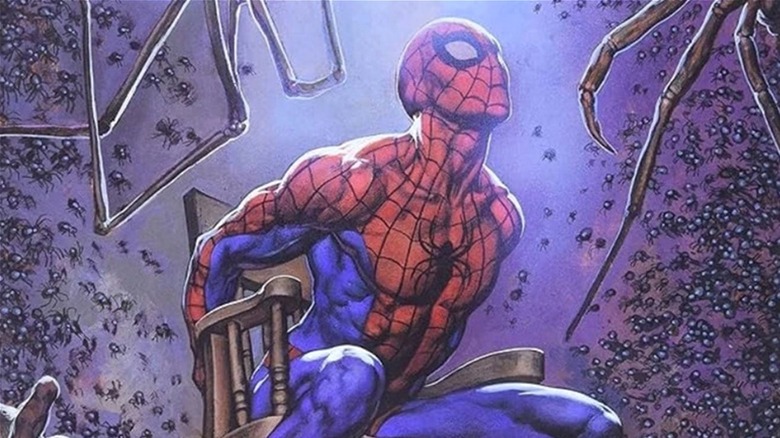
When the first trailer for Marvel Studios' "Spider-Man: Brand New Day" dropped in 2026, fans were all saying the same thing: As exciting as the film's more grounded, personal take was, it was also hard not to focus on the hints that Peter Parker (Tom Holland) appeared to be gaining new powers and emerging from a giant cocoon. Breaking down the trailer, these scenes fueled speculation that the Marvel Cinematic Universe would be adapting 1981's "Marvel Fanfare" #1-3, in which Peter is forcibly mutated into Man-Spider, or the epic 2005-06 crossover "The Other," in which Spider-Man dies and is reborn via cocoon.
Both arcs feature startling physical transformations. Still, neither comes close to the grotesque body horror contained in Spider-Man's creepiest story: "The Coming of the Thousand" from 2001's "Spider-Man's Tangled Web" #1-3. Written by Garth Ennis and drawn by John McCrea, the story introduces Carl King, a high school bully who witnesses Peter Parker being bitten by a radioactive spider. Envying Spider-Man's powers, Carl breaks into the lab and eats the dead super-spider.
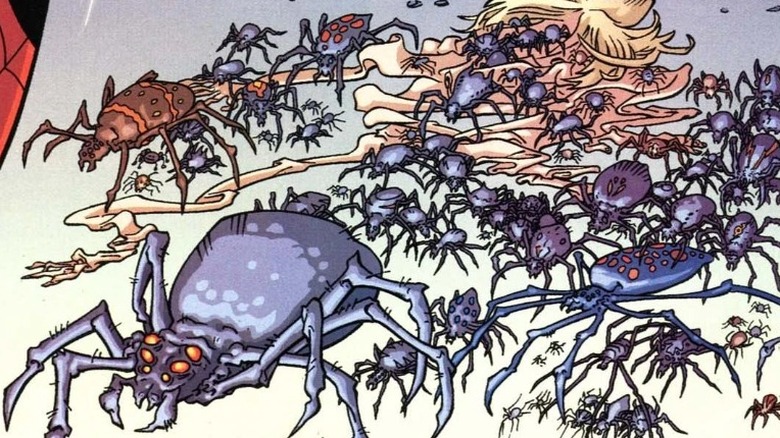
But instead of gaining powers, Carl's body gruesomely breaks down into a thousand spiders sharing a hivemind. Calling himself "the Thousand," Carl kills countless people — with his spiders wearing their flesh as skin suits — until he is strong enough to attack Spider-Man and attempt to steal his body. One of the most visceral and upsetting Spider-Man stories ever published, "The Coming of the Thousand" would be nearly impossible for the MCU to put on the big screen.
The Thousand is more appropriate for The Boys than the MCU
Spider-Man's life story has its share of tragedy, but "The Coming of the Thousand" is especially grim thanks to its creative team. Garth Ennis is an award-winning writer and the co-creator of "The Boys," the graphic superhero satire that inspired the hit show on Amazon Prime. Ennis' works are known for their shocking, boundary-breaking depictions of violence and debauchery, with his frequent artistic collaborator John McCrea drawing "The Boys: Herogasm" with Keith Burns in 2009. In short, they were never going to create a conventional Spider-Man story.
With Carl King, Ennis and McCrea created one of the most sadistic supervillains in Spider-Man's rogues gallery. Once Peter Parker's own bully, King was cruel to the end. He brags about his kills to Spider-Man, which include his own parents, Peter's co-worker Jess Patton, and even kids. McCrea's artwork is not for the squeamish; it's hard to forget the image of King's teeth falling out of his mouth as he transforms, or hundreds of spiders scurrying out of a victim's discarded skin — all because King had the nerve (and the stomach) to eat the same arachnid that once gave Peter his own gifts.
Spider-Man eventually triumphs over the Thousand, though the villain gets a chance to consume several victims and fill them with his hive-mind legion of creepy crawlies, all sketched in loving detail to activate a reader's latent arachnophobia. The storyline reaches an ironic end, leaving us thankful there hasn't been more of Carl King since. With so many classic Spidey villains already bouncing around the MCU, it's hard to imagine that Marvel would adapt "The Coming of the Thousand" and subject Tom Holland (much less us) to its horrors.