

Why Are There So Few Movie Or TV Adaptations Of Harlan Ellison's Work
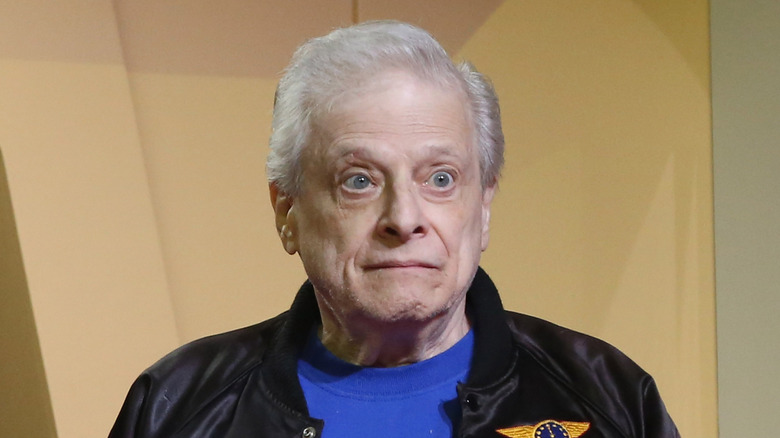
Writer Harlan Ellison is responsible for some of the finest science fiction ever published, from "A Boy and His Dog" to "'Repent, Harlequin!' Said the Ticktockman." That's why it may seem strange that his tales haven't been adapted nearly as often as you'd think. There are plenty of Isaac Asimov movies and TV shows out there, and ranking every Philip K. Dick adaptation is a massive undertaking.
As for Ellison film adaptations, there's director L.Q. Jones' cult flick, "A Boy and his Dog" (1975), which starred, improbably, Don Johnson. On the small screen, you'll find the occasional "based on the short story" adaptation of Ellison's work in various genre shows. Notably, the 1985 version of "The Twilight Zone" opens with the Wes Craven-directed, Alan Brennert-penned adaptation of Ellison's short story "Shatterday," starring Bruce Willis.
In 1964, Ellison himself adapted his story "Soldier from Tomorrow" into the Season 2 opener of "The Outer Limits," titled "Soldier," and the "Love, Death & Robots" Season 2 episode "Life Hutch" was based on an illustrated Ellison-Ken Steacy story of the same name. Apart from these and a few other sci-fi or horror anthology series outings, however – crickets.
The finest Ellison adaptation to date is the 1990s video game adaptation of what is arguably his best story, "I Have No Mouth, and I Must Scream," which he was extensively involved in creating, even voicing the hypermalicious AI, AM. In 1995, Dark Horse Comics also published "Harlan Ellison's Dream Corridor," a series of Ellison comic adaptations that notably included a John Byrne-illustrated comic version of "I Have No Mouth, and I Must Scream."Let's take a closer look at why Ellison adaptations are so scarce.
Ellison was a legendarily difficult and cantankerous man
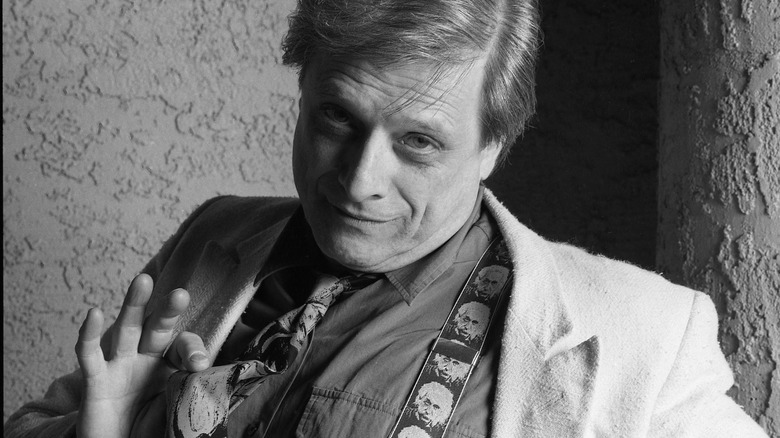
A precise history of why people haven't flocked to adapt Harlan Ellison's work doesn't exist, because it's hard to catalog things that haven't happened. However, a likely reason for entertainment industry folks generally steering away from Ellison adaptations is simple: Harlan Ellison was a difficult, even combative man.
The author, who died in 2018 at age 84, was a proud disruptor and overall agent of chaos who was known for his quick litigiousness and his clashes with other industry notables. His most famous feud is probably the one over a classic "Star Trek: The Original Series" episode, "The City on the Edge of Forever."
Ellison's original script was heavily revised and rewritten by "Star Trek" creator Gene Roddenberry and others, prompting years of bad blood between Ellison and Roddenberry. As late as in 2009, Ellison had filed a lawsuit for residuals regarding the episode. Another notable court case was over James Cameron's 1984 sci-fi classic "The Terminator," which Ellison argued was based on his previously-adapted story, "Soldier." The case was ultimately settled and Ellison received an "inspired by" credit.
Apart from bigger fish like "Star Trek" and "The Terminator," Ellison was also known for suing comic book publishers, websites, and suchlike for reasons ranging from logical to "what the hell, man." From a prospective filmmaker's viewpoint, all of this would likely be plenty of reason to avoid adapting Ellison's work, as opposed to more amenable authors.
Despite that lack of adaptations, Ellison's contributions still made it to live action
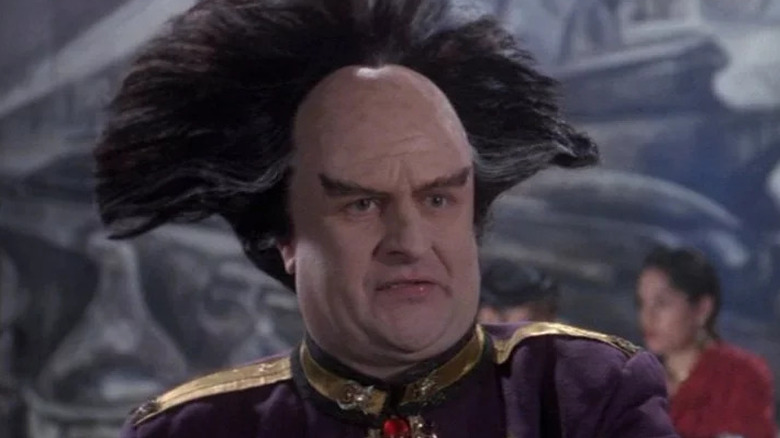
Of course, the thing about Harlan Ellison is that, while the adaptations of his published work are few and far between, his writing actually did make it to television surprisingly often. Ellison didn't create exclusively for the printed page, after all. Instead, he started writing TV shows in 1963, and amassed credits that ranged from the crime comedy-drama "Burke's Law" to "The Man From U.N.C.L.E."
Perhaps most notably, he contributed to J. Michael Straczynski's epic sci-fi series "Babylon 5" as a conceptual consultant, occasional voice actor (as a still cantankerous but less murderously capable AI), and one small onscreen role. Ellison and Straczynski became such good friends that the latter became the executor of Ellison's' estate after the writer's death, and Stracyznski even completed editing one of Ellison's most controversial unfinished projects, "The Last Dangerous Visions."
One reason why you might not bump into a lot of Ellison's TV work, despite the amount of TV writing he actually did, is because many episodes he wrote — and one full series, "The Starlost" — aren't credited to him. Whenever Ellison wasn't satisfied with the finished product, he demanded to go under the pseudonym Cordwainer Bird, a pun that suggested his work was now worthless and "for the birds."