

The Lightsaber Easter Egg You Missed In Star Wars: Maul – Shadow Lord

Contains spoilers for "Star Wars: Maul — Shadow Lord," Episode 3 — "Whispers in the Unknown"
Through its first four episodes, "Star Wars: Maul — Shadow Lord" focuses primarily on the former Darth Maul's — now just known as Maul (Sam Witwer) — mission of revenge against the underworld crime bosses who betrayed him when the Empire fell. But the emotional core so far revolves around Maul's relationship with Devon Izara (Gideon Adlon), a young Jedi on the run.
Maul targets her as a likely candidate to be his new apprentice, and while attempting to escape him in Episode 3, Devon steals half of Maul's dual-sided lightsaber and shows off her skills. Although the specifics of her moves might not look like anything special to some fans, those who are aware of the different canonical lightsaber forms likely noticed a few things. Devon seems to prioritize Form III, known as Soresu — the same form for which Obi-Wan Kenobi, Maul's great rival, was famous. However, she also occasionally drops into Form IV, Ataru, which was favored by Qui-Gon Jinn.
By having her employ both, the show does some interesting storytelling via choreography, which is especially fitting for a show about Maul. Few Star Wars characters are as inimitably tied to their lightsabers as Maul, and as he has become increasingly prevalent in the Star Wars animated universe, his iconic double-bladed weapon has stayed by his side (most of the time). It seems fitting, then, that "Maul — Shadow Lord," is loaded with lightsaber Easter eggs and hidden meanings for diehard fans.
Obi-Wan, Qui-Gon, and Maul's lightsaber problem
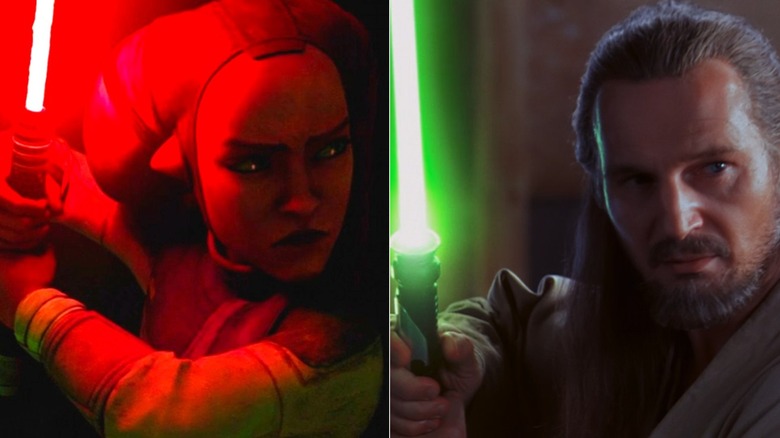
Lightsaber forms are a niche aspect of Star Wars, but if you know a few basics, there are a lot of interesting details in all the big Star Wars lightsaber fights. Maul traditionally uses Form VII, a hyper-aggressive style typically associated with dark side users (and also Mace Windu, including when he beats Palpatine). It's generally seen as a natural match for Ataru, Qui-Gon Jinn's form and a very common one among the Jedi, as it eclipses Ataru's own aggressive approach. Maul's defeat of Qui-Gon in "The Phantom Menace" is a great example.
Soresu, on the other hand, is generally seen as a better counter to Form VII. In "Star Wars Rebels," when Obi-Wan finally kills Maul in their final duel on Tatooine, he first adopts his famous Form III pose, then shifts into Qui-Gon's Form IV stance, effectively goading Maul into launching the same sort of attack he used to defeat Qui-Gon. Maul falls for the trap, and Obi-Wan counters.
Throughout Episode 3 of "Maul — Shadow Lord," Devon repeatedly enters and re-enters variants of that core Soresu pose. Form III is much more defensive in nature, and since she is cornered and afraid, this makes sense, especially if it's the form she was trained in. But when Maul pushes her emotionally, we see her slide into Ataru, either adopting the Qui-Gon pose, or engaging in some more aggressive acrobatics. Given Maul's historic dominance over Ataru, it would make sense for him to push her in that direction. But when he finally confronts her at the end of Episode 3 for a proper duel, he doesn't use much Form VII at all.
Maul is manipulating Devon through his choice of lightsaber form
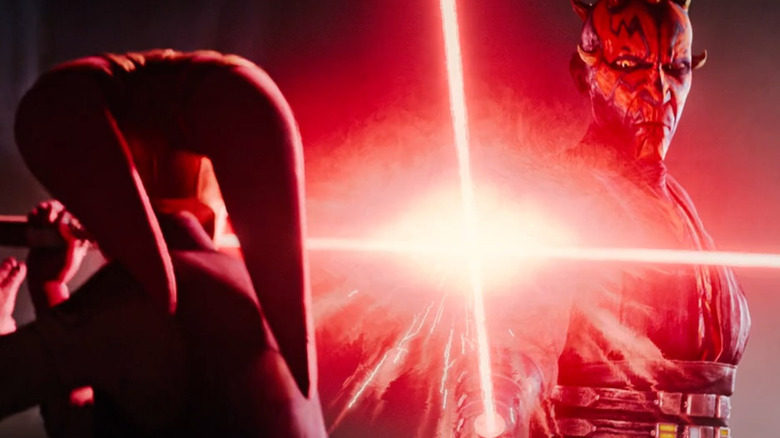
Form VII, Maul's typical preference, is strong against Ataru, but weaker against Soresu. But that's only relevant if you're trying to win a fight. In "Shadow Lord," Maul is uninterested in beating Devon. He wants to push her to her limits and decide on her own that the Jedi restraint she's been trained in is actually a weakness she needs to shed.
When he faces her at the end of Episode 3, he only uses a single blade, as she wields his other. And notably, he fights one-handed, his off-hand fixed behind his back — a dueling style that seems to be a variant of Form II, Makashi. Most commonly associated with Count Dooku, it's demonstrated to be strong against Form III, but substantially weaker against Ataru.
The read? Maul wants Devon to win, but he also wants her to use the most aggressive style in her repertoire to do it. By adopting Makashi instead of his usual Form VII, he dismantles her safe, defensive Soresu and pushes her into Ataru to gain an advantage. He creates a situation where she is rewarded for her aggression, which is exactly what he wants. How much of this is intentional? It's kind of hard to tell. What's certain is that the fights in "Maul — Shadow Lord" were crafted with a lot of intention, providing some of the most exciting lightsaber action we've seen in a while.