

The Boys Season 5: A Bold And Occasionally Brilliant Final Season
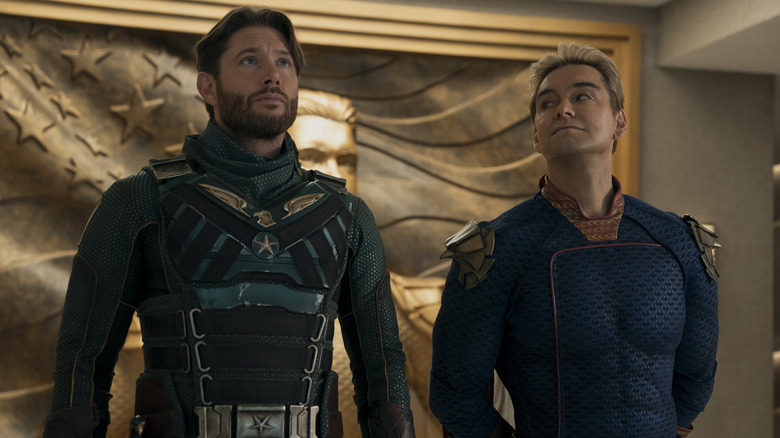
- - The boldest satire for the series yet, as it takes on the relationship between religion and politics.
- - Takes inspiration from "Robocop" and "Starship Troopers" in its incisive parody of fascism at its dumbest.
- - Daveed Diggs is an incredible addition to the already perfectly-cast supervillain ensemble.
- - The Boys are nowhere near as interesting to follow as the evil Supes they're trying to take down.
- - Kimiko's transformation is jarring, and betrays previous seasons.
- - All the action takes place at remote locations, so you never feel like a fascist takeover is happening.
The first season of "The Boys" premiered in the final summer of Marvel mania: "Avengers: Endgame" had just become the highest-grossing movie of all time and the franchise was all-but-certain to remain ubiquitous for years to come. It was the perfect time to satirise the not-so-subtly authoritarian nature of Earth's mightiest heroes and the entire entertainment industry that's made them inescapable in our everyday lives — and as interest has fallen, Eric Kripke's adaptation of the Garth Ennis graphic novels of the same name has increasingly stretched the metaphor of how The Seven and Vought International encapsulate all the world's evil.
As "The Boys" Season 5 opens, new Vought CEO Homelander (the ever-captivating Antony Starr) has installed his own puppet President — after the VP was killed and the president-elect was imprisoned last time around — to take his orders. He's also slowly attempting to rebrand America's Churches as places where he is worshipped as the one true God.
The Boys are the weakest part
Yes, it's an over-the-top satire of where America currently is as a nation, with Homelander an unholy hybrid of Elon Musk and Donald Trump, whose superiority complex is challenged only by the innate need to be liked by the people he's desperate to control. And yet, when placed next to "Robocop" or "Starship Troopers" — director Paul Verhoeven's two sci-fi satires of fascism — it feels a lot less hypothetical because of just how ridiculous it is. It's as joyously lowbrow as ever, so it is hardly the parody of our times that we need, but it is the one we deserve at such a dumb moment in history.
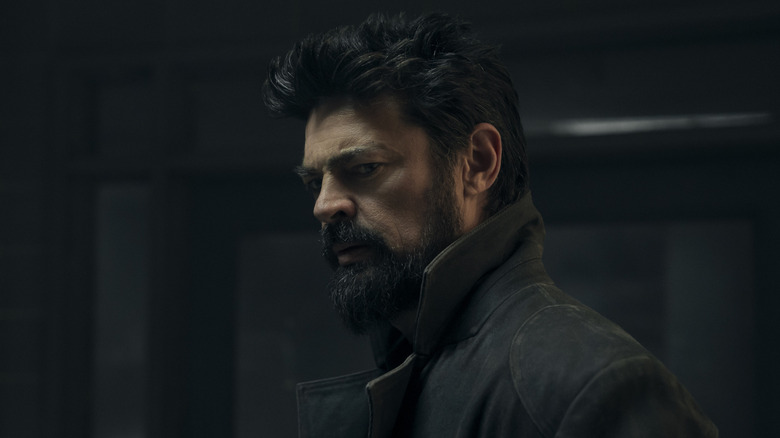
If there is one flaw with "The Boys" that's made the show seem repetitive in recent seasons even as it sharpens its comic focus elsewhere, it's the titular vigilante group themselves. Each prior season has followed the same basic arc of the team — led by Billy Butcher (Karl Urban), Hughie Campbell (Jack Quaid), and former Seven member Starlight (Erin Moriarty) — missing their one shot to take down Homelander at the very last minute, with the writers going round in circles to save that definitive showdown for the eventual finale. The prior season's finale saw the group separated, either on the run internationally or imprisoned in one of Homelander's re-education camps, which set the stage nicely for something different in Season 5. Unfortunately, the captured members are freed by Butcher and Kimiko (Karen Fukuhara) in the premiere and the Boys' arc instantly reverts to business as usual; an incredibly likable group of characters that are nowhere near as engaging to spend time with as the supervillains we love to hate.
The only transformation here is an awkward one with Kimiko. Showrunner Eric Kripke has admitted that he unfortunately strayed too close to the outdated media stereotype of the silent Asian woman, gradually building her up into a strong character who was a cutting communicator via sign language. In the previous season, a recurring plot point was that she was still unable to speak verbally despite extensive speech therapy lessons; here, she's re-introduced speaking almost immediately after returning, explaining this away as being a result of more speech therapy and endless TikTok scrolling. It's a jarring transformation for the final season — especially as she still largely communicates with partner Frenchie (Tomer Capone) via sign language — which only changes her on the surface. In the seven episodes screened for press, there isn't a moment where this breakthrough is lingered on as a meaningful change for her as a character, despite previous season arcs all alluding to the fact it would be. It's an anticlimax considering how this should have helped her come to terms with her tortured past, only to be shrugged off almost immediately by everybody onscreen.
Season 5 is the sharpest satire yet
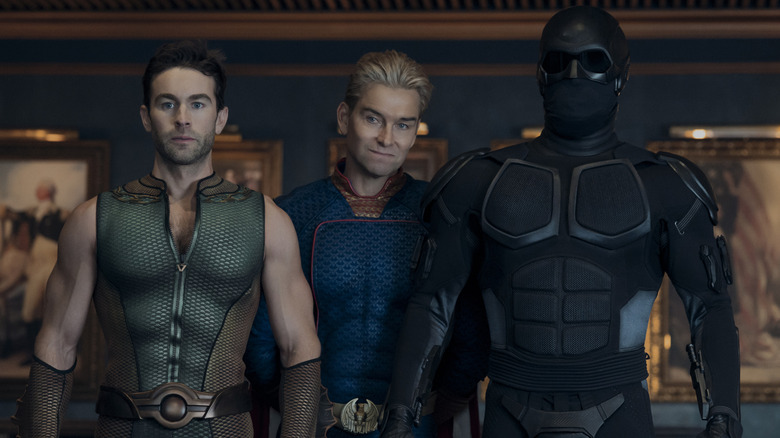
The other big flaw with both this season of "The Boys" and the series as a whole is that we rarely get to see Homelander's corruption of American society on anything above a micro-scale; the filming locations are the same sparse suburban streets, abandoned factories and remote forests as the average set piece from the Marvel assembly line. Instead, the writers tell and not show us how fascism is taking hold, at least gaining some laughs from the constant barrage of Verhoevian commercial breaks and news reports from this new "Golden Dawn" of America. In the first couple of episodes alone, we learn that Homelander and his father, the resurrected Soldier Boy (Jensen Ackles, who gets the best of the show's dirty one-liners), have been to Russia to ally the country with them instead of Ukraine (because Putin respects the family unit and "hates transgender bathrooms"), that abortion is imminently being banned, and that Chappell Roan has been sent to a re-education camp for speaking out against this. The writing team are fluent in the faux-patriotic parlance of everything from Fox News to manosphere podcasts, to the point it barely registers as a heightening of the worst right-wing rhetoric to be spewed on our social media timelines. Maybe the reason we rarely see the effect of this out in the real world of "The Boys" is because it's the kind of discourse exclusively used by the terminally online.
The season's boldest move is in how it aims to further anger the right-wing fans who somehow only discovered in the previous season that Homelander was no hero and that the joke was squarely on them. This is through the way it grapples with the cynical relationship between politics and religion, introducing a "Righteous Gemstones"-style Mega Church preacher played by Daveed Diggs, who quickly proves less interested in following the tenets set by the Lord than in establishing a new, distinctively American religion — because Americans are the "chosen people" who God speaks directly to, of course. For many viewers, particularly non-American ones, it will no doubt seem like the logical satirical conclusion to a series about how fascist leaders manage to enshrine themselves in power. However, there are bound to be many in the United States who will see religion as the target of the joke, not the people who manipulate it to obtain power. Those who can't (or won't) see the difference are probably better off sticking with the Marvel Cinematic Universe.
Even without the season finale (Season 5 hadn't been finished when screeners were sent to press), this final outing is a bold conclusion to a series which was beginning to grow stale. If only the core group of undercover heroes were as interesting as they are likable.
"The Boys" Season 5 premieres with its first two episodes on Wednesday April 8, 2026, on Amazon Prime Video.