

5 Sci-Fi Movies That Predicted Real Technology
Science fiction uses its speculative and futuristic stories for many things. Sometimes, it's to give social commentary about contemporary events. Other times, the rule of cool is in full play, and the goal is simply to have fun with some aliens and gadgets. Either way, many sci-fi yarns like to go all out with various imaginative technologies.
Some projects like to stay relatively close to existing technologies and themes, merely exaggerating them in appropriate ways to tell the stories they want to. Others, however, prefer to take massive educated guesses about what technology (or lack thereof) might look like in the future. Both approaches have led to some surprisingly successful insights over the years, and there are a number of perceptive sci-fi movies that have managed to become reality by introducing concepts that would later happen in the real world.
Today, we look at a batch of sci-fi movies that have managed to take root in reality with some truly surprising predictions. The following five films have managed to feature strange sci-fi technologies that ended up predicting very real technological developments.
Back to the Future II gave us a whole laundry list of predictions
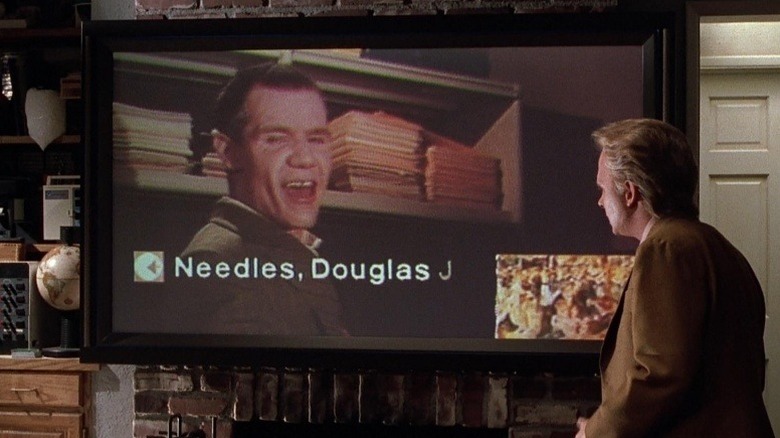
"Back to the Future Part II" came out in 1989, and it's one of the many sci-fi movies that take place in a future that has already passed. The film's "future" is the year 2015, and admittedly, it isn't quite how things ended up going down. In the real world, people can still walk the streets without running the risk of a giant holographic shark chomping down at them to advertise a "Jaws" sequel. Other details, like the film's suggestion of a lawyer-free future, didn't quite come to reality either.
Despite all this, the movie's fireworks display of future-themed visions did get a whole bunch of things very right, on a concept level at least. We can see a flying drone-like machine walking a dog. This is not what a real drone is likely used for these days, but the film also features a USA Today media drone that's not far removed from the technologies real media companies were already using in 2015. Real-world biometric scanning isn't a far cry from the way it's depicted in the movie, either. "Back to the Future" also predicted the modern prevalence of video calls, and there's even eccentric-looking eyewear that functions in a similar way as Meta AI glasses or Google Glass.
Still no proper hoverboards, though. We can only hope.
2001: A Space Odyssey predicted the rise of flat screen displays
Stanley Kubrick's "2001: A Space Odyssey" often gets science wrong, but at times it's surprisingly realistic. While you wouldn't necessarily expect the ambiguous space story about encounters with mysterious space monoliths to be rooted in hard science, Kubrick actually worked with experts to make his space flight scenes and spaceship design as realistic as possible.
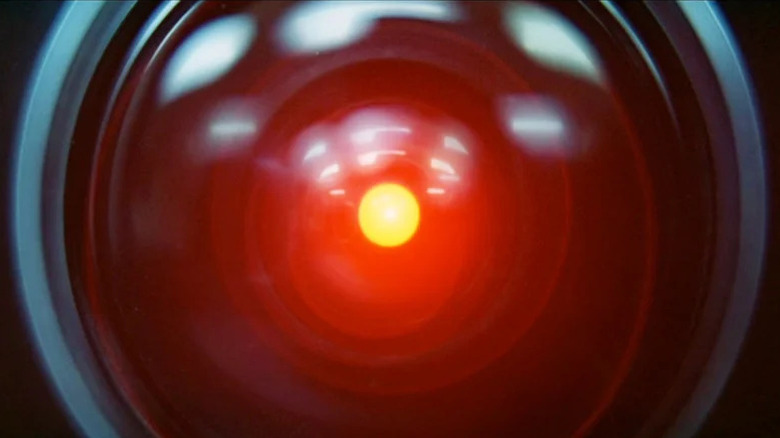
Apart from adhering to space-themed details available to him at the time, Kubrick also snuck in some surprisingly accurate predictions of the future. A contemporary viewer will, of course, notice that the subtext-laden "2001: A Space Odyssey" computer villain HAL 9000 responds (or, as Keir Dullea's Dave Bowman discovers, refuses to respond) to voice commands of the Discovery One astronauts, which is something that many personal devices can do these days with the right setup.
However, another, even more accurate "2001: A Space Odyssey" can be far less obvious for a contemporary viewer, simply because we're so used to the technology: The flat screen displays seen aboard Discovery One. While the very first prototype flat screen had already seen the light in 1964, the first working flat screen LED TV wasn't made until 1977, and the first flat screens didn't become commercially available until much later. This made "A Space Odyssey's" 1968 vision of how prevalent such screens would be in the future nothing short of ... well, visionary.
Logan's Run predicted Tinder and smartwatches
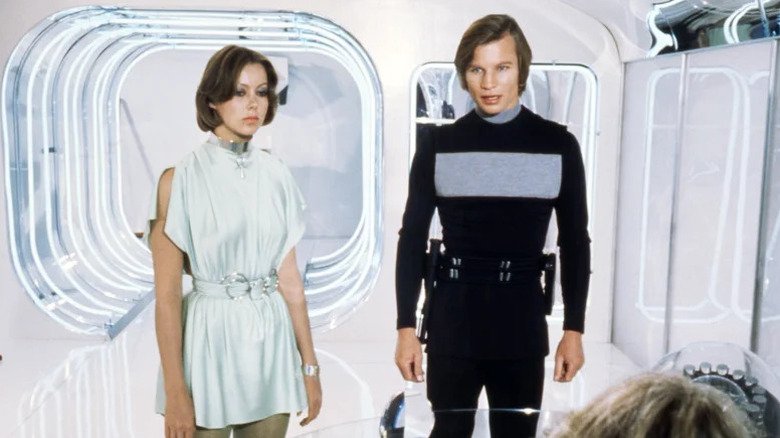
Many elements of director Michael Anderson's "Logan's Run" (1976) haven't aged all that well, but its depiction of a utopia that turns out to be a dystopian hellscape has a captivating core. In the far future, the citizens' life cycles are controlled by color-changing crystals that mark the time of their renewal ritual in a dramatic device known as the Carrousel. In reality, of course, the Carrousel functions to kill every citizen when they turn 30 so their consumption doesn't overload the system.
Fortunately, the Carrousel isn't the technology in "Logan's Run" that ended up predicting the future. Instead, the movie featured surprisingly prescient nods to now commonplace technologies like dating apps and smart watches.
The palm-embedded life clocks that trace where your life cycle is at are, of course, a pretty nasty thing in the movie's context. But they're also effectively devices that track your health, which makes them a rudimentary version of the health functions in smart watch devices like the Apple Watch. Another tech gadget from the movie is the machine Logan 5 (Michael York) uses to select and summon a lover, which is effectively Tinder without the awkward messages.
Minority Report predicted targeted advertising and retinal scan IDs
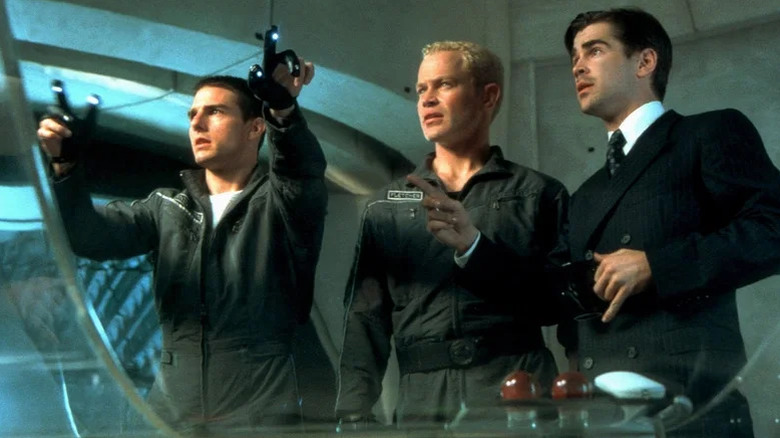
To create the world of 2002's "Minority Report," Steven Spielberg gathered 28 futurists together to come up with a vision of the year 2054. As it turns out, the group may have overshot a little, because some aspects of the movie's impressive tech are already very much in use today.
The basic premise of "Minority Report" is one that thankfully doesn't exist today, at least in the sense that it does in the movie: The government is able to tell that you're planning to commit a crime one day, and preemptively arrest you. However, the movie hits far closer to the mark with its depictions of certain retail technologies.
"Minority Report" features retinal scanning as a handy bio-recognition method. While not quite widespread yet, a similar real-world technology already exists courtesy of World ID, a retinal scan identity verification method that has already partnered with the likes of Visa, Gap, and Tinder. The movie's personalized ad billboards that speak to Tom Cruise's John Anderton might seem intrusive, but as most internet users can probably attest, they're also small fries compared to the personalized ads that haunt the online world of today.
Her predicted AI relationships and ChatGPT
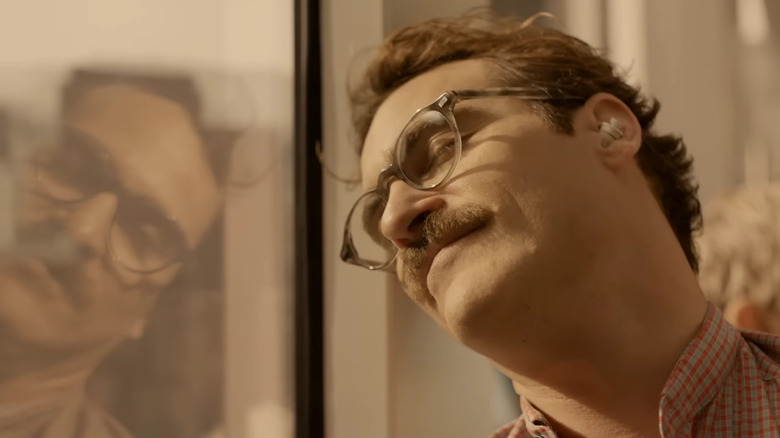
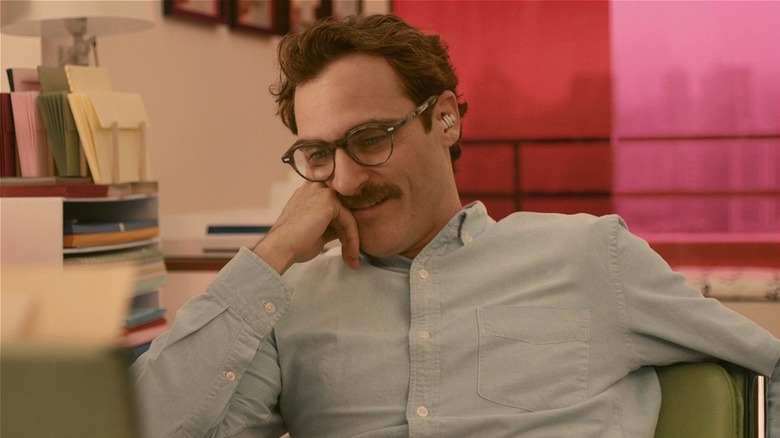
Watching Spike Jonze's 2013 sci-fi drama "Her" today will have tech-savvy viewers nodding their heads several times. As Joaquin Phoenix's Theodore Twombly slowly falls for his AI operating system, Samantha (Scarlett Johansson), it's pretty hard to avoid making comparisons to the rise of ChatGPT and AI relationships. There are ample real-world examples for the kind of predicament Twombly finds himself in, though the story does get a touch twistier than just flirting with a chatbot.
Samantha is effectively a personal assistant that learns from the data available to her, not unlike today's large language model (LLM) AI interfaces like ChatGPT, Gemini, Claude, and others. Since LLMs are able to "talk" with humans, there's also been a rise of Theodore Twombly-like people (both men and women) who have romantically or sexually interacted with an AI chatbot. Even the movie's revelation that Samantha, the program, is interacting with a great many users at once and isn't exclusive to Theodore — even though she convinces him that her feelings for him are real — seems pretty similar to how a chatbot with a large user base works.