

10 Highest-Rated Best Picture Oscar Winners On Rotten Tomatoes

Every year, the Academy of Motion Picture Arts and Sciences assembles and votes on something incredibly important to cinephiles the world over: what's the best movie of the year? Sometimes, they get it right, as you'll see with this list. Sometimes, they get it terribly wrong, but this isn't a list of worst Oscar winners ever. You won't find any "Green Book" or "Crash" entries in this article, so rest easy.
With that out of the way, there have — as of this writing — been 98 Academy Award ceremonies but 99 best picture winners (during the first-ever ceremony, "Wings" and "Sunrise" shared the two top prizes of best picture and "best unique and artistic picture"). So which are the best of the best? For that, we look to Rotten Tomatoes. The review aggregator has every single Oscar winner for best picture listed by its rating, so let's look at the top ten entries on that list and examine precisely what makes them so great. With incredible "runners up" like "The Godfather" and "Annie Hall" not even making the top 10, which movies beat out the best of the best? Keep reading to find out.
The Best Years of Our Lives (1946)
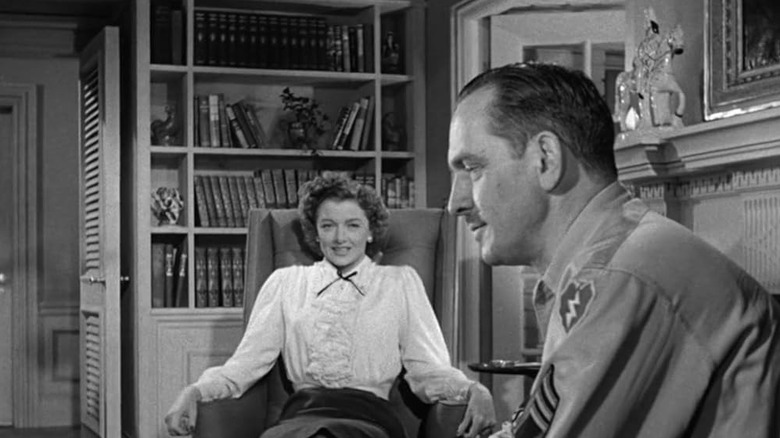
Released in 1946 and directed by the legendary Hollwood auteur William Wyler, "The Best Years of Our Lives" — which sits at a healthy 97% on Rotten Tomatoes — earned a critical consensus on the website that declares, "An engrossing look at the triumphs and travails of war veterans, 'The Best Years of Our Lives' is concerned specifically with the aftermath of World War II, but its messages speak to the overall American experience." That certainly gets right to the point. Wyler's movie stars acting luminaries Myrna Loy, Fredric March, Dana Andrews, Virginia Mayo and Harold Russell as soldiers returning from World War II and the wives who have to help them adjust.
From Air Force captain Fred Derry (Andrews) and his wife Marie (Mayo) to Army sergeant Al Stephenson (March) — who lives in luxury with his wife Milly (Loy) — to Navy officer Homer Parrish (Russell) and the object of his affection, Wilma (Cathy O'Donnell), "The Best Years of Our Lives" shows us how difficult it is to return from war as the veterans experience marital issues, money troubles, and other huge life events. "The Best Years of Our Lives" might not be one of the most well-known best picture winners these days, but it remains one of the very best.
All Quiet on the Western Front (1930)
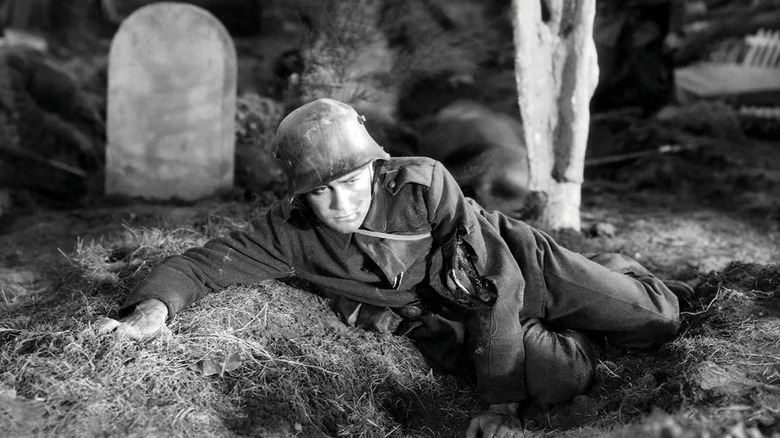
In 1929, the German writer Erich Maria Remarque wrote "All Quiet on the Western Front," and by 1930, it got the big-screen treatment thanks to director Lewis Milestone. The gripping, war-focused film still holds a 98% after so many years, with the Rotten Tomatoes critical consensus reading, "Director Lewis Milestone's brilliant anti-war polemic, headlined by an unforgettable performance from Lew Ayres, lays bare the tragic foolishness at the heart of war." You should be aware, if you're not already, that "All Quiet on the Western Front" isn't an easy watch by any metric, but in a world marked by violence and war, it feels like it's a necessary one.
The story centers around Ayres' young soldier Paul Bäumer, who's just a boy when he and a cohort of his equally young friends decide to join the German army and fight in World War I, just as the conflict begins in earnest. Throughout the film, Paul's bright-eyed wonder about the art of war and his dreams of bravely defending his country basically fall to pieces as he and his fellow soldiers are relentlessly attacked, and he sees the real cost — and bloodshed — of the massive war. Even after Paul briefly returns home due to an injury, he sees that his friends and family don't understand either, which only makes him feel more isolated. "All Quiet on the Western Front" is a classic American film (even though it's about Germany), to the point that it did get another adaptation in 2022 helmed by Edward Berger for Netflix that stars Felix Kammerer and Daniel Brühl.
Rebecca (1940)
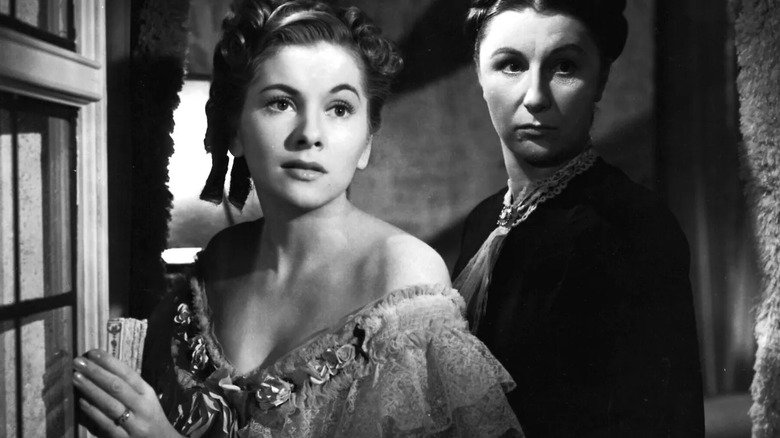
At first, "Rebecca" seems like just another literary adaptation that won best picture at the Oscars; it's based on the novel of the same name by Daphne du Maurier, a work that still remains readable and popular to this day. As it happens, "Rebecca" is also the only movie directed by Alfred Hitchcock to win best picture. (Truly insane statistic, honestly.) Led by Joan Fontaine and Laurence Olivier, the story doesn't focus on the titular Rebecca but on an unnamed narrator known only as the "second Mrs. de Winter" (Fontaine), who falls for and quickly marries the wealthy widower Maximillian de Winter (Olivier) after meeting him on a European vacation. When the two return to Maxim's sprawling English estate, Manderlay, the second Mrs. de Winter is dismayed to discover that his staff is rather unwelcoming ... especially the sinister housekeeper Mrs. Danvers (Judith Anderson), who dearly misses Maxim's late wife Rebecca de Winter and compares the newcomer to Rebecca at every opportunity.
"Rebecca" certainly isn't Hitchcock's most well-known movie, but it's among the most acclaimed — with 98% on Rotten Tomatoes, the consensus reads, "Hitchcock's first American film (and his only Best Picture winner), 'Rebecca' is a masterpiece of haunting atmosphere, Gothic thrills, and gripping suspense." Plus, it's certainly made its mark on pop culture as a whole. This movie was a major influence on the now-shuttered New York City production of the immersive theater show "Sleep No More," which is still running in Seoul, South Korea as of this writing; in 2020, Ben Wheatley directed a remake of "Rebecca" for Netflix starring Armie Hammer and Lily James. (Also, worldwide superstar Taylor Swift wrote a song inspired by "Rebecca" called "tolerate it," which is pretty cool.)
It Happened One Night (1934)
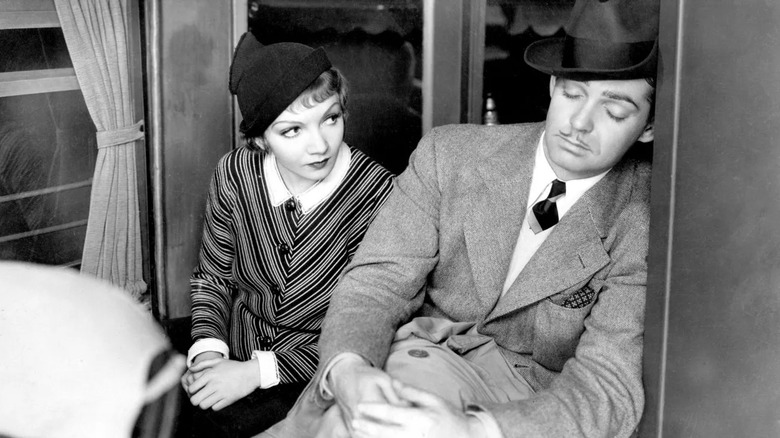
Directed by Frank Capra, "It Happened One Night" — adapted from a short story that ran in Cosmopolitan in 1933 called "Night Bus" by Samuel Hopkins Adams — is one of the early great romantic comedies, and it's also one of the highest-rated best picture winners on Rotten Tomatoes. With 98% on the aggregator and a critical consensus that says it's "remains unsurpassed by the countless romantic comedies it has inspired," "It Happened One Night" also holds a rare place in Oscar history in that it didn't just win best picture. At the 7th Academy Awards in 1935, "It Happened One Night" won best picture, best director for Capra, best adaptation for screenwriter Robert Riskin, best actress for Claudette Colbert, and best actor for Frank Gable. As of this writing, it's one of only three films to win all five of the evening's top awards aside from "One Flew Over the Cuckoo's Nest" in 1975 and "The Silence of the Lambs" in 1991.
So what is the movie about? When the rich heiress Ellie Andrews (Colbert) runs away from her controlling father to reunite with gold-digging new husband Westley (Jameson Thomas), but ends up meeting unemployed journalist Peter Warne (Gable) during her journey. As Ellie and Peter become unexpected travel companions, a spark grows between them — and Gable and Colbert's chemistry is truly incredible to watch. Plus, not for nothing? This is the movie where a woman — Ellie, specifically — lifts the hem of her skirt to flash an ankle while hitchhiking, a moment that's been parodied time and time again in pop culture.
Schindler's List (1993)
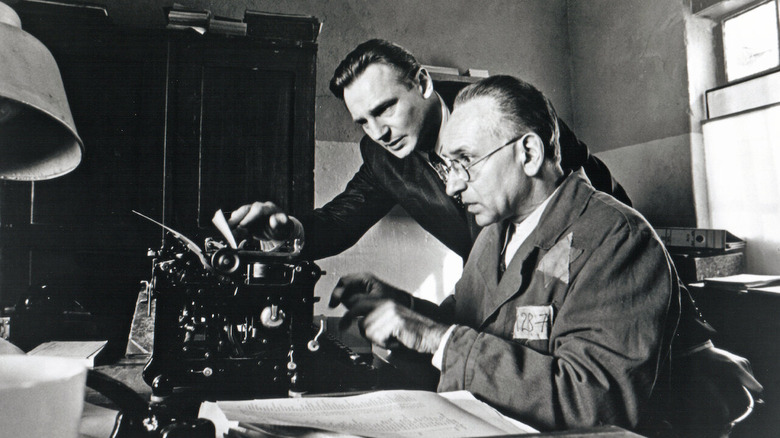
The name "Steven Spielberg" is quite literally synonymous with "good movies" at this point, and when he released his Holocaust epic "Schindler's List" in 1993, he officially earned his place as one of the best directors in the entire entertainment industry. Based on the shocking and real story of Oskar Schindler (played in this film by Liam Neeson, who earned an Oscar nod for his performance), the film has a rating of 98% on Rotten Tomatoes and a critical consensus that says, "'Schindler's List' blends the abject horror of the Holocaust with Steven Spielberg's signature tender humanism to create the director's dramatic masterpiece."
During the most dire years of World War II, Neeson's Oskar Schindler sets out on a personal mission to spare as many Jewish people from the perils of Nazi concentration camps as he possibly can, employing them to work in his industrial factories so that they're deemed "essential workers." Though Schindler maintains a cordial and even somewhat friendly relationship with high-ranking Third Reich officials to pull this off, he remains steadfastly committed to his goal of saving as many Jewish lives as he possibly can, even resorting to outright bribery to provide protection. A stunning true story told by one of the best living American directors, "Schindler's List" is both devastating and a triumph; it's no wonder that it won best picture, and it's also no wonder that it still has such a high critical rating.
Moonlight (2016)
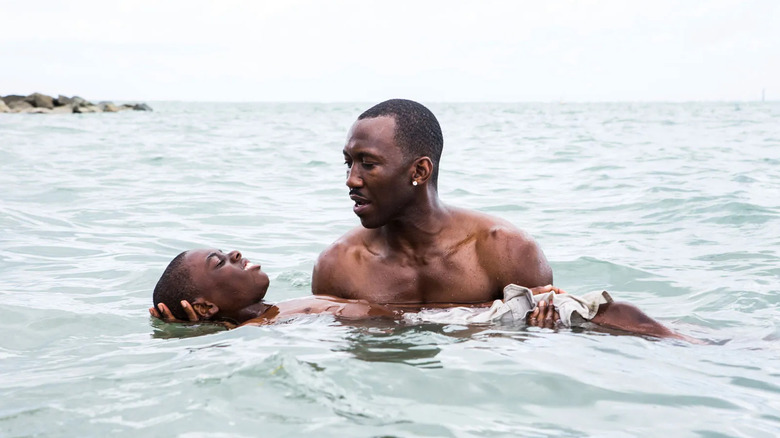
Adapted from a story by playwright Tarell Alvin McCraney and written and directed by Barry Jenkins, the stunning 2016 best picture winner "Moonlight" tells the story of a young Black man named Chiron across three distinct stages of life. As a child, he's portrayed by Alex Hibbert and forms a relationship with a drug dealer named Juan (Mahershala Ali, who won the first of two consecutive best supporting actor Oscars for the role) while struggling at home with his mother Paula (Naomie Harris). As a teenager, Ashton Sanders' Chiron explores his sexuality alongside his best friend Kevin (played as a teen by Jharrel Jerome) while trying to get through high school; he now lives with Juan's former girlfriend Teresa (Janelle Monáe) in the aftermath of Juan's death. Finally, as an adult, Chiron, now portrayed by Trevante Rhodes, reunites with Kevin, finally comes to terms with his identity as a queer man, and even reconciles with Paula.
Though "Moonlight" is likely "best" remembered as the movie that actually beat "La La Land" during the now-infamous mix-up at the 2017 Academy Awards, it's also just one of the most beautiful and emotionally resonant coming-of-age movies ever made and a truly worthy best picture winner. Rotten Tomatoes agrees; it has a 98% rating on the platform and a critical consensus that says it "uses one man's story to offer a remarkable and brilliantly crafted look at lives too rarely seen in cinema."
All About Eve (1950)
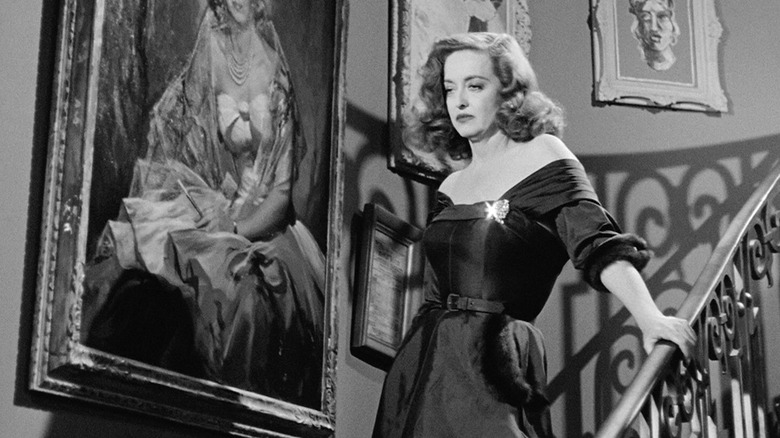
Written and directed by Joseph L. Mankiewicz and produced by Daryl F. Zanuck, "All About Eve" has more than earned its reputation as one of the best old Hollywood movies ever made ... and it's also one of the best movies to ever win best picture, according to Rotten Tomatoes. On the review website, it still boasts a near-perfect rating of 99%, and the critical consensus calls it "smart, sophisticated, and devastatingly funny" and "a Hollywood classic that only improves with age" (which is a really cheeky joke if you're at all familiar with the film's premise. As fading theater star Margo Channing (Bette Davis) tries to hold on to both her career and her director boyfriend Bill Simpson (Gary Merrill) — even with her performing on Broadway in New York and him in California working on a film — she's distracted by a new young actress who becomes her competition. When aspiring actress Eve Harrington (Anne Baxter) first meets Margo, she confesses that she's a fan, leading Margo to take her under her wing ... which proves to be a fatal mistake.
While Margo's resentment regarding Eve grows and the actress becomes a bigger and bigger sensation, the film builds to a truly wild climax — and it's no wonder that both Davis and Harrington received nominations for best actress at the Oscars. (Neither won, but their co-star George Sanders took home a statue for best supporting actor.) "All About Eve" is a cinematic classic, and it's also one of the most critically adored films to ever win best picture.
On the Waterfront (1954)
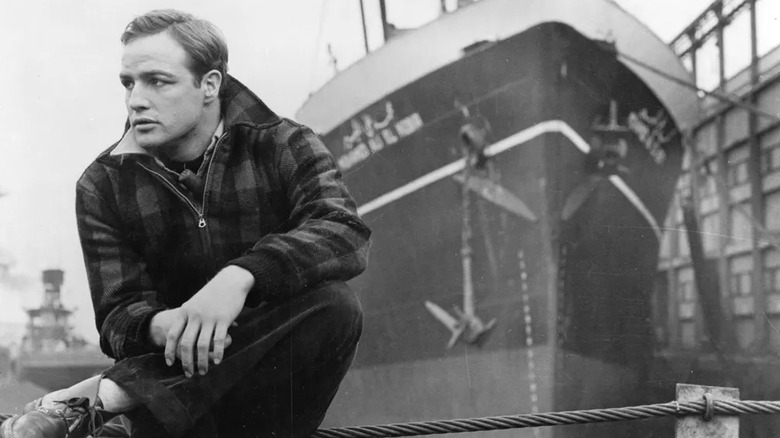
Marlon Brando was, without question, the best actor of his generation — and he's utilized perfectly in Elia Kazan's near-perfect film "On the Waterfront." Inspired by real events detailed in the New York Sun in the late 1940s titled "Crime on the Waterfront" by Malcolm Johnson, Kazan's film stars Brando as Terry Malloy, a former prizefighter who now works as a longshoreman at the New York City docks under the mob boss, Johnny Friendly (Lee J. Cobb), who paid him to throw his last-ever match. Alongside Terry's brother Charley (Rod Steiger), Friendly tricks Terry into getting one of his fellow workers onto a rooftop for a discussion, only to kill the man so he doesn't testify about rampant wrongdoing to the Waterfront Crime Commission. Under threat from Friendly, Terry remains quiet, but grapples with his decision to stay silent.
"On the Waterfront" is a timeless film about corruption, evil men, and people who are brave enough to speak up when they see something wrong — and Rotten Tomatoes agrees, apparently. "With his electrifying performance in Elia Kazan's thought-provoking, expertly constructed melodrama, Marlon Brando redefined the possibilities of acting for film and helped permanently alter the cinematic landscape," the critical consensus reads ... and all these years later, it still holds a 99% rating.
Casablanca (1942)
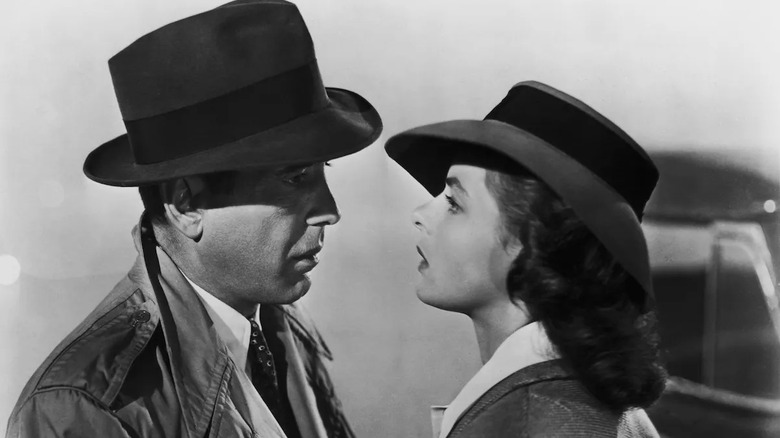
Has there ever been a greater love story than "Casablanca?" The experts, including everyone here at Looper, say no! In Michael Curtiz's sweeping, romantic World War II epic, we meet American expatriate Rick Blaine (Humphrey Bogart) as he runs a bar in Casablanca, Morocco that welcomes high-ranking government officials and refugees alike (though, truthfully, Rick seems to abhor his dealings with the former, especially the Vichy and Third Reich officials he encounters). Rick keeps to himself and lives a solitary life, but when his long-lost love Ilsa Lund (Ingrid Berman) walks into Rick's Café Américain one evening with her fiancée Victor Laszlo (Paul Henreid), he finds himself grappling with heartbreak all over again. Victor, a resistance leader from what was then called the Czechoslovakian Republic, is wanted by Nazis after narrowly escaping from a concentraton camp, and Rick must decide if he can put his love for Ilsa aside and help them escape their dangerous enemies.
"Casablanca" is unquestionably one of the best and most famous films in the entire canon, which makes it entirely unsurprising that it's ranked at number two on the Rotten Tomatoes list of the "best" best picture winners. "An undisputed masterpiece and perhaps Hollywood's quintessential statement on love and romance, Casablanca has only improved with age, boasting career-defining performances from Humphrey Bogart and Ingrid Bergman," the consensus boasts, and its rating sits at 99% ... which is the same as the number one pick.
Parasite (2019)

The first non-English language movie to ever win best picture at the Academy Awards, South Korean writer-director Bong Joon Ho's film "Parasite" became one of the Academy's biggest success stories when the 92nd Oscars aired in early 2020. Not only did Bong take home best director, best original screenplay, and best international feature film — in addition to best picture! — but "Parasite" remains one of the most acclaimed movies in recent memory. That's certainly what Rotten Tomatoes says; it calls the film "an urgent, brilliantly layered look at timely social themes" that "finds writer-director Bong Joon Ho in near-total command of his craft," and its rating sits very comfortably at 99%.
So what is "Parasite" about? Well, we don't want to spoil this wonderfully twisted movie for you in case you haven't watched it yet, but here's the gist. After Kim Ki-woo (Choi Woo-shik) gets a job tutoring for a wealthy family, his sister, mother, and father — Ki-jung (Park So-dam), Choi Yeon-gyo (Cho Yeo-jeong), and Ki-taek (Song Kang-ho), respectively — all conspire to get jobs in the household too, tricking the Parks into thinking that they're a collection of strangers and not a scheming family. Partway through "Parasite," though, the entire story changes drastically, and if you really want to enjoy this movie to the fullest, you'll watch it a few times to pick up on things you might've missed. "Parasite" is, according to every imaginable metric, one of the best movies ever made, and it's also — as of this writing — the highest-rated Oscar winner on Rotten Tomatoes.