

10 Best Alternate Movie Endings Of All Time, Ranked
You would think that with all the time and money that goes into making a film, the creative team would know how they'd want it to end. While that's usually the case, other times they stumble upon the conclusion along the way, or try out several different endings before landing on one that works. Maybe the director creates their dream finale, only for studio intervention to rear its ugly head and force them to film one they perceive as more palatable to viewers. Often, test screenings play a key role in these changes, proving that audiences don't always know what's best for them.
The results are, as you might expect, fairly mixed. A lot of the time, the ending that ultimately hit theaters is the one that works best for the movie, and it's clear why the other versions landed on the cutting room floor. But every once in a while, you learn of an alternate ending so perfect you can't imagine why it got subbed out. The entries on this list are the ones that, at the very least, add some ineffable quality to their respective film and we wish had been part of the final product.
10. Paranormal Activity
When "Paranormal Activity" was first released, it became one of the biggest success stories of the horror genre, making a huge impact on a tiny budget. However, there was initially some disagreement over how the found-footage classic was going to conclude — in fact, director Oren Peli actually filmed three potential endings.
With a disturbing presence haunting their house, Katie (Katie Featherston) and Micah (Michael Stoat) have taken to setting up cameras in each room in an effort to document what's going on. Things reach a fever pitch as the malevolent force grows bolder, and the theatrical version ends with Katie being possessed and murdering Micah, throwing his body at the camera before the final shot shows her with a devilish grin.
The two alternate endings, to be fair, don't deviate too far from the established conclusion. In one, Katie sits in the house with Micah's dead body until police arrive, and apparently breaks out of her possession — only to be shot by the startled officers when a door slams shut elsewhere in the house. This was the original ending, which was only shown once, upon the film's initial festival premiere. There's also a much more gruesome finale, where Katie kills Micah and then slits her own throat. No matter which one "Paranormal Activity" went with, it's safe to say that things didn't turn out too well for our central protagonists.
9. The Descent
If you watched the gruesome "The Descent" in the United States, the trials and tribulations of a group of women trapped underground while on a spelunking trip gone wrong ends on a reasonably optimistic note. Sarah (Shauna Macdonald) digs her way out, makes her way back to her car, and only breaks down into tears when she's out of harm's way. This is the widely accepted conclusion, and the one that the sequel springs from, taking place just two days after the original. But that's not the version of "The Descent" that international audiences necessarily received.
In the United Kingdom, viewers got a far more downbeat ending of "The Descent" that you may have not seen, where Sarah's escape is revealed to be a trick of the mind, and she spends the last moments of the film looking at a hallucinated version of her deceased daughter, accepting her fate. This ending makes it arguably more difficult for the sequel to exist, but it seems a much more appropriate conclusion than the one that American audiences got.
8. Little Shop of Horrors
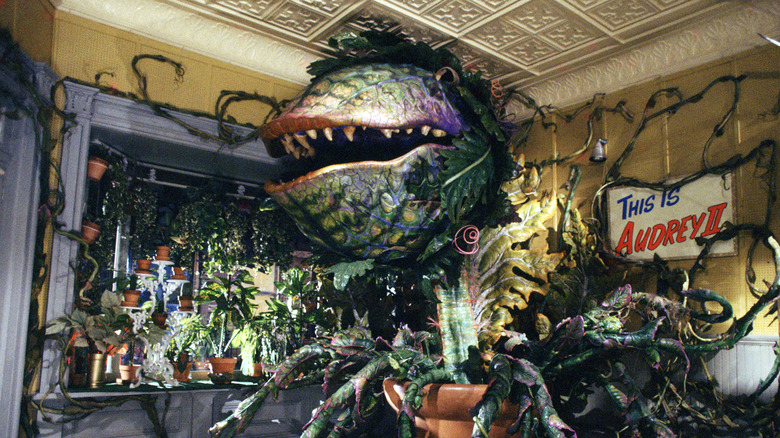
1986's "Little Shop of Horrors" follows the mild-mannered Seymour (Rick Moranis), who stumbles upon a strange and unusual plant he christens Audrey II, named after the girl he has a hopeless crush on (Ellen Greene). Upon learning of Audrey II's unconventional diet of human flesh, Seymour makes a terrible bargain that leads him to darkness. It comes down to a showdown between Seymour and Audrey II, with the humble florist coming out on top — although we see a small Audrey II growing outside Seymour and Audrey's white picket fence before the credits roll.
However, the alternate ending you never got to watch is far more ... well, apocalyptic. After killing both Seymour and Audrey, Audrey II mania sweeps the country and tiny versions of the plant are bought up everywhere. From there, the invasive species takes over Earth in fairly short order.
Despite the ending lining up with the conclusion of the 1982 play it was based on, audiences didn't like the heroes getting killed. Frank Oz recalled in an interview with Entertainment Weekly, "For every musical number there was applause, they loved it, it was just fantastic ... until we killed our two leads. And then the theater became a refrigerator, an ice box ... They were saying that they hated us killing them." Despite agreeing to alter the ending to the happier one we have now, Oz was largely unhappy about the change.
7. Terminator 2: Judgment Day
After hearing all about the man, the myth, and the legend of John Connor in "The Terminator," it's a fun treat to actually meet him as a kid (Edward Furlong) in "Terminator 2: Judgment Day." This time around, he's being hunted by another futuristic robot (Robert Patrick), while Schwarzenegger's Terminator is sent back to the early 1990s to protect him. Whatever happens, John Connor's destiny is laid out in front of him, and there's little hope of escape.
But the deleted "Terminator 2: Judgment Day" ending would have changed everything, suggesting that John does, in fact, side-step his fate. Set in the future, it features an elderly Sarah Connor (Linda Hamilton, in old age makeup) narrating what happened to her son. Instead of becoming the savior of humanity in a devastating war against robots, he's a senator, doing his part to help out the world in a different way.
Ultimately, this ending was scrapped, and we can see why. With the battle for humanity averted, there's not exactly room for future "Terminator" films — not unless audiences were clamoring to see John Connor at work in Congress, that is.
6. The Butterfly Effect
Considering that "The Butterfly Effect" is all about one man's power to go back in time and create an endless number of alternate futures based on seemingly insignificant past actions, it's somehow fitting that the film would have an alternate ending of its own. In the theatrical release, Evan (Ashton Kutcher) goes back to the first time he meets Kayleigh (Amy Smart) as a child, purposefully making a bad impression so they never become friends. Without their shared history, Kayleigh and the rest of Evan's friends never experience the childhood trauma that makes their lives such a nightmare. The film ends with Evan and Kayleigh passing each on the street years later, pausing briefly to look at one another.
But the director's cut of "The Butterfly Effect" goes way further. In it, Evan decides that simply avoiding the people he cares about isn't enough to protect them. Instead, he goes all the way back to the womb, killing himself as a fetus. And what's more, the doctor mentions that this was just one of several miscarriages his mother had experienced, implying that he had other potential siblings who were born but eventually followed the same devastating course of action. Yikes.
5. Clue
The 1985 murder mystery comedy "Clue," based on the popular board game, is a veritable treasure trove of alternate finales. When first released in theaters, there were three different versions of the ending, so how the movie concluded was entirely reliant on where you saw it. It wasn't until the VHS release of "Clue" that all three were edited together, allowing home viewers to experience them all.
In one, Miss Scarlet (Lesley Ann Warren) is responsible for the deaths; in another, Mrs. Peacock (Eileen Brennan) is the culprit. The final version, titled "What Really Happened," shows that each person, with the exception of undercover FBI agent Mr. Green (Michael McKean), was responsible for one death, and Wadsworth (Tim Curry) is revealed to be the real Mr. Boddy.
But did you know that in addition to these three released alternate endings, a fourth version was filmed? Tim Curry revealed in an interview with Empire that they originally shot an ending where it turned out that Wadsworth was responsible for every murder in the film, but they nixed it on the very reasonable grounds that it simply wasn't funny enough, and didn't match the tone of the other endings.
4. First Blood
It might be difficult to remember, but before "Rambo" was a jingoistic action franchise, "First Blood" was a pretty dark examination of the plight of a traumatized Vietnam veteran returning to a society he no longer belongs to. With that in mind, the alternate ending that was originally filmed for "First Blood" makes a lot more sense.
When John Rambo (Sylvester Stallone) is taken into custody by a group of small-town Washington cops, the abuse they inflict upon Rambo sends him spiraling, experiencing PTSD flashbacks to his time at war. This sends him into fight-or-flight mode and, knowing Rambo, it's going to be heavy on the fight. The theatrical release ends with him being talked down by his former mentor in the military, Colonel Sam Trautman (Richard Crenna).
However, there was initially a different, darker ending that would have destroyed the prospects of "First Blood" ever spawning a fully-fledged franchise. They actually filmed a finale where John Rambo, agonized by his trauma, begs Trautman to kill him, before ending his own life. While this conclusion would have been incredibly powerful and, in many ways, suited to the downbeat tone of "First Blood," it's easy to see why the team decided to let Rambo live.
3. I Am Legend
Based on the novel "The Omega Man," "I Am Legend" sees Will Smith as Robert Neville, a doctor living alone in an abandoned Manhattan in the wake of a global virus. The virus has killed 90% of humanity, while turning the vast majority of survivors into rage-filled zombies called Darkseekers, and Neville experiments on captured Darkseekers in an effort to find a cure. At the end of the film, Neville succeeds in turning a female Darkseeker back human. He manages to get a vial of her blood to two survivors — Anna (Alice Braga) and Ethan (Charlie Tahan) — providing hope for humanity, but sacrificing himself in the process.
But in an alternate ending, something unexpected happens. As he treats the female Darkseeker, he realizes that the male Darkseeker who has been hunting him is her mate trying to get his partner back. The discovery of the Darkseekers' sentience adds poignancy to the ending, as Neville grapples with the fact that he is the monster in their world just as much as they are in his. This ending was nixed as a result of negative reactions from test audiences, but is so widely regarded as the superior conclusion that when first talking about the upcoming "I Am Legend" sequel, writer Akiva Goldsman told Deadline in 2023 that they would disregard the theatrical ending and use the alternate version as a launching point.
2. Get Out
By the end of "Get Out," we're all exhausted — so you can only imagine how Chris (Daniel Kaluuya) feels, after being put through the wringer by his girlfriend Rose (Allison Williams) and her diabolical family. There's a sense of catharsis when he finally defeats her, but panic quickly sets in when a police car turns up. We've seen this narrative play out in the past, and we know all too well what often happens to Black men who find themselves in this situation. So the relief is enormous when we discover that it's actually his best friend Rod (Lil Rel Howery) coming to his rescue.
But that wasn't the original ending. There's a dark alternate "Get Out" ending that sees Chris getting arrested and sent to jail for murdering Rose, one last twist of the knife for a guy who has already been through so much. The decision to give the film a slightly more uplifting conclusion came as a result of the negative reaction from test audiences. "The audience was absolutely loving it, and then it was like we punched everybody in the gut," producer Sean McKittrick explained to Vulture. "You could feel the air being sucked out of the room."
1. Blade Runner
When it comes to alternate endings, Ridley Scott is pretty much the patron saint, and "Blade Runner" is his crowning achievement. The classic science fiction film based on the Philip K. Dick short story "Do Androids Dream of Electric Sheep?" stars Harrison Ford as Rick Deckard who, in a futuristic L.A. cityscape, is tasked with hunting down a group of escaped replicants. It initially received mixed reviews, largely because of the decision to include some fairly cheesy voiceover narration from Ford and a happy ending where Rick and Rachael (Sean Young) are able to ride off into the sunset together.
This was a choice inflicted upon the film by the studio. Speaking with Empire in 1999, Harrison Ford said, "I was very, very unhappy with their choices and with the quality of the material." But he and Ridley Scott got the last laugh, as eventually "Blade Runner" ended up with not one, not two, but four alternate versions. There are subtle changes made throughout the film between each iteration, but with the ending, the narration was the first thing to go — along with concluding Rick and Rachael's story on a slightly more ambiguous note.