

What Ryan Gosling's Project Hail Mary Looks Like Without Special Effects
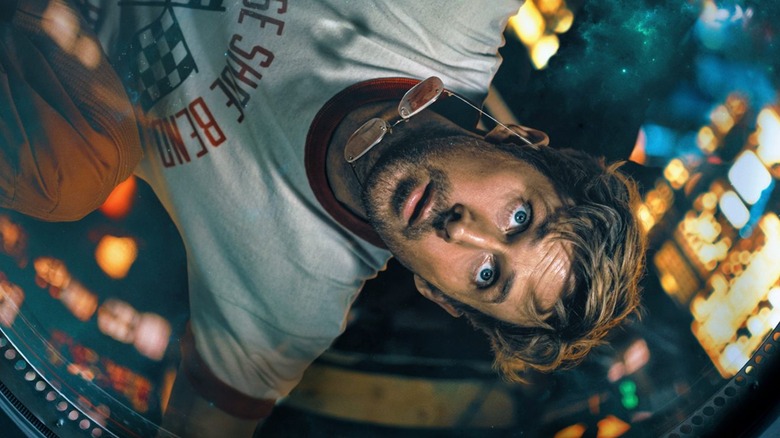
One of the biggest science fiction movies of 2026 is Ryan Gosling's "Project Hail Mary," based on Andy Weir's 2021 novel of the same name. The film reportedly cost $248 million to make, and it's easy to see why from the trailers, as it's largely set in space aboard a massive vessel. Gosling isn't alone either, thanks to another astronaut from a different world, whom Gosling's character, Ryland Grace, names "Rocky" due to his rocklike appearance.
Everything about the film is grand in scale, from the stakes that send Grace on his desperate mission aboard the Hail Mary to the settings. The movie's centerpiece is the ship itself, which looks about as real as possible, thanks to the incredible research put into its design. While Weir described it well in the book, the set designers and prop makers took Hail Mary off the page and into reality, and it's an incredible thing to see.
Because "Project Hail Mary" is an effects-driven film, it's interesting to peer behind the scenes to see what the movie looks like without special effects. That's always fascinating, whether it's a bunch of "Star Trek" movies, something like "A Minecraft Movie," or a sci-fi epic like "Project Hail Mary." Take a peek behind the curtain and see how an amazing group of talented artists and artisans brought "Project Hail Mary" to life on the silver screen.
A massive space movie without a single green screen
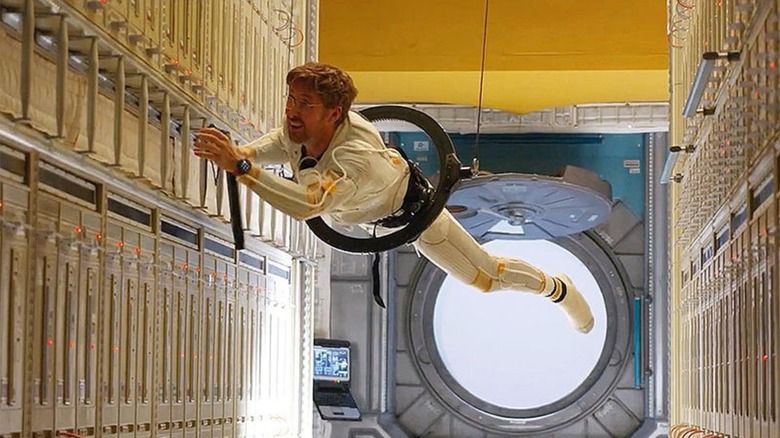
One of the most amazing aspects of "Project Hail Mary" is the complete lack of green screens used for any of its VFX shots. Co-director Christopher Miller spoke with ComicBook, explaining that the choice kept the movie feeling more natural, using practical lighting on real sets to shoot each moment in real time. Miller's comments created some confusion, because "Project Hail Mary" is clearly an effects-heavy film. He followed up his interview on X (formerly known as Twitter), explaining that the movie includes a total of 2,018 VFX shots.
The confusion arose due to misconceptions about green screens, which have become commonplace. Miller described green screens as being "used in lieu of building sets or figuring out locations/lighting in advance." They're primarily used to incorporate digital elements alongside live-action actors. You'll see them often in the behind-the-scenes clips for movies like "Avengers: Endgame" and similar fare. Miller opted to eschew the practice, requiring the set designers to build nearly everything in the real world, giving it a more realistic look and feel.
While 2,018 VFX shots sounds like a lot, it's relatively low when compared to something like "Avatar: Fire and Ash," which features more than 3,500. The biggest difference between the two movies is the almost entirely digital world of the "Avatar" threequel vs the primarily practical depiction of the Hail Mary, and a few other elements. The decision to film it in this way gave the directors and their team the ability to produce a less animated-looking film.
The Hail Mary's interior is entirely practical
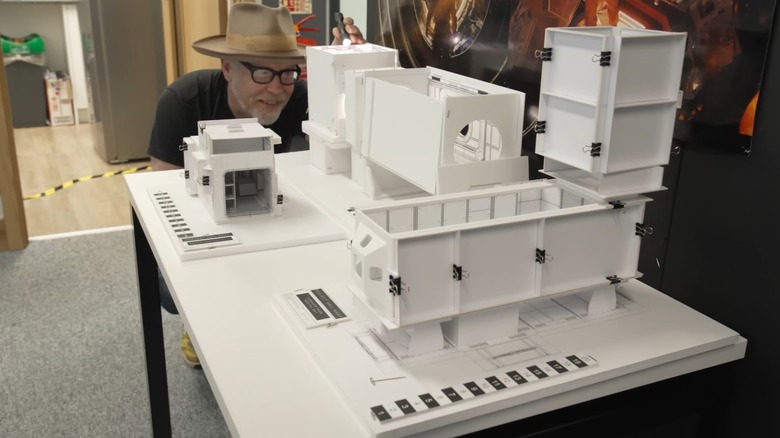
Most of the action in "Project Hail Mary" takes place in space aboard the Hail Mary — humanity's last, desperate chance at stopping its own extinction. While the ship could have been rendered fully in CGI without much issue, and it likely would have looked incredible, it was instead built practically. This wasn't a small undertaking, as the ship is considerably large. That said, it's also confined and claustrophobic, because research into the design revealed that to be an enduring feature of real spaceship manufacture.
Production designer Charlie Wood and his team took the time to study real-world space vessels to help design their fictional ship's look and feel. The team began with the production of 3D-printed miniatures, adding as many details as possible. Using the models, the team began the arduous process of building a full-size set, using the International Space Station as its primary inspiration.
A talented team created everything from airlocks to portholes and everything in between when crafting the ship. Physical sets are preferred by actors because they have something real to look at and interact with. There's only so much an actor can do with a tennis ball propped up on a pole, and while plenty have made it work well over the years, the tactile feel of a real set is better suited to most actors' talents. Ryan Gosling could touch walls, walk through corridors, and hit control panels, giving his performance a more realistic look and feel.
Thousands of buttons and hundreds of screens
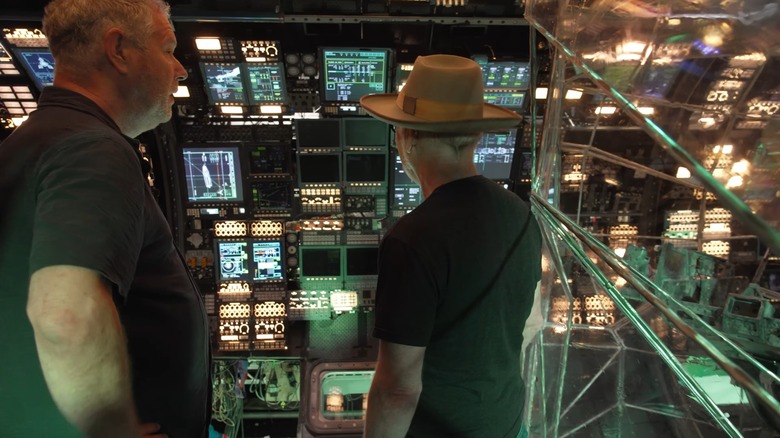
It's one thing to construct a life-size spaceship, but it's an entirely different affair to outfit its panels to make it look like the real deal. The team that worked tirelessly to bring the Hail Mary to life spent a great deal of time researching what spaceships and space stations actually look like, using the International Space Station, Mir, and other vessels as a guide. They also looked at terrestrial aircraft like the Boeing 747-400, and adopted a deliberate lack of symmetry to make it appear more realistic.
Charlie Wood explained that several of the screens showed different shades of black (or contrasts), making each panel look distinct from the next. This was done because different vendors often produce different panel instruments, meaning they won't look cohesive when put next to each other. By removing symmetrical appearances and adopting the piecemeal nature of contracted parts, the whole system looks more realistic. Some of the panels and buttons also have Mandarin script, while others are in English and a variety of languages, which matches the film's theme of a last-ditch humanity-wide effort to save Earth.
All told, the Hail Mary features thousands of buttons and switches and hundreds of individual screens to produce a realistic spaceship. The ship's hatch also utilized designs from the ISS (and similar orbital vehicles), while the windows were built in a manner similar to airplane portholes. It all comes together into what the viewer easily accepts as a proper, functional spaceship. These things could have been created digitally, but Grace has so many plot-important interactions with panels and buttons that a tangible set design was ideal.
Rocky is a seamless blend of puppetry, animatronics, and animation
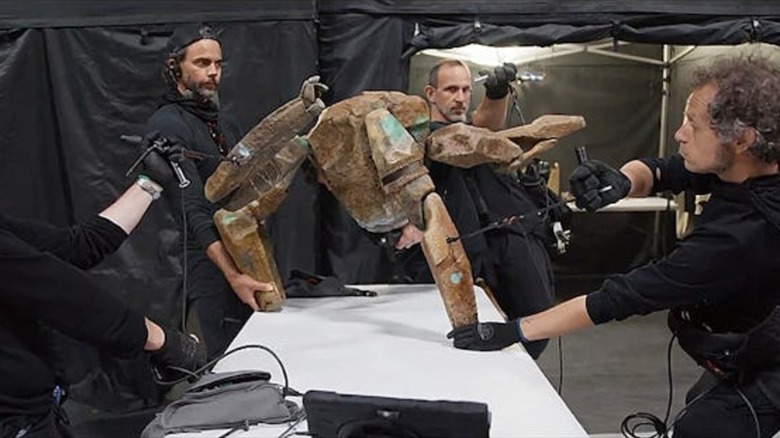
Because CGI has become photorealistic, it's natural to assume that an alien in a movie isn't practical, but in "Project Hail Mary," Rocky is actually a complex animatronic puppet. Creature designer Neal Scanlan, a longtime leader in the field who was responsible for the Porgs of "Star Wars: The Last Jedi'" (and many other amazing critters), brought Rocky to life. When he met award-winning puppet designer and performer James Ortiz, Scanlan explained the process to him, telling him that Ortiz is Frank Oz, and he's making Yoda just for him.
Oz famously created the diminutive Jedi in "The Empire Strikes Back," and both Scanlan and Ortiz worked together to craft Rocky as he's described in the book. His operation required a group of puppeteers, affectionately dubbed "Rockyteers" on the set, who would move the character throughout the environment, giving Ryan Gosling a physical character to act and react to in the moment. Because "Project Hail Mary" is about the two characters' relationship, getting Rocky right was paramount in everyone's minds.
Rocky is composed primarily of a thin fiberglass shell, which was digitally rendered, scanned, and printed so it could be cast. Five Rockyteers were needed to get him moving just right in many scenes, though some digital animation was used in areas where that wasn't possible. Additional VFX work ironed out the details, producing a blend of animatronics, puppetry, and digital animation. Add to that the amazing voiceover work of Ortiz, and the film created its co-lead.
Zero-g was achieved through a rotating set and wire work
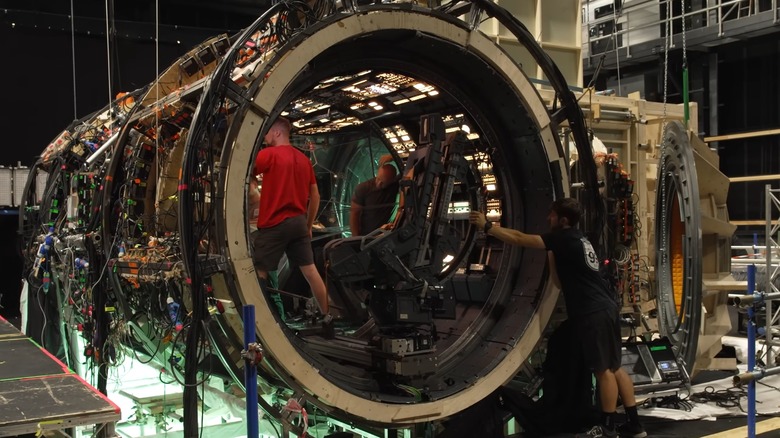
Filmmakers have been incorporating zero gravity into movies since the first major feature film did it in 1968's "2001: A Space Odyssey." There are many methods, including simulating it aboard the infamous Vomit Comet. That's how some of the best zero gravity scenes in movie history were shot, including in "Apollo 13." Getting zero-g just right isn't an easy technical feat, especially when the directors decide not to use green screens. CGI has been exceptionally efficient at depicting zero-g in movies like "Gravity," but that wasn't an option for "Project Hail Mary."
Instead, the tried and true method of wire work was involved when showing Ryan Gosling in weightless scenarios. To be clear, wire work was also employed in "Gravity" and almost every other feature film that depicts zero-g, but for "Project Hail Mary," it's the only method. The harness and wires are removed during post-production, leaving what looks like a man floating in three-dimensional space.
One of the other methods used by the filmmakers was a rotating set. That may sound relatively simple, but it's actually a complex feat of engineering, which has to accommodate for all kinds of wiring and power distribution. A rotating set like the Hail Mary's cockpit can still function while it's in motion. In addition to rotating, the set was also built on what's called a gimbal and shudder rig. These allow for pitch, yaw, roll, and vibration, adding even more dynamic movement options.
When Ryan Gosling is in space, he's up against practical backgrounds
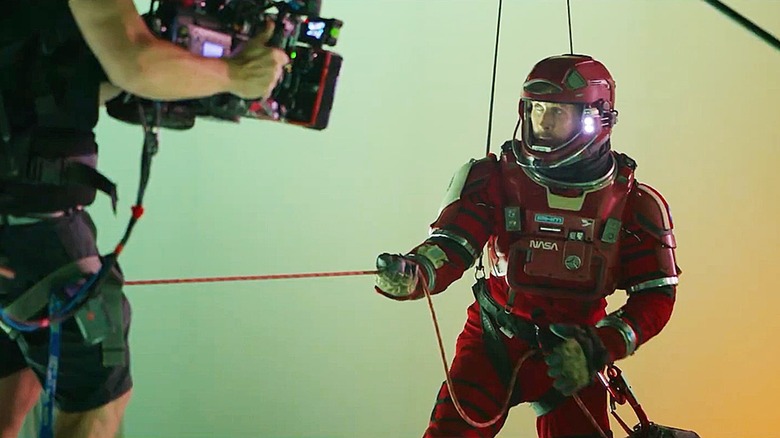
When you sit down to watch the film, which, as Reuben Baron wrote in his review of "Project Hail Mary" for Looper, you should absolutely do in an IMAX theater, you'll see several scenes of Ryan Gosling among gorgeous space settings. This is nothing new, and you've seen it in movies like "2001," "Star Wars," and many others over the years. Most modern movies that do it, especially those in the Marvel Cinematic Universe, use green screens,
"Project Hail Mary" revived an older method of shooting against specific backdrops. Co-director Christopher Miller explained in his post on X, "When Ryan is outside on the hull of the ship, we shot him in front of a black background for space and a shifting hue background when he was up against the aurora of a planet, which allowed for truer interactive light on him than a green screen would. The wide space exteriors and spaceship shots were entirely digital and beautifully done by ILM [Industrial Light and Magic]."
By using these backgrounds, the lighting department achieved realism in a manner that's more challenging than digital composition. The crew constructed large sections of the Hail Mary's outer hull, which Gosling can also be seen against in several shots. For the wider exteriors and more expansive scenes showing the spaceships, that's where the digital effects team stepped in and worked their inimitable magic, blending the practical and digital into undeniably beautiful shots.
The space suit is a practical costume
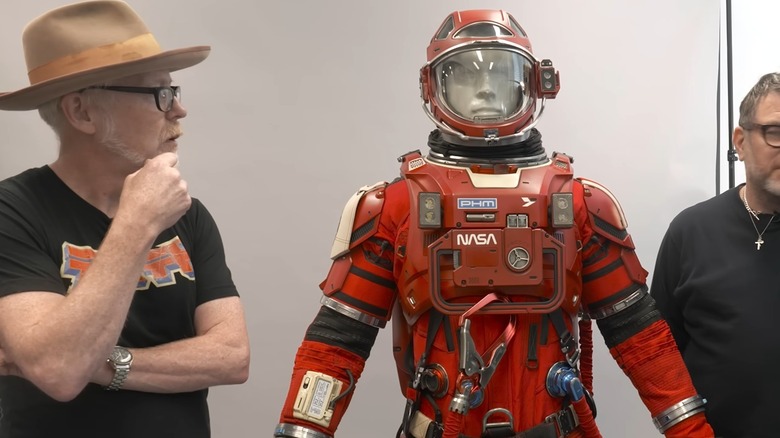
Costume design is an often overlooked aspect of filmmaking, but it's nonetheless one of the biggest necessities. After all, what would a period drama be if the costumes looked like they were bought at Spirit Halloween? It's fair to say that costume designers are often the unsung heroes of the industry, and several prominent ones worked on "Project Hail Mary." While Ryan Gosling wears more than 50 separate outfits throughout the movie, his most notable costume is easily the red spacesuit he dons for his extravehicular activities (EVA), and there are several of these scenes in the movie.
Something that's become more common of late is to film actors wearing motion capture suits and digitally paint their costumes over them. This is a technique that was heavily employed in "Avengers: Endgame," but for "Project Hail Mary," the costumes are entirely practical. To design the suit, costume designers David Crossman and Glyn Dillon, alongside a talented team of designers, costume cutters, and prop makers, consulted with NASA.
They produced an EVA suit that was agile and less cumbersome than those worn by NASA astronauts. They also looked at the suits used by Blue Origin and SpaceX, which are more streamlined and modern. They built everything from scratch, relying on NASA's practice of never putting anything untested into space. To that end, every component had to be pre-existing to maximize the realism. They created helmets and other elements via 3D printing with painted metallic finishes, resulting in a truly memorable movie costume. The results are fantastic in their tangibility.