
10 Low-Budget Movies That Look Way More Expensive Than They Actually Are
Making movies is expensive. Even in an age where everyone has cameras built into their phones, the collaborative effort and commitment necessary to make even the most low-fi found footage horror film is gonna max out some credit cards. As weird as it might sound to describe films that cost millions of dollars as "low-budget," it's the simple reality of a business where the most expensive blockbusters can cost upwards of $300 million. Innovations in affordable technology seem to get canceled out by inflation and other factors, making the average budget climb even higher.
Even so, films made for more modest budgets — for our purposes, let's say $15 million and under — can not only make a ton of money, but even do a more impressive job putting the money they spent on the screen than those made with far more resources. The following 10 movies, ordered from the most to least expensive, pulled off cinematic feats far beyond what most would expect from their means. Those in the know might be able to figure out how these filmmaking teams made their films for relatively cheap, but for most people watching these movies, they don't feel cheap.
Ex Machina
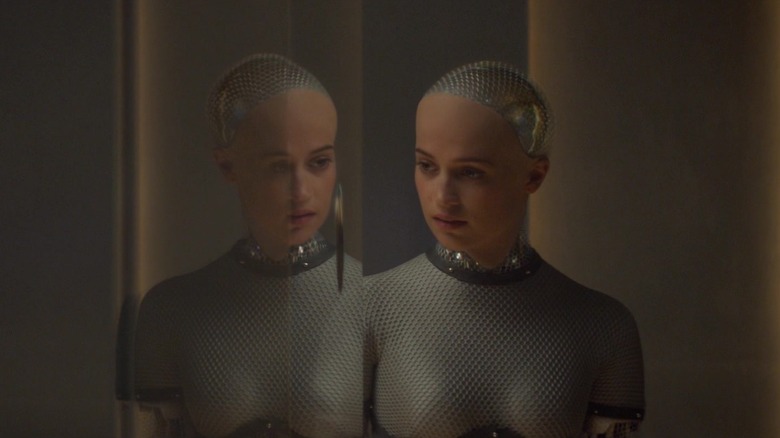
On one level, it makes sense how "Ex Machina" was able to keep to a fairly low $15 million: it's a chamber piece set mostly in one location with only four significant characters. However, that budget once again becomes mind-blowing when considering the fact that one of those characters, Ava (Alicia Vikander), is an android with transparent body parts that couldn't be done through costuming alone.
Every second Ava appears onscreen required extensive CGI enhancements of the kind you rarely see in low-budget films, and they didn't have the luxury of doing green-screen takes. Even when she's putting clothes on at the end of the movie, those clothes had to be done in CGI!
The effects were seamless, and "Ex Machina" beat out films costing over 10 times its budget, including "Star Wars: The Force Awakens" and "Mad Max: Fury Road," to win the best visual effects Oscar. In the 21st century, the only other effects Oscar winner made for a similarly small sum has been "Godzilla Minus One" — and while it's still astonishing what that film pulled off for somewhere between $10-15 million, it's not exactly "low budget" by the standards of Japanese filmmaking (where live-action studio films usually range between $1-5 million).
The Brutalist
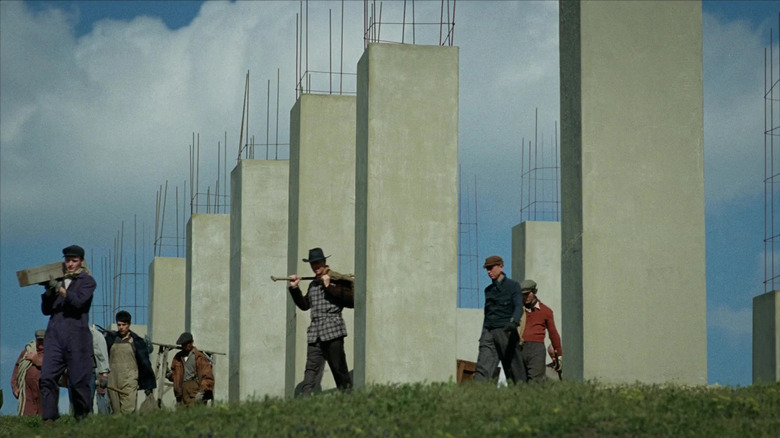
As a rule, historical epics cost money, especially when they take place across multiple continents. That's one of the reasons "Marty Supreme" is A24's most expensive film so far. All the more astonishing, then, is what Brady Corbet pulled off for under $10 million: His A24-released, VistaVision-shot, 3.5-hour Jewish-American historical drama, "The Brutalist."
Some of the budget's savings were location-based: tax breaks made it easier to mock up Hungary into 1950s Pennsylvania than to actually film in Pennsylvania (they did film the two Italy-based sequences on location, as well as a few shots in New York for the Ellis Island opening scene).
Other savings were based on implying greater scale than is actually shown: the film's central architectural accomplishment, The Van Buren Institute, was only constructed in select pieces and in miniature, with the props destroyed after filming due to lack of funds for storage space.
Speaking to The Hollywood Reporter, Corbet specifically credited the sound design for much of the film's epic feel, saying, "If anybody actually watched the movie with the sound off, they would see that the movie visually is not that big because we couldn't afford to make it that big. It's actually voiceover dialed up to nine or 10. It's music dialed up to 11. It is design and effects and foley and all of these things fighting for space." Similar techniques were used for the equally low-budget epic "The Testament of Ann Lee," directed by "The Brutalist" co-writer Mona Fastvold.
Get Out
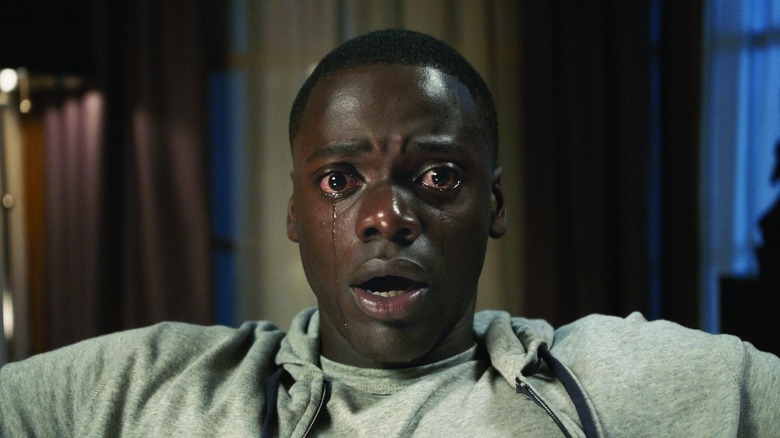
While Blumhouse has been raising its budgets in recent years ("Five Nights at Freddy's 2" cost a record $51 million for the studio), the horror production company made its name in the 2010s by making the most out of limited budgets. Original films were typically capped at $5 million, with sequels expected to go to $10 million. Those limitations paid off with many immensely profitable hits and, in the case of the $4.5 million-budgeted "Get Out," one instant classic.
Filmmaker Jordan Peele was able to use his limited resources in ways that didn't feel cheap, but instead reflected the psychological horror at the heart of his story. Consider how well the film uses its single primary location of the Armitage Estate, and how effectively it uses close-ups — a way to pull the audience in to Chris Washington's (Daniel Kaluuya) sensation of being trapped, and a method of shooting the violence viscerally but without needing much effects work.
The production worked on a limited 23-day schedule, but Peele and cinematographer Toby Oliver made sure none of that time was wasted. They storyboarded scenes and prepared the shot list in advance, based on photos taken at the locations.
Lost in Translation
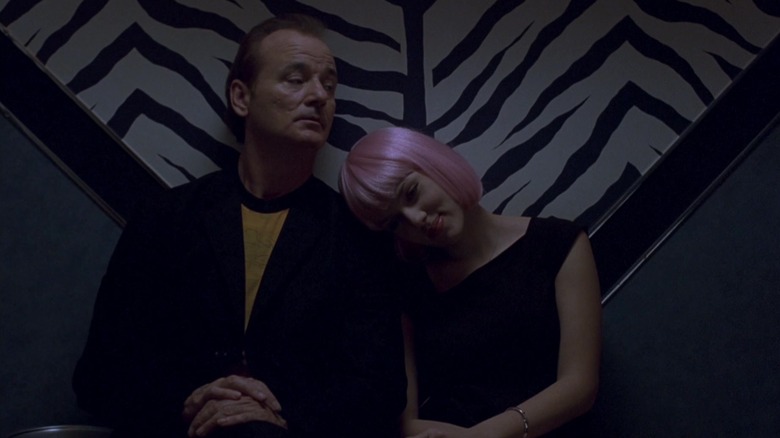
Sofia Coppola's "Lost in Translation" cost $4 million to make in 2003, which would equal around $7 million in today's dollars. That's unusual considering the film's star power; while Scarlett Johansson was not yet a marquee draw at the time, Bill Murray was a big name, and Coppola wrote the role of Bob specifically for him despite not having any guarantee he'd take a role in such a small production. Now consider that $1 million — a quarter of the budget — was already spent in pre-production before the filmmakers even knew for sure that Murray would show up on set. That it all worked out and resulted in one of the best Bill Murray movies is a miracle.
You can thank Japan's much more lenient attitudes towards shooting on location for the ease with which the film's crew captured the atmosphere of Tokyo. You can also thank Sofia Coppola's famous father, Francis Ford Coppola, for the decision to shoot "Lost in Translation" on film rather than on video. That might have saved money, but would have dated the movie and made it look cheaper.
Flow
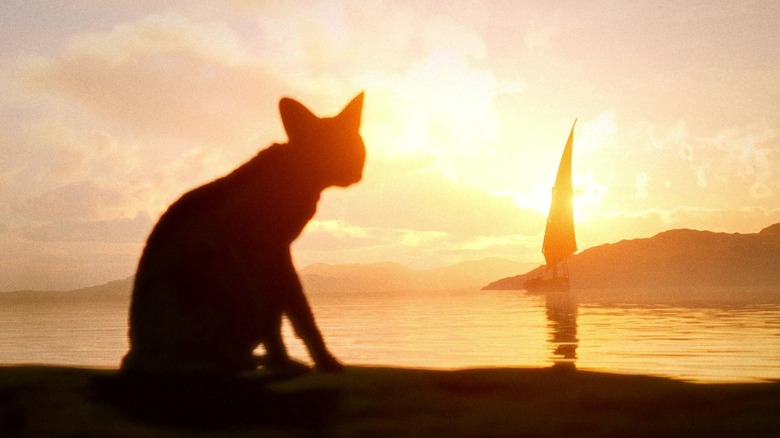
Even acknowledging that European animated films are, on average, much less expensive than American ones — budgets average at €5.9 million, or around $7 million in US dollars, way below the dozens if not hundreds of millions spent on American cartoons — Gints Zilbalodis' "Flow" is still an astonishing low budget accomplishment.
The 2024 Oscar winner about animals surviving a flood wowed our eyeballs with computer animation costing only around €3.5 million (depending on the exchange rate, that's somewhere from $3.8-$4 million). For comparison, DreamWorks' "The Wild Robot," with its similar painterly aesthetic, cost $78 million.
How do you make a movie so beautiful on a budget? Not spending any money on animation software helps: "Flow" was animated entirely in the free open source software Blender, which has also been used in microbudget cartoons like "Boys Go to Jupiter" and "Bouchra." Working with a small team of under 50 artists also helped contain the budget. You probably can't pull off Pixar-style realism with these resources, but "Flow" wasn't aiming for that. Its stylization allowed it to be made for cheap, but when the style is so beautiful, "cheap" is no epithet.
Nirvanna the Band the Show the Movie
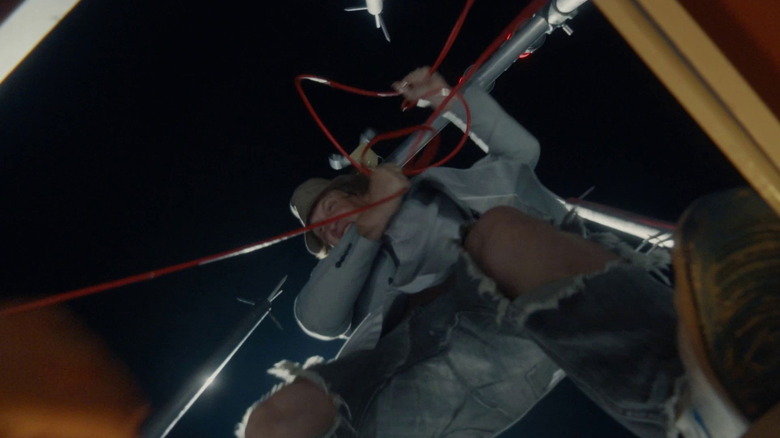
One common theme with low budget productions is the need to make sure all the money shows up onscreen — which makes it all the wilder to realize Matt Johnson says he cut around 95% of the footage shot for the $2 million production of "Nirvanna the Band the Show the Movie." He can get away with it because the film is mostly him and his friend Jay McCarrol fooling around with each other, but the scale on which they fool around boggles the mind.
Consider the stunt in the first act, where Matt and Jay leap off the CN Tower onto SkyDome stadium. How they pulled it off remains a mystery, but regardless, they did it without permits. Johnson told Filmmaker Magazine, "If a Hollywood movie were to do [these sequences], they would rebuild the CN Tower, they would do it with [professional] actors. It would be a $5 million stunt."
Much of the critically acclaimed comedy's "how they got away with it" special sauce came from knowing when to be in the right place at the right time. They filmed around Drake's mansion after a real shooting, and pulled off a big trolley stunt amidst the chaos of the Taylor Swift Eras Tour's Toronto stop. Johnson also keeps things cheap by knowing the ins and outs of fair use law, getting away with as many pop culture references as he can without becoming overwhelmed in licensing fees.
Moonlight
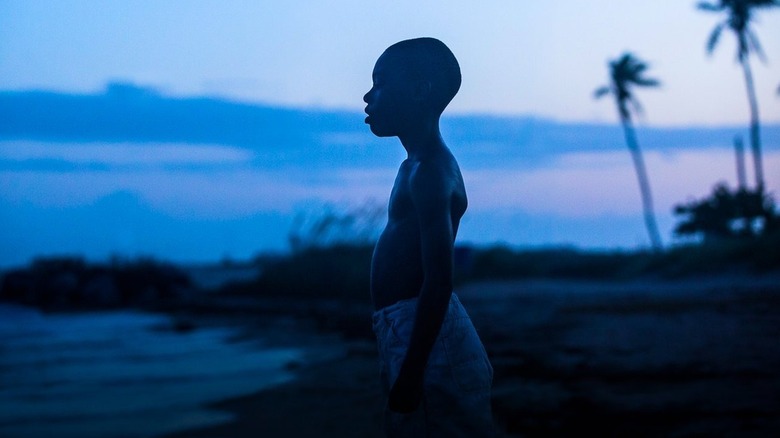
With a budget of $1.5 million in 2016, "Moonlight" is the lowest-budgeted film to win the best picture Oscar after adjusting for inflation. That's small even by the standards of small-scale indies — for comparison, the documentary-style "Nomadland" cost $5 million and the comparatively un-flashy "CODA" cost $10 million. Despite this, there's no obvious visible signs of cost-cutting on-screen amidst the virtuosic cinematography, making the accomplishments of director Barry Jenkins and his team all the more impressive.
The big skills needed to make a film like "Moonlight" for just $1.5 million are to plan ahead but work quick. Jenkins' close working relationship with many of his collaborators, going back to their film school days, allowed for years of planning before the tight 25-day shoot. The film's better-known supporting players had extremely limited schedules, with Naomi Harris performing all her scenes in 3 days and Mahershala Ali only available on weekends due to his role in "Luke Cage."
Decisions were improvised on the fly, such as the way the camera goes underwater when young Chiron (Alex Hibbert) learns to swim. While the production could have gone to other states for tax incentives, "Moonlight" shot in Florida to maintain authenticity to its setting. The results prove out the method.
Monsters
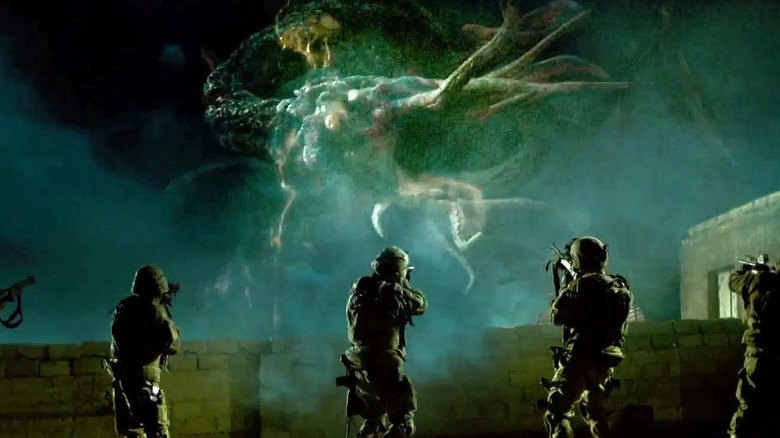
If you're going to make any sort of film at all for a budget below a million, it helps to be a polymath — those who can't afford to pay others to do important jobs better be able to do such jobs themselves. That's what Gareth Edwards had to do for his $500,000-budgeted 2010 debut feature "Monsters," working not only as the writer and director, but as the cinematographer, production designer, and visual effects artist.
It's Edwards' work in the effects, specifically, that earns "Monsters" a place on this list. We've seen plenty of microbudget genre films that use documentary techniques, non-professional actors, and a "hide the monster" ethos to get away with minimal resources, but it's hard to think of others where the scenes that do show the monsters have such impressive CGI.
That's not to say "Monsters" is a great film. It's visually stunning but kind of boring, in the way Edwards' subsequent big budget projects (the ones not saved by Tony Gilroy reshoots) are visually stunning but kind of boring. If you're an indie filmmaker looking for technical inspiration, however, it's well worth watching.
Mad Max
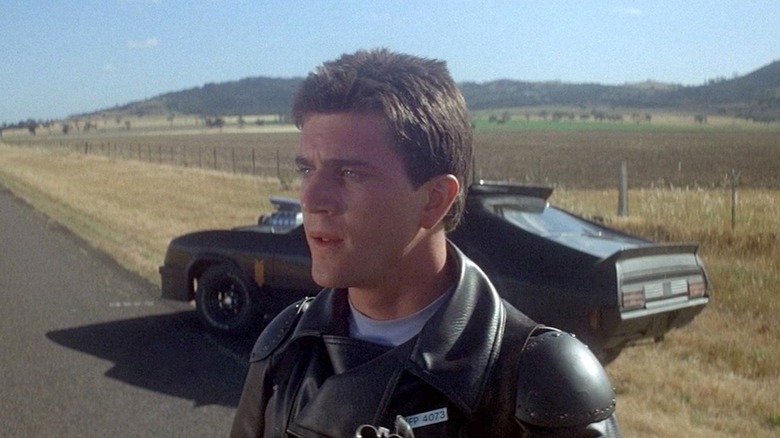
Somewhere between $350,000 and $400,000 was spent on the original "Mad Max" in 1979, which in 2026 dollars equals $1.5-1.8 million. If that sounds dangerously low for a movie with that many car chases and explosions, note that it was dangerous to make — though not for the reasons you might expect. While director George Miller's background as a doctor helped avoid injuries on set, the production couldn't afford transportation for the cast, so stuntman Grant Page and the original female lead Rosie Bailey both got injured while biking to the shoot.
Other ways the guerrilla production saved money included paying crew members in beer, stealing items to use as props (and returning them to the stores right after), and closing down roads without permission. Strangely enough, the Melbourne police found the dubiously legal movie interesting enough that they actually volunteered to help out on shoot!
The 1981 sequel, "Mad Max II: The Road Warrior," upped the production value extensively and was at the time Australia's most expensive film ever. Yet, even if that record-breaking $4.5 million ($16.1 million adjusting for inflation) production wasn't "low-budget" in relative terms, it's still hard to imagine such grand spectacle being made for so little today. Indeed, the two most recent "Mad Max" films, 2015's "Fury Road" and 2024's "Furiosa," cost $150 million and $168 million respectively.
El Mariachi
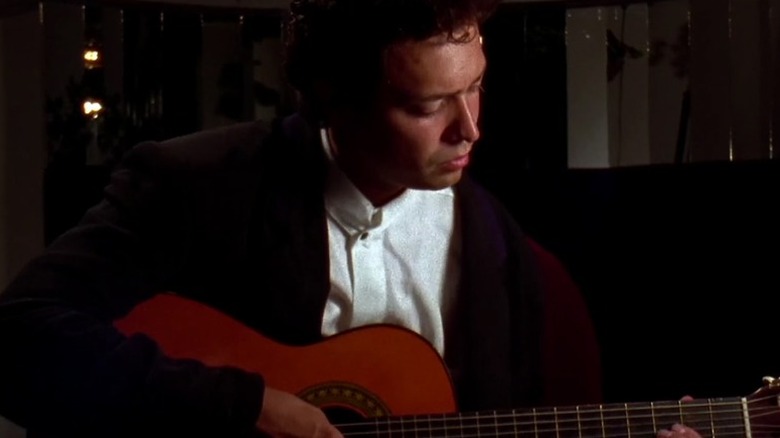
The $7,225 total (which would be over $16,000 today) thrown around as the budget for Robert Rodriguez's 1993 directorial debut action film "El Mariachi" is somewhat mythologized. It's true that was the amount spent on the production when Rodriguez envisioned it as a direct-to-video cheapie, but post-production to get the sound and picture quality up to a theatrical standard cost an additional $200,000.
Even the full total is still way cheaper than what anyone would expect to spend on even the lousiest throwaway B-movie, especially in the pre-digital era, so it's no wonder that the production of "El Mariachi," an actually fun and exciting B-movie, became the stuff of legend.
Rodriguez's making-of book "Rebel Without a Crew" recounts how he raised the original shooting budget by taking part in clinical drug trials, filming scenes in just one or two takes, and did almost every job he could, from operating the camera to composing the score, by himself. This could have resulted in an Ed Wood-style disaster but instead became an arthouse sensation, inspiring a whole generation of indie directors.