

12 Most Rewatchable Episodes Of Rick And Morty
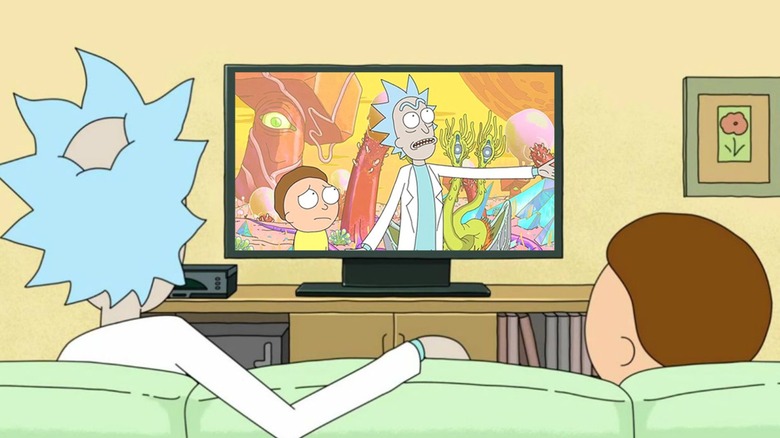
When it first premiered in 2013, few could have guessed that "Rick and Morty" would become a cultural phenomenon. Over time, the series has built upon its ever-expanding lore and Rick's (Justin Roiland and Ian Cardoni) backstory. Much of the show is linear as a way to avoid time travel, and despite its multidimensional structure, the overarching narrative of "Rick and Morty" involves character development that differs from most animated series.
"Rick and Morty" is running full steam on Adult Swim, releasing new seasons at relatively regular intervals. After more than 80 episodes, the adult animated series has brought more than enough comedy, melodrama, and complex storytelling to the masses. Many of the best episodes of "Rick and Morty" have both permeated the zeitgeist while being highly rewatchable.
Of course, rewatchability is entirely subjective, but several episodes have consistently drawn fans in for repeated viewing. Many have contributed to memes, added extensive lore to the overarching storyline, and contained character or worldbuilding details that may not have been apparent the first time around. These episodes are presented in no particular order, as they're all equally worth a rewatch by new and longtime fans alike.
Rick: A Mort Well Lived (Season 6, Episode 2)
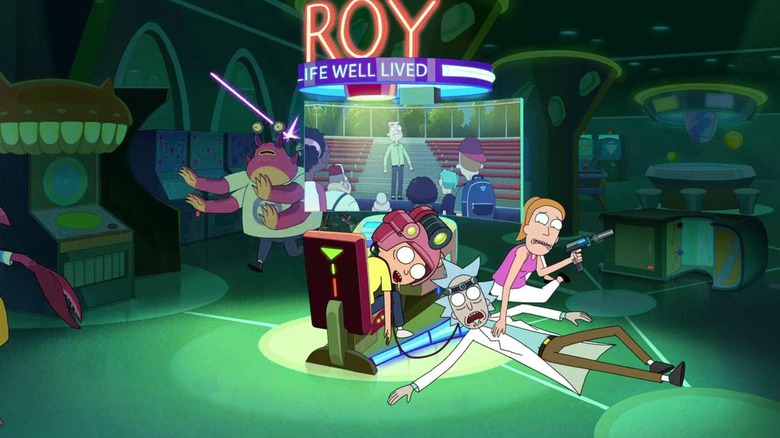
Like most great "Rick and Morty" episodes, "Rick: A Mort Well Lived" has two interwoven storylines. One focuses on Summer (Spencer Grammer) doing a "Die Hard" in Blitz and Chipz to stop a group of terrorists. The other deals with Morty (Roiland), whose consciousness has fractured into every NPC in the game "Roy: A Life Well Lived." To save him, Rick enters the game and inadvertently creates a religion while attempting to convince everyone that they're all Morty.
It's complex, but funny, and it all ties together as Summer takes down one terrorist after another, channeling her inner John McClane (Bruce Willis) despite never seeing "Die Hard." It's a fun Summer story where she fakes her way through, becoming an incredibly successful killer in the process, while Rick fumbles for decades of in-game time that causes no end of frustrations.
"Die Hard" is spoken 42 times, and as any sci-fi fan knows, the number 42 holds a great deal of significance. It ends with an amusing homage to the conclusion of "Raiders of the Lost Ark" because no "Rick and Morty" episode would be complete without numerous pop culture references. The episode is great to rewatch because, like many of the show's best stories, it features numerous details that are easy to miss on a first or fifth viewing.
Night Family (Season 6, Episode 4)
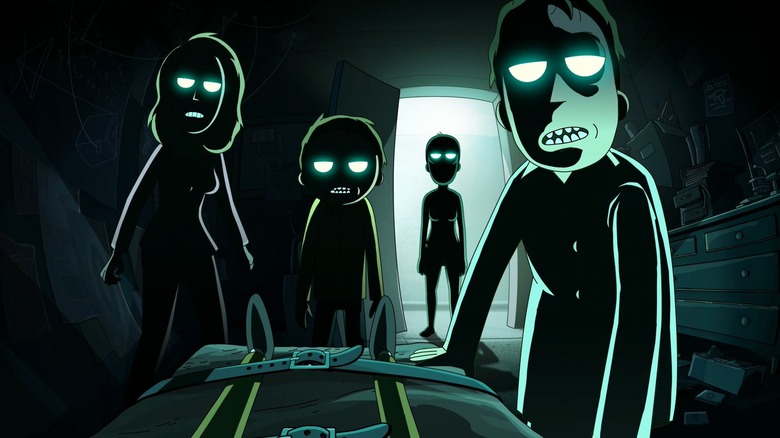
Rick creates tons of great inventions or finds interesting things at an alien shop, and a lot would be amazing IRL. One such example is explored in "Night Family," when Rick reveals his Somnambulator, a device that programs his unconscious body to carry out tasks while he sleeps, so he doesn't have to do them while awake. The Smith clan instantly wants in, and while he's reluctant, Rick gives in to their wishes, giving birth to the titular Night Family.
Summer has her Night Person learn Spanish, Beth (Sarah Chalke) learns to play the trumpet, Morty follows Rick's example and gets killer abs, and Jerry (Chris Parnell) becomes pen pals with his Night Person. When Jerry's Night Person asks that the family rinse the dishes so the gunk doesn't stick to them, Rick outright refuses, setting up a conflict that sees all-out war break out between the families.
The episode culminates in the Night Family taking over, destroying their credit, bankrupting their finances, and ultimately giving up, returning things to normal. This kind of high-concept sci-fi is where "Rick and Morty" excels, perfectly exploring the duality of each character as they repeatedly switch sides. By the end, it that will have you thinking, 'What would I do with a Somnambulator?'
Rixty Minutes (Season 1, Episode 8)
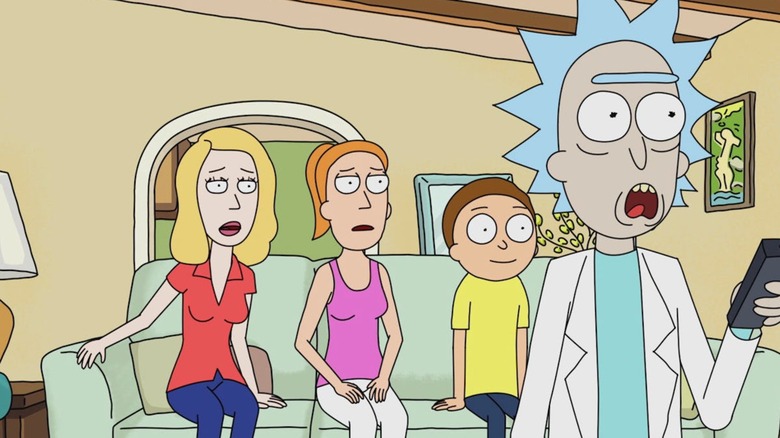
"Rixty Minutes" is all about Rick's greatest invention: an interdimensional cable TV box. Series producer Dan Harmon is famous for his "what-if" style of clip shows featuring previously unseen moments, but he took it in a new direction here. In it, Rick throws together a new cable box because he hates everything on TV. The box offers endless viewing possibilities, tapping into other dimensions to show all kinds of realities.
The commercials, movie trailers, and television shows they stumble across depict some of the most ridiculous, clearly ad-libbed content in the series, and it's all hilarious. The B story involves a world where Jerry is an international film star, while Summer finds that she doesn't exist in most realities because her parents go their separate ways and decide not to keep her.
An important moment comes when Morty reveals to his sister that he's not her real brother. While doing so, he delivers the now-famous line based on his transdimensional experiences, "Nobody exists on purpose, nobody belongs anywhere, everybody's gonna die ... Come watch TV?" Another highlight is the post-credits scene, where the family travels to "Hamster-in-Butt World" to learn how the strange society functions. It's overtly silly, funny, and a great capper to a somewhat melodramatic episode.
Mortyplicity (Season 5, Episode 2)
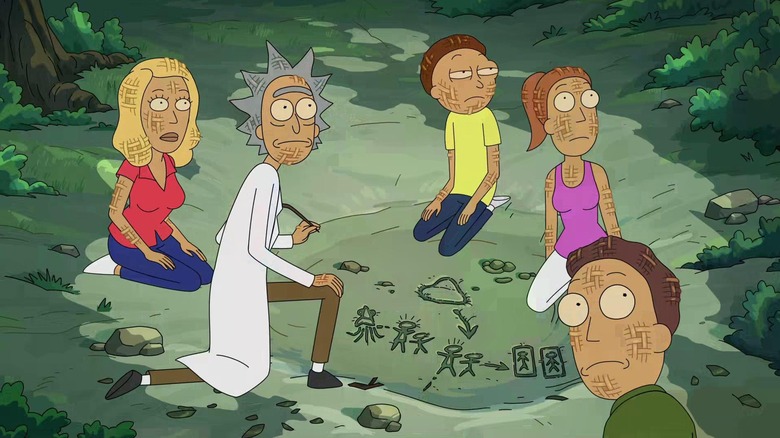
Rick has never been shy about his enemies, and "Mortyplicity" explores one of his contingency plans in case he's attacked. He created a family of robotic duplicates housed somewhere in middle America, and once ambushed, he gets an alert. The best thing about this episode is that the viewer is never truly certain if they're seeing the real Smith family or a decoy until the last moment. As each one appears authentic, the viewer becomes invested right up to the point of their incineration.
It's then revealed that the family Rick made spawned into multiple decoy families. This continued happening results in what Rick calls an "Asimov cascade." The resulting cascade failure of the expansive decoy network reveals that lazy Ricks created shoddy duplicates, including families made of wood. Everything gets out of hand as unit after unit kills or is slaughtered by one another.
"Mortyplicity" demands a rewatch, as there's so much happening throughout that it's impossible to completely take in on one viewing. Throughout it all, the episode keeps you guessing, and the best moment is its post-credit scene that sees wooden Jerry get attacked by beavers. He continues to exist, immobile as eons pass, begging for death in what can only be described as a "Pure Jerry" moment.
Rest and Ricklaxation (Season 3, Episode 6)
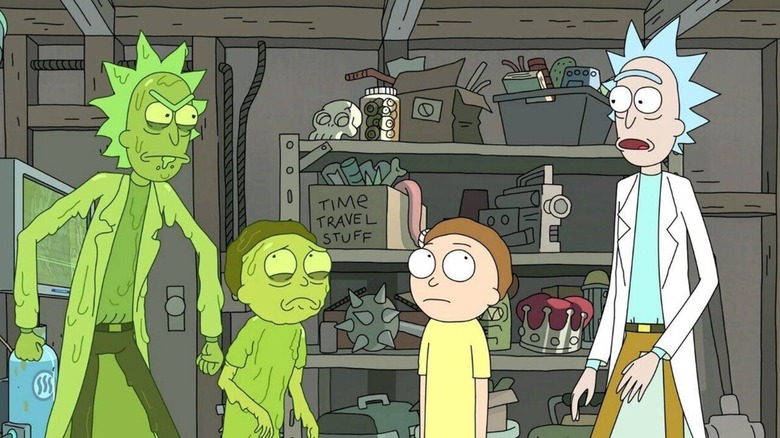
There's no denying that Rick is a toxic person, and in "Rest and Ricklaxation," we find out why. After a six-day space jaunt that leaves them exhausted, Rick and Morty head to a health spa, where they use an alien detox machine. It removes their negative personality traits, and when they exit, they're entirely new people with wonderful outlooks on life. Rick is less of a jerk, and Morty gains a great deal of self-confidence.
Unbeknownst to them, their toxic alter egos exist within the machine's storage tank, and soon escape. Rick is as maniacal as ever, and Morty is afraid of everything, and they enact a plan to turn the entire world toxic. Things get interesting when Morty refuses to reacquire his toxic self despite Rick's best efforts, and becomes a stockbroker in New York City.
His career comes to an end after a call from Jessica (Kari Wahlgren) when Rick sends in Voltron-style drones to subdue him. One of the best parts that makes this episode especially rewatchable is seeing the world temporarily turn toxic. Everyone gives into their absolute worst impulses in the most sick and humorous ways possible, thanks to some irreverent, irreligious activity and a kid's birthday party.
Edge of Tomorty: Rick Die Rickpeat (Season 4, Episode 1)
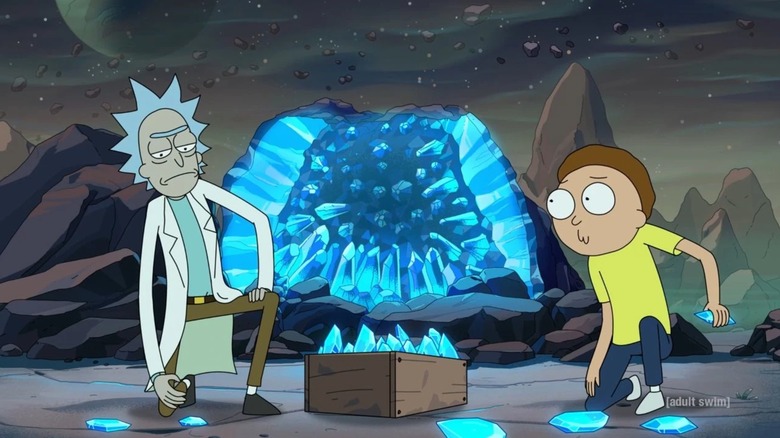
If there's one thing "Rick and Morty" doesn't get enough credit for, it's the show's dynamic approach to animation. The series is experimental in many ways, and one of the best indulgences for animation fans is "Edge of Tomorty: Rick Die Rickpeat." The episode begins with Rick and Morty collecting Death Crystals, which show a person their possible deaths. When Morty gets a hold of one, he envisions Jessica comforting him on his deathbed.
To make the vision become a reality, Morty mucks up the mission, resulting in Rick's death. His hologram attempts to get Morty to restore Rick, but he only does what the crystal demands, becoming a lawless so-called "Akira," employing a series of sci-fi gadgets to fight authority. It's a fantastic analysis of how our futures can be manipulated by the choices we make, but at its core, the episode is a master class in animation.
Whenever Morty holds a Death Crystal, the screen fractures into a series of potential death visions, each distinctly animated from one another. It's a similar approach to the animation in "A Rickle in Time," when Rick, Morty, and Summer fracture time into ever-increasing alternate timelines. It's not only great animation, but the episode demands numerous rewatches, as you'll never be able to take it all in with a single viewing.
Morty's Mind Blowers (Season 3, Episode 8)
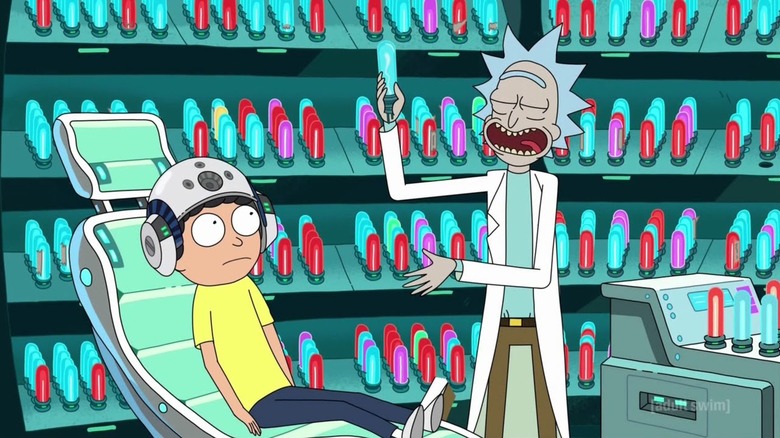
When a "Rick and Morty" concept opens itself to endless possibilities, you know it's going to be good. "Morty's Mind Blowers" introduced the idea of erasing bad memories and storing them in colored vials for later viewing. Rick breaks the fourth wall, informing viewers that "we'll be doing this instead of interdimensional cable," though the format is somewhat similar. Each Mind Blower is a memory that Rick extracted from Morty, which he relives as brief vignettes.
It's essentially clips that viewers hadn't seen before, and as they play out, Morty notices that some involve Rick making dumb mistakes. Whenever Morty witnesses him messing something up, Rick evidently removes the memory. It's especially funny to see the trite nonsense Rick screws up and removes from Morty's brain.
Morty loses his temper and fights Rick, and they end up wiping both of their memories, using the Mind Blowers to find out who they are. Eventually, Summer stumbles upon them in a completely wrecked state and follows previously established instructions to bring them back to normal. She's met with plenty of backlash, and Rick and Morty end the episode none the wiser. Witnessing all the forgotten memories is hilarious, and all are well worth experiencing multiple times.
Pickle Rick (Season 3, Episode 3)
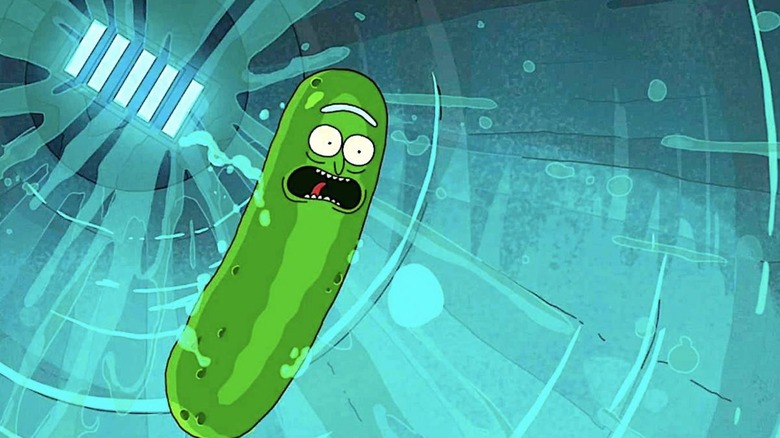
Of all the episodes of "Rick and Morty," "Pickle Rick" is probably the best known. The concept is so utterly absurd that it plays out as one of the series' best episodes. It begins with Morty getting ready to go to family therapy, but he's interrupted by Rick, who turned himself into a pickle. It becomes clear that Rick did this to get out of going to therapy, and when the family leaves him, he goes on something of an adventure.
After falling into the sewer, Rick kills some cockroaches and uses their parts to gain locomotion. Over time, he levels up, killing rats as he incorporates their appendages into his pickle body. When he escapes the sewer, he erupts from a toilet in a high-security building. He takes down some guards, and the building's leader dispatches a killer named Jaguar, voiced by none other than Danny Trejo, resulting in an epic conclusion.
Meanwhile, the family is in therapy, trying to deal with the odd behavior of the children, but the doctor (Susan Sarandon) wants to talk about Rick. He finally arrives, as a pickle, and expresses his true feelings about therapy. Afterwards, he reverts to his human form with Beth's help. Everything about the episode is over-the-top, as it's action-packed and entertaining, making it fun to rewatch.
The Ricks Must Be Crazy (Season 2, Episode 6)
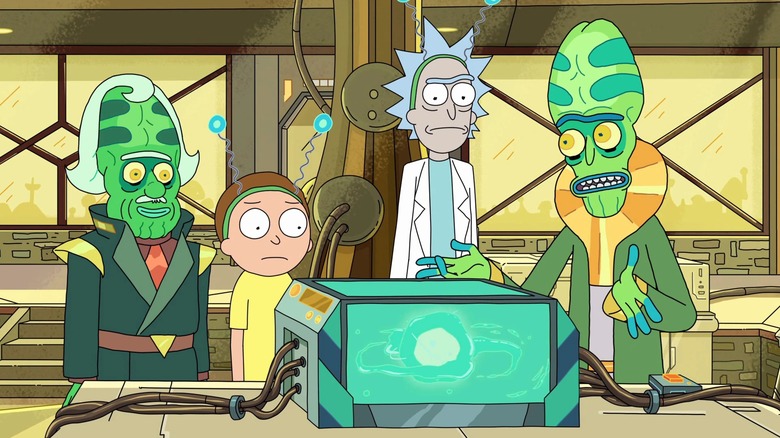
Rick is an egomaniacal genius, and he's more than happy to point out how smart he is. He hates meeting anyone even remotely like him, and in "The Ricks Must Be Crazy," he not only meets his equal, but learns he's his creator. After Rick takes the kids to a movie in another reality, they head out for ice cream, but the car battery dies. Rick and Morty shrink down into the battery's micro-universe, finding a world filled with people.
Rick is a god to them, but learns that another scientist has created a similar technology, explaining why Rick's battery no longer functions. They all dive into the new battery, finding yet another civilization where another scientist is working on the same technology. Eventually, Rick and Zeep Xanflorp (Stephen Colbert) fight, wind up stuck in a primitive society, and jump from one mini-verse to another.
It all comes to a head when Rick leaves Zeep bleeding on the ground after another fight. Meanwhile, Summer remains inside the car, which was instructed to keep her safe, and it does so by killing, cloning, and horrifying everyone around it before forging peace on the planet. Both stories are fascinating and funny, making the episode one of the show's best.
Fear No Mort (Season 7, Episode 10)
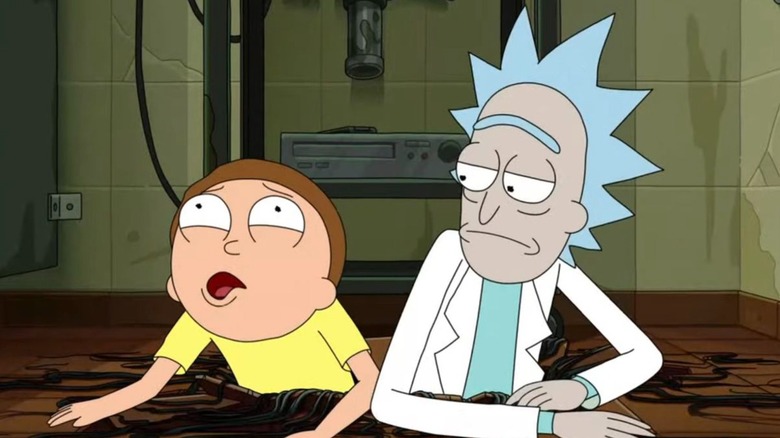
Introspection isn't one of Rick's strong suits, but he's fully confronted with it in "Fear No Mort," after Rick and Morty meet a strange man who suggests they check out the scariest place in the universe. He takes them to a Denny's, where they find a hole in the floor of the men's bathroom that displays a person's greatest fear, so it can be conquered.
When someone jumps in, they encounter their trauma and leave without any fears. Morty enters and is immediately attacked by monsters, so Rick follows and saves him. They return home and Rick's dead wife, Diane (Wahlgren), appears. What follows is Rick's desire to rekindle his romance, and Morty's growing concern over the hole subsisting on Rick. They escape and then play out a series of realizations that they're still trapped.
Ultimately, it turns out that everything shown from that point, which includes several years of time, is an illusion. Morty leaves, realizing he never jumped in at all. As he walks away, Rick runs toward the hole. It's one of those episodes that messes with your head, but in as entertaining and rewatchable a way as possible.
The Vat of Acid Episode (Season 4, Episode 8)
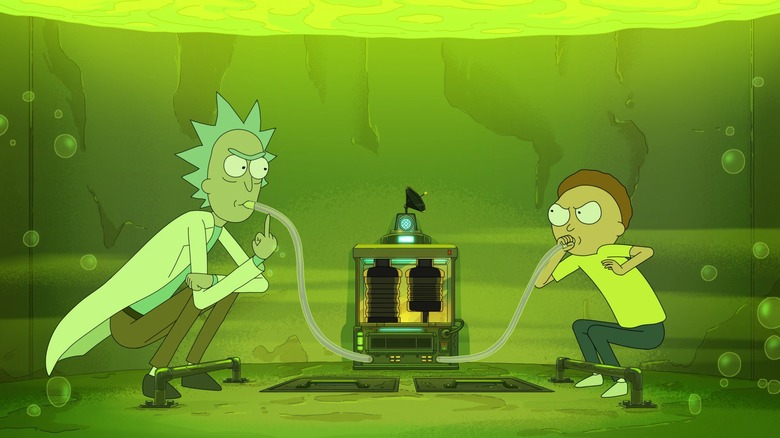
Morty puts up with a lot from Rick, and in "The Vat of Acid Episode," Rick puts him through the wringer for questioning his methods. This comes after the pair jump into a fake vat of acid to fool some gangsters, but have to remain submerged for hours. Morty grows increasingly angry and jumps out, killing the bad guys while sticking it to Rick over his idea. Later, Rick does something Morty always wanted — he creates a save button.
This allows Morty to save his life, do something crazy, and respawn at the save point. He exploits this endlessly, but ultimately finds love. Morty's life with his new girlfriend plays out in a series of dialogue-free vignettes. It goes on for years, but Jerry accidentally presses the button, returning Morty's life to normal.
Rick tells Morty the horrific reality that every time he uses it, a Morty in another reality dies. He forces him into a vat of acid to prove his initial point, and it's pretty much the worst thing Rick has ever done to his grandson. The episode won a Primetime Emmy Award, which isn't surprising, and it's a great one to watch multiple times.
Total Rickall (Season 2, Episode 4)
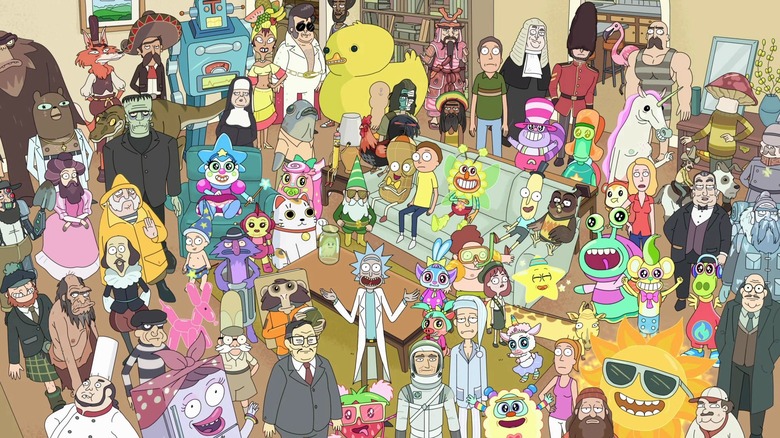
Of all the "Rick and Morty" episodes, "Total Rickall" is easily one of the most fun. It introduces Mr. Poopybutthole (Roiland) while making viewers wonder what's going on as one crazy character after another erupts onto the screen from nonsensical flashback clips. It all begins when Rick throws some parasite-infested crystals away, noticing that Jerry's brother is at the breakfast table.
Rick kills him, as he's a parasite, and locks down the house. From there, the family is confronted with the zaniest characters ever put to animation, and each one seems to be real. Mr. Poopybutthole is there from the beginning, even appearing throughout the show's intro, so it's unclear if he's a parasite or not. The episode plays with your head as you become invested in one character after another.
In the end, the family goes on a killing spree, taking out the parasites. While they're celebrating, Beth shoots Mr. Poopybutthole, and surprise, he's 100% real. When you get right down to it, the episode is comedy gold and easily one of the best in the series; that's more than fun to watch, over and over again.