

'90s Action Movies That Changed Hollywood Stunts Forever
The '90s isn't only special because of Ricky Martin's "Livin' la Vida Loca" and Los del Rio's "Macarena" electrifying dance floors. It's also a decade that transformed the action movie genre. Several films featured high-quality, innovative stunts that changed the game in Hollywood and charted an exciting course for the future. If it weren't for these motion pictures, some of the best action movies of all time, such as "John Wick" and "Sicario," may not have come into being.
It's next to impossible to compile an exhaustive list of all the influential movies from the decade. An entire feature could be dedicated to Hong Kong action cinema from that era alone. So, we picked films with the most major impact on Hollywood's presentation of action. While some were influenced by the movies before them, these made the bigger splash thanks to their star power, advanced production values, and the studio muscle behind them. Sometimes life is unfair and doesn't reward those who came first, but those who make the louder noise. With that said, let's head back to the past and explore the '90s action movies that changed Hollywood stunts forever.
The Matrix
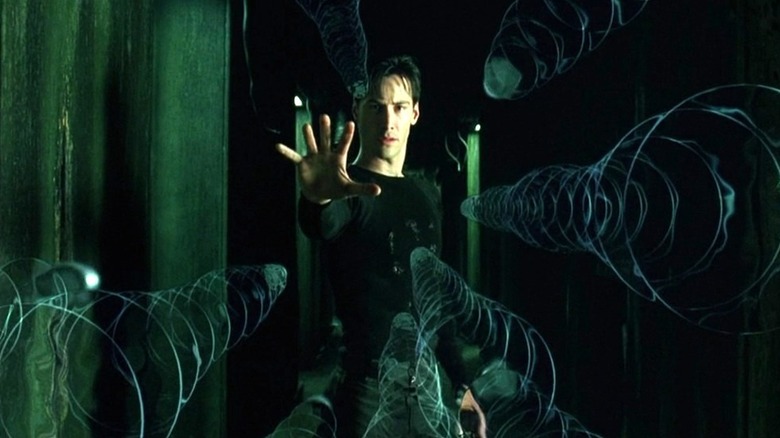
Not only is "The Matrix" one of the best sci-fi movies of all time, but it also shaped the action genre as we know it today. Borrowing heavily from Hong Kong action cinema, the Wachowskis employed a blend of wire work and gun fu (the combination of gunplay and kung fu) for a highly stylized aesthetic that caught mainstream audiences by surprise.
Of course, everyone remembers the famous bullet time scene, which sees Neo (Keanu Reeves) dodge a flurry of bullets in slow motion as the camera pans around him. Slow-mo shots weren't novel by any means, but the Wachowskis set a new standard when they set up 120 cameras in a curved setup, with each snapping the shot in sequence to catch the effect in action.
In 2021, Chad Stahelski, who served as Reeves' stunt double in "The Matrix" and went on to direct "John Wick," told Vulture how "The Matrix" changed both his career as a stunt choreographer and the action movie industry as a whole. "Back in the day, fight scenes were secondary to car chases and horse chases and helicopter chases and motorboat chases," Stahelski said. "Now, what does every great Marvel movie have? Whether it's flying or in spaceships or in boats or in airplanes and so forth, they want action design centered around fight scenes."
Rumble in the Bronx
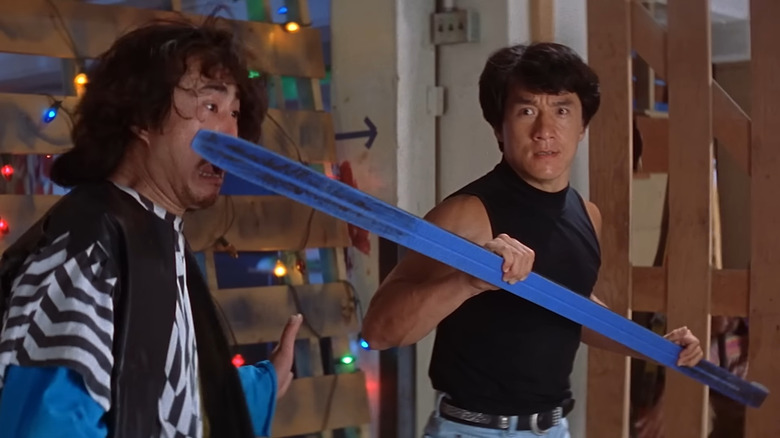
Fans of Hong Kong action movies knew of Jackie Chan's abilities as not only an action star but also an innovative stuntman. However, he evolved into a household Hollywood name after 1995's "Rumble in the Bronx," which New Line Cinema picked up for distribution in the U.S.
"Rumble in the Bronx" demonstrated how stunts don't only have to be centered around kicks and punches, as Chan incorporated comedy and environmental props into the choreography of his frenetic — and quite frankly, death-defying — action scenes. For instance, one sequence sees Chan's character Ma Hon Keung face off against a bunch of goons in their hideout. Keung uses everything around him — from a pool table to pinball machines to a refrigerator — to defeat his adversaries in humorous but jaw-dropping fashion.
Even renowned critic Roger Ebert praised "Rumble in the Bronx," especially in terms of Chan's contribution, writing, "The whole point is Jackie Chan — and, like [Fred] Astaire and [Ginger] Rogers, he does what he does better than anybody. There is a physical confidence, a grace, an elegance to the way he moves." After the success of "Rumble in the Bronx," Chan carved out a niche for this brand of action comedy, pushing the limits of what many thought was physically possible and unleashing instant classics like "Rush Hour" and "Shanghai Noon."
Mission: Impossible
It's funny to look back at 1996's "Mission: Impossible." Compared to the most dangerous stunts in the later "Mission: Impossible" films, the original looks rather tame. Yet, without the foundation laid by this initial entry, we wouldn't have Ethan Hunt scaling up the Burj Khalifa or dangling from the side of an airplane.
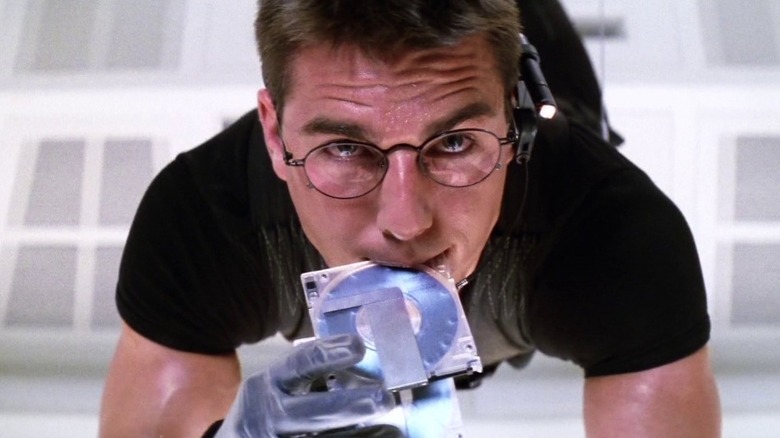
"Mission: Impossible" boasts an endless array of action set pieces, but the one that embodies the franchise's trademark nail-biting tension sees Ethan hanging on a wire to infiltrate a highly secure vault. As Ethan drops down, there are several moments in which it appears like he might set off the alarms or hit the floor. In the end, he doesn't.
According to Cruise's comments in a behind-the-scenes featurette, that was one of the most difficult scenes to film, since he kept hitting the floor during takes. The actor needed to think out of the box to perform the stunt perfectly. "I said, 'Give me coins,'" Cruise said. "In England, they have Pound coins. So I put Pound coins in and hung on the cables to see if I was level. Brian [De Palma] was like, 'One more and then I'm gonna cut into it and do it.' And I said, 'I can do it.' It was also very physically straining." The coins did the trick in balancing out the weight distribution, and resulted in one of the most iconic scenes in cinema history.
Heat
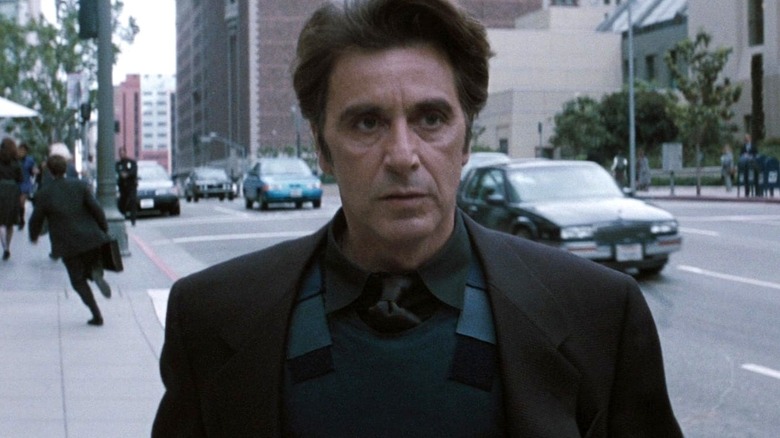
Michael Mann's "Heat" remains one of the best crime movies ever made. The 1995 film values realism over fantasy, but that doesn't mean it neglects the stunt side of the business. Quite the contrary. Instead, Mann knows the action is the juice, and grounds it in the real world. Everything feels authentic, mostly because it is.
As per Esquire, Mann went to great lengths to make the action sequences as realistic as possible. For the bank heist scene, Robert De Niro, Tom Sizemore, and Val Kilmer scoped out an actual bank as if they were casing the joint themselves. In addition, Mann organized training for the actors with special forces personnel; this included them firing active weapons and learning to reload. That wasn't all, though, as Mann used between 800 and 1000 rounds of live ammunition for each take to match the sound of actual gunshots.
By committing itself to realism, "Heat" comes across as much more believable than its contemporaries. Nothing about it comes across as a Hollywood interpretation; the viewer is right there in the thick of the danger and action. The influence of Mann's approach can be felt in other genre films to this day, even acting as inspiration to one of the greatest superhero movies of all time, "The Dark Knight."
Terminator 2: Judgment Day
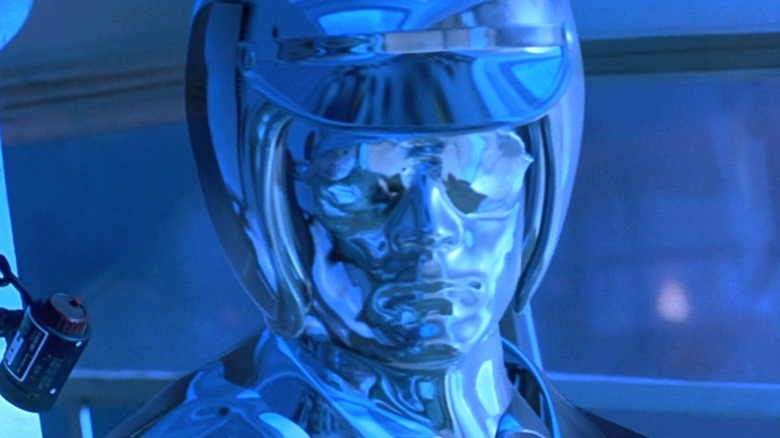
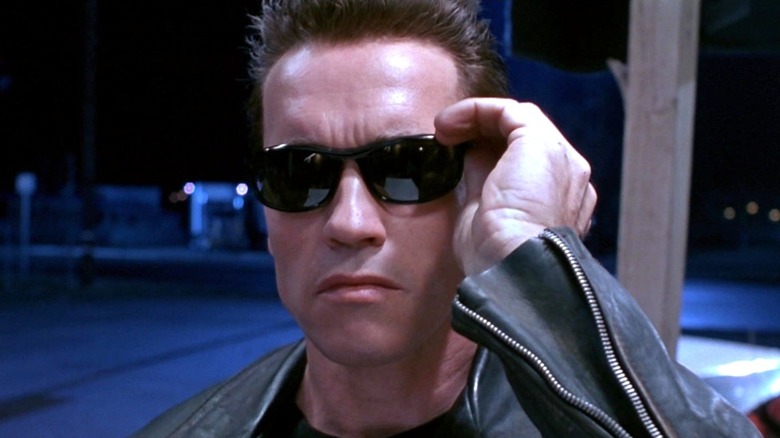
Watch any James Cameron movie and it's clear that he loves pushing the boundaries of filmmaking. For 1991's "Terminator 2: Judgment Day," Cameron broke new ground in the usage of special effects. While most credit the sequel for its revolutionary CGI, Cameron also blended high-octane dangerous stunts into the mix, particularly in the chase scenes.
A major moment from "Judgment Day" sees the T-1000 (Robert Patrick) take control of a helicopter and pursue an armored truck containing the T-800 (Arnold Schwarzenegger), John (Edward Furlong), and Sarah Connor (Linda Hamilton). At one point, the helicopter flies under a freeway overpass — blades spinning and all. It's heart-in-throat action, especially when you learn that this was actually an in-camera stunt. "We could've run a CG helicopter underneath the freeway overpass, but it was so much more fun to do it with the real thing," Cameron told Female.com.au.
As revealed in the director's commentary, the crew told Cameron that they weren't prepared to shoot such a scene, so the director hopped into the helicopter with the stunt pilot and shot it himself. Naturally, it was a risky scene to film, but it added a level of authenticity and realism that couldn't have been achieved with CGI. It's practical stunts like this that continue to inspire filmmakers to pull off similar feats, such as Christopher Nolan crashing a real Boeing 747 airplane for 2020's "Tenet."
Point Break
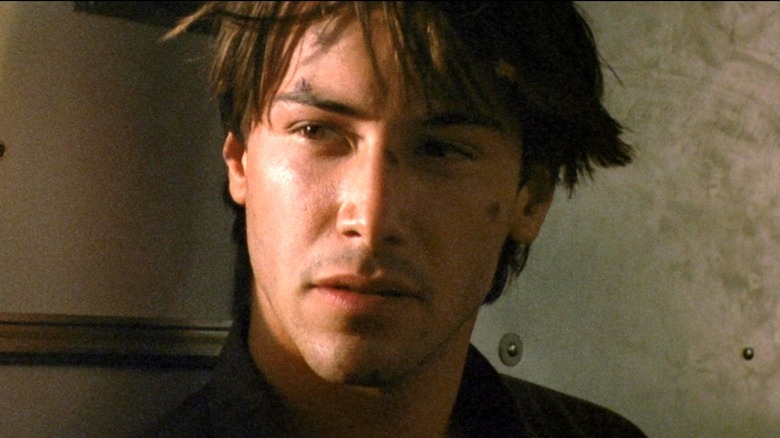
Thrill seekers love 1991's "Point Break," because of its commitment to showcasing extreme sports in the most extreme way. From surfing to skydiving, there's no shortage of awe-inspiring action on display, as Keanu Reeves and Patrick Swayze ride the wave of awesomeness and go full throttle throughout the 122-minute runtime. To bring this immersive quality, director Kathryn Bigelow organized for the performers to receive surf training from expert Dennis Jarvis.
As Jarvis told Entertainment Weekly, the actors reported to him every morning to learn the basics of hitting the waves. "They were basically all beginners," he said. "Patrick said he'd been on a board a couple of times, Keanu definitely hadn't surfed before, and Lori [Petty] had never been in the ocean in her life." In a feature for the DVD, Swayze revealed that he "almost died six to ten times" doing the surfing scenes, as well as how he had to fight to do the skydiving stunts himself.
While it might have been a grueling and highly physical shoot for the actors, it was well worth it in the end, as these scenes hold up and revolutionized the genre. One only needs to look at an extreme sports-inspired film like Vin Diesel's "xXx" to see "Point Break's" influence in action.
Hard Target
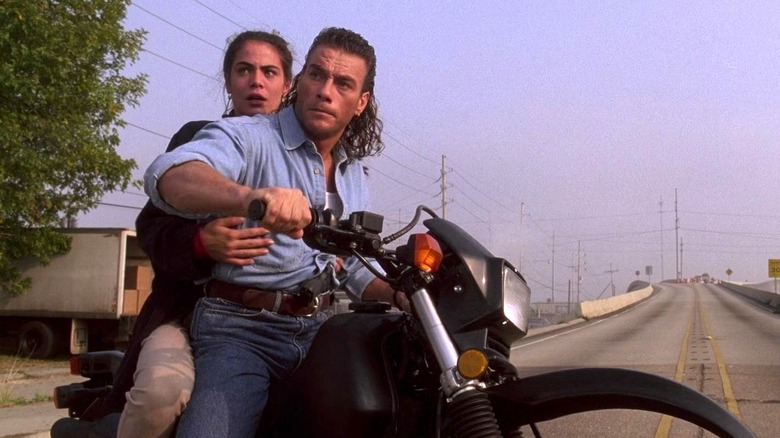
It's impossible to ignore how much John Woo shaped the action genre. In the 1993, he made the leap from Hong Kong action cinema to Hollywood, with his first American blockbuster "Hard Target" starring the Muscles from Brussels himself, Jean-Claude Van Damme.
It was a match made in heaven, as Woo brought his signature hyper-violent style to the film, while JCVD pumped it up with his action star charisma and expertise. For Woo, it was as much about the fists and kicks as it was the explosions, gunfights, and car chases. As stunt coordinator Billy Burton revealed in an interview for the 4K release (via High-Def Watch), the director told him, "It's just like a Western. We've just substituted the horses and stagecoaches with motorcycles and cars."
"Hard Target" featured some of JCVD's greatest movie fight scenes and proved to be a glorious Hollywood debut for Woo. It kicked off a generational run of films for the director, including "Broken Arrow," "Face/Off," and "Mission: Impossible 2," which also played a part in changing stunts in showbiz. Equally important, other filmmakers took notes from "Hard Target" and brought Woo's bloody ballet to their own movies.
Bad Boys
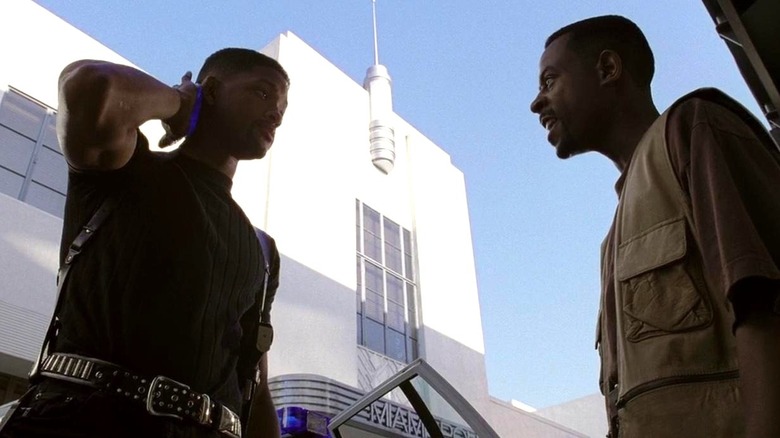
In the '90s, the hills of Hollywood were alive with the sound of Bayhem, and it hasn't stopped since then. "Bad Boys" was Michael Bay's first feature film, and he wasted no time in showcasing to the world what he was all about. The script took a backseat for the most part, as the director focused on capturing non-stop action that had audiences on the edge of their seats. There are explosions galore, of course, but "Bad Boys" confirmed Bay's need for speed.
In 1995's "Bad Boys," Will Smith's Mike Lowrey and Martin Lawrence's Marcus Burnett put the pedal to the metal at all opportunities. If the stunts look slightly dangerous, that's because they were. During an appearance on "The Tonight Show Starring Jimmy Fallon," Smith spoke about how they pushed boundaries to capture realism, joking that "it was safety third" instead of first. Bay also rolled the dice, using his own Porsche 911 Turbo in the movie. "The studio didn't want to rent a car and we didn't have the money to rent one," he told Car and Driver. "And Porsche didn't want to support the movie."
The gambles paid off, as "Bad Boys" became an all-time action classic. It also turned audiences on to Bay's unmistakable spectacle-driven filmmaking style that has left its stamp on the genre. Without the success of "Bad Boys," you can forget about "The Fast and the Furious" even existing.
Mortal Kombat
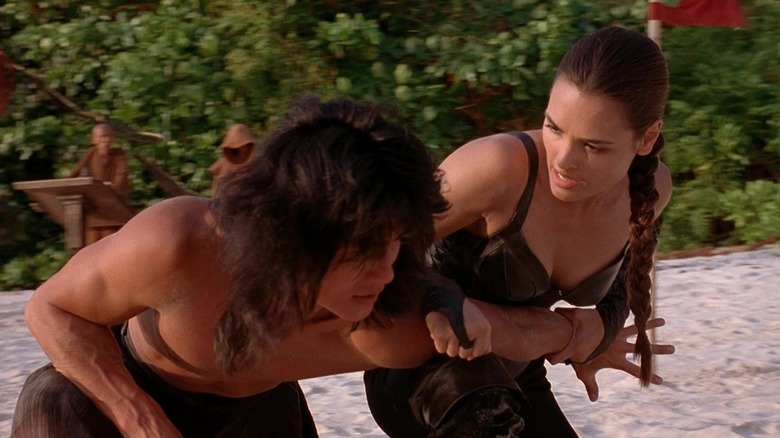
Up until 1995's "Mortal Kombat," you would have been better served pouring bleach in your eyes than watching live-action video game movies. They were bad with a capital B. While director Paul W. S. Anderson didn't exactly produce an Oscar-worthy masterpiece, the fight scenes alone are worth their weight in gold. Anderson knew fans wanted on-screen battles on-par with the games, and he committed by hiring key stunt people and talented martial artists among the cast.
As per The Hollywood Reporter, Anderson and co. listened to test screening feedback calling for more action. So they went back into production and loaded up on fight scenes. "We added my favorite fights, which were the Scorpion fight with Johnny Cage and the Reptile fight with Liu Kang," Anderson said. "We had a very good stunt coordinator, but as the movie went on, I wanted to embrace more of a Hong Kong, wirework martial arts feel. Robin [Shou] was great for that, and he choreographed the extra fights."
As Anderson rightfully pointed out, "Mortal Kombat" was one of the first Hollywood blockbusters to embrace wire work, as "The Matrix" wouldn't arrive until four years later. It's fair to say that it set the tone for what video game movies should aspire to be, while encouraging other Hollywood films to step up their game in the stunt and action departments.
Speed
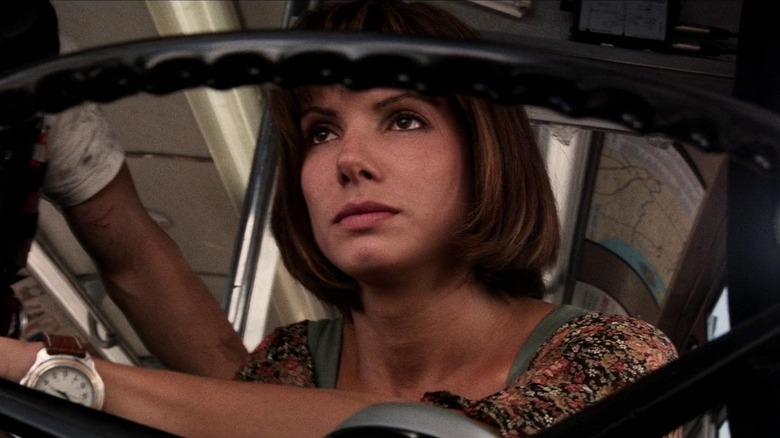
The premise of 1994's "Speed" could've easily fallen apart if audiences didn't believe what was happening on screen. Hence the reason director Jan de Bont insisted on as much realism as possible. The bumpy-looking bus jump scene? All real and done by a stunt driver. What about when Keanu Reeves' Jack Traven rolls under the vehicle while it's moving? Also real.
"I tried to do as much as I could," Reeves told HuffPost. "The stunt coordinator Gary Hymes really took care of me and came up with inventive ways of putting me in those situations. Through harnessing he got me under the bus at 30 mph."
"Speed" blended race-against-time energy with daredevil action set pieces that remain etched in the viewer's mind. Everything feels timeous and important, as the film doesn't stop moving until the very end. It also demonstrated what was possible when stunt teams and actors work together to push believability. Films like 2009's "The Taking of Pelham 123" and 2010's "Unstoppable" would certainly look different if "Speed" hadn't accelerated to the sublime levels it did in the '90s.