

5 Star Trek Episodes That Completely Rewrote Canon

With all the technobabble and various alien histories, being in the writers' room for a "Star Trek" series or film has never been easy, and with each new addition to the ever-growing franchise, the job gets even more difficult. While it might have once been simple enough to hand-wave away a minor plothole or the constantly shifting rules for how stardates work in "Star Trek," the internet has given fans a place to hash out all those nitty gritty canon rules, making it a whole lot harder to just retcon any decades-old storyline that's no longer convenient.
The flip side is that, in a world of science fiction, just about anything can be explained away if you try hard enough. Need to revive a character? We've got mirror universes, parallel timelines, clones, and bio-mimetic lifeforms. No matter how canon-violating a storyline might be, someone will work out a solution. In the spirit of Trek's most revisionist writers, here are five "Star Trek" episodes that completely changed canon.
Inquisition (Star Trek: Deep Space Nine)
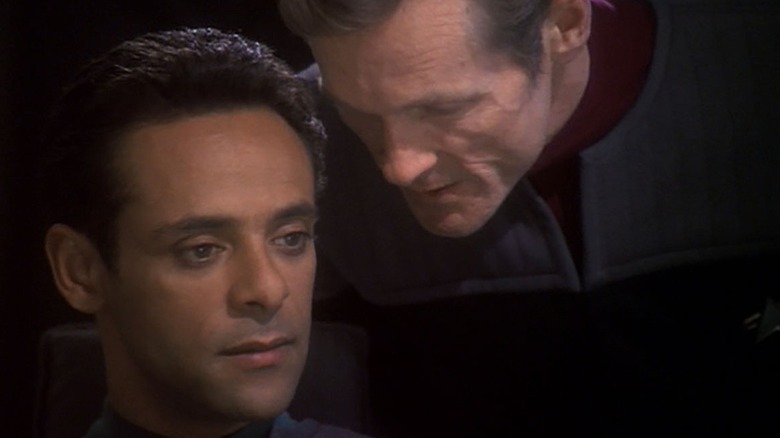
One of the major through-lines from "Star Trek: The Original Series" and "Star Trek: The Next Generation" is the inherent benevolence of Starfleet and the United Federation of Planets. Sure, Starfleet's ships are packed with state-of-the-art weapons and there's a rigid, military-style command structure, but, as Captain Jean-Luc Picard (Patrick Stewart) drills into everyone with one high-minded speech after another, Starfleet is, first and foremost, an organization of explorers. Even if we occasionally see cracks in the future utopia branding the admiralcy loves to project in episodes like "The Drumhead" and "Chain of Command" (which are among the best episodes of "Star Trek: The Next Generation"), there's always a sense that, for the most part, Starfleet is an idealistic, moral, and generally evolved sort of social experiment — until the "Star Trek: Deep Space Nine" episode "Inquisition" came along.
The 142nd episode of "Deep Space Nine" revealed that our dirty little suspicions about Starfleet were right all along by rolling out Section 31, the shady black-ops side of the Federation named for Article 14, Section 31 of the Starfleet Charter. As it turns out, it had been there all along. Set in the middle of the Dominion War, "Inquisition" finds the Deep Space Nine crew under investigation by the formidable Deputy Director Luther Sloan (William Sadler) from Starfleet's Department of Internal Affairs. Suspecting a mole, Sloan relieves all of DS9's senior officers, confining them to their quarters for the duration of his investigation. But it's pretty quickly revealed that Sloan is actually there to accuse Dr. Julian Bashir (Alexander Siddig). Eventually, Sloan offers Bashir a job with Section 31, the existence of which turned "Star Trek" completely on its head. Suddenly, Trek's supposed utopia became much darker.
Charades (Star Trek: Strange New Worlds)
Captain James T. Kirk (William Shatner) might get most of the space hookups in "Star Trek: The Original Series," but Spock (Leonard Nimoy) is the true heartbreaker aboard Kirk's Enterprise. Uhura (Nichelle Nichols) practically throws herself at him as he sits in the Captain's chair in the episode "The Man Trap," batting her eyelashes as she asks, "Why don't you tell me I'm an attractive young lady, or ask me if I've ever been in love?" But, compared to Uhura's charming, flirty, "let's play a duet" energy, the unrequited love Nurse Christine Chapel (Majel Barrett) shows for Spock throughout "The Original Series" is almost depressing, particularly given the coldness he returns it with.
Even though she's been infected by a virus in "The Naked Time," Chapel's confession of love for Spock is genuine and almost gut-wrenching. It's hard not to feel for her when she tells Spock: "I love you. I don't know why, but I love you. I do love you just as you are." In turn, Spock sincerely replies that he's sorry. And we learn it's not just the virus speaking in "Amok Time" when Chapel cries over Spock's uniquely Vulcan health problem before making him Plomeek soup, causing Bones to say: "You never give up hoping, do you?"
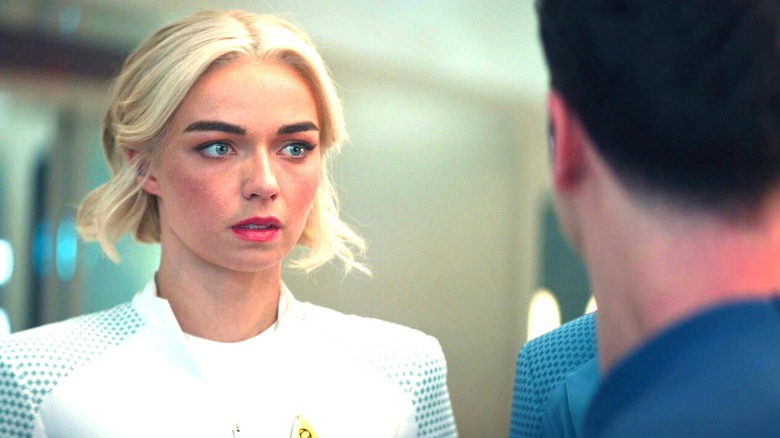
All of Chapel's pining gets completely recontextualized with the "Strange New Worlds" Season 2 episode "Charades," which finds Chapel (Jess Bush) and Spock (Ethan Peck) kissing in what would kick off a very mutual romance. Since "Strange New Worlds" is canonically set before the original "Star Trek" series, this move fundamentally recolors those "TOS" episodes so that Chapel's heartache isn't born from a love she'll never have, but from a former lover who eventually comes to see her as a stranger.
The Vulcan Hello (Star Trek: Discovery)
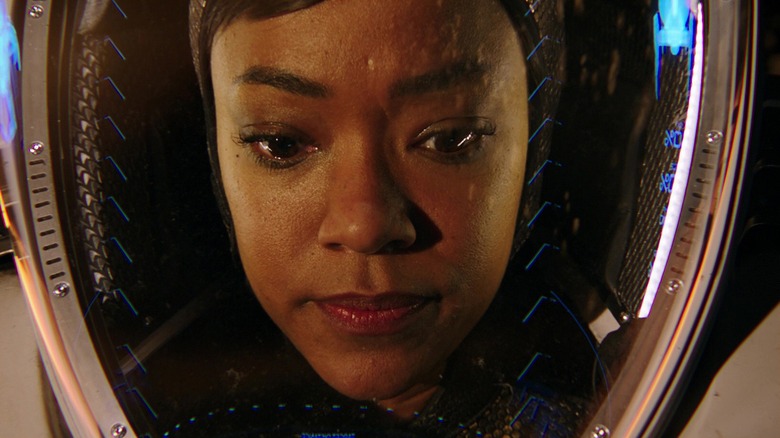
The premiere of "Star Trek: Discovery" did so much messing around with Trek canon that it's hard to know where to begin. The series, which is set after "Enterprise" and serves as a prequel to both "The Original Series" and "Strange New Worlds," introduces a whole cargo bay's worth of canon-crashing visuals and technology, and that's without mentioning the dramatically altered appearance of the inexplicably (at least, at this point) bald Klingons, a bold choice that many "Star Trek" fans consider to be among the biggest offenses in "Discovery."
The biggest canon rewrite is the revelation that the show's main character, Michael Burnham (Sonequa Martin-Green), is yet another previously unmentioned sibling of Spock as the adopted child of Sarek (James Frain) and Amanda (Mia Kirshner). It was always weird enough that Spock never mentioned Sybok (Laurence Luckinbill), the culty, logic-rejecting half-brother who shows up in "Star Trek V: The Final Frontier." While it's certainly in character for the snarky half-Vulcan to keep his cards close to the vest, the choice to reveal a second secret sibling at this point is kind of starting to feel like a matryoshka doll of Sarek's family skeletons.
Even without the later revelation that the Federation has been secretly working on a galaxy-tripping spore drive, "The Vulcan Hello" was full of technologically advanced moments that felt out of step with much later series. The fact that many of these, like the near-ubiquitousness of hologram communications, get rolled back by the time of "Strange New Worlds" is just a further reminder that, despite the show's many good points, the "Discovery" production team was a bit too gung-ho with their big Paramount budget bucks.
All Those Who Wander (Star Trek: Strange New Worlds)
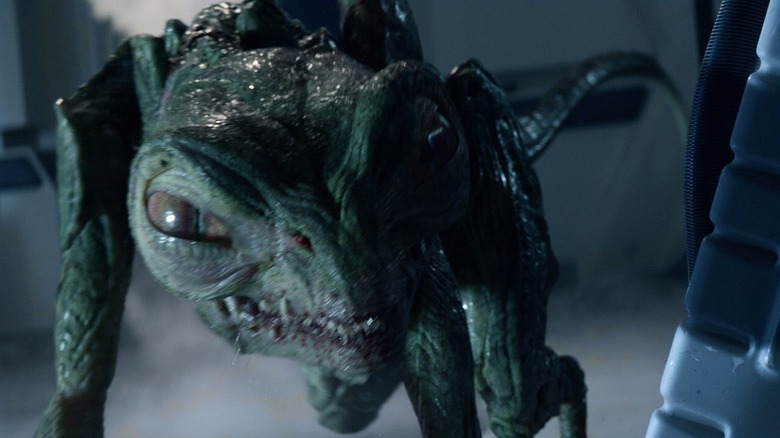
The Gorn are an advanced race of reptilian humanoids that first showed up in the "TOS" episode "Arena," leveling a Federation colony. Responding to a dinner invite that they quickly learn was deep-faked, Kirk and his crewmen find the outpost destroyed and soon come under attack from an unknown reptilian species. After an outpost survivor recounts failed attempts to surrender amid the unprovoked attack, prompting Kirk to conclude an invasion of the quadrant is imminent, the Enterprise heads out in pursuit of the ship.
Asked if he knows which intelligent life forms in the area might potentially be behind the attack, Spock references "unscientific rumors only, more like space legends," but otherwise seems rather clueless about the nature of the attacks. Their pursuit encroaches into the territory of the powerful Metrons, who decide to resolve the dispute by pitting both ships' captains against each other in a weapons-stocked arena for a good old-fashioned grudge match. It's in that arena that we meet our first Gorn, a chiseled, avocado green reptilian beefcake with bedazzled bug eyes.
Despite Kirk's inner monologue stating that this is his first encounter with one, "Strange New Worlds" takes a much closer look at the villainous Gorn, beginning with "All Those Who Wander." In this episode, Captain Pike's (Anson Mount) away team go to a Gorn hatchery planet. As the terrifying episode reveals, the Gorn are much more than Swarovski-eyed ravenous reptiles, which has led many to question how Spock completely forgot about his many encounters with them under Pike's captaincy.
The Expanse (Star Trek: Enterprise)
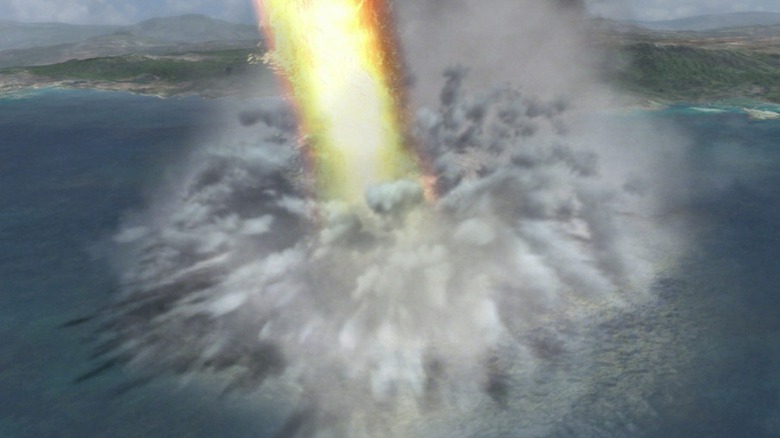
As Earth's first venture into serious space exploration, one would imagine the crew of the old NX in "Star Trek: Enterprise" would be mostly concerned with exploring new planets and discovering species. But, in the grim and paranoid zeitgeist of post-9/11 America, "Star Trek: Enterprise" took a much darker turn, with the Season 2 finale "The Expanse" introducing a previously-unencountered enemy. The Xindi send a seemingly unprovoked weapon to carve out a massive 4000-kilometer-long trench stretching vertically across the Americas, killing seven million humans including Trip Tucker's (Connor Trinneer) sister.
The attack would fundamentally alter the mission of the Enterprise and humanity's path. Yet, the Xindi — a collective of five (originally six) sentient species — never show up again in any meaningful way in the Trek franchise. We later learn the impetus for the attack: It was engineered by the trans-dimensional beings the Sphere Builders as part of a false flag operation designed to distract humanity from their plans to take over the Delphic Expanse.
All of that kind of seems like it would be important information to put in a Starfleet Academy textbook. While part of the dramatic canon shift could potentially be swatted away with a degree of wibbly-wobbly, timey-wimey head-canoning, the fact that a storyline so massive could simply get shoehorned into the maiden voyage of the most important ship in Starfleet history makes this one of the more notable canon changes in the franchise. Still, there's no denying that "The Expanse" is one of the best-ever episodes of "Star Trek: Enterprise."