

5 Stephen King Books That Were Inspired By Real Life Events

Stephen King is the creator of some of the most indelible images in all of horror. Who can forget Pennywise, the clown from "It," peering up out of a sewer drain? He's the man who brought us "The Shining" and its snowbound Overlook Hotel, full of mystery and tragedy. He invented The Dark Tower, and Carrie, and Cujo, and Christine, the evil car — which, by the way, became a film by John Carpenter that holds up as one of the most underrated Stephen King adaptations.
What some Constant Readers may not know, however, is that King often takes inspiration from real-life events. Even though his stories often feature elements that are supernatural, paranormal, and inexplicable, King bases a lot of his stories on things he has encountered in the real world. "The Shining," for example, was sparked by a snowy stay in a Colorado hotel , and King once sat next to a man dressed as Ronald McDonald on a flight (we assume you can work out for yourself which book that led to).
"I think people have a hunger for things that are scary, and for the fantastic that is sort of wedded to everyday life and every day things," he told the Utica Observer-Dispatch. In other words, by depicting a reality infected with an even-more-obvious touch of the horrific, King is able to comment on modern life as he gives us all nightmares. Here are five more Stephen King books that were inspired by real-world events.
Stephen King knew two girls who inspired Carrie
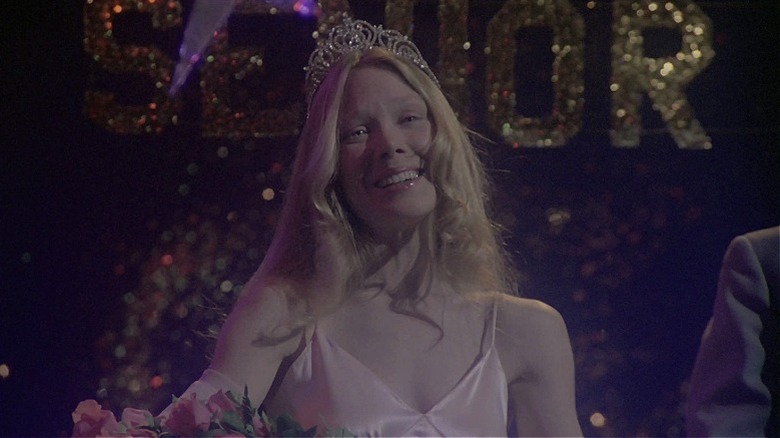
Stephen King's first novel was "Carrie," the now-classic book about an outcast teenager who taps into telekinetic powers as she becomes a woman. It's an epistolary novel, told in a collage of excerpts from diaries, letters, memoirs, news articles, and more. Its style makes you believe you are reading something like an actual true-crime text recounting a particularly deadly prom.
King doesn't claim to know any telekinetic teenagers, but the dark history of "Carrie" is based on two girls he knew personally in high school. In his book "On Writing: A Memoir of the Craft" (via The Guardian), King looked back at the experience of feeling his first novel coming together. He created Carrie White out of the combination of a girl he called "Tina" and another he called "Sandra." Tina, he said, was bullied. "Not because she was stupid (she wasn't), and not because her family was peculiar (it was) but because she wore the same clothes to school every day," he wrote.
Sandra, on the other hand, grew up in an extremely religious household. "I was struck by the crucifix hanging in the living room, over the Irving couch. If such a gigantic icon had fallen when the two of them were watching TV, the person it fell on would almost certainly have been killed," he recalled. Enter Carrie White: a bullied girl who wears the same outfit as a result of her overbearing, religious mother. An icon was born.
Stephen King's doctor told him to lose some weight and inspired Thinner

"Thinner" isn't one of Stephen King's best-known works; it was originally published under his pseudonym, Richard Bachman, and it probably wouldn't hold up to scrutiny today. For starters, there's an awful lot of body-shaming. It's about an overweight lawyer who accidentally kills a woman with his car, and he learns that she's a member of a community of travelers (the book, of course, uses a slur that's fallen out of fashion). While writing the book, King even invented their language by randomly selecting Swedish words. The lawyer is cursed by a man from his victim's family, who proclaims one word: "Thinner." Soon, he rapidly loses weight, slimming down to horrific levels. It's not an excuse, but an explanation to point out that the truth of Stephen King in the 1980s involved a severe drug addiction.
That being said, the inspiration for "Thinner" came from a real-life experience King had while going in for a doctor's visit. On the book's page on his website, King explained, "I used to weigh 236 pounds, and I smoked heavily. I went to see the doctor and he told me 'Listen, man, your triglycerides are really high. In case you haven't noticed it, you've entered heart attack country.'" That sentence wound up in the book, as did King's reaction to what happened when he followed the doctor's advice: an eerie feeling that he was losing a part of himself.
Stephen King didn't even realize the Vietnam War inspired The Long Walk

Though "Carrie" was the first novel Stephen King got published, he actually wrote "The Long Walk" first. The book would eventually come out under his Richard Bachmann pseudonym, and it would go on to inspire a 2025 film that's one of the best Stephen King adaptations in years. It imagines a dystopian world where young men compete in an endless march, forced to walk under penalty of death until there's only one left alive. It's a brutal book, one involving dozens of graphic deaths of children, and King said he wrote it to impress a girl.
"I gave it to her chapter by chapter," he told Vanity Fair. "She liked it, and that was cool. I don't think that I ever managed to get lucky, but I certainly tried."
In retrospect, King now recognizes that the book was subconsciously inspired by the Vietnam War, which was raging at the time he was writing about these young men forced to die senselessly for the morale of the country. "You write from your times, so certainly, that was in my mind. But I never thought about it consciously," he explained to the magazine. "I was writing a kind of a brutal thing. It was hopeless, and just what you write when you're 19 years old, man. You're full of beans and you're full of cynicism, and that's the way it was."
There's a real baseball player named Tom Gordon

In his 1999 book "The Girl Who Loved Tom Gordon," Stephen King wrote of a young Boston Red Sox fan lost in the Maine wilderness. Convinced she's being followed by a malevolent god, she retreats into fantasy, listening to baseball games on her Walkman as she loses her grip on her sanity. It's secretly one of the bleakest King books; unfortunately, the planned adaptation by Lynne Ramsay became a cancelled horror movie we'll never see.
King is famously a longtime Red Sox fan, and as he was writing the book, the Sox were having a great season. There was a real-life Tom Gordon, a pitcher who energized fans with his insane fastballs. King and his wife were huge fans, and Gordon later told Fox News that they'd come to watch him play that entire year. "I didn't know that they watched everything I did," he recalled.
They met when the writer wanted the player's permission to name him directly in the book. "I asked a couple times, why me? You know, why me?" Gordon said. "And he said to me, there was no better guy to do this with, because we liked how you approached the game." When the book came out, Gordon said the response was overwhelming. "[The Kings are] just humble, down-to-earth people that you just fall in love with," Gordon said. "And I'm definitely a Stephen King fan and I'm grateful that I got a chance."
A real mean St. Bernard inspired Cujo
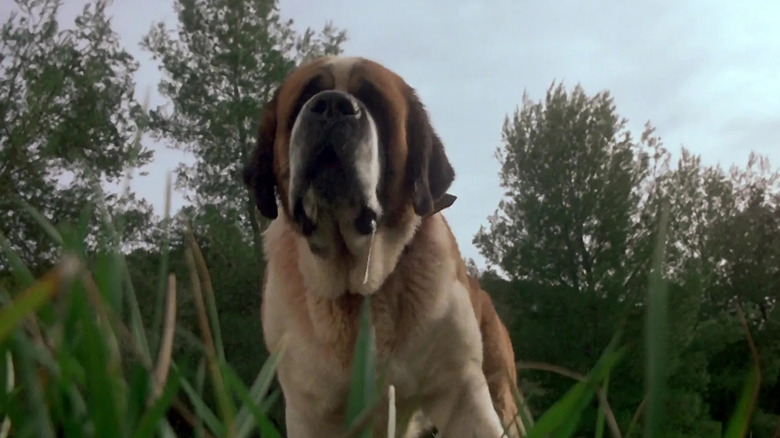
In Stephen King's seminal novel "Cujo," a mother and child are trapped in a hot car by a St. Bernard with a rabies problem. Cujo starts as a beloved family pet, but after an encounter with a bat, he becomes a bloody, slobbering monster, menacing the terrified humans who have no way to escape their car without falling victim to his snapping jaws. It's a devastatingly cruel book, and one of King's most enduring works.
No one wants to imagine their own beloved pup going through such a horrific transformation, and thankfully, King doesn't seem to have any first-hand experience with losing a family pet to the deadly disease. "Cujo" was, however, inspired by a real-life experience with a scary St. Bernard. The writer's motorcycle had broken down, and as he wheeled it into a mechanic's shop, a big dog leapt at him. "I was retreating, and wishing that I was not on my motorcycle, when the guy said, 'Don't worry. He don't bite.' And so I reached out to pet him, and the dog started to go for me," King recalled in a story posted to his website.
The dog's owner was apologetic. "[He] gave him this huge whack on the rump, and the dog yelped and sat down," King said. "The guy said, 'Gonzo never done that before. I guess he don't like your face.' And that became the central situation of the book."