

10 Most Disturbing Star Trek Alien Species, Ranked
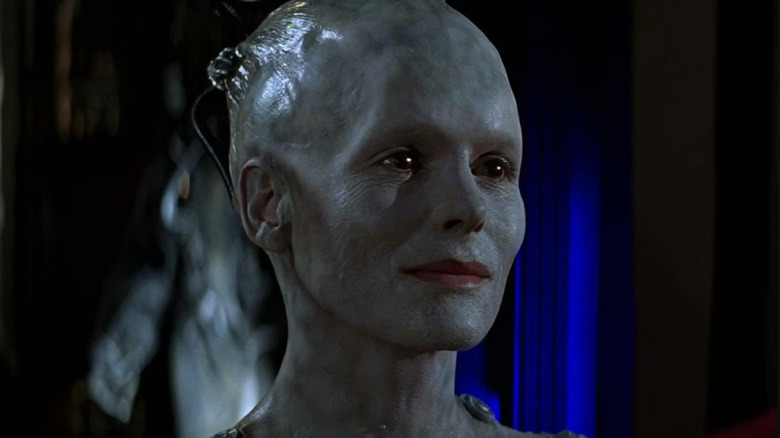
Some of the most famous alien races in all of science fiction originate in the "Star Trek" universe. From the violent, war-mongering Klingons to the silly, furry Tribbles, there are any number of alien races in the franchise that are recognizable to nearly everyone the world over. But what some more casual viewers may not realize is that "Star Trek" is also home to some of the most disturbing aliens in fiction, too.
Often spawned from some of the most horrifying "Star Trek" stories, these upsetting alien races are more than just scary. Their very nature is enough to chill the spine, with motives, tactics, and attributes that defy imagination. Usually deadly, and almost always hideous to behold, these unnerving alien races often operate on a different level than the adversaries and rival interstellar powers that fans are used to. Indeed, even the franchise's greatest captains may find themselves at a loss for how to even deal with them when they come into contact.
Some of these aliens will remind you of classic movie monsters. Others will churn your stomach with nauseating details. But from bad to worse, we've ranked 10 of the most disturbing alien races in "Star Trek." You might be surprised who tops our list.
10. The alien parasites, TNG's Conspiracy
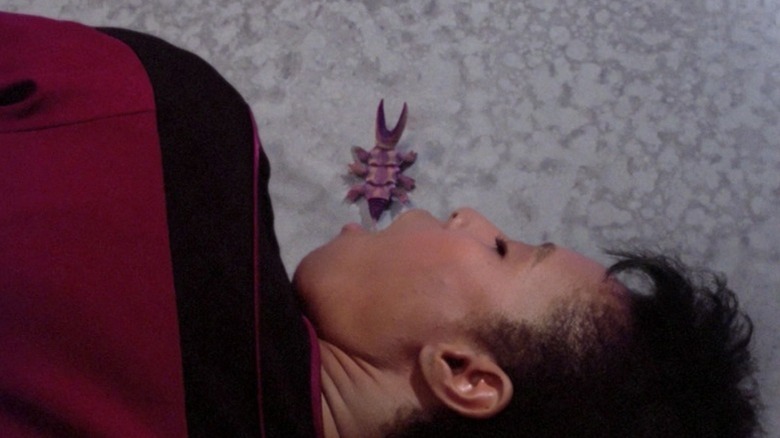
"Star Trek: The Next Generation," despite its status as arguably the most beloved "Trek" series, also had the franchise's worst first season. One of the few bright spots, however, was the late-season entry "Conspiracy," which sees Picard (Patrick Stewart) uncover a mysterious plot to take over the Federation. A race of aliens is slowly replacing key Starfleet personnel at the highest levels, similar to the events of "Invasion of the Body Snatchers."
As Picard learns, this alien race isn't humanoid at all, but is instead a species of insect-like parasites that enter a person's body through the mouth. From there, they plant themselves at the base of the brain, taking control of a person's body. They can even use their hosts to become veritable supermen, able to augment their strength, speed, and agility. And the parasites are smart about it, too: They don't invade in full force, they subtly work their way into Starfleet, one-by-one. If Picard hadn't been keyed to the plot, they might have gained control of the Federation.
What makes these alien parasites so disturbing isn't that they take control of our hero's bodies, nor the unsettling manner in which they do it. It's that, by the end of the episode, we still don't know what their ultimate purpose really was, though we do get one of the franchise's most disgusting moments out of it. Plus, they sent out a beacon before their "queen" was killed — meaning there's still a chance we could see them return.
9. The Solanogen-base lifeforms from Schisms
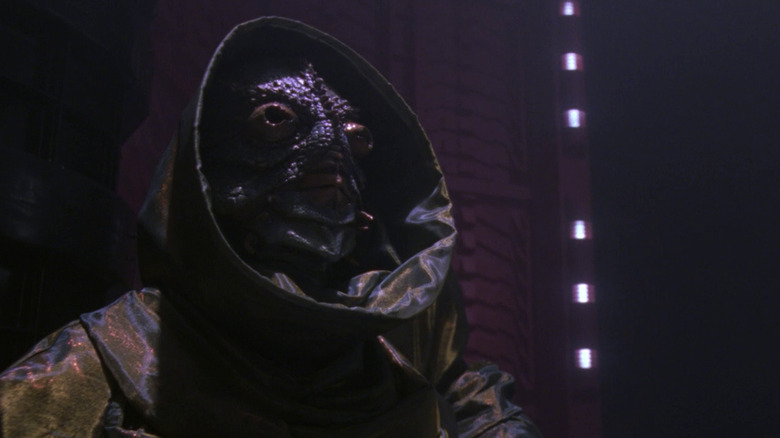
"Conspiracy" wasn't the last time we saw a mysterious alien race from a distant corner of the galaxy attempt an invasion of the Federation. In the Season 6 "TNG" episode "Schisms," a different kind of invasion takes place when a race of solanogen-based lifeforms resembling cloaked reptiles begins abducting members of the Enterprise crew and performing hideous medical experiments on them.
Though never named, these alien invaders seem to exist in another realm of space beyond our own, giving them the ability to snatch people from their beds in the middle of the night, undetected. Worse yet, the experiments they perform are upsetting, with one crew member having all of his blood replaced with a liquid polymer.
The capper? They also seem to be able to wipe the memory of those they abduct, leaving only unsettling, dream-like memories behind. Though the crew of the Enterprise got wise to their scheme, it's conceivable they could still be out there, abducting others for their own twisted reasons. It's suspected that their true purpose was to discover a way of existing in our universe, too, potentially as a precursor to an all-out invasion.
Like in "Conspiracy," these alien invaders also send a signal out into space once they are defeated, leaving the audience to expect some kind of return. Of course, we haven't seen them again, leaving "Schisms" as a storyline that never paid off.
8. The Salt Vampire from the Man Trap

The very first episode of "Star Trek" to ever air on television was actually not the first filmed, but it did feature one of the most disturbing alien races the franchise would ever see, even some 60 years later. In fact, if you didn't know what was coming from "Star Trek" in the ensuing decades, you might have been mistaken for thinking it was a horror show after "The Man Trap."
The episode's villain is known only as the salt vampire, a member of a race of aliens who hail from the planet M-113. That world, when visited by Captain Kirk (William Shatner) and the Enterprise, is nothing but ancient ruins, where a long-dead civilization once thrived. But the people, they discover, did not go extinct because of war or ecological destruction. It was because their species had consumed all of the planet's salt — a substance that they required for survival. And when one of the last living members of the species is discovered, it comes aboard the Enterprise to feed on the crew and steal the salt from their bodies to survive.
Genuinely a kind of vampire, the alien from "The Man Trap" has a series of octopus-like suckers on its fingers that it uses to extract minerals from the blood of its victims. Add to that its hideous appearance, and it's easy to see why it earns a place on this list.
7. The Organians from Star Trek: Enterprise
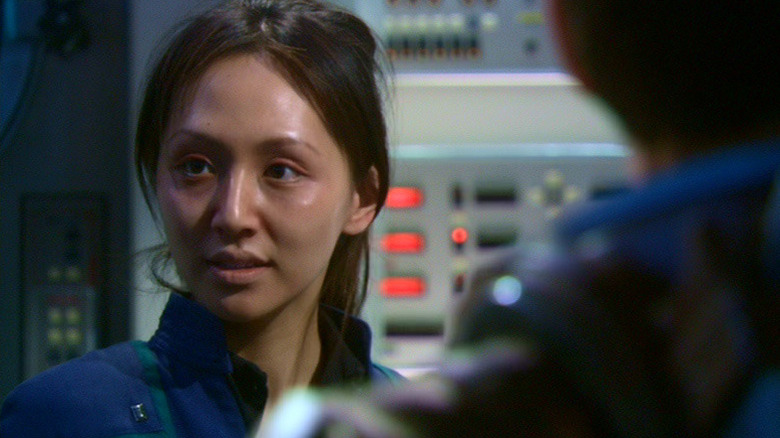
The Organians are an intriguing race in "Star Trek," in that they've appeared more than once with very different portrayals each time. In their first appearance in the original "Star Trek" series, they're portrayed as non-corporeal beings who no longer possess physical bodies. They are not the villains in the story, but are a race of beings under threat from the Klingons before Kirk and the Enterprise realize the Organians' true nature. They appear again in "The Observer Effect," an episode of the 2001 prequel series, "Star Trek: Enterprise," and it's this portrayal of the Organians that is truly disturbing.
In "Observer Effect," which takes place a century before the Organians' encounter with Kirk, the crew of the Enterprise begins dealing with a deadly virus sweeping the ship. But one of its first victims, communications officer Hoshi Sato (Linda Park), begins acting strangely, and the audience soon realizes that a non-corporeal alien being has taken possession of her body. As revealed later in the episode, this is an Organian, and it's their first encounter with humans. They've decided to possess members of the crew to experience what it's like for them to deal with a deadly disease that will soon wipe them all out.
What's so disturbing about the Organians here isn't their ability to possess a human host. It's that they are so far removed from human existence that they regard people as little more than insects. They seemingly have no empathy or feeling of any kind for our suffering, even when they could cure every member of the crew instantly.
6. The Srivani from Scientific Method
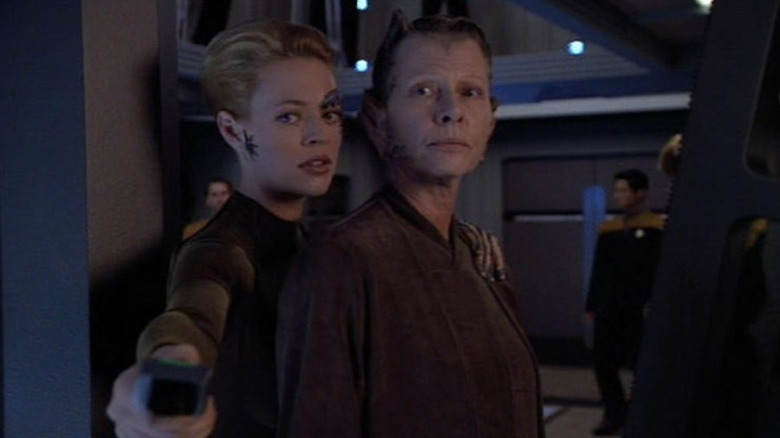
While "Star Trek: Voyager" was revealed by Netflix to be the spin-off with the most-watched episodes on streaming, the series doesn't have many episodes that rank among the franchise's best. Still, one of the best episodes in its run, according to IMDb, is "Scientific Method," a gripping thriller that is among the first episodes to demonstrate just how good Jeri Ryan is as Seven of Nine.
"Scientific Method" begins with Captain Janeway (Kate Mulgrew) dealing with extreme fatigue and exhaustion, not to mention debilitating migraines. But when Chakotay (Robert Beltran) and Neelix (Ethan Phillips) also suffer sudden medical emergencies, the Doctor discovers that someone or something is altering the crew's genetic codes without their knowledge. We soon discover that a race of aliens known as the Srivani has invaded the ship while in a cloaked state, and they are performing horrifying experiments on the crew. But rather than abduct them and perform these experiments in secret, they're doing it out in the open, with cloaking technology masking their invasive procedures.
Even worse than the Organians, the Srivani are a humanoid species whose lack of regard for their victims makes them cruel rather than unfeeling. They don't care about the suffering they are inflicting, even though they can clearly understand what they are doing. They only seem to care about results, with little regard for the fact that their work is downright torture, and almost always results in a painful death. Beyond disturbing, the Srivani also made our list of most underrated "Star Trek" villains.
5. The Devidians from Time's Arrow
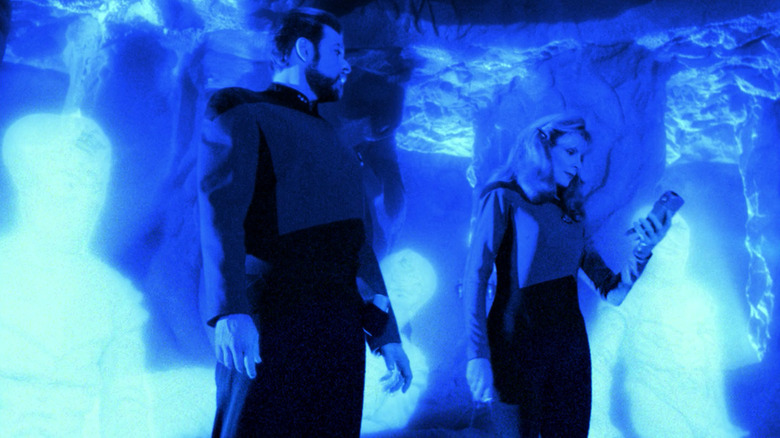
By now, you may be seeing a common theme: Many of the most disturbing aliens in the history of "Star Trek" are races that use other species for their own needs, be it as food, experimentation, or as some kind of resource. That's also true of the Devidians, the alien race seen in the two-part season-ending "Next Generation" episode "Time's Arrow" — one of the best time travel stories in "Star Trek."
The episode opens with the discovery of Data's (Brent Spiner) head beneath San Francisco, and before long, the crew of the Enterprise finds themselves time-traveling back to the 19th century, fulfilling a causal time loop. But the reason they go back into the past is for more than ensuring Data's head ends up where it needs to be: They're chasing a race of aliens from the planet Devidia II, who require human life energy to sustain themselves. They've travel back in time to 19th-century San Francisco, where a cholera epidemic serves as the perfect cover for them to drain humans of the energy they need, without being discovered.
If they hadn't been stopped by Picard and his crew, the Devidians could have been one of the most devastating aliens ever in "Star Trek." Their ability to go back in time, kill swaths of humans, and leave undetected makes them a terrifying and disturbing threat that, conceivably, knows no boundaries of time or space.
4. The Gorn
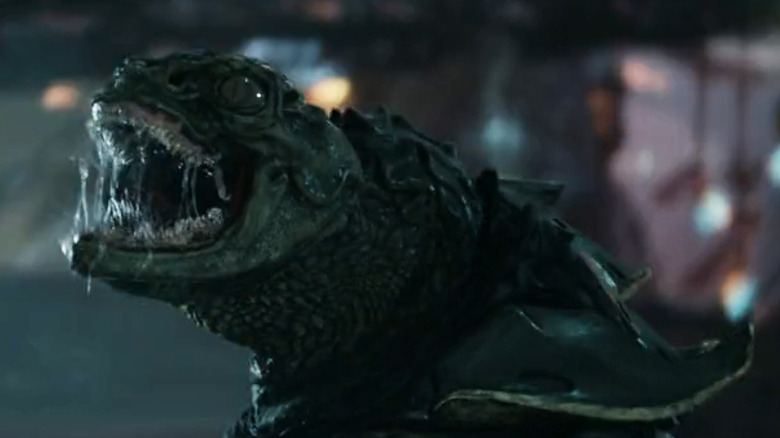
Like the Organians, the Gorn were first introduced in an iconic episode of the original "Star Trek" and then later brought back in a prequel spin-off where their portrayal was a bit different. In this case, the Gorn show up in the classic episode "Arena" before the 2022 series "Star Trek: Strange New Worlds" gave them a modern revamp. In the new series, they are far less civilized, much more animalistic, and driven mostly by a hunter's instinct rather than a calculated strategy.
Whether you like the change or not, the updated version of the Gorn is truly terrifying and downright disturbing. Because not only are they far more monstrous than the original Gorn from "Arena," their animalistic behavior is more akin to the xenomorphs from "Alien" than anything in the reptile kingdom. As Captain Pike (Anson Mount) and the Enterprise learn, the Gorn use human bodies as breeding sacks for their eggs, which are eventually torn apart by the process and used as food during the birthing cycle. Worse still, their intelligence has allowed them to develop advanced technology, weapons, and even spacecraft, which has given rise to an interstellar empire that humanity still doesn't understand.
3. Species 10-C from Star Trek: Discovery

"Star Trek: Discovery" has seen rave reviews from critics, but has proven to be one of the most controversial shows in the franchise. Despite having plenty for fans new and old to love, it's hard to argue that it's left an impression on pop culture the way earlier "Trek" shows have. Nevertheless, it does boast plenty of great stories, and one of them features an alien race that sits among the most unnerving beings in "Star Trek."
Known only as Species 10-C, the aliens are at the center of a season-long storyline from "Star Trek: Discovery" Season 4. Though not a malevolent species, like many entries on this list, what makes 10-C so disturbing is that they are highly advanced on a cosmic level. Not only are they incredibly powerful — able to wipe out entire star systems with relative ease — they don't even view the human race as intelligent life.
One of the few alien races in "Trek" to hail from outside the Milky Way galaxy, Species 10-C don't live on a planet but within a massive gas giant. Their physical form is among the most alien we've ever seen, to the point that they do not have a spoken language, nor do they communicate telepathically. Instead, they communicate by releasing various hydrocarbons, something that the Federation's universal translator cannot decipher. With a combination of technological advancement, awesome power, and dizzying intellect that defies convention, Species 10-C can give anyone nightmares.
2. The Borg
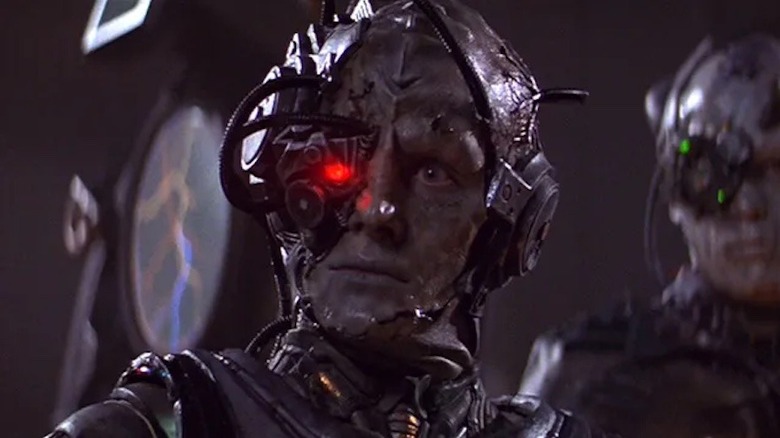
First introduced in the "Star Trek: The Next Generation" Season 2 episode "Q Who," the Borg have become perhaps the most famous foe in all of "Star Trek," possibly even eclipsing the Klingons. They appeared in numerous episodes of "TNG" and were a persistent foe on "Voyager." They were the villains of "Star Trek: First Contact" and played a major role in all three seasons of "Star Trek: Picard." All these appearances may have defanged the Borg, who are now seen as a popular, sometimes humanized antagonist. It obscures that, for years, they were among the most disturbing alien races in all of science fiction.
Unfeeling and uncaring, the Borg are living AI merged with mortal flesh, and with a horror that's unmatched elsewhere in "Trek." They are both vampires and zombies, in function. They use retractable mechanical tendrils to infect a humanoid victim with microscopic robots that rewrite their DNA, turning them into a Borg. A victim's body becomes a host for mechanical parts, all to serve the collective, who gain knowledge and advance their species by absorbing prey civilizations. They are led by a Borg Queen whose sole goal is to assimilate enough species to eventually reach a perfect stage of evolution.
Not only that, but the Borg's technology, while not quite to the highest level we've ever seen, allows them to easily outmatch and adapt to just about any species they encounter. The Borg can even use time travel, like the Devidians, to find their next meal. The only reason they don't? It's less efficient for them.
1. The Vidiians from Star Trek: Voyager
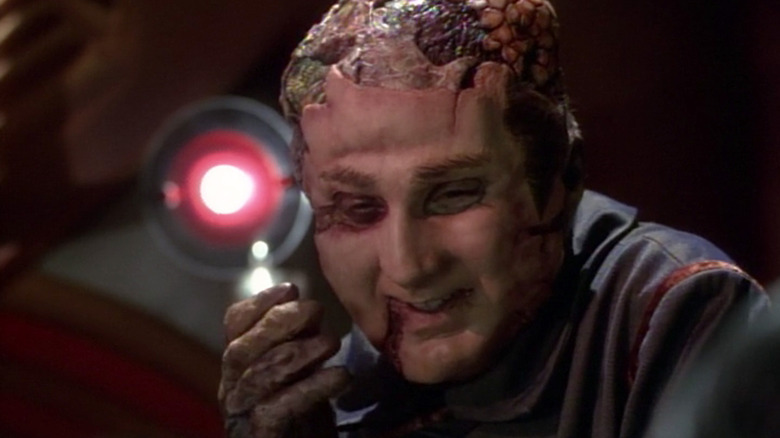
The most disturbing race of aliens in "Star Trek" is one we've seen only on "Star Trek: Voyager," and it's a race that, ironically, isn't so disturbing anymore. They're the Vidiians, a race encountered by Captain Janeway early in her journey home from the distant Delta Quadrant. They are a race much like humans, with an advanced civilization and warp technology. They enjoyed a culture much like our own, with art, music, and science that should have led to a veritable utopia. Unfortunately, their world was ravaged by a disease they call the Phage.
The Phage was a deadly infectious disease that destroyed their bodies, eating them from the inside out, targeting vital organs before resulting in a grisly, excruciating death. To survive, the Vidiians were forced to become cannibalistic hunters, tracking compatible humanoid species who could act as organ donors. Eventually, they became monsters themselves, killing innocent alien species like the humans on Voyager, just to harvest their organs to stay alive. We even saw them stealing a Voyager crewman's face to become a Frankenstein-like monster.
More than just disturbing, the Vidiians are a "Star Trek" tragedy, a once-thriving race of people forced to abandon all morality just to continue their own existence. They do it with such horrifying methods, stealing limbs, internal organs, and skin, that they have lost their entire cultural identity. Thankfully, at some point after their early encounters, we learn that the Phage was cured thanks to the help of a group of highly advanced intellects known as the Think Tank.