

10 Best Holodeck Episodes In Star Trek, Ranked
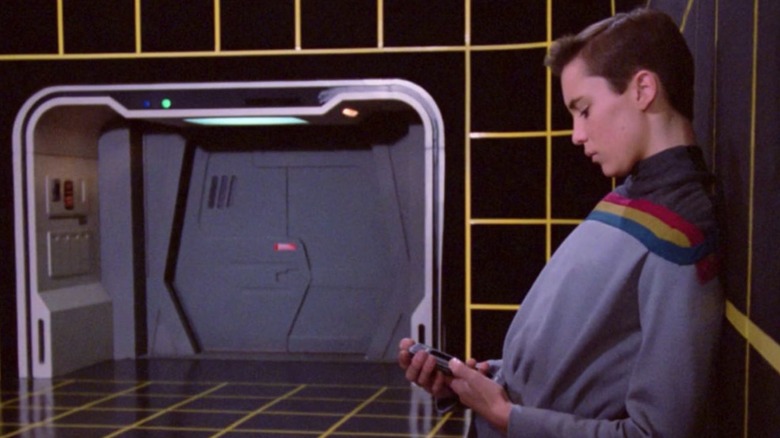
When the "Star Trek" franchise introduced holodecks in the 1987 pilot episode of "Star Trek: The Next Generation," it opened a universe of possibilities for storytelling. Believe it or not, every holodeck-focused episode doesn't involve some glitch or error that turns off the safety protocols, as the miraculous room has been used to tell expressive stories that delve deeply into the franchise's many characters. Over time, holodecks took on even greater importance to the franchise, expanding to various shows and films.
Holodecks first appeared on the silver screen in "Star Trek: Generations," and they've been a focal point for the franchise in the years since. There have been dozens of episodes from various series that tell stories in and around holodecks, and many of them are considered among their particular series' best episodes. This is largely due to what a holodeck represents because it can transform a series set in the 24th century into a tale of Robin Hood in Sherwood Forest — there are endless possibilities.
Determining which of the many holodeck-themed episodes from all the "Star Trek" shows is no easy task, as it's largely subjective to the viewer. To find the best, each episode's score on IMDb was compared to fan discussions about particular episodes. The results are the following 10 best holodeck episodes in "Star Trek." While there's one in the top spot, all of them are exceptional examples of entertaining sci-fi told through the lens of a 24th-century ideal world.
10. Star Trek: The Next Generation — Future Imperfect
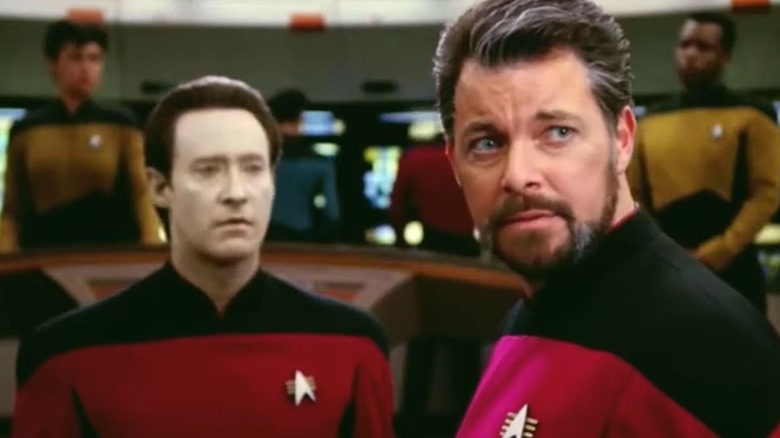
Holodecks are designed for recreation and training, but in "Future Imperfect," the technology is utilized for deception. The episode opens with William Riker (Jonathan Frakes) celebrating his birthday, which is interrupted by an away mission to Alpha Onias III. On the planet, he and his comrades are rendered unconscious via methane gas. When Riker awakens in sickbay, he's the Captain of the Enterprise and is noticeably older, as 16 years have passed.
Dr. Crusher (Gates McFadden) explains that he's recovering from Altarian encephalitis, which he caught on the away mission 16 years earlier, and it's affecting his memory. He later "meets" his son, Jean-Luc (Chris Demetral), named after Admiral Picard (Patrick Stewart), and various aspects of his life unfold, showing that time truly has passed. As he struggles to adapt, Riker notices several inconsistencies, including meeting a former holodeck character IRL. He surmises that his new life is all a ruse, pointing his finger at Ambassador Tomalak (Andreas Katsulas).
Tomalak isn't truly an ambassador from Starfleet's former enemy, and is instead using the holodeck to extract intelligence from Riker. It's an ingenious deception, but Riker sees through the ruse, leading to a confrontation, but Tomalak isn't the true perpetrator. Jean-Luc turns out to be Barash, a lone survivor on the planet Alpha Onias III, who used his scanning and holographic equipment to rope Riker into being his companion out of loneliness. The episode ends with the two beaming up to the Enterprise-D.
9. Star Trek: Deep Space Nine — Our Man Bashir
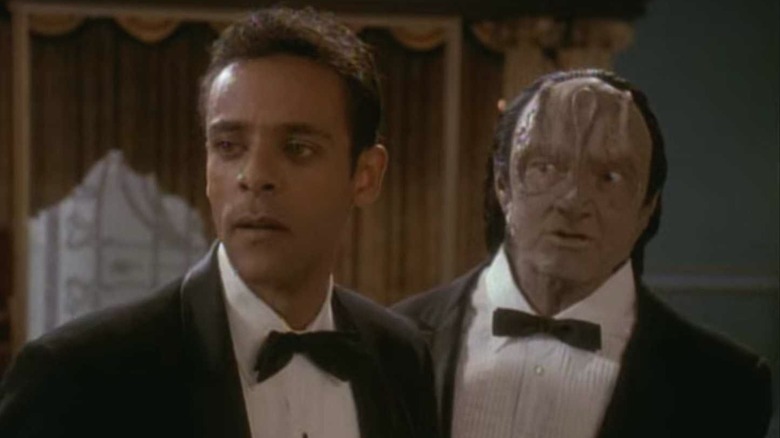
Of the many great characters featured on "Star Trek: Deep Space Nine," Dr. Bashir (Alexander Siddig) and Garak (Andrew J. Robinson) are among the fans' favorites. Their friendship is central to several running story arcs, but it also affords them time in the station's holosuites, and they tend to prefer spy dramas. This is normally a great time for all involved, but in "Our Man Bashir," a transporter accident coincides with the program the two pals are running, putting the entire senior staff at risk.
While Bashir and Garak enjoy their secret agent holo novel set in 1964, the transporter digitizes the senior officers' patterns, and instead of rematerializing them, they're stored in the station's memory. This results in their physical patterns manifesting in the holosuite, which presents a problem. They're not themselves and are instead characters within the story. Given the situation, if any of them die, they die for real.
What plays out is a classic spy story with the twist of real-life and death stakes. The cast performs their altered characters so well that you can tell the actors had a blast filming the episode. It all ends with a near-miss as the senior officers' patterns are beamed out at the last second, saving them from death by holosuite. The episode ends with Bashir escalating the villain's plan to destroy the world, as it was the only way to play out the story to save everyone.
8. Star Trek: Voyager — Worst Case Scenario
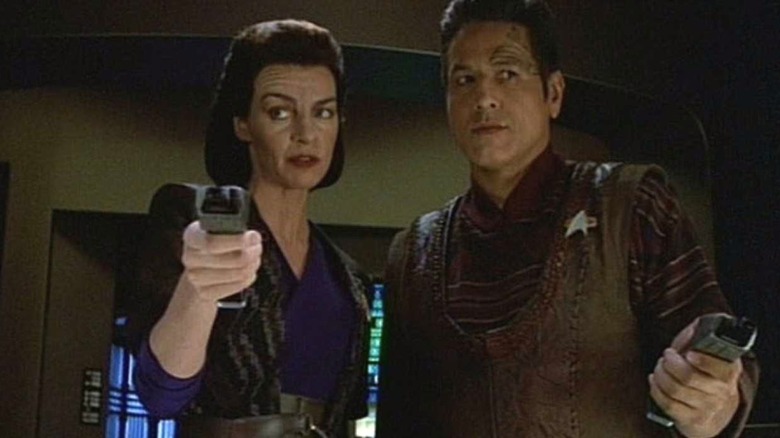
When the USS Voyager is trapped in the Delta Quadrant, the circumstances that caused it also lead to a merger between the Starfleet team and the Maquis crew. This becomes a common story element throughout the first season, but by the third season, when "Worst Case Scenario" aired, the crews had evolved into a cohesive unit. That's what makes the episode so intriguing because it centers around a holosuite program Tuvok (Tim Russ) created to test what would happen if the Maquis tried to take over Voyager.
Initially, the crew finds it to be a fun and engaging exercise, building in popularity such that everyone has a go, but there's a problem. Written deep within the scenario's code, Seska (Martha Hackett) implanted a trap, which triggers when Tom Paris (Robert Duncan McNeill) and Tuvok attempt to add an ending. They're suddenly in the ship's brig, where a holographic Seska explains that the program has control over the ship, there are no safety protocols, and they're in a no-win scenario endangering Voyager.
While they attempt to survive the holodeck story to its completion, the crew works tirelessly from outside to fix the situation. It all comes to a head when Seska corners Tuvok and Paris, meaning to kill them. Her weapon malfunctions, thanks to Tuvok's meddling, and Seska dies, ending the story and saving the ship from Seska's villainous machinations. The episode is a fan-favorite due to Seska's return, having died earlier in the season.
7. Star Trek: Lower Decks — Crisis Point
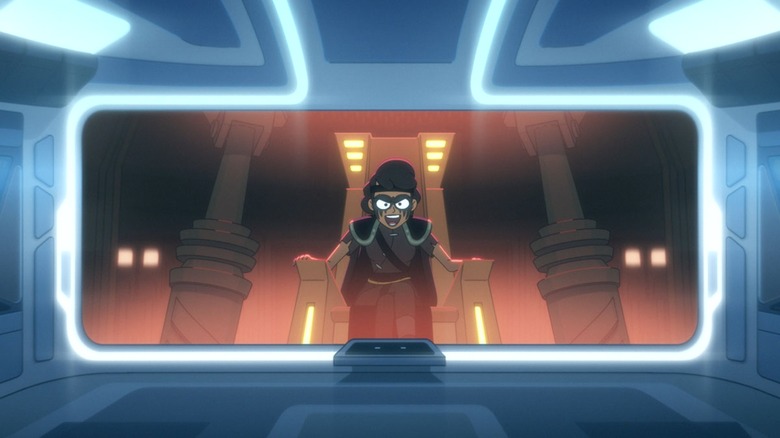
One of the reasons that "Star Trek: Lower Decks" is such a fun series is how it delves deeply into the franchise's lore. It's also able to do pretty much anything in holodeck episodes because animation allows for whatever the artists can create, and the series has some excellent holo-themed storylines. The best is "Crisis Point," which centers around Beckett Mariner (Tawny Newsome) repurposing Brad Boimler's (Jack Quaid) program as a way to avoid going to therapy.
Boimler's program uses the crew's personal logs to emulate everyone so he can practice social and professional interactions. Seeing this, Mariner quickly reprograms it into a movie-style story, where she plays the villain. Boimler is initially apprehensive, while everyone else dives right in. He gets into the movie's adventure pretty quickly, using his interactions with Captain Freeman (Dawnn Lewis) to help him prepare as he'd planned. Through it all, Mariner happily plays the psychotic Vindicta, vaporizing her holographic crew members until she makes it to the captain.
It's a great character analysis, and the movie, "Crisis Point: The Rise of Vindicta," is a fun means of character development. It's filled with all kinds of references to various sci-fi franchises and "Star Trek," culminating in a fight between Vindicta and a holographic version of Mariner. This leads to a final confrontation that's ultimately cathartic for Mariner, giving her the therapeutic breakthrough her captain (revealed to be her mother) sought at the beginning of the episode.
6. Star Trek: The Next Generation — Elementary, Dear Data
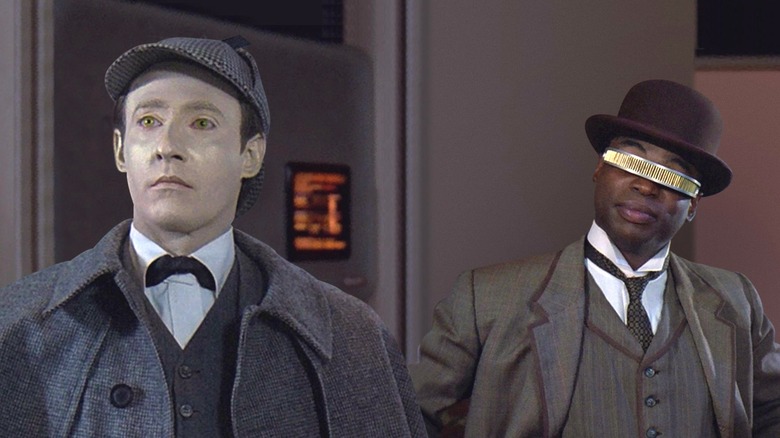
Of the many holodeck episodes in "The Next Generation," "Elementary, Dear Data" is one where it seems the cast had a blast making it. It's also one of the best Data episodes, and it's centered around his interest in Sherlock Holmes, which began in the first season. The episode begins with Data (Brent Spiner) and Geordi (LeVar Burton) working together on a Holmes mystery on the holodeck. Data easily solves the case without going through any of the steps, which is boring, so Geordi comes up with a solution.
He asks the computer to create a character capable of defeating Data, resulting in a hologram version of Holmes' nemesis, Professor Moriarty (Daniel Davis), appearing in the story. Because of Geordi's instruction, the computer fashions a version of the classic character who's not only capable of defeating Data, but is sentient. This presents something of a problem when Moriarty kidnaps Dr. Pulaski (Diana Muldaur) and later explains that he's fully aware of his situation and the holodeck.
This becomes an ethical dilemma because, in a way, Moriarty is a new form of life. He wants to break the confines of the holodeck, which is impossible, so Captain Picard makes a deal with him. He promises to keep him in permanent stasis, and should a solution be found, he would revive him and allow Moriarty to leave the holodeck. Moriarty proves to be a fascinating character, and he returns multiple times in the franchise.
5. Star Trek: Deep Space Nine — Inquisition
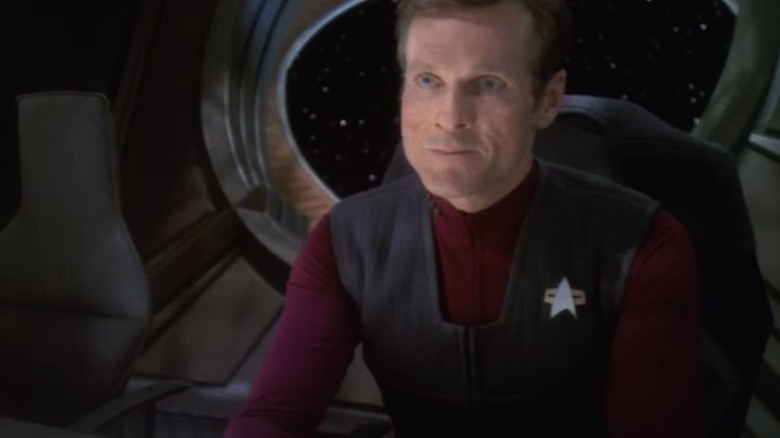
While it's a well-known element of the franchise today, the first time anyone mentions Section 31 is in the "Deep Space Nine" episode "Inquisition." The episode sees Luther Sloan (William Sadler) from Starfleet Internal Affairs arrive on DS9 to interrogate the staff. In Dr. Bashir's first meeting with Sloan, he's cordial and brief. Bashir later learns that others' interviews took hours, focusing entirely on Bashir, so the second time they meet, Sloan is no longer pleasant.
He accuses Bashir of being a Dominion spy, having repressed his memory of accepting the Dominion's offer after his imprisonment the previous year. Bashir denies all of this, and things proceed badly as more evidence mounts indicating his guilt. The next day, Bashir is beamed onto a Dominion ship, where he's happily greeted by Weyoun (Jeffrey Combs), who furthers the insinuation that Bashir is a spy. He's rescued by DS9's crew and is again accused of spying for the Dominion, but Bashir notices some irregularities.
Bashir realizes that he's been in a holodeck simulation since the previous day, and once the curtain is pulled, Sloan reveals the truth. He's from Section 31 and was testing Bashir's loyalty as a potential recruit. Bashir isn't too happy about this, so he refuses, and Starfleet neither confirms nor denies Section 31's existence. At the end of the episode, Captain Sisko (Avery Brooks) tells Bashir to accept the next time Sloan approaches him, so they can learn more about Section 31.
4. Star Trek: Voyager — Real Life
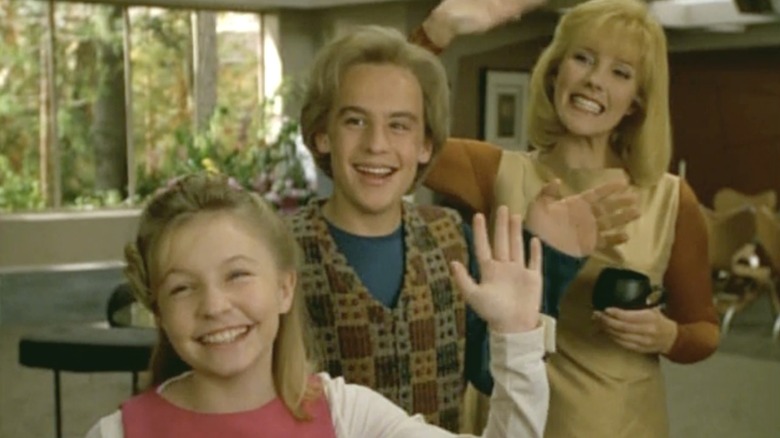
One of the most fascinating characters in "Star Trek: Voyager" is The Doctor (Robert Picardo). He starts as an emergency medical hologram, but expands his programming significantly, hoping to better understand what it means to be human. Additionally, The Doctor wants to establish his own identity, and to that end, he programs a holographic family in the episode "Real Life." After hosting his colleagues for dinner, they're nonplussed with the idyllic family, so B'Elanna (Roxann Dawson) reprograms the simulation.
When The Doctor returns to his holographic home, he finds that his family has changed to be more realistic. Instead of a 24th-century version of "Leave It to Beaver," his teenage son is rebellious and determined to hang out with Klingon kids to The Doctor's disapproval. His wife is too busy to care for the children, and his daughter gets involved in a dangerous game that The Doctor doesn't want her to play.
After she's injured during a game, The Doctor is forced to perform surgery on her. Sadly, her injuries are too great, so The Doctor shuts down the program and leaves. After Paris tells him that humans have to take both the good and bad, The Doctor returns and holds his daughter's hand as she dies, bringing the family back together through the tragedy. It's a tough scene to watch, which is performed brilliantly by Picardo, and it takes The Doctor one step closer to understanding what it means to be human.
3. Star Trek: Deep Space Nine — It's Only a Paper Moon
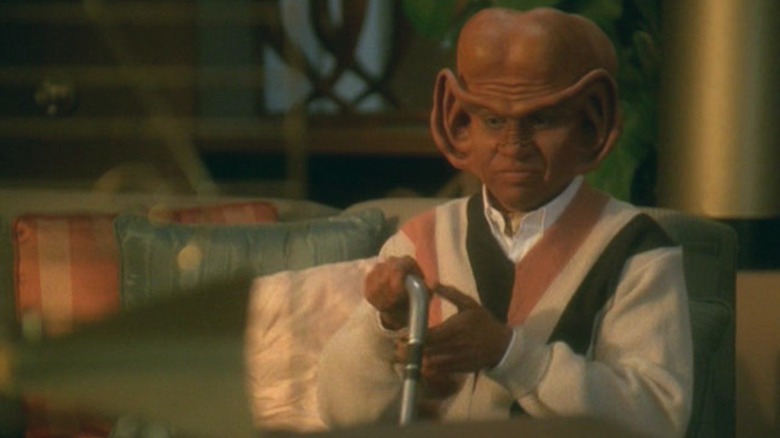
In "It's Only a Paper Moon," Nog (Aron Eisenberg) struggles after he loses his leg in combat and is dealing with post-traumatic stress disorder. To cope, Nog takes solace inside the holosuite running the Vic Fontaine (James Darren) program. He sleeps throughout the day and listens to Fontaine's "I'll Be Seeing You" on repeat, as it's the song that played during the mission where Nog lost his leg.
The station's counselor, Ezri Dax (Nicole de Boer), approves Nog's plan, as she believes it could be therapeutic. Nog and Vic become close, while Nog's real friends and family become alienated. Vic also becomes strained because he has to run full-time, which takes a toll. Nog throws himself fully into 1962 Las Vegas, and he plans to build a casino with Vic. This helps to turn his mood around, and he begins using his cane less often, though he doesn't appear to notice.
Eventually, Ezri talks to Vic, who enjoys Nog's company, and convinces him to help get Nog out of the holosuite. Vic agrees, and because he has control over his program, he shuts it down and doesn't restart it. He reappears and talks to Nog, telling him he has to live his real life. This works, and Nog slowly returns to the life he once knew. To pay Vic back for his help, he arranges to have the program run forever, granting Vic a chance at his own real life.
2. Star Trek: Voyager — Pathfinder
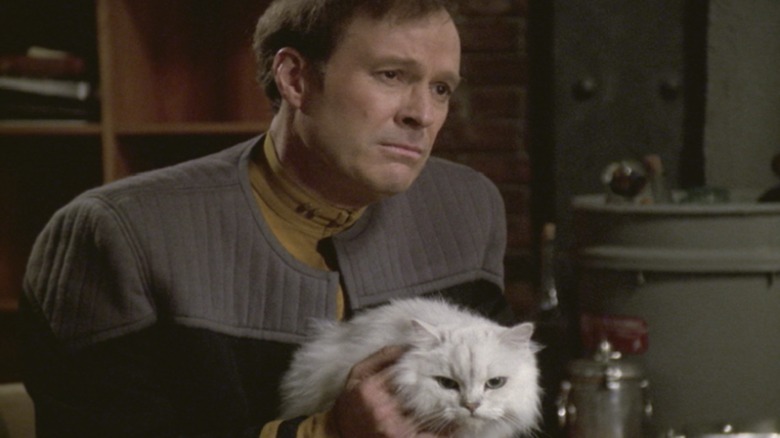
Reginald "Reg" Barclay (Dwight Schultz) has struggled with holo addiction during his life, and in "Pathfinder," he comes close to repeating old patterns. Reg is desperate to facilitate contact with Voyager, so he creates a holo simulation of the crew, whom he befriends and uses to help bounce ideas off of when he could otherwise be socializing. This creates problems at work, leading Deanna Troi (Marina Sirtis) to check in on her old shipmate/patient to offer help, as Reg's Voyager work is becoming an obsession.
Reg becomes convinced that his theory involving the creation of wormholes to the Delta Quadrant is sound, but he fails to convince his boss. This leads to him breaking into the lab to test his theory, which proves true, but his colleagues are concerned about him. Inevitably, this leads to Reg getting into serious trouble, but being as determined as he is, he pushes forward and successfully establishes two-way communication with Voyager in the Delta Quadrant.
Through it all, Reg delves deeply into his holodeck program, showing that his ability to befriend holograms can be problematic. After Reg succeeds, the crew of the Voyager looks him up in their records, proclaiming Reg an honorary crewmember, which is, in truth, what he mostly desires. Reg's holodeck addiction is explored in a previous "Next Generation" episode, but it's expanded upon significantly in "Voyager," and is superior. It ends far more positively for the beleaguered Reg, who only wants to help bring Voyager home.
1. Star Trek: The Next Generation — Ship in a Bottle
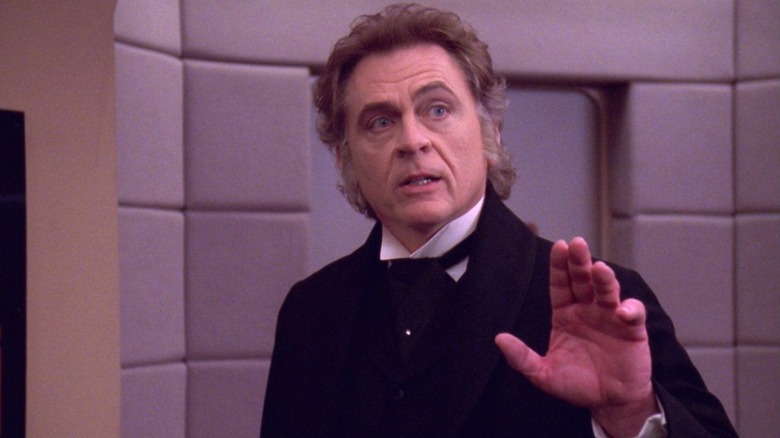
"Ship in a Bottle" is atop most fans' lists of the best holodeck episodes, and it has a lot to do with one character. Professor James Moriarty is inadvertently reactivated by Reginald Barclay, and he still wants to get off the holodeck. Angry that Captain Picard hasn't followed through with his part of the deal, Moriarty defiantly walks off the holodeck, declaring, "I think, therefore I am." This astounds the crew, as it's impossible for a hologram to leave the holodeck. Moriarty does so regardless, and he then creates his own sentient companion.
Not long after, Moriarty takes control of the Enterprise while demanding that the crew come up with a means of taking the newly sentient Countess Regina Bartholomew (Stephanie Beacham) off the holodeck. As this is impossible, they cannot accommodate his request, and through trickery, Picard uses his command codes before realizing that he's been in a simulation Moriarty created the whole time. This gives Moriarty the real command codes for the Enterprise, and he takes over the ship.
Through more deception, Picard convinces Moriarty that he and Regina can be materialized via a transporter into the real world. He does this, but unbeknownst to Moriarty, it's all a holographic simulation. He and the Countess leave in a shuttlecraft to explore the galaxy, all the while remaining in a memory device. It's a fun episode because it keeps the audience guessing — is this real, or is it a simulation?