

10 Controversial Changes Game Of Thrones Made From George R. R. Martin's Books
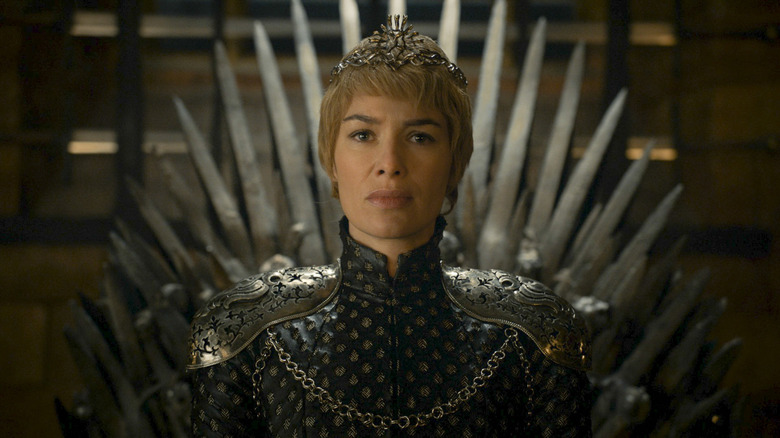
When most people think of controversial "Game of Thrones" decisions these days, they think first of the polarizing final season. It's understandable, given that the HBO titan reigned for years as the biggest show on Earth, only to wrap things up in a dimly lit, narratively perplexing mess. With the success of "House of the Dragon" and the easing effect of years, the strongest ire over that finale has faded, and the show's primary reputation still centers around its many shining moments.
But long before showrunners David Benioff and D. B.Weiss ran out of material to adapt from George R. R. Martin's unfinished novel series, they were already making a wide range of changes. Many of those made perfect sense. After all, a 10-episode season of television is a totally different beast than an 800-word novel. Adaptations must take creative liberties, and "Game of Thrones" soared to global success through its own. The fact remains, though, that many of these individual changes from the "Game of Thrones" books did more damage to the story than good.
Or, at least, many would say that. Others may uphold the HBO version of events as the superior story. Whichever side you fall on, these changes from the "Song of Ice and Fire" novels were polarizing among fans at the time, and they remain so. Today, we're taking a look at the most controversial changes "Game of Thrones" made to the source material in an attempt to reevaluate them, or, perhaps, to categorize them clearly as mistakes.
Jaime Lannister's story is wildly different in many ways

Let's start off with a very broad change — an entire character arc. Well, not the entire arc, but a huge part of it. Jaime Lannister (Nikolaj Coster-Waldau) is a fan favorite, and it's easy to see why. Everybody loves to hate a smarmy villain, and everybody genuinely loves a slow-burn redemption story.
In both Martin's books and the HBO series, Jaime transitions from an incestuous, duplicitous, would-be child-murderer to a man who at the very least hates himself, and at most feels genuine remorse for the life he's lived. He gets a bunch of help in the sympathy department due to his brutal childhood under tyrannical father Tywin Lannister (Charles Dance) and his role in deposing the mad king Aerys Targaryen, an act that saved many lives but earned him the "Kingslayer" nickname.
It's after Jaime gets back to King's Landing from his imprisonment by Robb Stark (Richard Madden) that his story really starts to diverge from the books. On HBO, he teams up with the sellsword Bronn (Jerome Flynn) to rescue Princess Myrcella (Nell Tiger Free) from Dorne. In the books, he goes north, instead of south, to help break the Lannister army's siege at Riverrun. While there, Cersei (Lena Headey) sends him a letter begging him to return and help her in her time of need, but he burns the note, determined to separate himself from her. Needless to say, that's not the way his story goes on the show. If Martin ever finishes the novels, maybe Jaime will get an ending more befitting his growth.
Sansa Stark isn't forced to marry Ramsay Bolton in the novels
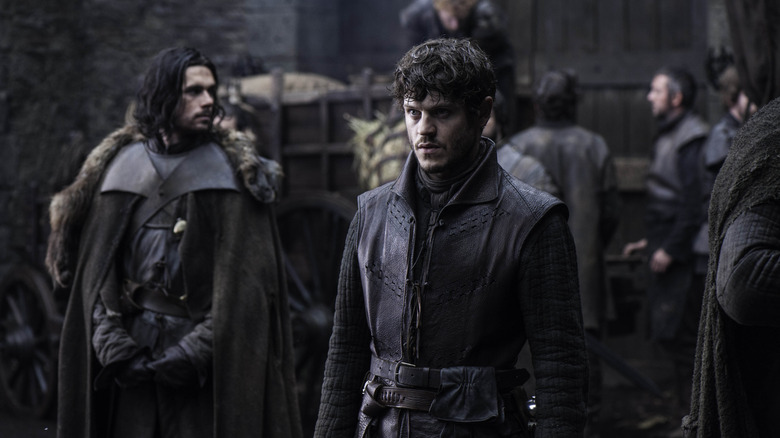
"Game of Thrones" season 5 is where the show really began to diverge from the novels. While season 4 covers many events from the third book, "A Storm of Swords," it also includes material from the fourth and fifth novels, as Martin's split timeline is kept as a single stream of events for the show. Major plotlines from "A Feast for Crows," including arcs in Dorne and the Iron Islands, are changed far more than was previously standard for the series (more on that later), and in the absence of loyalty to the source material, "Game of Thrones" became more and more of a zeitgeist show, playing on the discourse that would hit online circles after every Sunday episode.
We can debate all day what counts as "shock value" and what counts as drama. Regardless, there's no denying the controversy that arose when season 5, episode 6 — "Unbowed, Unbent, Unbroken" — first aired. In the novels, Littlefinger (Aidan Gillen) takes Sansa (Sophie Turner) directly to the Eyrie after getting her out of King's Landing. In the show, she's married off to the sadistic Ramsay Bolton (Iwan Rheon), who rapes her at the end of "Unbowed, Unbent, Unbroken."
Ramsay is still a monster in the books. He marries Sansa's friend Jeyne Poole, who he claims is Arya Stark (Maisie Williams), in order to lay claim to Winterfell, and is every bit as brutal to her off-page as he is to Sansa on-screen. But it was the camera's own fixation with Sansa's suffering that garnered backlash from viewers, turning the whole episode into a major "before and after" moment for the show writ large.
Lady Stoneheart doesn't appear in the show at all

The Red Wedding is probably still the most famous event in the entirety of "A Song of Ice and Fire" — show, books, spin-offs, you name it. Yes, the beheading of Ned Stark (Sean Bean) in both versions is the initial hard left turn, signalling that in this story, no one is safe. But when people think about George R. R. Martin's propensity for betrayal and shocking violence in his stories, they think of the Red Wedding.
In the show, Catelyn Stark (Michelle Fairley) is killed by the Freys alongside her son Robb, and that's the end of it. But in the books, her story goes on. A late Arya chapter in "A Storm of Swords" features a "wolf dream" (where the Stark children enter the consciousness of their direwolves) in which Arya Stark's wolf, Nymeria, who previously ran off to live in the woods near the riverlands, finds and retrieves Catelyn's dead body. This thread is then left hanging until the end of "A Feast for Crows," when Brienne of Tarth (Gwendoline Christie on the show) is captured by the Brotherhood without Banners — a rebel group previously led by rogue knight Beric Dondarrion.
The long and short of it is this: After her body was saved by Nymeria, Beric came upon Catelyn Stark, using the same magic he'd been employing to resurrect himself from various fatal wounds to bring her back to life. However, her body remains corpselike, earning her the new name Lady Stoneheart. As with many of the more magical elements of Martin's books, this storyline was dropped entirely for the HBO adaptation.
Bran isn't the only magical Stark in the novels

As previously mentioned, Arya has wolf dreams of Nymeria in the "Song of Ice and Fire" books. That may surprise those who've only seen the show, as "warg magic" — the ability to transfer one's consciousness into another living being — is used only by Bran Stark (Isaac Hempstead Wright) in the show.
In the books, Arya and Jon Snow (Kit Harrington) also experience wolf dreams of their respective wolves, Nymeria and Ghost, in their POV chapters. It's unclear whether or not this ability was available for Sansa, Rickon, and Robb as well, as Robb and Rickon never get POV chapters in the novels, and Sansa's direwolf, Lady, is killed very early on.
While it's safe to say that Bran's story is still the one most directly connected to warging in the books — and that Bran is by far the most powerful in terms of magic – this is another case of the show reducing and distilling the show's more mystical elements for easier HBO consumption.
Renly Baratheon is way cooler in the books

Sometimes, the most frustrating changes in adaptation aren't major plot alterations. Sometimes, it's just that a character who's so interesting in the books is so much less interesting on the screen, and that's the plight of Lord Renly Baratheon (Gethin Anthony). In the show, Renly is generally portrayed as an effeminate, well-intentioned, but frivolous man. His onscreen love scenes with Ser Loras Tyrell (Finn Jones) were heralded by some as progressive in their day, but returning to them now, it's hard to see them as much more than the most stereotypical portrayal of queerness.
In broad strokes, the character may not seem so different in Martin's novels. But in the details, he gets far more dimension. Renly is described as looking just as Robert did in his youth — a charismatic leader and capable fighter who leads with compassion, but also strength. In the books, Garlan Tyrell wears Renly's armor at the Battle of the Blackwater after his death. This ploy is described as invigorating the entire army to fight harder, while similarly dispiriting Stannis' force, as the appearance of Renly's "ghost" by itself carries significant power.
In the show, Loras is the one who wears the armor, and it's played more as a simple sign of affection than a rallying cry for all those who considered Renly a great leader. Loras attempts to wear the armor in the books, but Renly's greater stature and broad chest make it too big for him. And speaking of Loras ...
Loras Tyrell lives (and is way cooler) in the books

If the character of Renly Baratheon is reduced to a stereotype on "Game of Thrones," then the character of Loras Tyrell is outright assassinated. Though both versions of the story declare Loras to be one of the greatest knights in the seven kingdoms, he gets much less action on screen, suffering the same sort of generic feminization that Renly encounters, only for many more episodes on the "Game of Thrones" show. Here, Loras meets his end with the rest of his family when Cersei Lannister blows up the Sept of Baelor, but not before he's publicly shamed for the crime of being queer.
Now what if we told you that none of that happens in the book, at all? Instead, Loras goes to Dragonstone to hasten a siege by the Lannister navy, after Cersei refuses to divert her ships to help defend Tyrell lands from Ironborn raids. "A Feast for Crows" details his heroic charge into the heart of the fortress, taking multiple arrows and a vat of boiling oil, and still surviving to see the victory. As of the end of "A Dance with Dragons," Loras is in rough shape, but still alive.
It's a far more fitting storyline for a character who, in the books, at least, Jaime Lannister sees as his heir apparent for the status of Lord Commander of the Kingsguard. Jaime's attempts to mentor Loras, even knowing about his sexuality, is one of the most underrated parts of the books. But of course, that wouldn't have provided the audience-stunning, headline-generating "Game of Thrones" moment you get from a fan-favorite villainess blowing up a building after several episodes of extreme homophobia. Perhaps more than any other adapted character, Loras deserved better.
The Game of Thrones show massacres Dorne for no reason

All right, let's do the big one. Dorne is amazing in "Song of Ice and Fire" novels. Dorne is extremely lame in the show. The storylines are so different that one is hardly an adaptation of the other. Instead, the HBO version is an excuse to put fan favorites Bronn and Jaime in a sort of buddy action story, with all of the nuanced Dornish politics and several key characters thrown away entirely.
The Dorne arc in the show goes something like this: After Oberyn Martell (Pedro Pascal) is killed in King's Landing, his partner Ellaria Sand (Indira Varma) and their daughters demand vengeance. Oberyn's brother Doran (Alexander Siddig), the Prince of Dorne, urges peace, but Ellaria and the Sand Snakes kill Princes Myrcella, as well as Doran and his heir. They later attempt to ally themselves with Daenerys (Emilia Clarke), but they have little impact later in the "Game of Thrones" timeline.
By contrast, Dorne hosts one of the primary arcs of "A Feast for Crows." A far more capable character than his HBO counterpart, Prince Doran imprisons Ellaria and the Sand Snakes, which enrages his daughter Arianne, who also wants vengeance for her uncle's death. She hatches a plan to kidnap Myrcella from Sunspear and declare her the new Queen of Westeros, but her father catches wind of the plot and locks her up as well. At the end of the book, Doran explains that he craves revenge far more than he lets on, but that his plans demand time. He reveals that years ago, he betrothed Arianne to Viserys Targaryen, with the intention of aligning Dorne with the exiled family when they returned to reclaim Westeros.
The House of the Undying is a treasure trove of foreshadowing in the novel

As we've mentioned several times already, "Game of Thrones" tends to cut out a lot of the most mystical aspects of the "Song of Ice and Fire" novels. This extends to one of the most memorable sequences in the books, when Daenerys Targaryen ventures into the House of the Undying in Qarth in search of answers as to her purpose.
In the show, Daenerys sees several visions before facing off against the Undying Ones. These scenes prophecy events from much later in the show, like her claiming of the Iron Throne and her arrival at the Wall in the North of Westeros. It's a cool sequence, anchored at the end by an early display of her dragons' power. However, in "A Clash of Kings," the visions are legion, foreshadowing all sorts of other things.
Most notably, Dany sees a clear representation of the Red Wedding, as well as several scenes that, taken together, most readers interpret as evidence that Jon Snow is in fact the son of Rhaegar Targaryen and Lyanna Stark. While the show gets to these revelations in due time, the experience of reading the scene for the first time is unmatched by the House of the Undying in "Game of Thrones."
A Dance with Dragons introduces another Targaryen heir
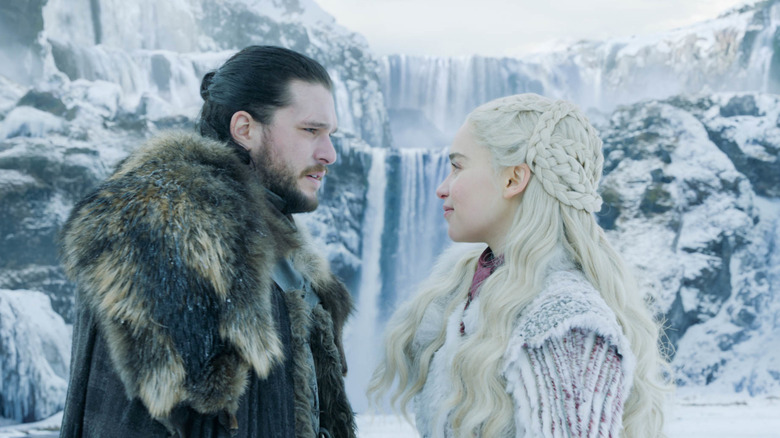
In George R. R. Martin's "A Dance with Dragons," as in the "Game of Thrones" show, Tyrion Lannister flees to Essos after killing his father. And, in both versions, he's kidnapped by Ser Jorah Mormont (Iain Glen). However, in the novel, Tyrion first encounters a character who doesn't appear in the series — a young man called Griff, who's later revealed to be Aegon Targaryen, the son of Rhaegar and Elia Martell who was supposedly murdered as a baby.
As a living male heir in what would have been the direct Targaryen line of succession, Aegon arguably has a stronger claim to the Iron Throne than Daenerys. And, like his aunt, Aegon has aspirations to rule Westeros. Over the course of "A Dance with Dragons," he hatches his own plan to return across the Narrow Sea and take over the nation his family once ruled.
It makes sense why the HBO team would cut this storyline, as it's yet another character and faction to include in a story already bursting at the seams. However, it's also easy to imagine the presence of Aegon adding some much-needed dimension to the eventual meeting of Daenerys and Jon Snow. Many felt that Dany's arc was missing something in season 8. Maybe a clear familial rival could have made her transition to a villain a bit easier to swallow.
The Night King was invented for HBO
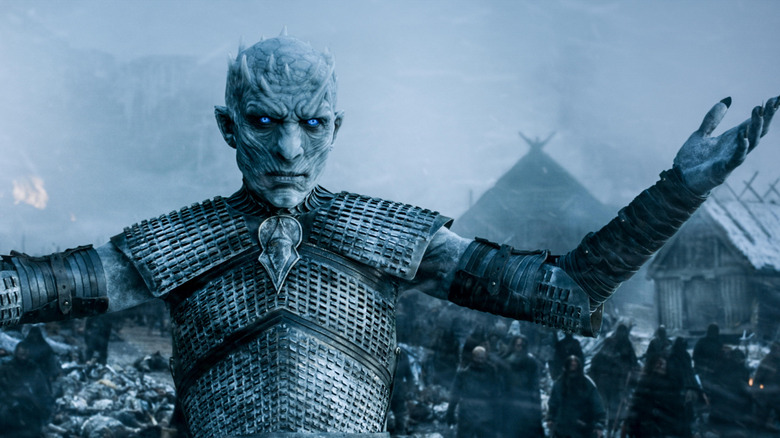
Capping off our list is the Big Bad of "Game of Thrones," the Night King – eldritch terror, great character design, and "Elden Ring" boss energy all combined into a single, stoic supervillain. The Night King became such a massive presence on the show and in the fandom that those who've never read the books would likely be shocked to learn that he doesn't exist in the books at all. At least, not yet.
There is a character of legend in the novels called the Night's King, but that refers to a Lord Commander of the Night's Watch, not a magical rule of the White Walkers. The dark force of the North is portrayed less as a waiting enemy army and more as an ancient, unknowable entity. Of course, giving the White Walkers a leader makes a lot of sense on television, but given how the Night King's story ultimately ends, it may have been more satisfying to keep some more of the mystique from the books.