

Blade Runner 2099: Ending Explained

Contains spoilers for "Blade Runner 2099"
It's been a long 50 years since we last saw the dystopian Los Angeles of the "Blade Runner" universe. In the half century since the in-universe events of 2017's "Blade Runner 2049," the hierarchy of power has changed even more drastically than when Black Adam joined the DCEU, with replicants overtaking humanity and becoming the Blade Runners who hunt down any who are out of line.
Mankind is now the underclass, destined to perform the menial tasks the Replicants were invented for, while their new AI superiors have started colonizing other worlds to extend their new social order across the universe. The eight-episode miniseries doesn't depict a revolution in the other direction, just the seeds of what might become one, as knowledge of an increasingly sentient race starts to spread amongst humanity, and Replicant law enforcement is on the precipice of being further infiltrated by those on the outside.
"Blade Runner 2099" exists as a stand-alone story, but offers plenty of intriguing ideas about what could be next in the timeline of this alternate Earth. We unpack the season finale in more depth below, but first, here's a quick recap to reset the table.
What to remember about the plot of Blade Runner 2099

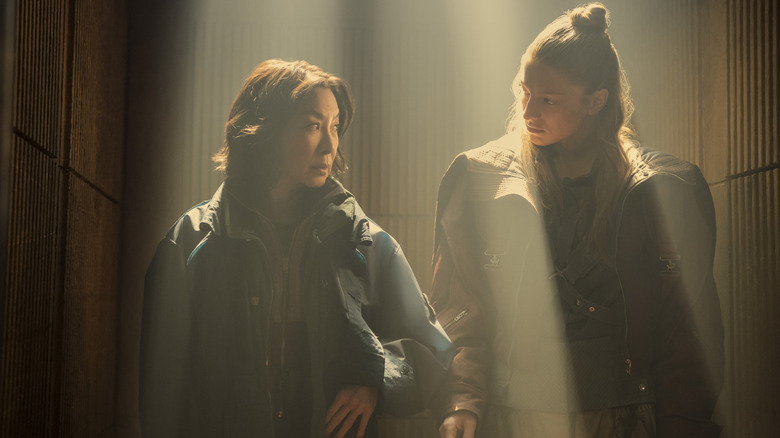
After arriving at the abandoned off-world launch complex, Cora (Hunter Schafer) and Olwen (Michelle Yeoh) set out to find Julius (Tom Burke) and take back the Tyrell memory before he can manufacture a new fleet of super sentient Nexus-1's. They don't realize he's already operated on Clotilde (Amy Lennox), and upon arrival, they kill Julius' assistant Hodge (Wil Coban) after he tells them he's resurrecting the dead and is skeptical anybody but them inside the LAPD knows what they're up to. They stumble into the facility housing several reborn Replicants and swiftly kill them, but not without sustaining significant wounds.
Clotilde evades this, but has a change of heart after her initial attempt to kill Olwen, as the dying replicant –- with only a few hours of life left –- opts to save her from a deadly fall. Elsewhere, Julius stabs Cora, taunts that he has her memory, and brutally attacks her when she tries to stop him killing Olwen. He destroys the memory before Olwen appears to shoot him, but luckily, Clotilde also saw its contents, and knows how to perform the Nexus-1 transformation surgery that can give Olwen a new lease on life, which she does before disappearing. Olwen goes off-world, and Cora reassumes the replicant alias to remain within the LAPD.
Elsewhere, Elias (Lewis Gribben) and Bebeto (Dimitri Abold) discover that they've been played by Ray (Maurizio Lombardi), the client who wanted the Tyrell memory. He didn't want to destroy replicants, but to have an instruction manual to build Nexus-1's, and profit while humanity goes extinct; Bebeto reluctantly joins him, but Elias tries to start a human uprising of his own.
Why were the memories important?
In Episode 7, "One More Kiss, Dear," we finally see the saved memory of Eldon Tyrell (Joe Turkel), a character from the original 1982 movie (unseen here beyond a brief reflection), whose company manufactured the replicants. We see the final stages of the laboratory's attempts to build the first unregulated models known as Nexus-1's, which the rebelling replicant Julius now has as an instruction manual to help usher in a stronger fully sentient race, that will finally crush humanity.
However, as we learned in the heated conversation between Clotilde and a guard at the modern Tyrell Institute, Julius' army are replicants he's using under the false pretense that he can transform their existing bodies into Nexus-1's that'll live forever -– something only a "newborn" like him could be. This is why he needed to kill Clotilde before using her as a prototype. Julius is finally killed by Olwen just after he crushes the memory sphere, saying that the memory dies with him, as the only one who watched it; but of course, the reborn Clotilde still maintains the memory from when he was watching it in her presence previously, so she operates on Olwen before her time fully runs out.
Equally important is that Ray's stated intent for wanting to be delivered to the memories (to deprogram replicants with this as an instruction manual) was a lie. He works for Tyrell Corp, who still own the Nexus-1 patents, and he wanted the memory to profit from Replicants by selling them these surgeries. As a human, he saw their takeover as inevitable, cynically believing that he couldn't "upend the order of the universe," just his place in it, convincing Bebeto to join him.
A Human Uprising?
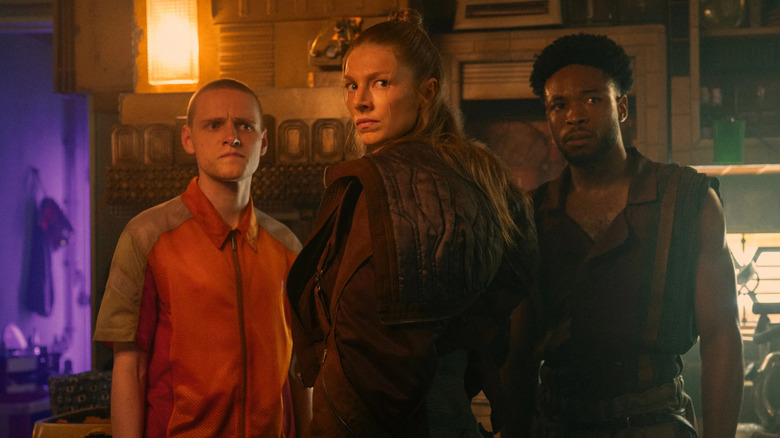
Elias left Ray and Bebeto after the latter gave in, claiming that working with the enemy in the Tyrell Corporation was the only safe bet. However, just like the "It's Always Sunny In Philadelphia" quote, Ray has been playing both sides and always comes out on top, made apparent earlier in the season when he implanted the idea in Elias' mind that someone had to rebel against replicant rule, so why not him? After rumors that Mexico City remained a safe haven had proven false -– TV broadcasts from there were more obviously AI –- and that humans with visas to travel there were instead getting shipped off world, Elias instead makes the bold decision to broadcast an emotional speech to inspire an uprising.
It's been a replicant fear since Episode 1, when Olwen was told rogue replicants needed to be hunted, as humans would exercise free will in killing them if they discovered first. How Elias' speech is received is unclear, however, heading back to the recording studio in the monastery where he grew up (which we discover earlier had been taken over by a Mercerism cultist) to deliver an impassioned cry about how he won't "be their prisoner anymore." To inspire rebellion, he even takes claim for the destruction of the replicant birthing center, which was destroyed by Julius as part of his masterplan to ensure future replicants could only be born following the original unrefined models.
We don't see whether it has any larger impact (some brief reaction shots show Blade Runners will be on his tail soon enough), but the final scene with Cora -– taking one of the empathy tests she previously faked to pose as a replicant –- alludes to a future of a newly emboldened human race.
What is next for Cora?

After telling her brother that the woman who raised them was one of the two Nexus-1 prototypes, Cora argued that maybe everything they'd been told about Replicants was a lie -– without the social hierarchy, they can co-exist with humans. After seeing the results of her first empathy test in Episode 1, Olwen stressed that Cora was "meant to be here," and that there was "no soul inside of her at all." At the time, it just appeared that Cora did a great job of assuming the role of a Replicant, but this exchange is crucial for setting up her final scene in the season, where she retakes Greta's (Katelyn Rose Downey) test.
Having seen the young human's origin story, we know she was taken during a dark period and used to detect signs of human emotion in artificial life. Now that Cora doesn't feel the need to hide her identity, she appeals to Greta's humanity after deliberately failing an empathy test -– leading the kid to state "everything about you is different" — which Greta appears to deliberately omit from the record. She seems to realize that both of them are estranged from their families and forced into roles where their humanity must be suppressed, which could bond them further; we don't find out if Greta takes the risk with her.
With no safe space to go, Cora must stay exactly where she is; luckily, she'll be perceived as stopping a rogue replicant and has gained a powerful human ally that could keep her in the LAPD Blade Runner position for as long as she needs. Only Olwen knows any different about her true identity within the organization, and she's back off world having illegally evaded a death of her own.
Why does Olwen go off world?

As the season ends, only two Nexus-1's are left in commission; Clotilde, whose final whereabouts are unaccounted for, and the newly reborn Olwen, who we see in the final shot back in space, reassuming the earlier work she did scouting potential new habitats off world. When she did that many years earlier with Marek (Johnny Harris), he placed the idea into her head of escaping to one of these worlds that were inhospitable to humans; their superiors would assume their spacecraft immediately burnt up after not hearing from them, and nobody would come looking.
At that point, Olwen was still suppressing desires to extend her lifespan and leave the system she was born into. Now, she's been given a new lease on life thanks to the Nexus-1 operation and no longer has any ties to her former job –- Cora, as the only surviving witness, can testify that she was killed, following through with the final stage of her mission to help Olwen extend her lifespan and escape. They had a heart-to-heart earlier where Cora encouraged her to leave, and that was before she was reborn in a body mere hours from death.
The last shot shows Olwen hovering above the planet she tried turning into a livable colony all those years ago, now with buildings populating the scorching horizon. Whether this could be her safe haven is left ambiguous, but it seems likely she'll seize the opportunity to start a new life where nobody is checking up on her.